Anduril’s YFQ-44A Fury CCA Has Flown Alongside F-35sAnduril公司的YFQ-44A“狂怒”CCA曾与F-35战斗机一同飞行。
The YFQ-44 Fury has already taken to the skies alongside fifth-gen fighters as the company works toward a true crewed-uncrewed teaming demonstration. The YFQ-44 Fury has already taken to the skies with fifth-gen fighters as the company works toward true crewed-uncrewed teaming.
新闻视频
Published Sep 14, 2026 5:44 PM EDT
Staff Sgt. Kristal Munguia
Anduril’s YFQ-44A Fury Collaborative Combat Aircraft (CCA) has already flown in formation alongside F-35 fighters during U.S. Air Force testing, company executives have revealed, offering the clearest indication yet that live manned-unmanned teaming work with the fifth-generation fighter is underway.
The disclosure came during a briefing by Anduril executives Jason Levin, senior vice president for Air Dominance and Strike, and Aaron Simpson, vice president for Strategy for Air Dominance and Strike, at the Air & Space Forces Air, Space and Cyber Symposium that TWZ is attending. The executives said the Fury flew alongside F-35s during a July exercise conducted with the Air Force’s Experimental Operations Unit (EOU) at Creech Air Force Base, Nevada. You can read more about that event in our past reporting here .
A YFQ-44A Fury assigned to the Collaborative Combat Aircraft Experimental Operations Unit taxis toward a sunshade at Creech Air Force Base, Nevada, July 20, 2026. U.S. Air Force photo by Senior Airman Renee Blundon Senior Airman Renee Blundon
“We’ve already started flying in formation alongside crewed. I can even say fifth-gen fighters. F-35,” Levin said.
The testing is an important step toward the Air Force’s broader vision for its Collaborative Combat Aircraft program, in which relatively inexpensive autonomous aircraft are intended to operate alongside and support crewed fighters in contested airspace.
The executives stressed, however, that the F-35 was not yet controlling the Fury during those flights.
“But they’re not controlling it from the crewed fighter yet,” Levin said. “Not yet.”
Instead, the July testing involved Fury operating under its Mission Autonomy system while sharing airspace with crewed fighters, other CCAs, and other aircraft. Anduril says Air Force personnel were able to operate the autonomy system without Anduril personnel directly running the aircraft, although company personnel remained on site in a supporting role.
The company described the progression toward direct manned-unmanned teaming as a “crawl, run, build-up” process.
Anduril says it has already begun work on what it calls “quarterback integration,” referring to the ability for a crewed aircraft to direct or task autonomous aircraft. That work has been conducted in hardware-in-the-loop and software-in-the-loop environments as well as on the Fury itself.
“Most of those events will be coming up here in a matter of weeks or months,” Levin said when asked about the timeline for the first quarterback integration with Fury.
Asked whether those events would involve live flying, the answer was unequivocal: “Yes.”
A YFQ-44A undergoes an undated captive carry test at a California test location. This test phase uses inert munitions to methodically validate weapons integration, structural performance and safety, ensuring the platform can safely carry external stores. Courtesy photo via U.S. Air Force Secretary of the Air Force Publi
Exactly how an F-35 would control Fury remains part of that ongoing development effort. The executives pointed to work involving integration of the appropriate human-machine interfaces, primarily including tablet-based control from the crewed fighter, at least at first.
The distinction between flying alongside an F-35 and being controlled by an F-35 is important. The former demonstrates that Fury’s aircraft and autonomy systems can operate safely in the same battlespace as a fifth-generation fighter. The latter would represent a much more significant demonstration of the operational concept behind CCAs: allowing a single crewed fighter to employ and manage additional autonomous aircraft as part of a larger force.
Anduril’s July testing went beyond simple formation flying. The company said Fury was conducting Mission Autonomy flights using live sensor data and was operating in airspace shared with crewed fighters and other CCAs. Air Force operators reportedly conducted both relatively basic route and pattern work and more representative tactical scenarios.
The Fury’s work with the Air Force’s Experimental Operations Unit has progressed through two increasingly ambitious phases. During the first exercise in April at Edwards Air Force Base, Air Force personnel were trained to operate the aircraft and were able to launch and recover it using Anduril’s compact Menace-T setup, essentially a pair of ruggedized cases and a laptop rather than a conventional ground-control station.
By the second exercise, conducted at Creech in July, the Air Force had reduced the manpower and infrastructure required further. A single EOU operator could launch and recover the aircraft after only hours of training, while Air Force personnel independently operated Fury’s Mission Autonomy. The aircraft also flew in airspace shared with other CCAs, while the exercise demonstrated disaggregated operations and a rapid “hot reload” in which two operators replaced an AIM-120 AMRAAM with the engine running, reducing the turnaround between sorties to single-digit minutes.
A U.S. airman assigned to the Collaborative Combat Aircraft Experimental Operations Unit loads an inert missile onto a YFQ-44A Fury aircraft at Creech Air Force Base, Nevada, July 20, 2026. U.S. Air Force photo by Senior Airman Renee Blundon Senior Airman Renee Blundon
The July exercise also included a live weapons demonstration that Anduril characterized as a complete end-to-end kill chain rather than simply a captive-carry or basic weapons-release test. The Fury launched from Edwards with a single operator and received a track generated by an external source over a beyond-line-of-sight connection. That track was ingested by Anduril’s Lattice AI-infused autonomy software system, after which the operator tasked the aircraft to engage. Fury then launched an AIM-120 AMRAAM and guided the weapon to the target. Anduril described the test as demonstrating the complete kill chain from offboard targeting information, through the aircraft’s mission systems and operator tasking, to an actual air-to-air weapons engagement.
New test footage: first missile shot from YFQ-44A. YFQ-44A executed an end-to-end, beyond-line-of-sight strike against a simulated target. The test, executed out of @EdwardsAFB , represents an important step in turning CCA into an operational capability. pic.twitter.com/70cRIs6uXJ — Anduril Industries (@anduriltech) July 15, 2026
New test footage: first missile shot from YFQ-44A. YFQ-44A executed an end-to-end, beyond-line-of-sight strike against a simulated target. The test, executed out of @EdwardsAFB , represents an important step in turning CCA into an operational capability. pic.twitter.com/70cRIs6uXJ
On the weapons side, the production FQ-44 is being designed around four external hardpoints, allowing it to carry four AIM-120 AMRAAMs for the Air Force’s primary air-to-air mission set. Currently, the demonstration aircraft can carry two. Regardless, the company is also pursuing a much broader weapons portfolio for Fury. Executives said they have already begun integration and fit checks for 500-pound guided bombs, Small Diameter Bombs , low-cost cruise missiles — including Anduril’s Barracuda 500 offering —other air-to-air weapons, rocket pods and targeting pods. Those integrations are intended to give Fury options beyond air-to-air combat, including counter-drone, counter-cruise-missile and air-to-ground/air-surface strike missions. Anduril stressed that these are currently integration and engineering efforts rather than claims that all of those weapons have been flight-tested from Fury. The company also said additional sensors, such as a targeting pod, could be added for some of those missions.
The executives acknowledged that some of the more advanced tactical capabilities remain under development and are being explored extensively in simulation. Those efforts include areas such as sensor fusion, track discrimination and tactical engagements.
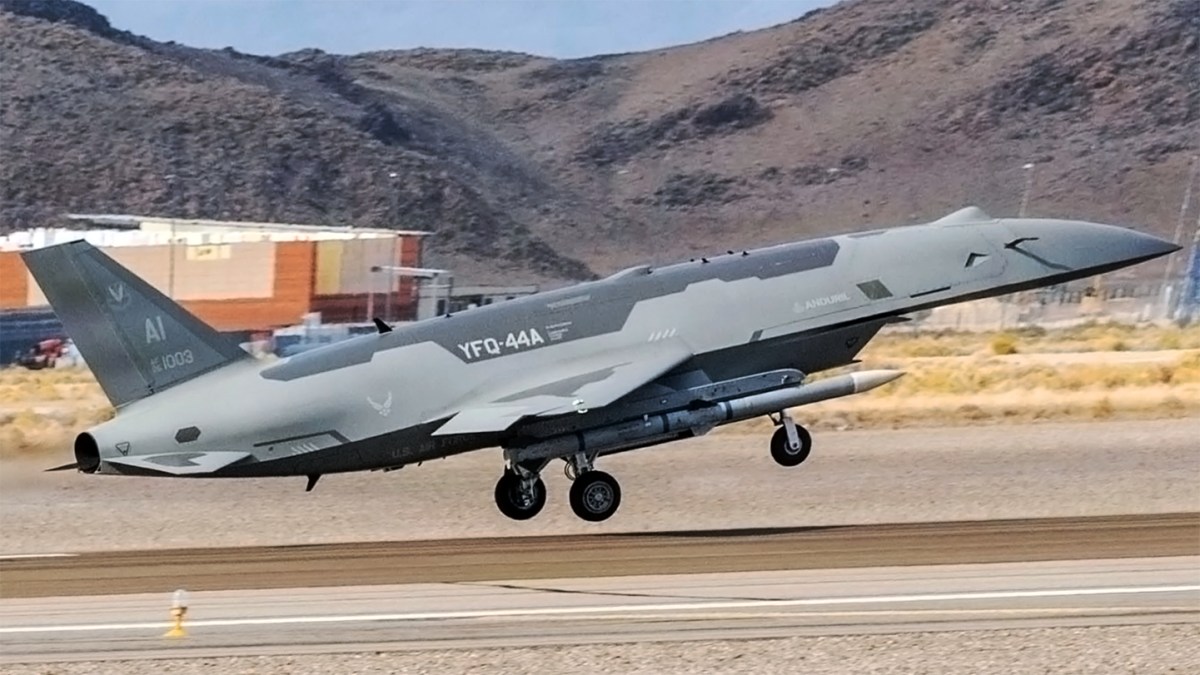
A U.S. Air Force YFQ-44A Fury takes off for a mission flight during an Agile Combat Employment exercise at Creech Air Force Base, Nevada, July 21, 2026. U.S. Air Force photo by Staff Sgt. Kristal Munguia Staff Sgt. Kristal Munguia
The ultimate objective is an aircraft that does not require a large ground-control infrastructure or a dedicated operator for every individual sortie. As previously noted, during the July exercise, Anduril says a single Air Force operator was able to launch and recover a Fury after only hours of training, while other Air Force personnel operated the aircraft’s Mission Autonomy functions.
That same exercise also demonstrated what Anduril described as “disaggregated operations,” with personnel at multiple locations able to operate the same aircraft. The concept is intended to support an Agile Combat Employment-style approach in which CCAs can be dispersed across multiple operating locations rather than relying on a single large ground footprint.
The company has since delivered a Fury aircraft to the Air Force’s EOU at Creech, making it the first CCA to be permanently delivered to the unit, according to Anduril. The service is now flying the aircraft multiple times a day with what the company said is a very limited Anduril presence.
A YFQ-44A production-representative test vehicle is staged in a testing chamber at Costa Mesa, California. Courtesy photo via U.S. Air Force Master Sgt. Gustavo Castillo
Menwhile, Anduril says assembly of Fury airframes has already begun at its Arsenal facility, with production aircraft expected to begin coming off the line early next year. The company says it has built the facility and supply chain around a potential production rate of 150 aircraft per year, although that figure is a planned capacity rather than an existing Air Force order. Anduril executives said the company has already advanced procurement of long-lead items and worked with its Tier 1, 2 and 3 suppliers to support that rate, while also examining additional production lines. They emphasized that the current Air Force pricing is based on a substantially lower annual buy than 150 aircraft, but said the Fury’s unit cost is well below $20 million at the quantities currently contemplated. The company also says the production line is designed for relatively rapid reconfiguration, allowing capacity to be shifted between products in weeks rather than the months or years associated with more traditional aircraft production facilities.
Earlier this year, the Air Force awarded contracts for the production of FQ-44A Fury and General Atomics FQ-42A Dark Merlin drones — the latter has now been formally named Vengeance . This sets the service up to operate a split initial fleet of CCAs. As you can read about here , the Air Force is now aiming to have at least 500 CCA in service by 2032, a substantial step up from earlier plans, with the USAF having previously talked about acquiring “over” 150 of these drones by the end of the decade. The 500 target will likely include upcoming increment two CCAs, as well, the requirements of which the Air Force is still working on.
For Anduril, the next major milestone should go far beyond simply putting a Fury and an F-35 in the same formation, demonstrating that a crewed fifth-generation fighter can actually command and employ the autonomous aircraft as part of a live mission.
If Anduril’s timeline holds, that testing could begin relatively soon.
Contact the author: thomas@thewarzone.com
Comments couldn’t be loaded. Please refresh the page.
发布于美国东部时间2026年9月14日下午5:44
参谋军士克里斯塔尔·蒙吉亚
安杜里尔公司的高管透露,该公司研发的YFQ-44A“狂怒”协同作战飞机(CCA)已在美国空军的测试中与F-35战斗机进行编队飞行,这最清楚地表明,与第五代战斗机进行有人-无人协同作战的实战工作正在进行中。
此次披露是在安杜里尔公司(Anduril)高管杰森·莱文(Jason Levin,负责空中优势和打击的高级副总裁)和亚伦·辛普森(Aaron Simpson,负责空中优势和打击战略的副总裁)在TWZ出席的空军与太空部队空中、太空和网络研讨会上进行简报时透露的。两位高管表示,在7月份与空军实验作战部队(EOU)在内华达州克里奇空军基地进行的一次演习中,Fury战斗机曾与F-35战斗机并肩飞行。您可以在我们之前的报道中阅读更多关于此次演习的信息(点击此处)。
2026年7月20日,一架隶属于协同作战飞机实验作战部队的YFQ-44A“狂怒”战斗机在内华达州克里奇空军基地滑行至遮阳篷前。美国空军高级飞行员蕾妮·布伦登摄
“我们已经开始与有人驾驶的战斗机进行编队飞行了。我甚至可以说与第五代战斗机,比如F-35,进行编队飞行,”莱文说道。
此次测试是空军“协同作战飞机”计划更广泛愿景的重要一步,该计划旨在制造相对廉价的自主飞机,与有人驾驶战斗机在敌对空域并肩作战并为其提供支持。
不过,高管们强调,在这些飞行中,F-35 还不能控制“狂怒”战斗机。
“但他们目前还无法从有人驾驶的战斗机上控制它,”莱文说。“还没有。”
相反,7月份的测试中,“狂怒”战机在其任务自主系统的支持下,与有人驾驶战斗机、其他协同作战飞机(CCA)以及其他飞机共享空域。安杜里尔公司表示,空军人员能够在无需安杜里尔人员直接操控飞机的情况下操作该自主系统,但公司人员仍留在现场提供支持。
该公司将迈向有人与无人直接协同作战的进程描述为一个“爬行、奔跑、积累”的过程。
Anduril公司表示,他们已经开始着手研发所谓的“四分卫集成”技术,即让有人驾驶飞机能够指挥或分配自主飞机的任务。这项工作已在硬件在环和软件在环环境下进行,并在Fury无人机本身上也得到了应用。
“这些事件中的大多数都将在几周或几个月内发生,”莱文在被问及与弗瑞进行首次四分卫融合的时间安排时说道。
当被问及这些活动是否会涉及现场飞行时,答案是明确的:“是的。”
一架YFQ-44A导弹发射车在加利福尼亚州某试验场进行未注明日期的挂载测试。该测试阶段使用惰性弹药,系统地验证武器集成、结构性能和安全性,确保该平台能够安全地携带外部挂载物。图片由美国空军部长办公室提供。
F-35 将如何控制“狂怒”无人机仍是正在进行的研发工作的一部分。高管们指出,这项工作涉及集成相应的人机界面,主要包括至少在初期阶段,由战斗机上的飞行员使用平板电脑进行控制。
与F-35并肩飞行和由F-35控制之间的区别至关重要。前者表明“狂怒”战机及其自主系统能够在与第五代战斗机相同的战场环境中安全作战。后者则更能体现协同作战能力(CCA)背后的作战理念:允许一架有人驾驶战斗机作为更大规模作战力量的一部分,运用并管理其他自主飞行器。
安杜里尔公司7月份的测试远不止简单的编队飞行。该公司表示,“狂怒”无人机利用实时传感器数据进行任务自主飞行,并在与有人驾驶战斗机和其他协同作战飞机共享的空域中运行。据报道,空军操作人员进行了相对基础的航线和模式训练,以及更具代表性的战术场景演练。
“狂怒”无人机与空军实验作战部队的合作已经历了两个阶段,每个阶段的难度都越来越大。在4月份于爱德华兹空军基地举行的第一次演习中,空军人员接受了操作该无人机的训练,并能够使用安杜里尔公司紧凑型的“威胁-T”系统(本质上是一对加固型机箱和一台笔记本电脑,而非传统的地面控制站)进行无人机的起飞和回收。
到7月在克里奇空军基地举行的第二次演习时,空军已进一步减少了所需的人力和基础设施。一名作战单元操作员只需经过数小时的训练即可完成飞机的起降,而空军人员则能够独立操作“狂怒”战机的任务自主性。该战机还在与其他作战指挥中心共享的空域飞行,演习还展示了分散式作战和快速“热换弹”能力——两名操作员在发动机运转的情况下更换AIM-120先进中程空空导弹,将出击间隔缩短至个位数分钟。
2026年7月20日,在内华达州克里奇空军基地,一名隶属于协同作战飞机实验作战部队的美国空军士兵正在将一枚惰性导弹装载到YFQ-44A“狂怒”战斗机上。美国空军高级飞行员蕾妮·布伦顿摄。
7月份的演习还包括一次实弹武器演示,安杜里尔公司将其描述为完整的端到端杀伤链,而不仅仅是简单的挂载或基础武器投放测试。“狂怒”无人机从爱德华兹空军基地起飞,由一名操作员操控,并通过超视距连接接收来自外部源的跟踪信息。该跟踪信息被安杜里尔公司集成了Lattice人工智能的自主软件系统接收,之后操作员向飞机发出攻击指令。“狂怒”随后发射了一枚AIM-120 AMRAAM导弹,并引导其击中目标。安杜里尔公司表示,此次测试展示了从外部目标信息、飞机任务系统和操作员指令,到实际空对空武器交战的完整杀伤链。
最新测试视频:YFQ-44A导弹首次发射。YFQ-44A对模拟目标进行了端到端、超视距打击。此次测试在爱德华兹空军基地进行,标志着CCA向作战能力转型迈出了重要一步。pic.twitter.com/70cRIs6uXJ — Anduril Industries (@anduriltech) July 15, 2026
最新测试视频:YFQ-44A导弹首次发射。YFQ-44A对模拟目标进行了端到端、超视距打击。此次测试在爱德华兹空军基地进行,标志着CCA向作战能力转型迈出了重要一步。pic.twitter.com/70cRIs6uXJ
在武器方面,量产型FQ-44的设计围绕四个外挂点展开,使其能够携带四枚AIM-120 AMRAAM导弹,满足空军的主要空对空作战任务需求。目前,演示机可携带两枚导弹。尽管如此,该公司仍在为“狂怒”(Fury)战机开发更广泛的武器组合。高管表示,他们已经开始对500磅制导炸弹、小直径炸弹、低成本巡航导弹(包括安杜里尔公司的“梭鱼500”导弹)、其他空对空武器、火箭发射器和目标指示吊舱进行集成和适配性检查。这些集成旨在使“狂怒”战机具备空对空作战以外的更多选择,包括反无人机、反巡航导弹以及空对地/空地打击任务。安杜里尔强调,这些目前仍处于集成和工程研发阶段,并非声称所有这些武器都已在“狂怒”战机上进行过飞行测试。该公司还表示,在某些任务中,可以添加额外的传感器,例如瞄准吊舱。
高管们承认,一些更先进的战术能力仍在研发中,并正在通过模拟进行广泛探索。这些研究领域包括传感器融合、目标识别和战术交战等。
2026年7月21日,在内华达州克里奇空军基地举行的敏捷作战部署演习中,一架美国空军YFQ-44A“狂怒”战斗机起飞执行任务飞行。美国空军照片,由参谋军士克里斯塔尔·蒙吉亚拍摄。
最终目标是研发一种无需庞大地面控制基础设施或每次飞行任务都配备专职操作员的飞机。正如之前提到的,安杜里尔表示,在7月份的演习中,一名空军操作员仅经过数小时的训练就能够独立完成“狂怒”无人机的起飞和回收,而其他空军人员则负责操作飞机的任务自主功能。
那次演习也展示了安杜里尔所说的“分散式作战”,即多个地点的人员能够操作同一架飞机。这一概念旨在支持敏捷作战部署模式,使作战指挥中心能够分散在多个作战地点,而不是依赖于单一的大型地面部署。
据安杜里尔公司称,该公司已向位于克里奇空军基地的空军远征作战单位交付了一架“狂怒”战斗机,使其成为该单位永久接收的第一架CCA(协同作战飞机)。目前,该部队每天多次使用该飞机进行飞行训练,而安杜里尔公司表示,其人员在场人数非常有限。
一架YFQ-44A量产型测试样机停放在加利福尼亚州科斯塔梅萨的测试舱内。照片由美国空军一级军士长古斯塔沃·卡斯蒂略提供。
与此同时,安杜里尔公司表示,其位于阿森纳的工厂已开始组装“狂怒”战斗机的机身,预计将于明年初开始下线。该公司称,其工厂和供应链的建设均以每年150架飞机的潜在产能为基准,但该数字仅为计划产能,并非空军的现有订单。安杜里尔公司高管表示,公司已提前采购了交货周期较长的零部件,并与一级、二级和三级供应商合作以支持该产能,同时也在考察增设生产线的可能性。他们强调,目前空军的定价是基于远低于150架的年采购量,但表示“狂怒”战斗机的单价远低于2000万美元(按目前计划的采购量计算)。该公司还表示,该生产线的设计可实现相对快速的重新配置,从而能够在几周内完成产品产能的转换,而无需像传统飞机生产设施那样耗费数月甚至数年时间。
今年早些时候,美国空军授予了FQ-44A“狂怒”(Fury)和通用原子公司FQ-42A“暗梅林”(Dark Merlin)无人机的生产合同——后者现已正式命名为“复仇”(Vengeance)。这使得空军能够组建一支初期采用混合型CCA(战斗攻击无人机)的机队。正如您在此处所读到的,空军目前的目标是到2032年至少拥有500架CCA服役,这比之前的计划有了显著提升。此前,美国空军曾表示,计划在本十年末之前采购“超过”150架此类无人机。这500架的目标很可能也包括即将推出的第二批CCA,空军仍在制定这些CCA的需求。
对于安杜里尔来说,下一个重大里程碑应该远远不止于将一架“狂怒”和一架F-35放在同一个编队中,而是要证明有人驾驶的第五代战斗机实际上可以指挥和使用自主飞机作为实战任务的一部分。
如果 Anduril 的时间表保持不变,测试可能很快就会开始。
联系作者:thomas@thewarzone.com
评论加载失败,请刷新页面。