Air quality in all 5 regions of Singapore in the unhealthy range新加坡所有五个区域的空气质量均处于不健康范围。
All five regions of Singapore recorded unhealthy air quality levels due to haze, with PSI readings urging the public to reduce outdoor activities. Read more at straitstimes.com.
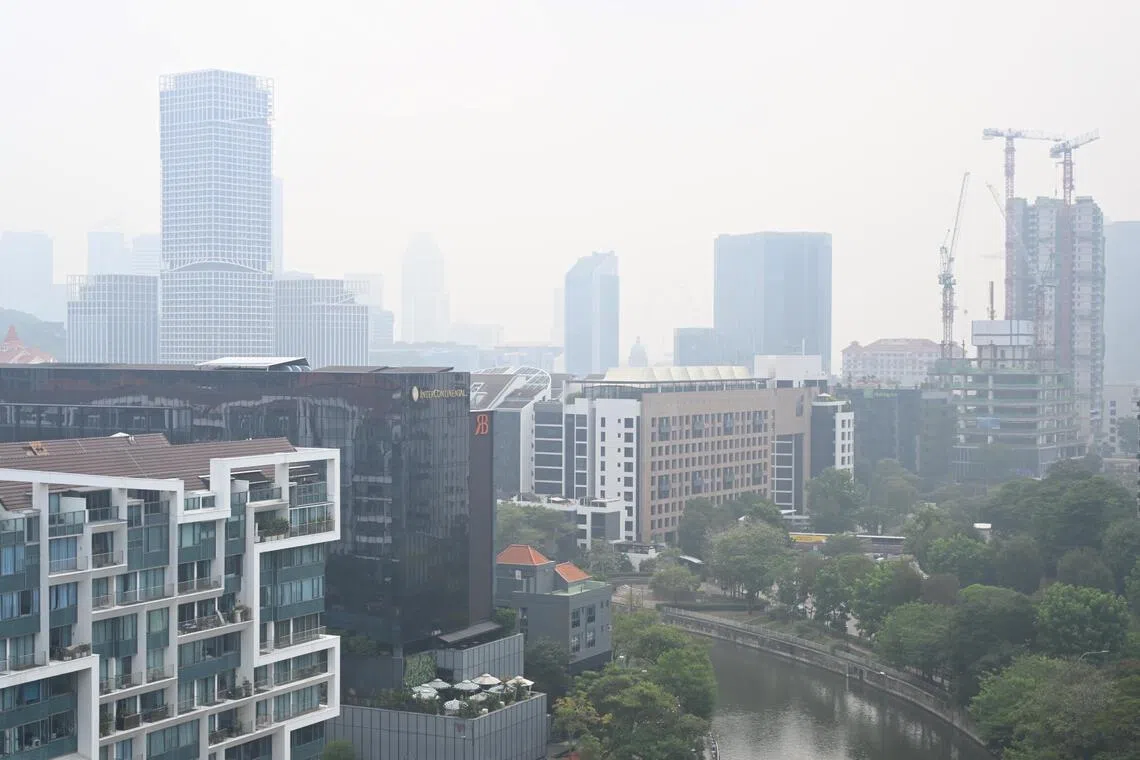
Haze seen from Robertson Quay towards the Singapore River and downtown at about 10am on Sept 14.
ST PHOTO: CHONG JUN LIANG
Published Sep 15, 2026, 06:20 AM
Updated Sep 15, 2026, 06:20 AM
SINGAPORE - All areas of Singapore had an unhealthy level of pollutants in the air early on Sept 15. At 6am, the 24-hour Pollution Standards Index (PSI) readings for the north (104), south (111), east (128), west (128) and central (154) regions all stood in the unhealthy range. Air quality is considered unhealthy when the 24-hour PSI is in the range of 101 to 200, during which the National Environment Agency (NEA) advises the public to reduce outdoor activities. The air quality in Singapore had worsened on Sept 14 with the PSI across the island, except for the north, hitting unhealthy levels, following several days in the moderate range . The PSI reading for the north crossed the 101 threshold - when air quality is deemed unhealthy - at about 1am on Sept 15, rising to 102 from 99 at midnight.
PSI readings of 51 to 100 are considered moderate, while values of 0 to 50 are in the “good” range. The one-hour PM2.5 readings across the island on Sept 15 largely fell to normal levels, ranging from 32 to 44 micrograms per cubic m, as at 6am. The exceptions were the central (66) and west (59) regions, where the PM 2.5 readings remained in the elevated range. Readings of 56mcg per cubic m to 150mcg per cubic m are considered elevated, while levels of 151mcg to 250mcg per cubic m are in the “high” range. Anything below 55 and below is considered normal. In an advisory at about 6.30pm on Sept 14, NEA said air quality in Singapore for the next 24 hours is forecast to be in the high moderate to mid-unhealthy range. The PSI crossed into the unhealthy range two weeks ago, hitting 101 in central Singapore on the morning of Sept 4. In the days that followed, readings in the central, eastern and western parts of Singapore occasionally crossed into the unhealthy range. This month’s developments mark the first time since October 2023 that the PSI in Singapore hit unhealthy levels because of haze, with the authorities earlier warning of the risk of haze between June and October as a result of warmer and drier conditions brought on by both El Nino and the Indian Ocean Dipole.
In its Sept 14 advisory, NEA added that moderate to dense smoke plumes, some of which were noticed to be drifting towards Singapore, continue to be observed from forest fires in Kalimantan.
Smoke plumes were also observed in southern Sumatra.
Dry conditions are forecast over Singapore and the surrounding region in the coming days, NEA added.
“With the prevailing winds forecast to continue blowing from the south-east to east-southeast, Singapore will likely be affected by smoke haze,” the agency said.
National Environment Agency
9月14日上午10点左右,从罗伯逊码头望向新加坡河和市中心,可以看到雾霾。
《海峡时报》照片:梁崇俊
发布于 2026 年 9 月 15 日上午 6:20
更新于2026年9月15日上午6:20
新加坡——9月15日清晨,新加坡所有地区的空气污染物浓度均达到不健康水平。早上6点,北部(104)、南部(111)、东部(128)、西部(128)和中部(154)地区的24小时污染标准指数(PSI)均处于不健康范围。当24小时PSI值在101至200之间时,空气质量被视为不健康,国家环境局(NEA)建议公众减少户外活动。新加坡的空气质量在9月14日开始恶化,除北部地区外,全岛其他地区的PSI值均达到不健康水平,此前几天空气质量一直处于中等水平。9月15日凌晨1点左右,北部地区的PSI值突破101的阈值——空气质量被视为不健康——并在午夜时分从99上升至102。
空气污染指数(PSI)读数在51至100之间被认为是中等污染,而0至50则属于“良好”范围。9月15日上午6点,全岛PM2.5一小时读数基本降至正常水平,范围在32至44微克/立方米之间。例外情况是中部地区(66微克/立方米)和西部地区(59微克/立方米),这两个地区的PM2.5读数仍处于偏高水平。读数在56微克/立方米至150微克/立方米之间被认为是偏高,而151微克/立方米至250微克/立方米之间则属于“高污染”范围。低于55微克/立方米则被认为是正常污染。新加坡国家环境局(NEA)在9月14日下午6点30分左右发布的公告中表示,预计未来24小时新加坡的空气质量将处于“中度偏高”至“中度不健康”的范围内。两周前,新加坡空气污染指数(PSI)突破不健康范围,9月4日上午,新加坡中部地区的PSI指数达到101。此后几天,新加坡中部、东部和西部地区的PSI指数也时有突破不健康范围。本月的情况标志着自2023年10月以来,新加坡的PSI指数首次因雾霾达到不健康水平。此前,由于厄尔尼诺现象和印度洋偶极子带来的气候变暖干燥,当局曾警告称,6月至10月期间存在雾霾风险。
新加坡国家环境局在 9 月 14 日发布的公告中补充说,加里曼丹森林大火持续产生中等至浓重的烟雾,其中一些烟雾被注意到正向新加坡飘去。
苏门答腊南部也观测到了烟雾。
新加坡国家环境局补充说,预计未来几天新加坡及周边地区天气干燥。
该机构表示:“由于预计盛行风向将继续从东南吹向东南偏东,新加坡可能会受到烟霾的影响。”
国家环境局