India boosts submarine fleet as region’s warship traffic picks up随着该地区军舰活动增多,印度加强了潜艇舰队建设。
India is working on a new class of attack submarines after the government approved almost $5 billion for the program.
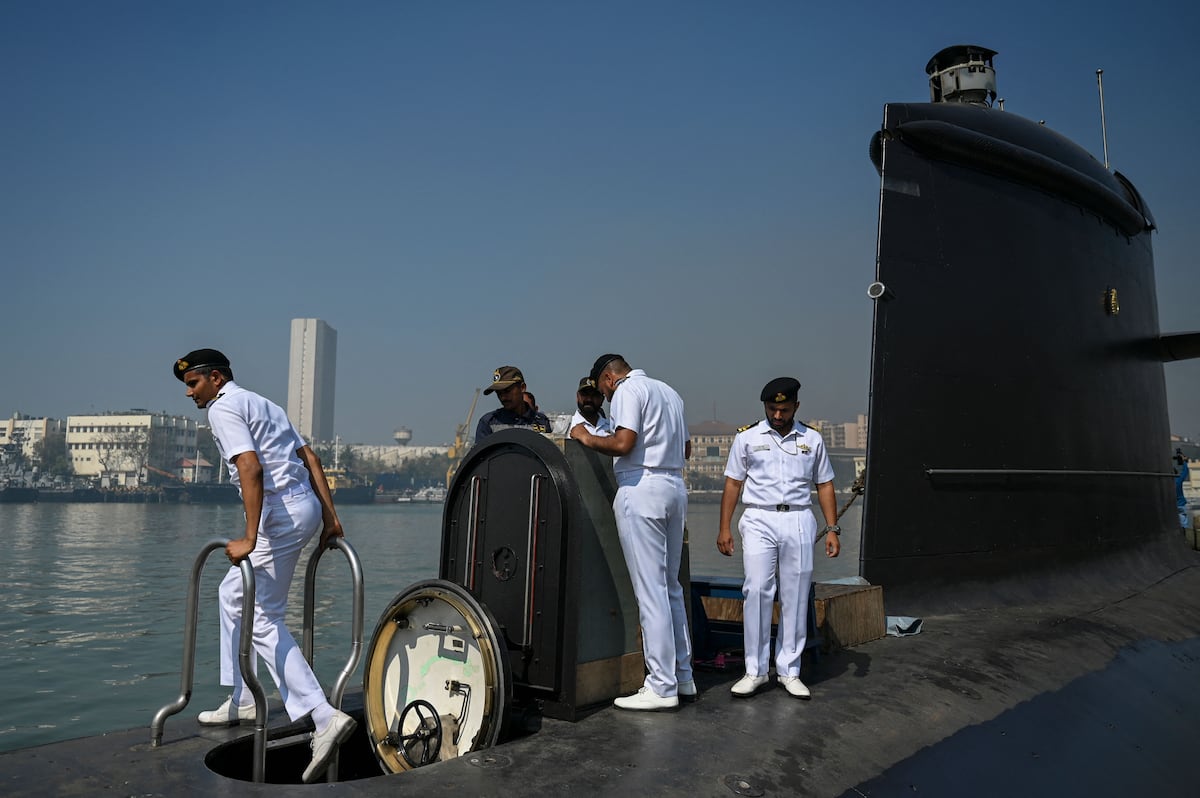
As India eyes the prospect of more Chinese and Pakistani warships and submarines traversing the Indian Ocean, Delhi is boosting its nuclear-powered submarine fleet.
India is now working on a new class of attack submarines (SSN) after the government approved 400 billion rupees (US$4.8 billion) for the construction of an initial two 6,000-ton boats.
Local media reported that more than 90% of the boats’ content will come from domestic sources, and that an eventual six SSNs in this class are planned for the Indian Navy (IN).
The submarines will help the sea service keep tabs on Chinese activity in the Indian Ocean and monitor strategic waterways like the Malacca Strait, Gulf of Aden and Persian Gulf. China’s naval presence in the Indian Ocean has been gradually increasing, spurred by ongoing Gulf of Aden counter-piracy rotations since 2008.
The SSNs will be armed with torpedoes and BrahMos anti-ship, land-attack missiles, but it will be many years before the first vessel built in Visakhapatnam enters service.
Delhi has previously leased SSNs from Russia, most recently an Akula-class boat from 2011-2021. After years of delay, another Akula may be leased from 2028 as a stopgap. However, constructing its own boats means India will become more self-sufficient in the future.
As well as SSNs, India is investing in nuclear-powered, ballistic-missile submarines (SSBN). In August, INS Arighaat, a 6,000-ton SSBN, was commissioned in Visakhapatnam. This is India’s second SSBN, after INS Arihant entered service in 2016.
“Today, India is surging ahead to become a developed country,” said Minister of Defence Rajnath Singh. “It’s essential for us to develop rapidly in every field, including defense, especially in today’s geopolitical scenario. Along with economic prosperity, we need a strong military.”
Singh asserted that the 111.6m-long Arighaat will strengthen India’s nuclear triad, enhance nuclear deterrence, help establish strategic balance and peace in the region, and play a decisive role in India’s security.
It took a protracted 15 years to construct Arighaat. No photos are publicly available of the vessel, whose keel was laid in 2009 and which was launched in 2017.
A Ministry of Defence press release states: “The technological advancements undertaken indigenously on this submarine make it significantly more advanced than its predecessor Arihant. The presence of both INS Arihant and INS Arighaat will enhance India’s capability to deter potential adversaries and safeguard its national interests.”
Modifications are believed to be a larger missile capacity, improved internal design and better propulsion. The MoD stated, “The construction of INS Arighaat involved the use of advanced design and manufacturing technology, detailed research and development, utilization of special materials, complex engineering and highly skilled workmanship.”
A third SSBN, measuring some 20m longer and designated S4, should commission in 2025.
Then, as India continues to boost its sea-based nuclear triad, a fourth 7,000-ton SSBN called S4* was launched on Oct. 16.
Gordon Arthur is an Asia correspondent for Defense News. After a 20-year stint working in Hong Kong, he now resides in New Zealand. He has attended military exercises and defense exhibitions in about 20 countries around the Asia-Pacific region.
随着印度密切关注中国和巴基斯坦更多军舰和潜艇穿越印度洋的前景,德里正在加强其核动力潜艇舰队。
印度政府已批准拨款 4000 亿卢比(48 亿美元)用于建造首批两艘 6000 吨级的潜艇,目前印度正在研发一种新型攻击型潜艇(SSN)。
当地媒体报道称,该型舰艇90%以上的部件将来自国内,印度海军最终计划建造6艘该级别的SSN(攻击型核潜艇)。
这些潜艇将帮助海军密切监视中国在印度洋的活动,并监控马六甲海峡、亚丁湾和波斯湾等战略水道。自2008年以来,受亚丁湾持续开展的反海盗轮换行动的推动,中国在印度洋的海军存在不断增强。
这些攻击型核潜艇将配备鱼雷和布拉莫斯反舰陆攻导弹,但从维沙卡帕特南建造的第一艘潜艇投入使用还需要很多年。
印度此前曾从俄罗斯租赁攻击型核潜艇(SSN),最近一次是从2011年至2021年租赁了一艘阿库拉级潜艇。经过多年的拖延,印度可能从2028年起再次租赁一艘阿库拉级潜艇作为过渡方案。然而,自主建造潜艇意味着印度未来将更加自给自足。
除了攻击型核潜艇(SSN)外,印度还在投资建造核动力弹道导弹潜艇(SSBN)。今年8月,排水量6000吨的“阿里哈特”号(INS Arighaat)弹道导弹潜艇在维沙卡帕特南正式服役。这是印度的第二艘弹道导弹潜艇,第一艘“歼敌者”号(INS Arihant)于2016年服役。
“如今,印度正朝着发达国家的目标奋力迈进,”国防部长拉杰纳特·辛格表示,“在当今的地缘政治形势下,我们必须在包括国防在内的各个领域快速发展。经济繁荣固然重要,但我们也需要一支强大的军队。”
辛格断言,111.6米长的阿里加特号将加强印度的核三位一体,增强核威慑力,有助于在该地区建立战略平衡与和平,并在印度的安全中发挥决定性作用。
“阿里加特”号的建造历时15年之久。该船于2009年铺设龙骨,2017年下水,目前尚无该船的公开照片。
印度国防部新闻稿称:“这艘潜艇采用的自主研发技术使其比其前身‘歼敌者’号先进得多。‘歼敌者’号和‘歼敌者’号的服役将增强印度威慑潜在对手和维护国家利益的能力。”
据信,此次改进包括更大的导弹容量、更优化的内部设计和更强大的推进系统。国防部表示:“‘阿里哈特’号的建造运用了先进的设计和制造技术、详尽的研发、特殊材料的使用、复杂的工程设计以及高超的工艺。”
第三艘弹道导弹核潜艇(SSBN)比第一艘长约 20 米,代号 S4,预计将于 2025 年服役。
然后,随着印度继续加强其海基核三位一体力量,第四艘7000吨级的弹道导弹核潜艇(SSBN)S4*于10月16日下水。
戈登·阿瑟是《防务新闻》的亚洲特派记者。在香港工作20年后,他现居新西兰。他曾到访亚太地区约20个国家,参加过军事演习和防务展览。