After dillydallying, Thailand proceeds with Chinese-built submarine泰国在犹豫不决之后,终于开始接收中国制造的潜艇。
Once tempted to ditch its acquisition of a Chinese-built S26T diesel-electric submarine, Thailand has decided the project will now proceed.
CHRISTCHURCH, New Zealand — Once tempted to ditch its acquisition of a Chinese-built S26T diesel-electric submarine, Thailand has decided the project will now proceed.
The cause of the indecision was China’s failure to obtain German diesel engines for the submarine, and its proposal to substitute Chinese variants instead.
However, the Thai Cabinet approved a contract amendment on Aug. 5, which permits this project to recommence after it had remained dormant since 2021.
Bangkok ordered this solitary S26T submarine on May 5, 2017, although it had originally wanted three submarines until fiscal constraints scuppered this plan.
Wuchang Shipbuilding Industry Group subsequently laid the boat’s keel in Wuhan on Sept. 5, 2019.
The Thai government had stipulated that the 2,600-ton boat must use German-manufactured MTU 396 diesel generator sets.
When Germany refused to supply these engines, China Shipbuilding & Offshore International Co (CSOC) then proposed to utilize equivalent Chinese-made CHD620 engines to resurrect the project.
Bangkok was reluctant to do so, however, over concerns about the quality and longevity of Chinese engines. The Royal Thai Navy — or RTN — next conducted a series of studies and stipulated that China must certify these CHD620V16H6 engines to assure their reliability.
After China bench-tested the engines for more than 6,000 hours, the RTN issued its conclusion.
“It demonstrates a quality comparable to the original engine,” the RTN stated, “in accordance with the performance limits specified in the agreement, and does not affect the submarine’s performance.”
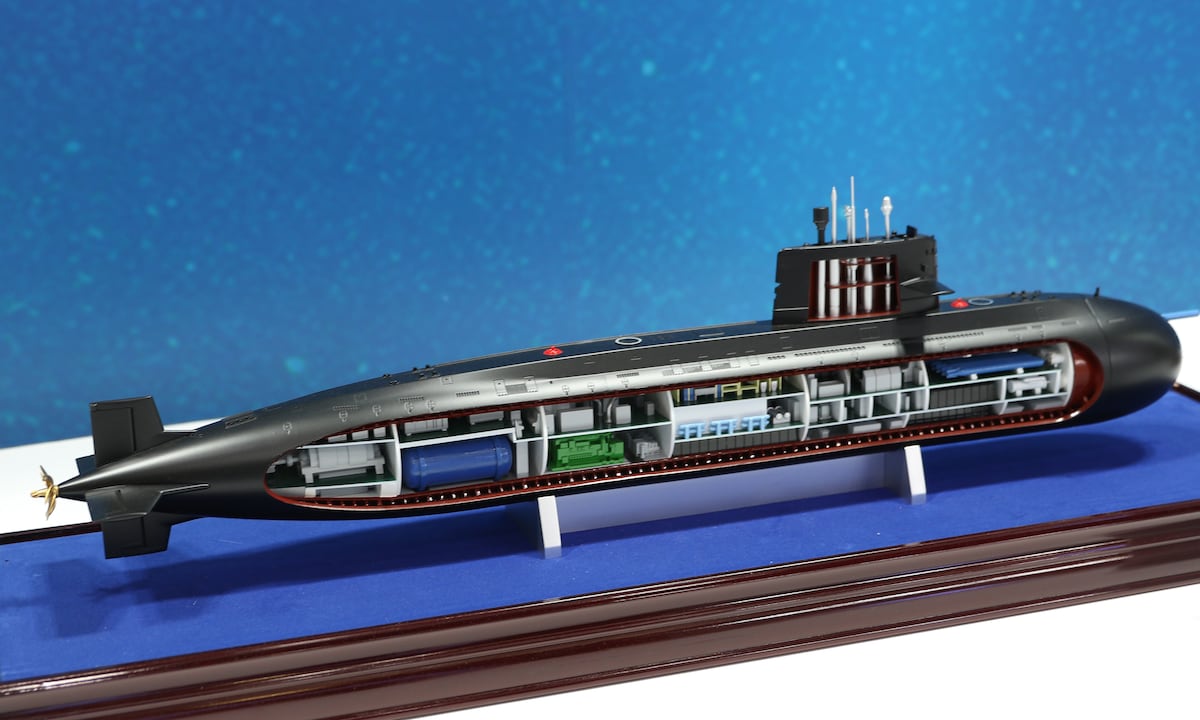
Thailand’s S26T is based on the Type 039 Yuan class used by the People’s Liberation Army Navy, one of which is seen here. (Chinese MND)
Bangkok simultaneously requested compensation, with Beijing agreeing to assistance worth US$24.7 million. This includes China extending the warranty and maintenance support from two to eight years; providing future equipment and weapons; and giving support for submarine simulators.
It is unclear what weapons the RTN will receive, but the package presumably includes heavy torpedoes, sea mines and perhaps anti-ship missiles like the CM-708UNB.
Following August’s approval, China now has until December 2028 to finish the submarine. Originally slated to enter service in 2023, the vessel is currently 64% complete.
So far, Thailand has paid CSOC 7.7 billion baht, about US$237 million, across 10 instalments. Another 5.5 billion baht, or 37% of the submarine’s cost, remains outstanding.
This saga raises several issues. First, there was contractual laxity on the part of both China and Thailand, which assumed there would be no issue obtaining MTU engines. This proved not to be the case.
Secondly, why did Germany block the export of these engines? Ostensibly it was because of a EU embargo imposed in late June 1989 in the wake of the Tiananmen Square massacre, with the German government confirming to Defense News that this 1989 declaration listed “an embargo on trade in arms with China.”
However, countries like France and Germany have not rigorously applied the embargo. For example, China has manufactured hundreds of Z-9 helicopters based on the Airbus Dauphin. Similarly, Chinese warships and submarines are commonly powered by German-derived engines.
“The Chinese and the Thais were in agreement, and then suddenly the Germans threw a spanner in that wheel, which is somewhat surprising,” said Siemon Wezeman, a senior researcher at the Stockholm International Peace Research Institute.
Wezeman noted the engines themselves “are not supersensitive,” and “similar MTU engines have been actually sold by Germany to China.”
However, he suggested Germany may have reevaluated its policy, and that dual-use items destined for China’s military are now being more strictly policed.
Wezeman even suggested the deeper problem Germany had might lie in the end user of the submarine being Thailand, rather than the builder being China.
Thailand has been under military rule since a 2014 coup, and Germany previously blocked the sale of engines for Ukrainian-built BTR-3E 8x8 armored vehicles to Thailand.
Thirdly, there is the important question of what engines Chinese submarines use. If China had to put the CHD620 through a qualification regime to satisfy Thailand, this indicates the People’s Liberation Army Navy has not been using these engines on its own Type 039 submarines. Whose engines, then, has it been using?
Defense News approached MTU numerous times for comment on the issue of selling engines to China for naval use, but the company failed to respond as of publication.
Wezeman said it becomes hazy to what extent China is producing or buying foreign engines.
“As far as we know, there’s still production going on in China of engines of originally French and German design,” he said. “Very often this is under an agreement which is very old.”
The Pakistan Navy has eight similar Chinese-designed Hangor-class submarines under construction as well. These will use the same CHD620V16H6 engines.
Thailand’s submarine purchase was emblematic of closer ties between its junta-led government and Beijing, as ties with the U.S. waned after the 2014 coup d’état.
In fact, Australian scholar Dr. Greg Raymond concluded that “the preponderance of evidence suggests that Thailand’s submarine procurement was not solely about capability, but also intertwined with geopolitics and diplomacy.”
Raymond found evidence that the Thai government “exerted pressure on the navy to select the Chinese submarines,” even though European and South Korean alternatives offered better performance.
Gordon Arthur is an Asia correspondent for Defense News. After a 20-year stint working in Hong Kong, he now resides in New Zealand. He has attended military exercises and defense exhibitions in about 20 countries around the Asia-Pacific region.
新西兰基督城——泰国曾一度想要放弃购买中国制造的S26T柴电潜艇,但现在决定继续推进该项目。
造成犹豫不决的原因是中国未能为潜艇获得德国柴油发动机,并提议用中国制造的柴油发动机代替。
然而,泰国政府内阁于 8 月 5 日批准了一项合同修正案,允许该项目在 2021 年以来一直处于停滞状态后重新启动。
曼谷于 2017 年 5 月 5 日订购了这艘 S26T 型潜艇,尽管它最初想要三艘潜艇,但财政限制破坏了这一计划。
武昌船舶工业集团随后于 2019 年 9 月 5 日在武汉为该船铺设了龙骨。
泰国政府规定,这艘 2600 吨的船必须使用德国制造的 MTU 396 柴油发电机组。
当德国拒绝提供这些发动机时,中国船舶重工集团有限公司(中船集团)提议使用中国制造的同等型号的CHD620发动机来重启该项目。
然而,曼谷方面出于对中国发动机质量和寿命的担忧,起初并不愿意这样做。随后,泰国皇家海军(RTN)进行了一系列研究,并规定中国必须对这些CHD620V16H6发动机进行认证,以确保其可靠性。
在中国对发动机进行超过 6000 小时的台架试验后,RTN 发布了结论。
“它展现出与原装发动机相当的质量,”RTN表示,“符合协议中规定的性能限制,并且不会影响潜艇的性能。”
泰国的S26T型潜艇以中国人民解放军海军使用的039型元级潜艇为原型,图中所示即为其中一艘。(中国国防部)
曼谷方面同时要求赔偿,北京方面同意提供价值2470万美元的援助。这包括中国将保修和维护支持期限从两年延长至八年;提供未来的设备和武器;以及为潜艇模拟器提供支持。
目前还不清楚RTN将接收哪些武器,但据推测,该批武器包括重型鱼雷、水雷,或许还有像CM-708UNB这样的反舰导弹。
继8月份获得批准后,中国现在有时间在2028年12月之前完成这艘潜艇的建造。该潜艇原计划于2023年服役,目前已完成64%。
迄今为止,泰国已分10期向CSOC支付了77亿泰铢(约合2.37亿美元)。另有55亿泰铢(约占潜艇造价的37%)尚未支付。
这件事引发了几个问题。首先,中国和泰国在合同方面都存在疏忽,双方都想当然地认为获得MTU发动机不会有问题。但事实证明并非如此。
其次,德国为何阻止这些发动机的出口?表面上的原因是欧盟在1989年6月下旬天安门事件后实施的武器禁运,德国政府向《防务新闻》证实,1989年的这项声明列出了“对华武器贸易禁运”。
然而,像法国和德国这样的国家并没有严格执行禁运。例如,中国已经生产了数百架基于空客海豚直升机的Z-9直升机。同样,中国的军舰和潜艇也普遍使用德国制造的发动机。
“中国人和泰国人达成了一致,但德国人突然从中作梗,这有点出乎意料,”斯德哥尔摩国际和平研究所高级研究员西蒙·韦泽曼说。
韦泽曼指出,这些发动机本身“并不十分敏感”,而且“德国实际上已经向中国出售过类似的MTU发动机”。
不过,他暗示德国可能已经重新评估了其政策,并且现在对运往中国军队的两用物项的监管更加严格。
韦泽曼甚至认为,德国面临的更深层次的问题可能在于潜艇的最终用户是泰国,而不是建造者是中国。
自 2014 年政变以来,泰国一直处于军人统治之下,德国此前曾阻止向泰国出售乌克兰制造的 BTR-3E 8x8 装甲车的发动机。
第三,还有一个重要问题:中国潜艇使用的是什么发动机?如果中国需要对CHD620发动机进行认证才能满足泰国的要求,这表明中国人民解放军海军在其039型潜艇上并没有使用这种发动机。那么,它使用的究竟是什么发动机呢?
《防务新闻》多次联系 MTU 公司,就向中国海军出售发动机一事征求意见,但截至发稿时,该公司仍未作出回应。
韦泽曼表示,中国在多大程度上生产或购买外国发动机变得模糊不清。
他说:“据我们所知,中国仍在生产最初由法国和德国设计的发动机。而且,这种情况通常是依据一份非常古老的协议进行的。”
巴基斯坦海军目前也在建造八艘类似的中国设计的汉戈尔级潜艇。这些潜艇也将使用相同的CHD620V16H6发动机。
泰国购买潜艇象征着其军政府与北京之间更加紧密的联系,因为在 2014 年政变后,泰国与美国的关系逐渐减弱。
事实上,澳大利亚学者格雷格·雷蒙德博士得出结论:“大量证据表明,泰国采购潜艇不仅仅是为了提升能力,还与地缘政治和外交息息相关。”
雷蒙德发现有证据表明,泰国政府“向海军施压,要求其选择中国潜艇”,尽管欧洲和韩国的替代方案性能更好。
戈登·阿瑟是《防务新闻》的亚洲特派记者。在香港工作20年后,他现居新西兰。他曾到访亚太地区约20个国家,参加过军事演习和防务展览。