France experiments with smaller tank units to evade drone attacks法国试验小型坦克部队以规避无人机攻击
French Army commanders want to know if dispersed “Lego bricks” of Leclerc tanks and support vehicles can make themselves uninteresting to adversaries.
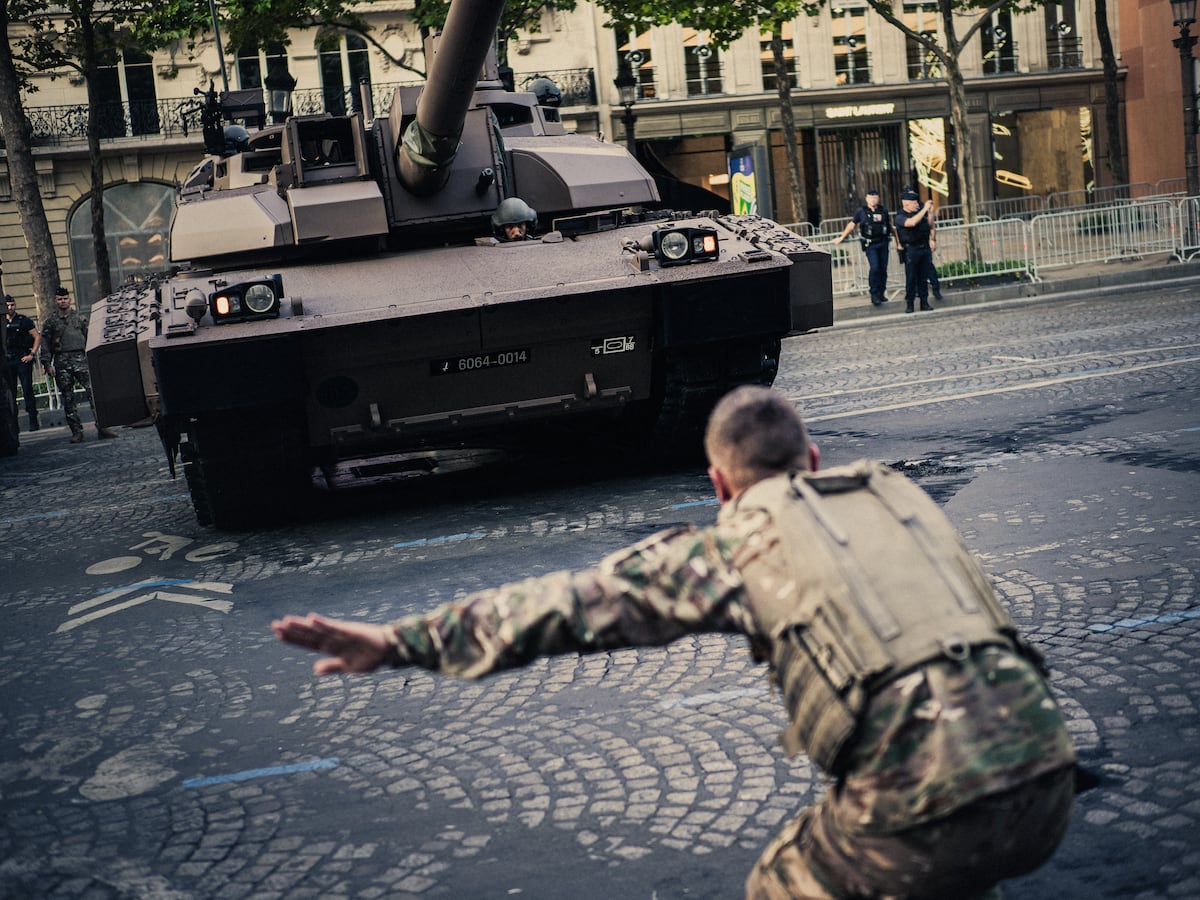
BESANÇON, France — France’s 7th Armored Brigade is experimenting with breaking up its armored platoons into smaller teams to be more discreet and offer less valuable targets on a drone-dominated battlefield, the unit’s commander said.
Whereas a French heavy cavalry platoon typically consists of four Leclerc main battle tanks and four VBL light armored vehicles, the brigade has been testing smaller units that can be combined “like Lego bricks,” Gen. Maxime Do Tran told Defense News last week at the brigade headquarters in Besançon in eastern France.
Drones have made armored maneuver more difficult in Ukraine, creating a heavily surveilled “kill zone” stretching kilometers from the frontline. Operating in smaller units reduces the risk of being targeted because an enemy might be less inclined to spend resources on just one or two tanks, according to Do Tran, who commands France’s flagship heavy armored brigade.
“The more insignificant you are, the less likely you are to be targeted,” Do Tran said at an innovation day on Sept. 9. “So it’s really about being as dispersed as possible.”
“Even if we’re spotted, even if there’s transparency on the battlefield, since we’re insignificant, ultimately it’s not worth the effort because we’re still talking about cost-effectiveness. It poses a dilemma to the enemy.”
Elements of the brigade, known in French as the 7e Brigade Blindée or 7e BB, have been deployed to Romania, where France leads a multinational battle group.
Do Tran said he considers a basic brick of heavy cavalry to consist of a tank and a VBL, while an infantry brick might be made up of seven or more soldiers. The brigade found that the single-tank, single-VBL combo was too small to provide sufficient tactical coherence, and has gone back to two tanks and two light armored vehicles for now, according to the general.
“We maybe have to get away a little from this squadron structure,” Do Tran said. “If we want to perform a breakthrough maneuver, I don’t want to say, I need two or three squadrons. Maybe I need twenty bricks.”
Gen. Maxime Do Tran (R), commander of France's 7th Armored Brigade, speaks to a French officer from NATO's Allied Reaction Force at his headquarters in Besançon, eastern France, on Sept. 9, 2026. (Rudy Ruitenberg/staff)
The “brick” concept may require a change in military training to prepare small-unit commanders to operate with more autonomy, he said.
“A tank platoon in our doctrine consists of four tanks. In terms of doctrinal developments, why couldn’t it be one tank surrounded by three motorcycles and with drones overhead? Why couldn’t it be ten tanks if we want to break through?”
The 7th Armored Brigade’s heavy cavalry tested half-platoon operations during France’s Orion 2026 exercise earlier this year , mainly to assess the ability of non-commissioned officers to operate the concept, Do Tran said. The first challenge was to get NCOs to understand the commander’s intent and take the initiative without the lieutenant, he said.
“We haven’t yet reached the stage of full autonomy and differentiated missions being assigned to a half-platoon. But in terms of structure, we’re there.”
The peacetime constraints of Orion 2026 kept movement largely confined to roads rather than allowing armor to maneuver across fields, according to the general. He said that meant the brigade wasn’t able to fully practice force dispersion and force concentration as it would have liked.
The brigade did successfully test reducing the footprint of its command posts and streamlining information flow, including through graphical orders transmitted via data link, the general said.
The French Army presented an upgraded Leclerc tank featuring a drone cage at the Eurosatory defense exhibition near Paris on June 14, 2026. (Rudy Ruitenberg/staff)
Do Tran said he has implemented the same concept of modularity to command, breaking up the command post into “five Lego bricks” that can all operate together or be completely dispersed.
The brigade commander said modularity is also something he’ll be looking for in a future tank, “a more open platform” where the main gun might be swapped out for a counter-drone system or drone launchers.
Firepower will sit mainly with artillery and drones, with the latter now almost equivalent to “flying bombs,” according to Do Tran. While direct fire hasn’t disappeared, “direct fire from one cannon to another, that maybe is disappearing,” and rather than a 120 mm or larger tank cannon, “why not a loitering munition?”
Tanks will continue to be needed to create tactical breakthroughs, even if movement has stalled in Ukraine for now, according to Do Tran. He said the French Army needs to retain the capacity to maneuver and exploit a breakthrough, whether obtained on the ground, in the air or through other means.
Rudy Ruitenberg is a Europe correspondent for Defense News. He started his career at Bloomberg News and has experience reporting on technology, commodity markets and politics.
法国贝桑松——法国第7装甲旅指挥官表示,该旅正在试验将装甲排拆分成更小的团队,以便在无人机主导的战场上更加隐蔽,并减少目标价值。
法国重骑兵排通常由四辆勒克莱尔主战坦克和四辆VBL轻型装甲车组成,而该旅一直在测试可以像“乐高积木”一样组合的较小单位,马克西姆·杜·特兰将军上周在法国东部贝桑松的旅部告诉《防务新闻》。
无人机的使用使乌克兰境内的装甲部队机动更加困难,在距离前线数公里范围内形成了一个严密监控的“杀伤区”。法国旗舰重型装甲旅指挥官杜特兰表示,以较小规模的单位作战可以降低被敌方锁定的风险,因为敌人可能不太愿意将资源投入到仅一两辆坦克上。
“你越微不足道,就越不容易成为攻击目标,”杜特兰在9月9日的创新日活动上说。“所以关键在于尽可能分散开来。”
“即使我们被发现,即使战场上一切透明,由于我们微不足道,最终也得不偿失,因为我们仍然在讨论成本效益。这给敌人制造了一个难题。”
该旅的部分兵力(法语称作 7e Brigade Blindée 或 7e BB)已被部署到罗马尼亚,法国在那里领导着一个多国战斗群。
杜陈将军表示,他认为重骑兵的基本兵力单位应包含一辆坦克和一辆轻型装甲车,而步兵的基本兵力单位则可能由七名或更多士兵组成。据这位将军透露,该旅发现单辆坦克加单辆轻型装甲车的组合规模太小,无法提供足够的战术协同,因此目前已恢复为两辆坦克和两辆轻型装甲车的配置。
“我们或许应该稍微调整一下这种中队编制,”杜陈说。“如果我们想进行突破性作战,我不想说,我需要两三个中队。也许我需要二十个‘砖块’。”
2026年9月9日,法国第7装甲旅旅长马克西姆·杜·特兰将军(右)在位于法国东部贝桑松的总部与一名来自北约盟军快速反应部队的法国军官交谈。(鲁迪·鲁伊滕贝格/摄)
他表示,“砖块”概念可能需要改变军事训练方式,以使小型部队指挥官能够更自主地开展行动。
“按照我们的作战理论,一个坦克排由四辆坦克组成。从理论发展的角度来看,为什么不能是一辆坦克,周围环绕着三辆摩托车,头顶还有无人机呢?如果我们想要突破防线,为什么不能是十辆坦克呢?”
杜陈表示,今年早些时候,第7装甲旅的重骑兵在法国“猎户座2026”演习中测试了半排作战模式,主要目的是评估士官运用该模式的能力。他说,首要挑战是让士官理解指挥官的意图,并在没有中尉指挥的情况下主动采取行动。
“我们还没有达到完全自主和为半个排分配不同任务的阶段。但在组织结构方面,我们已经做到了。”
据这位将军称,由于“猎户座2026”演习的和平时期限制,部队的行动主要局限于公路,而无法在田野间进行机动。他表示,这意味着该旅无法像预期那样充分演练兵力分散和兵力集中。
这位将军说,该旅已成功测试了缩小指挥所规模和简化信息流的方法,包括通过数据链传输图形化命令。
2026年6月14日,法国陆军在巴黎附近的欧洲防务展上展示了一款升级版的勒克莱尔坦克,该坦克配备了无人机笼。(Rudy Ruitenberg/staff)
Do Tran表示,他已将模块化的概念应用到指挥部,将指挥所拆分成“五个乐高积木”,这些积木可以一起运作,也可以完全分散。
旅长表示,模块化也是他未来在坦克设计中会考虑的因素,“一个更开放的平台”,主炮可以更换为反无人机系统或无人机发射器。
火力将主要集中在火炮和无人机上,据杜特兰称,无人机现在几乎等同于“飞行炸弹”。虽然直接射击并未消失,但“一门火炮直接射击另一门火炮的方式或许正在消失”,与其使用120毫米或更大的坦克炮,“为什么不使用巡飞弹呢?”
据杜特兰称,即使目前在乌克兰的军事行动陷入停滞,坦克在创造战术突破方面仍然必不可少。他表示,法国陆军需要保持机动能力,并能利用任何突破口,无论该突破是通过地面、空中或其他方式取得。
鲁迪·鲁伊滕贝格是《防务新闻》的欧洲记者。他的职业生涯始于彭博新闻社,拥有报道科技、大宗商品市场和政治方面的经验。