French military plants seed money to ‘master’ near-space operations法国军方投入启动资金,旨在“掌握”近太空作战行动
French defense leaders expect the near-space domain to become increasingly contested, similar to low Earth orbit and the ocean floor.
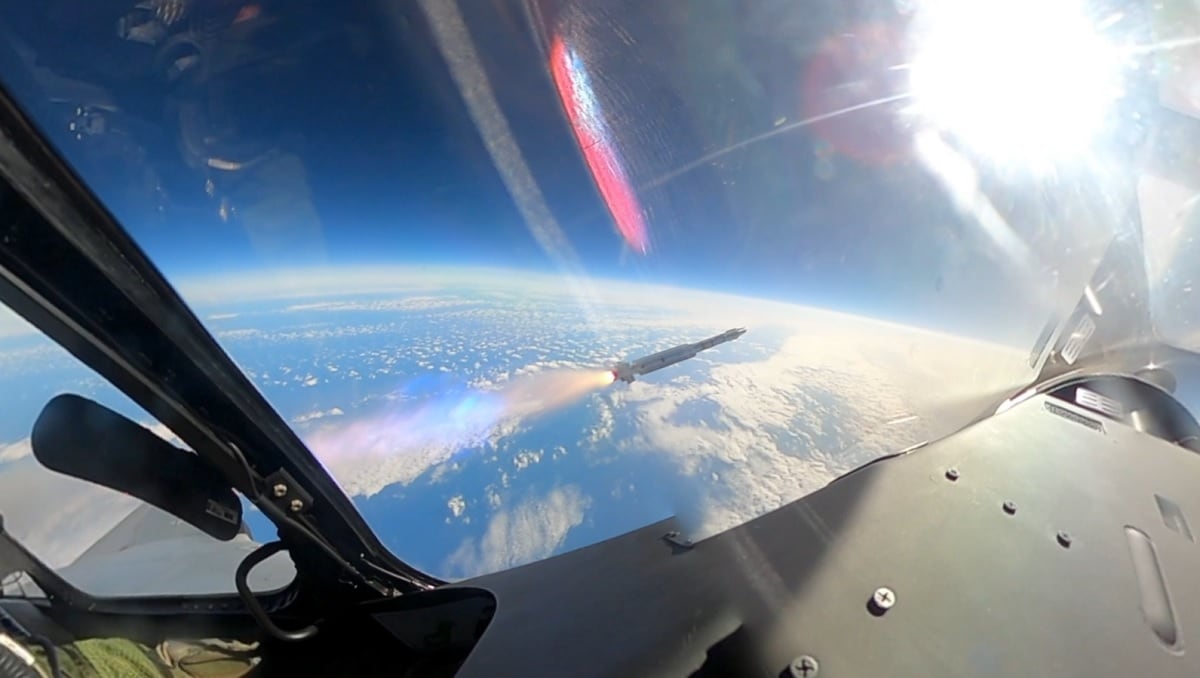
PARIS — France’s military is expanding into what it calls “very high altitude,” or near-space, with a test on Monday shooting down target balloons at an altitude of more than 20 kilometers, and this week detailing the strategy for what the country sees as an increasingly contested area.
France is upgrading radars to detect objects between 20 and 100 kilometers altitude and adapting fighter jets and air defenses to intercept high-flying targets, Philippe Koffi, in charge of strategy for air, land and naval combat systems at the Directorate General for Armament, said in a press briefing here on Thursday. Next steps will include lasers, space planes and stratospheric drones.
Near-space will become increasingly militarized, similar to what happened in low Earth orbit and on the sea floor, Armed Forces Minister Sebastien Lecornu said at the Paris Air Show on June 17, where he outlined France’s very-high altitude strategy.
The minister and other officials discussing the plans all referenced the 2023 incident of a Chinese high-altitude balloon overflying the United States, before being shot down .
“As technology develops, we will collectively be flying higher and faster, and therefore investing in this altitude range between 20 and 100 kilometers, for both civilian and military purposes,” said Brig. Gen. Alexis Rougier, in charge of very high altitude within the French Air and Space Force, at the briefing on Thursday.
Near-space is a legal gray area, according to Rougier. While the Chicago Convention defines a country’s airspace as sovereign, and the Outer Space Treaty states outer space shall be free for everyone to use, neither defines where airspace ends and outer space begins.
“Beyond the international legal ambiguity on this point, the challenge lies in our capacity to climb so high and so quickly to enforce sovereignty,” Rougier said.
“The goal is to master this segment in the future in all three areas: detecting objects in this segment, which is no easy task; being able to intercept them and neutralize them if they pose a threat; and operating at very high altitudes to take advantage of these benefits,” Rougier said.
In a first step on Monday, a Rafale and a Mirage fired MBDA Mica missiles at two target balloons “well above” 20 kilometers altitude, neutralizing the targets, DGA head Emmanuel Chiva told a parliamentary defense committee on Wednesday. The test entailed optimizing the radar and the guidance on the fighters and the Mica missiles, according to Koffi.
Rougier said he spoke to U.S. F-22 pilots who shared some details on the 2023 balloon shoot-down, which helped to prepare Monday’s test.
France is also in the process of upgrading its Thales GM400 and GM200 radars with optimized filters and artificial intelligence to detect “complex objects” in near-space, according to Koffi. For early warning of ballistic missiles and hypersonic weapons, France is also counting on a long-range UHF alerter from Thales, as well as its Nostradamus over-the-horizon radar.
The DGA is providing new financing for Nostradamus, operated by French aerospace research center Onera since at least the early 2000s. The fixed radar array about 100 kilometers west of Paris uses high-frequency radio waves bouncing off the ionosphere to detect any aircraft, including stealth and hypersonic, at a range of between 700 and 3,000 kilometers.
Over-the-horizon radar was deployed in 1960s by the United States and the Soviet Union to detect ballistic missile launches. With the Cold War over, French researchers in recent years had been using Nostradamus to track meteorites and observe radio emissions from the Sun and Jupiter.
France is also counting on Europe’s future Odin’s Eye satellite constellation for space-based detection, which Koffi said should become available around 2030.
The DGA is evaluating the capability of the next-generation SAMP/T air-defense system to intercept high-flying and fast targets such as balloons and hypersonic missiles, and is investing in the development of a ground-based 50 kilowatt laser demonstrator that by 2030 would be capable of neutralizing optics onboard satellites and balloons.
The third leg in the French very-high altitude strategy is being able to operate there, with ongoing projects including the Stratobus airship being developed by Thales Alenia Space, focused on surveillance and communication.
The BalMan maneuverable balloon developed by Hemeria will be tested by the end of the year, while the Airbus Zephyr high-altitude solar-powered drone will perform a test flight by the end of the summer, according to Koffi.
The French budget allocated to near-space is limited for now, around €10 million euros ($12 million) for the first projects such as Nostradamus and BalMan, according to Koffi. That will increase to several tens of millions when France updates its annual defense budget, particularly to fund the UHF alerter and the Stratobus, he said.
Going forward, big, long-term weapons programs will need to allocate funding to incorporate near-space requirements, Koffi said. That includes SAMP/T NG but also as the Future Combat Air System, according to the DGA engineer, who is also the French head of the team in charge of FCAS program management. “So the very-high altitude won’t be an isolated budget line.”
Lecornu said that France can’t miss the boat on near-space, saying “there is no question of reliving what we went through with drones,” where the country has been playing catch-up.
For its part, “the DGA is obviously committed to seeing this through, with the aim of equipping the armed forces with capabilities to neutralize threats and operate in this new domain, control of which is now more than ever a matter of national sovereignty,” Chiva told lawmakers in his hearing on Wednesday.
France also signed an agreement with Dassault Aviation on June 20 to provide financing to develop a reusable space-plane demonstrator called Vortex , for Véhicule Orbital Réutilisable de Transport et d’Exploration. The DGA will provide €30 million of financing on a total budget of €70 million for the demonstrator, which Koffi said is expected to fly late 2027 or early 2028.
The armaments office together with the French space center CNES will work on identifying possible missions for Vortex, according to Koffi. In addition to bringing cargo into space, that could include actions from orbit exploiting the aircraft’s high maneuverability during re-entry, which could be “reconnaissance missions or even strike missions,” he said.
The goal of the demonstrator will be a suborbital flight at Mach 12 by 2027 to test hypersonic guidance, thermal protection and terminal maneuverability, Chiva told lawmakers.
“We want to be able to launch satellites reactively, for example, or carry out operations in orbit,” Chiva said. “A space plane is absolutely necessary.”
Rudy Ruitenberg is a Europe correspondent for Defense News. He started his career at Bloomberg News and has experience reporting on technology, commodity markets and politics.
巴黎——法国军方正在向其所谓的“超高空”或近太空领域扩张,周一进行了一次测试,击落了20公里以上高度的目标气球。本周,法国将详细介绍其在该国眼中日益成为争议地区的战略。
法国军备总局负责空地海作战系统战略的菲利普·科菲周四在新闻发布会上表示,法国正在升级雷达,使其能够探测20至100公里高度的目标,并对战斗机和防空系统进行改造,以拦截高空目标。下一步将包括激光武器、空天飞机和平流层无人机。
法国武装部队部长塞巴斯蒂安·勒科尔努在6月17日的巴黎航展上表示,近太空将日益军事化,类似于低地球轨道和海底的情况。他在航展上概述了法国的超高空战略。
部长和其他官员在讨论这些计划时都提到了 2023 年中国高空气球飞越美国上空后被击落的事件。
“随着科技的发展,我们将共同飞得更高更快,因此,我们将投资于 20 至 100 公里的高度范围,用于民用和军事用途,”法国空军和太空部队超高空飞行负责人亚历克西·鲁吉尔准将在周四的简报会上说。
鲁吉尔指出,近地空间是一个法律灰色地带。《芝加哥公约》将一国领空定义为主权领空,《外层空间条约》规定外层空间应供所有人自由使用,但这两项公约均未明确界定领空和外层空间的边界。
鲁吉尔说:“除了国际法律在这方面的模糊性之外,挑战在于我们是否有能力迅速攀升到如此高的地方来维护主权。”
“我们的目标是在未来全面掌握这一领域的三个方面:探测这一领域的物体(这并非易事);能够在物体构成威胁时拦截并摧毁它们;以及在高空作业以充分利用这些优势,”鲁吉尔说。
周一,一架“阵风”战斗机和一架“幻影”战斗机向两个高度远高于20公里的目标气球发射了MBDA“米卡”导弹,成功摧毁了目标。法国国防情报局局长埃马纽埃尔·奇瓦周三向议会国防委员会表示。科菲称,此次测试旨在优化战斗机和“米卡”导弹的雷达和制导系统。
鲁吉尔表示,他与美国 F-22 飞行员进行了交谈,他们分享了一些关于 2023 年气球击落事件的细节,这有助于准备周一的测试。
据科菲称,法国正在对其泰雷兹公司的GM400和GM200雷达进行升级,采用优化滤波器和人工智能技术,以探测近地空间中的“复杂目标”。此外,法国还依靠泰雷兹公司的远程超高频预警系统以及其“诺查丹玛斯”超视距雷达,对弹道导弹和高超音速武器进行早期预警。
法国国防采购局(DGA)正在为诺斯特拉达姆斯雷达站提供新的资金。该雷达站由法国航空航天研究中心ONERA运营,至少从2000年代初就开始运行。这座位于巴黎以西约100公里的固定雷达阵列利用从电离层反射的高频无线电波,探测700至3000公里范围内的任何飞机,包括隐形飞机和高超音速飞机。
20世纪60年代,美国和苏联部署了超视距雷达,用于探测弹道导弹发射。冷战结束后,近年来法国研究人员一直利用诺查丹玛斯雷达追踪陨石,并观测太阳和木星的无线电辐射。
法国还指望欧洲未来的“奥丁之眼”卫星星座进行天基探测,科菲表示该星座应该在 2030 年左右投入使用。
DGA 正在评估下一代 SAMP/T 防空系统拦截高空高速目标(如气球和高超音速导弹)的能力,并投资开发地面 50 千瓦激光演示器,该演示器到 2030 年将能够干扰卫星和气球上的光学设备。
法国超高空战略的第三步是能够在高空作业,目前正在进行的项目包括泰雷兹阿莱尼亚宇航公司开发的 Stratobus 飞艇,该飞艇专注于监视和通信。
据科菲称,Hemeria 开发的 BalMan 可操纵气球将于今年年底进行测试,而空客 Zephyr 高空太阳能无人机将于今年夏季末进行试飞。
科菲表示,目前法国近地空间领域的预算有限,首批项目如诺查丹玛斯(Nostradamus)和巴尔曼(BalMan)的预算约为1000万欧元(1200万美元)。他指出,法国更新年度国防预算后,预算将增加到数千万美元,主要用于资助超高频预警器(UHF Alerter)和同温层巴士(Stratobus)项目。
科菲表示,未来大型长期武器项目需要拨出专项资金来满足近太空需求。他指出,这不仅包括SAMP/T NG项目,还包括未来作战空中系统(FCAS)。这位法国国防采购局(DGA)工程师同时也是FCAS项目管理团队的负责人。“因此,超高空作战不会是一笔独立的预算。”
勒科尔努表示,法国不能在近太空领域错失良机,他说:“我们绝不能重蹈无人机领域的覆辙”,法国在无人机领域一直处于追赶状态。
奇瓦周三在听证会上告诉议员们:“国防总局显然致力于完成这项工作,目的是使武装部队具备消除威胁和在这个新领域开展行动的能力,而对这个领域的控制现在比以往任何时候都更加关乎国家主权。”
法国于6月20日与达索航空公司签署协议,为名为“Vortex”(全称为“可重复使用轨道运输与探索飞行器”)的可重复使用航天飞机验证机的研发提供资金。法国国防采购局(DGA)将为该验证机提供3000万欧元的资金,总预算为7000万欧元。科菲表示,该验证机预计将于2027年底或2028年初进行首飞。
据科菲透露,军备办公室将与法国国家空间研究中心(CNES)合作,共同确定“旋涡”号的潜在任务。除了向太空运送货物外,这些任务还可能包括利用该飞行器在重返大气层时的高机动性,从轨道上执行各种行动,例如“侦察任务,甚至是打击任务”。
奇瓦告诉议员们,演示机的目标是在 2027 年以 12 马赫的速度进行亚轨道飞行,以测试高超音速制导、热防护和末端机动性。
“例如,我们希望能够按需发射卫星,或者在轨道上执行任务,”奇瓦说。“空天飞机是绝对必要的。”
鲁迪·鲁伊滕贝格是《防务新闻》的欧洲记者。他的职业生涯始于彭博新闻社,拥有报道科技、大宗商品市场和政治方面的经验。