The Three Foreign Frigates Being Studied For Possible U.S. Navy Service正在研究三艘外国护卫舰是否适合美国海军服役
Modern Japanese, South Korean, and Turkish frigate designs have emerged as possible contenders to meet increasingly urgent Navy demands.
新闻视频
By Joseph Trevithick
Published Sep 3, 2026 5:02 PM EDT
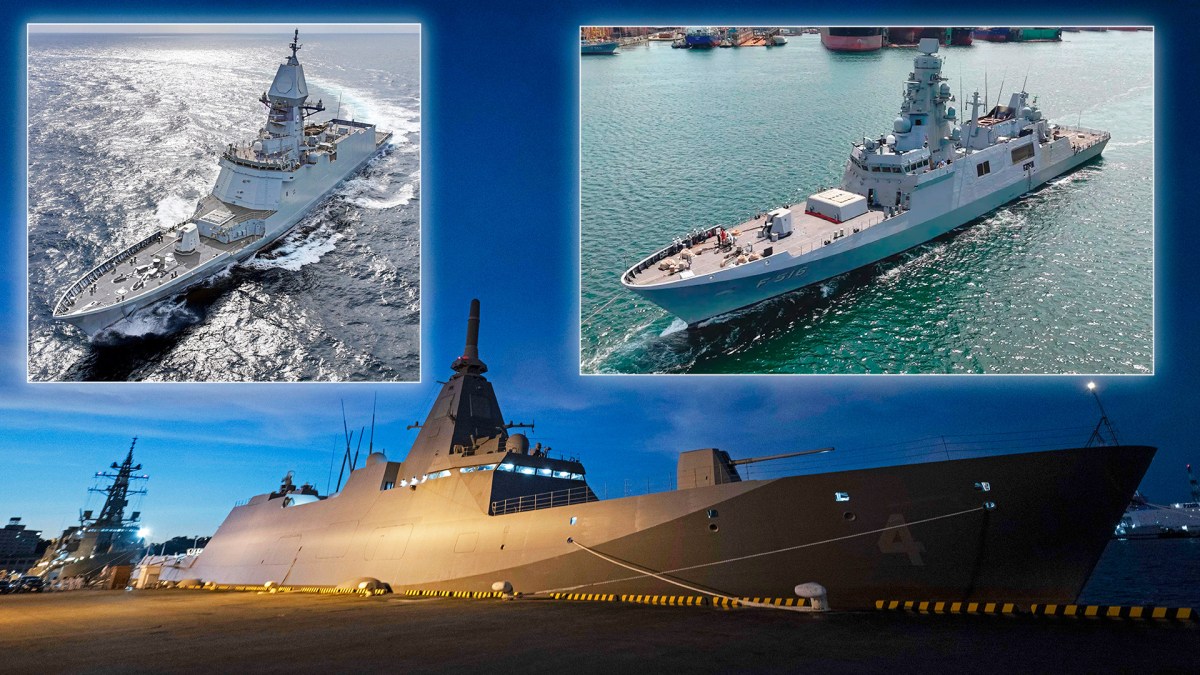
Yuichi Yamazaki-Pool/Getty Images/HD Hyundai Heavy Industries/Anadolu Shipyard
Three foreign frigates – Japan’s Mogami class , the South Korean Chungnam class , and the Istanbul class from Turkey – are reportedly included in a study of ships the U.S. Navy could procure. The Trump administration has been openly pushing to leverage ships designed in friendly countries to rapidly bolster the Navy’s fleet while also working to rebuild America’s shrunken domestic shipbuilding capacity . So, it is worth examining what each design brings to the table, as well as the broader opportunities and major hurdles procuring any of them would represent.
USNI News was first to report on Tuesday that the Japanese, South Korean, and Turkish frigates are included in an ongoing Navy study, citing anonymous sources. The review is in direct response to one of the provisions in a larger memo President Trump sent out last month, titled “Rebuilding the United States Navy and America’s Shipbuilding Industrial Base.” This also comes amid strong opposition in Congress to the basic idea of buying foreign warships for the Navy.
A pair of the Japan Maritime Self Defense Force’s (JMSDF) Mogami class frigates. JMSDF
Per that memo, the Secretary of the Navy (currently Acting Secretary Hung Cao) was directed to “submit a plan to the President … that includes timelines and resourcing requirements, for a new competitive acquisition approach for surface combatants with sufficient inherent capabilities to perform anti‑submarine warfare, surface warfare, and convoy escort duties.” The memo also said the “plan should address meeting the requirements for Consolidated Cargo Replenishment at Sea (CONSOL) Tankers and — separately — Roll-On, Roll-Off Vessels.”
The study could lead to “an international warship competition [that] could include building up to two of the ships in foreign shipyards before transitioning to domestic yards as part of the Trump administration’s push to rapidly expand the fleet, three industry sources familiar with the deliberations confirmed,” according to USNI News ‘ report. The outlet also said the Navy declined to “directly address the potential for an open competition for a new frigate” when asked.
The South Korean Navy’s ROKS Chungnam seen during sea trials before its delivery in 2024. HD Hyundai Heavy Industries
The acquisition approach described here is in line with what the Trump administration is currently calling the “Finland Model,” which entails construction of an initial batch of ships overseas before moving further production to yards in the United States. The name comes from a partnership the U.S. and Finnish governments announced last year regarding the construction of new icebreakers for the U.S. Coast Guard. Canada’s Seaspan Shipyards is also involved in that plan.
Broader plans to explore foreign surface combatant designs for the U.S. Navy, and potentially more to acquire one of those ships, were mentioned in the Pentagon’s 2027 Fiscal Year budget request released earlier this year. President Trump , former Secretary of the Navy John Phelan , and other U.S. officials have also openly raised the possibility of cooperation with shipbuilders in Japan and South Korea, specifically, including with regard to surface combatants. USNI ‘s report says that the Istanbul class was included in the current review after it came up in discussions between Trump and Turkish officials on the sidelines of the NATO summit in Ankara in July.
Many questions remain, but there are clear signs the Trump administration wants to move in pursuing the acquisition of foreign naval vessels. The particular focus on frigates also aligns with a clear Navy need for new ships in that size class.
Before exploring the specific designs the Navy is now said to be reviewing, it is worth taking a step back to understand why frigates are so important to the service’s shipbuilding plans, in general. The United States has not technically operated frigates since the retirement of its last Oliver Hazard Perry class type in 2015. The expectation had been that the Freedom and Independence class Littoral Combat Ships (LCS) would fill the resulting gaps. However, those ships struggled for years with a variety of major issues over the years and still have not lived up to their promised potential, despite certain strides having been made in expanding their operational employment in recent years .
The Navy’s announcement of a new frigate program in 2019, dubbed FFG(X), was widely seen as a rebuke of the core concepts behind the LCS. This, in turn, led to the Constellation class frigate, which became a debacle unto itself and was finally canceled last year . It is important to point out the Constellation design was based on the established Franco-Italian FREMM frigate . The expectation was that only relatively minor changes would be made before putting the ship in American service. In the end, the U.S. derivative had only 15 percent design commonality with its European ‘parent,’ which directly contributed to the demise of the program.
A rendering of a now-cancelled Constellation class frigate. USN
A new FF(X) frigate program has since emerged. Through that effort, the Navy is now in line to get ships derived from the U.S. Coast Guard’s Legend class National Security Cutter (NSC), with the goal being to have the first one in the water by 2028. However, those frigates, at least the ones built in the initial tranche, will lack a Vertical Launch System (VLS) and certain other features that were seen as critical for the preceding Constellation class. This has immediately raised questions about the operational utility of these new small surface combatants, as TWZ has previously explored in detail .
A rendering of the US Navy’s future FF(X) frigate. USN
None of this diminishes the Navy’s current desire for new frigates, and more of them, to provide smaller, lower-cost platforms that can be used to bolster larger surface action groups or operate more independently in roles that do not require larger, more capable designs. When fielded in sufficient volume, they can also free up other types of surface combatants for other, higher priority duties or similar help relieve strain on those fleets.
Today, the Navy’s fleet of Arleigh Burke class destroyers “gets used with a very high demand signal combatant commanders. The Navy can’t operate with only one size of ship,” Rear Adm. Brian Metcalf, the Navy’s Deputy Portfolio Acquisition Executive for Maritime for Combatants, said in an official video in June. “The [FF(X)] frigate will fill that gap. They can be used in less contentious waters. They can be used as high-value escorts. There are all kinds of things the frigate can fill the gap for and allow destroyers to execute the high-end mission set.”
With all this in mind, it is not surprising that the Navy would be seeking to further bolster its future frigate fleets on a shorter timetable by leveraging foreign shipbuilders. There are also clear benefits to taking advantage of capable, in-production designs, which leads us to the Mogami , Chungnam , and Istanbul classes.
Japan’s Mogami class, with its stealthy design characteristics, has long been a standout among modern frigates currently in production globally. The ship is designed as a multi-mission platform with anti-air, anti-surface, anti-submarine, and mine warfare capabilities, the latter of which includes both mine-hunting and mine-laying.
TWZ has covered the ship in detail in the past, writing :
“The original Mogami class design (also known as the 30FFM), the first of which only entered Japanese service in 2022, is already a very modern design with its shape featuring some stealthy characteristics. The 436-foot-long, 53-and-a-half-foot-wide, 5,500-metric-ton displacement frigates have a combined diesel and gas (CODAG) propulsion system that allows for fuel-efficient normal cruising operations and an additional burst of speed in combat. The ships have an active electronically scanned array (AESA) main radar, as well as a host of other advanced sensors and mission systems . One of the Mogami ‘s most distinctive features is its NORA-50 UNIted COmbined Radio aNtenna (UNICORN) mast on top of the main superstructure, which contains various antennas. The frigates also have especially futuristic-looking Combat Information Centers (CIC)…”
The Japan Maritime Self Defense Force’s (JMSDF) first-in-class JS Mogami . JMSDF
“Armament-wise, the baseline Mogami class frigate has two four-round launchers for Type 17 anti-ship cruise missiles , a SeaRAM close-in defense system loaded with RIM-116 Rolling Airframe Missiles (RAM), and a five-inch main gun in a turret at the bow. There are also two remote weapon stations, each armed with a .50 caliber machine gun, on top of the bridge for additional protection against close-in low-end threats.”
“The Mogami design was originally slated to feature a 16-cell Mk 41 launch system array, but the seventh ship in the class, the JS Niyodo , which was commissioned in May, was the first to be fitted with it. The first six of these frigates were delivered without this capability, but they are expected to be back-fitted with it in the future. Mk 41 cells on Mogami class frigates are expected to be primarily filled with domestically-developed A-SAM or U.S.-designed RIM-162 Evolved Sea Sparrow Missiles . Four ESSMs can notably be loaded in a single Mk 41 cell.”
The Mogami class frigates also have a flight deck and hangar designed to accommodate a single Seahawk helicopter . The ships can also deploy uncrewed underwater and surface vessels (UUV/USV), as well as rigid-hull inflatable boats (RHIBs), via a ramp at the stern.
MHI in Japan has also developed an enlarged derivative that is close to 466 feet long, almost 56 feet at its widest, and displaces some 6,200 metric tons. This version also features a 32-cell VLS array, along with an upgraded radar, other improved sensors, and updated mission systems. Last year, the Australian government announced it would be acquiring a fleet of these ships with certain unspecified country-specific features as part of its SEA 3000 program.
A model of the enlarged derivative of the Mogami class. Japan Ministry of Defense
The Australian deal is one of, if not still the most significant foreign arms sale for Japan since the end of World War II. It also helps ensure that the Mogami production line will remain hot for years to come. For the U.S. Navy, sharing a frigate with two of America’s two highest-profile allies in the Pacific, and which could therefore be readily serviced in those countries, would be very advantageous.
The Mogami is also a contender to become New Zealand’s next frigate , and there have also been discussions about sales to Indonesia . The Japan Maritime Self Defense Force only has two more of these frigates on order, the last of which is expected to be commissioned into service by March of next year.
The Chungnam class (also sometimes referred to as the FFX-III or FFG-III) is the latest frigate for the South Korean Navy, and feature a mix of anti-air, anti-ship, and anti-submarine capabilities. The first example entered service in that country in 2024. These ships are just over 423 feet long, approach 49 feet at the widest point in the hull, and displace some 4,300 tons with a full combat load. The design is based on the earlier Daegu class , which was itself an evolution of the preceding Incheon class that traces its roots back to the late 1990s.
As was the case on the Daegu class, the Chungnam class uses combined diesel–electric or gas (CODLOG) propulsion, which offers benefits for power management and efficiency, as well as when it comes to reducing maintenance requirements and operating costs. The design features a prominent integrated mast structure with four fixed-face arrays for the main multi-function AESA radar near the top. The ships have additional radars and other sensors, as well as an electronic warfare suite.
The ROKS seen at the time of its launch. HD Hyundai Heavy Industries
Each one of the Chungnam class frigates has a 16-cell K-VLS array. Domestically developed K-SAAM surface-to-air missiles and Haeseong I anti-ship cruise missiles (also called the SSM-700L or C-Star), as well as K745A1 Hong Sang Eo (Red Shark) vertically-launched anti-submarine rockets, can be loaded into these cells.
The armament package on these ships also includes a five-inch main gun in a turret at the bow, a pair of triple torpedo tubes, and a Close-in Weapon System II (CIWS II) armed with a seven-barrel 30mm Gatling-type cannon.
A look at the CIWS-II, which is part of the full armament package on the Chungnam class frigate. Hyundai WIA
The Chungnam class frigates also have a flight deck and hangar for a single helicopter at the stern.
As it stands now, the South Korean Navy has two Chungnam class frigates in service and has plans to acquire four more over the next few years. The lead ship in the class was built by HD Hyundai Heavy Industries, which is also one of the principal designers of the ship. A different shipbuilder, SK Oceanplant, built the second ship in the class, ROKS Gyeoungbuk , and is now working on the third and fourth examples. Hanwha Ocean is reportedly in line to build the last two ships in the class for South Korea. Hyundai and Hanwha have pitched export designs based on the Chungnam class, with both firms notably in the running to supply new frigates to Thailand .
Hanwha has already been making steady inroads in the shipbuilding industry in the United States, including the acquisition of the Philly Shipyard in Philadelphia, Pennsylvania, in 2024. Hyundai has reportedly been working to do the same. Just last month, Hanwha publicly announced a new $1.2 billion bid to buy out Australian shipbuilder Austal’s U.S. subsidiary, Austal USA. Austal notably built the Independence class LCSs for the U.S. Navy and continues to supply that service with other vessels . Austal subsequently said it was considering the South Korean offer.
Turkey’s Istanbul class (also known as the Istif class or just I class), developed under the country’s MILGEM national warship program , is not a design that has typically come up in previous discussions about potential foreign-made frigates for the U.S. Navy. It is described as a multi-role frigate with anti-air, anti-surface, and anti-submarine capabilities. The lead ship in this class, TCG Istanbul , entered Turkish Navy service in 2024.
At around 371 and a half feet long and with a beam of just over 47 feet, as well as a displacement of some 3,000 tons with a full combat load, the Istanbul class is notably smaller than either the Mogami class or Chungnam class. Like the Mogami , it uses CODAG propulsion. The Turkish design is understood to have leveraged lessons learned from the Project GENESIS program to upgrade the country’s second-hand ex-U.S. Navy Oliver Hazard Perry class frigates, as you can learn more about here .
TCG Istanbul is armed with a 16-cell MiDLAS VLS array, with past reports saying it is primarily configured to fire Hisar short-to-medium-range surface-to-air missiles. However, just in August, it was revealed that the second ship in the class, the future TCG Izmir , which is undergoing sea trials now, has a new 16-cell version of MiDLAS with visibly longer cells . This would allow the ship to fire larger weapons vertically, such as the Siper medium-range surface-to-air missiles, Atmaca anti-ship cruise missiles, and/or Gezgin land-attack cruise missiles. MiDLAS is a scalable VLS design developed in Turkey as an alternative to the U.S.-made Mk 41.
The future TCG Izmir with its noticeably larger VLS array in front of the main superstructure. Anadolu Shipyard
The initial Istanbul class design already had four deck-mounted launchers that can be loaded with up to 16 Atmaca missiles, in total. The frigates also have a 76mm cannon in a turret on the bow, a Gokdeniz CIWS with a twin-barrel 35mm cannon, two 25mm cannon-armed remote weapon stations, and a pair of twin torpedo tubes.
The main sensor on the Istanbul class is a rotating AESA radar mounted on top of the ship’s main integrated mast structure. It has additional radars and other sensors, as well as electronic support measures and electronic countermeasures systems.
The Istanbul class design also features a flight deck and hangar at the stern, sized around the Seahawk helicopter.
An infographic offering a general overview of the Istanbul class’ capabilities. STM via X
As mentioned, the second Istanbul class frigate for the Turkish Navy is now in sea trials, and the country plans to eventually acquire eight of these warships in total. They are being built through several shipyards in Turkey. Last year, Turkey’s TAIS Shipyards also secured a contract to build at least two Istanbul class frigates for Indonesia.
Growing U.S. roadblocks to any foreign warships
Much remains to be seen about how the U.S. Navy might proceed with the acquisition of new frigates, or any other naval vessels, via foreign shipbuilders. Whether any other relevant, in-production designs are being considered, or could be in the future, is unknown. USNI News ‘ report says the current study is scheduled to wrap up in November.
Furthermore, what the Navy might want to do could well turn out to be moot. Members of Congress on both sides of the political aisle have been very vocally pushing back on any plans to acquire foreign warships amid concerns about negative impacts on the U.S. shipbuilding industry.
Current U.S. law would already require the Trump administration to issue a national security waiver to pursue foreign-made naval vessels. A draft of the annual defense policy bill, or National Defense Authorization Act (NDAA), for the 2027 Fiscal Year now making its way through the Senate would eliminate the ability to issue such a waiver . In June, members of the House Armed Services Committee separately moved to outright block any spending on foreign-built warships in a separate draft NDAA.
The aforementioned Finland Model, as outlined in Trump’s August memo, is clearly intended to try to assuage Congressional concerns. Under the stated plan, foreign shipbuilders would be required to make major investments in U.S. shipbuilding enterprises and hire American workers as part of any future contract, even if an initial tranche of vessels is built overseas.
A rendering of one of the future Arctic Security Cutter icebreakers the US Coast Guard is set to acquire in part through a shipyard in Finland. Seaspan
“The Administration strongly opposes section 1025, which would prohibit the use of funds for procurement of initial battle force ships to be built in a foreign shipyard, especially while, in accordance with the ‘Finland Model’ first employed with the Coast Guard’s medium icebreaker program, long-term investments are being made in an American brown or greenfield shipyard,” the White House’s Office of Management and Budget (OMB) wrote in a statement of Administration Policy in July, specifically in response to provisions in the the House’s NDAA draft. “This prohibition fails to seriously address the challenges posed by current shipbuilding backlogs across six major programs in our ‘prime’ shipyards.”
This latter point here speaks to an already worrisome and still-widening gap between U.S. shipbuilding capacity and that of chief global competitor China. The U.S. government has tried to take steps in recent years to revitalize the American side of the equation, but workforce retention and other factors have continued to present serious hurdles. There are additional concerns now about how the addition of work on the Trump class battleship program will affect America’s naval shipbuilding ecosystem, which the Trump administration has separately pushed back on.
An unclassified Office of Naval Intelligence briefing slide from circa 2023 underscoring the disparity between U.S. and Chinese naval shipbuilding capacity. ONI
Continuing U.S. shipyard capacity and quality issues raise their own questions about the viability of the Finland Model. The construct inherently limits the U.S. government’s ability to make use of yards overseas and is heavily contingent on the shipbuilding industry in the United States expanding at a rate where it will be able to absorb the additional production demands. With the naval shipbuilding deficit already becoming extremely problematic, buying examples of relevant classes with minimal changes and having them built where production is already established could arguably be the priority, especially in light of the failures of the LCS and Constellation programs.
Ensuring that any U.S.-specific changes to the design are minimal will also be critical for any such plan to be successful. As mentioned, the Constellation class was undone in large part due to a near-constant stream of changes ordered by the Navy, which negated the benefits of choosing a derivative of an in-production design. The service has stressed its intention to avoid any similar pitfalls with its existing FF(X) frigate program, which also has to be factored into the larger domestic shipyard capacity question.
“The President has directed the Navy to aggressively increase domestic shipbuilding capacity, including leveraging the proven shipbuilding skills and industrial expertise of our allies,” Navy Capt. Ron Flanders said in a statement on Tuesday, according to USNI News . “We are actively developing options to fulfill the President’s intent to deliver ships faster while ensuring long-term investment, technology transfer, and workforce expansion within United States shipyards.”
Signs are certainly growing that the Navy is moving closer to kicking off a formal process to acquire foreign-designed warships, which could include Mogami , Chungnam , and/or Istanbul frigates, to help grow its fleets, especially in the face of growing challenges posed by China.
Contact the author: joe@twz.com
Comments couldn’t be loaded. Please refresh the page.
作者:约瑟夫·特雷维西克
发布于美国东部时间2026年9月3日下午5:02
Yuichi Yamazaki-Pool/Getty Images/HD Hyundai Heavy Industries/Anadolu Shipyard
据报道,美国海军正在研究三种外国护卫舰——日本的“最上”级、韩国的“忠南”级和土耳其的“伊斯坦布尔”级。特朗普政府一直公开推动利用友好国家设计的舰艇,以迅速增强海军舰队实力,同时致力于重建美国萎缩的国内造船能力。因此,有必要仔细研究每种设计的优势,以及采购它们所带来的更广泛的机遇和主要障碍。
美国海军学会新闻网(USNI News)周二率先报道,援引匿名消息人士的话称,日本、韩国和土耳其的护卫舰已被纳入海军正在进行的一项研究。此次研究是对特朗普总统上月发布的一份题为《重建美国海军和美国造船工业基础》的备忘录中一项条款的直接回应。与此同时,国会内部对海军购买外国军舰这一基本想法也存在强烈反对。
日本海上自卫队的两艘最上级护卫舰。
根据该备忘录,海军部长(现任代理部长洪曹)被指示“向总统提交一份计划……其中包括时间表和资源需求,以制定新的竞争性采购方案,采购具备足够内在能力执行反潜作战、水面作战和护航任务的水面作战舰艇。”备忘录还指出,“该计划应解决海上联合货物补给(CONSOL)油轮以及滚装船(Roll-On Roll Off Ships)的需求。”
据美国海军学会新闻网(USNI News)报道,三位熟悉相关讨论的业内人士证实,这项研究可能导致“一场国际军舰竞标,其中可能包括在外国造船厂建造至多两艘舰艇,之后再转移到国内造船厂建造,这是特朗普政府为快速扩充舰队而采取的举措之一”。该媒体还称,当被问及“是否会就新型护卫舰的公开竞标进行直接回应”时,海军拒绝正面回应。
韩国海军“忠南”号驱逐舰在2024年交付前进行海上试航。图片来源:现代重工
本文所述的采购方式与特朗普政府目前所称的“芬兰模式”相符,该模式是指先在海外建造首批舰艇,然后再将后续生产转移到美国船厂。这一名称源于美国和芬兰政府去年宣布的一项合作计划,该计划旨在为美国海岸警卫队建造新的破冰船。加拿大西斯潘造船厂也参与了该计划。
五角大楼今年早些时候发布的2027财年预算申请中提到了更广泛的计划,即探索外国水面作战舰艇设计方案以供美国海军使用,并可能进一步采购其中一艘。特朗普总统、前海军部长约翰·费兰和其他美国官员也公开提出了与日本和韩国造船厂合作的可能性,尤其是在水面作战舰艇方面。美国海军学会(USNI)的报告称,在7月安卡拉北约峰会期间,特朗普与土耳其官员会谈时提到了伊斯坦布尔级战舰,因此该级战舰被纳入了当前的评估范围。
尽管仍有许多疑问,但种种迹象表明,特朗普政府有意推进外国海军舰艇的采购。尤其关注护卫舰,也与海军对该级别新舰艇的迫切需求相吻合。
在深入探讨海军目前正在审查的具体设计方案之前,有必要先回顾一下护卫舰为何对海军的造船计划如此重要。自2015年最后一艘奥利弗·哈泽德·佩里级护卫舰退役以来,美国实际上已经没有护卫舰服役。人们曾期望“自由”级和“独立”级濒海战斗舰(LCS)能够填补由此产生的空白。然而,这些舰艇多年来饱受各种重大问题的困扰,尽管近年来在扩大其作战应用方面取得了一些进展,但至今仍未达到预期的水平。
美国海军于2019年宣布启动一项名为FFG(X)的新型护卫舰项目,此举被广泛视为对濒海战斗舰(LCS)核心理念的否定。这反过来又导致了“星座”级护卫舰的出现,而该项目本身也以失败告终,并最终于去年被取消。值得注意的是,“星座”级的设计是基于成熟的法意联合研制的FREMM护卫舰。当时的预期是,在将其交付美国服役之前,只需进行相对较小的改动。然而最终,这款美国衍生舰与其欧洲“母舰”的设计相似度仅为15%,这直接导致了该项目的夭折。
这是一艘现已取消建造的星座级护卫舰的效果图。美国海军
一项新的FF(X)护卫舰计划已经启动。通过该计划,海军有望获得基于美国海岸警卫队“传奇”级国家安全舰(NSC)的衍生舰艇,目标是在2028年之前交付首舰。然而,这些护卫舰,至少是首批建造的舰艇,将缺少垂直发射系统(VLS)以及此前“星座”级护卫舰所具备的某些其他关键功能。正如TWZ此前详细探讨的那样,这立即引发了人们对这些新型小型水面作战舰艇作战效用的质疑。
美国海军未来FF(X)护卫舰的效果图。
这一切都丝毫没有减弱海军目前对新型护卫舰的需求,而且需要更多此类舰艇,以提供更小、更低成本的平台,用于增强大型水面作战群的力量,或在不需要更大、更强大舰艇的情况下独立执行任务。当护卫舰的部署数量达到一定规模时,它们还可以让其他类型的水面作战舰艇腾出手来执行其他优先级更高的任务,或帮助缓解现有舰队的压力。
海军作战海事采购副主管布莱恩·梅特卡夫少将在6月份的一段官方视频中表示:“如今,海军的阿利·伯克级驱逐舰舰队‘承受着作战指挥官们极高的需求。海军不能只依靠一种舰艇作战。[FF(X)]护卫舰将填补这一空白。它们可以在冲突较少的水域使用,也可以作为高价值护航舰艇。护卫舰可以胜任各种任务,使驱逐舰能够执行高端任务。”
考虑到以上种种因素,海军寻求通过与外国造船厂合作,在更短的时间内进一步加强其未来的护卫舰舰队也就不足为奇了。利用性能优异且已投入生产的现有设计也具有明显的优势,这就引出了最上级、忠南级和伊斯坦布尔级护卫舰的建造计划。
日本最上级护卫舰凭借其隐身设计,长期以来一直是全球在建现代护卫舰中的佼佼者。该舰被设计为多用途平台,具备防空、反舰、反潜和水雷作战能力,其中水雷作战包括猎雷和布雷。
TWZ 此前曾详细报道过这艘船,文章写道:
“最上级(也称30FFM)的原始设计,首舰于2022年才在日本服役,其外形已具备一定的隐身性能,是一款非常现代化的设计。该级护卫舰长436英尺(约133米),宽53.5英尺(约16.3米),排水量5500吨,采用柴燃气联合推进系统(CODAG),既能保证巡航时的燃油效率,又能提供战斗时的额外速度。舰上配备有源相控阵雷达(AESA)主雷达,以及众多其他先进传感器和任务系统。最上级最显著的特征之一是位于主上层建筑顶部的NORA-50 UNICORN(独角兽)桅杆,该桅杆上装有各种天线。此外,该级护卫舰还拥有极具未来感的作战信息中心(CIC)……”
日本海上自卫队首艘舰艇“最上”号。
“在武器装备方面,最上级护卫舰的基本型配备两座四联装17型反舰巡航导弹发射器、一套装载RIM-116滚体导弹(RAM)的SeaRAM近程防御系统,以及舰艏炮塔内的一门五英寸主炮。此外,舰桥上方还设有两座遥控武器站,每座配备一挺.50口径机枪,用于防御近距离低速威胁。”
“最上级护卫舰最初的设计方案是配备16单元的Mk 41导弹发射系统,但该级舰的第七艘舰——于5月服役的“仁淀”号——率先安装了该系统。前六艘最上级护卫舰交付时并未配备该系统,但预计未来会进行改装。最上级护卫舰上的Mk 41发射单元预计主要装载国产反舰导弹或美国设计的RIM-162改进型海麻雀导弹。值得注意的是,单个Mk 41发射单元可装载四枚ESSM导弹。”
最上级护卫舰还设有飞行甲板和机库,可容纳一架海鹰直升机。此外,该级舰艇还可以通过舰尾的跳板部署无人水下航行器/水面航行器(UUV/USV)以及硬壳充气艇(RHIB)。
日本三菱重工(MHI)也开发了一种加大型衍生型号,全长近466英尺(约141米),最宽处近56英尺(约17米),排水量约6200吨。该型号同样配备了32单元垂直发射系统(VLS),以及升级后的雷达、其他改进型传感器和更新的任务系统。去年,澳大利亚政府宣布将采购一批此类舰艇,并根据其“东南亚3000”(SEA 3000)计划,为其配备一些未公开的、针对澳大利亚国情定制的部件。
最上级舰艇放大衍生舰的模型。日本防卫省
这笔澳大利亚军售即便不是二战结束以来日本最重要的对外军售,也是其中之一。它还有助于确保“最上”号的生产线在未来几年内保持旺盛的生产能力。对于美国海军而言,与美国在太平洋地区最重要的两个盟友共享一艘护卫舰,并因此可以在这些国家获得便捷的维修服务,将非常有利。
“最上”号也是新西兰下一艘护卫舰的候选舰之一,此外,印尼方面也曾讨论过出售该舰的可能性。日本海上自卫队目前仅订购了两艘同类型护卫舰,其中最后一艘预计将于明年3月服役。
忠南级护卫舰(有时也称为FFX-III或FFG-III)是韩国海军最新型的护卫舰,具备防空、反舰和反潜能力。首舰于2024年在韩国服役。该级舰长略超过423英尺(约120米),船体最宽处接近49英尺(约15米),满载排水量约为4300吨。其设计基于早期的“大邱”级护卫舰,而“大邱”级本身又是“仁川”级护卫舰的改进型,后者最早可追溯至20世纪90年代末。
与大邱级护卫舰一样,忠南级护卫舰采用柴电或燃气联合动力(CODLOG)推进系统,这有利于提高动力管理和效率,并能降低维护需求和运营成本。该舰设计亮点在于其醒目的集成式桅杆结构,顶部附近安装了四组固定式阵列主多功能有源相控阵雷达。此外,该舰还配备了其他雷达、传感器以及电子战系统。
韩国战机在下水时的景象。HD 现代重工
每艘忠南级护卫舰都配备有16单元的K-VLS垂直发射系统。这些单元可以装载国产K-SAAM地对空导弹、海星I型反舰巡航导弹(又称SSM-700L或C-Star)以及K745A1红鲨垂直发射反潜火箭。
这些舰艇的武器装备还包括舰艏炮塔内的一门五英寸主炮、两座三联装鱼雷发射管,以及配备七管30毫米加特林式火炮的近程武器系统II(CIWS II)。
近距离观察CIWS-II,它是忠南级护卫舰全套武器装备的一部分。现代威亚
忠南级护卫舰的舰尾还设有飞行甲板和可容纳一架直升机的机库。
目前,韩国海军拥有两艘忠南级护卫舰,并计划在未来几年内再采购四艘。该级首舰由现代重工建造,该公司也是该级舰的主要设计方之一。另一家造船厂SK Oceanplant建造了该级第二艘舰“京北”号,目前正在建造第三艘和第四艘。据报道,韩华海洋有望为韩国建造该级最后两艘舰。现代和韩华都曾提交过基于忠南级的出口设计方案,两家公司都在竞标向泰国供应新型护卫舰。
韩华集团已在美国造船业稳步扩张,包括计划于2024年收购位于宾夕法尼亚州费城的费城造船厂。据报道,现代集团也在积极寻求类似举措。就在上个月,韩华集团公开宣布以12亿美元收购澳大利亚造船企业奥斯塔(Austal)的美国子公司奥斯塔美国公司(Austal USA)。值得一提的是,奥斯塔曾为美国海军建造了“独立”级濒海战斗舰,并持续为美国海军提供其他舰艇。奥斯塔随后表示正在考虑韩华集团的收购要约。
土耳其的伊斯坦布尔级护卫舰(也称伊斯蒂夫级或简称I级)是根据该国的MILGEM国家军舰计划开发的,这种设计并非以往美国海军考虑采购外国制造护卫舰时经常提及的型号。它被描述为一种具备防空、反舰和反潜能力的多用途护卫舰。该级首舰“伊斯坦布尔”号于2024年加入土耳其海军服役。
伊斯坦布尔级护卫舰长约371.5英尺(114米),舰宽略超过47英尺(14米),满载排水量约3000吨,明显小于最上级和忠南级。与最上级一样,它也采用CODAG推进系统。据了解,土耳其的设计借鉴了“创世纪计划”(Project GENESIS)的经验,该计划旨在升级土耳其的二手前美国海军奥利弗·哈泽德·佩里级护卫舰,您可以在这里了解更多信息。
土耳其海军“伊斯坦布尔”号护卫舰装备有一套16单元的MiDLAS垂直发射系统,此前报道称其主要用于发射“希萨尔”短程至中程舰空导弹。然而,就在今年8月,有消息透露,该级舰的二号舰——目前正在进行海试的“伊兹密尔”号护卫舰——配备了一套新型的16单元MiDLAS垂直发射系统,其单元长度明显更长。这将使该舰能够垂直发射更大口径的武器,例如“西珀”中程舰空导弹、“阿特马卡”反舰巡航导弹和/或“格兹金”陆攻巡航导弹。MiDLAS是土耳其自主研发的一种可扩展垂直发射系统,旨在替代美国制造的Mk 41系统。
未来的伊兹密尔号巡航导弹舰,其主上层建筑前方的垂直发射系统阵列明显更大。阿纳多卢造船厂
最初的伊斯坦布尔级护卫舰设计已经配备了四个甲板发射装置,总共可装载多达16枚阿特马卡导弹。这些护卫舰还在舰艏炮塔内配备一门76毫米舰炮,一套配备双管35毫米舰炮的“格克德尼兹”近防系统,两个配备25毫米舰炮的遥控武器站,以及两具双联装鱼雷发射管。
伊斯坦布尔级巡洋舰的主要传感器是安装在舰艇主桅杆顶部的旋转式有源相控阵雷达。此外,它还配备了其他雷达和其他传感器,以及电子支援措施和电子对抗系统。
伊斯坦布尔级舰艇的设计还包括舰尾的飞行甲板和机库,其尺寸是围绕海鹰直升机而定的。
一张信息图,概述了伊斯坦布尔级帆船的性能。STM via X
如前所述,土耳其海军第二艘伊斯坦布尔级护卫舰目前正在进行海试,该国计划最终共采购八艘此类战舰。这些战舰由土耳其多家造船厂建造。去年,土耳其的TAIS造船厂还与印度尼西亚签订了至少两艘伊斯坦布尔级护卫舰的建造合同。
美国对外国军舰的阻碍日益增多
美国海军将如何通过外国造船厂采购新型护卫舰或其他舰艇,目前仍有很多未知数。是否正在考虑或未来可能考虑其他相关的在产设计方案,目前也不得而知。美国海军学会新闻网(USNI News)的报道称,目前的研究计划于11月完成。
此外,海军的计划很可能最终毫无意义。由于担心会对美国造船业造成负面影响,国会两党议员都强烈反对任何购买外国军舰的计划。
根据现行美国法律,特朗普政府若要采购外国制造的军舰,必须获得国家安全豁免。目前正在参议院审议的2027财年国防授权法案(NDAA)草案将取消颁发此类豁免的权力。今年6月,众议院军事委员会成员在另一份NDAA草案中提出动议,彻底阻止任何用于购买外国制造军舰的支出。
特朗普在8月份的备忘录中概述的上述“芬兰模式”,显然旨在缓解国会的担忧。根据该计划,外国造船企业将被要求在未来的任何合同中对美国造船企业进行重大投资并雇用美国工人,即使首批船舶是在海外建造的。
这是美国海岸警卫队计划通过芬兰一家造船厂部分采购的未来北极安全巡逻舰破冰船的效果图。
白宫管理和预算办公室(OMB)在7月份发布的一份行政政策声明中写道:“本届政府强烈反对第1025条,该条款将禁止使用资金采购在外国造船厂建造的首批作战舰艇,尤其是在按照海岸警卫队中型破冰船项目首次采用的‘芬兰模式’,对美国本土的棕地或绿地造船厂进行长期投资的情况下。”这份声明是专门针对众议院国防授权法案草案中的相关条款而发布的。声明还指出:“这项禁令未能认真解决目前我们主要造船厂六大项目造船积压所造成的挑战。”
后一点表明,美国造船能力与其主要全球竞争对手中国之间本已令人担忧且仍在扩大的差距。近年来,美国政府试图采取措施重振美国造船业,但劳动力保留和其他因素仍然构成严峻挑战。此外,人们还担心,特朗普级战列舰项目的加入将如何影响美国的造船生态系统,而特朗普政府此前已对此予以反对。
一份约2023年美国海军情报局(ONI)的非机密简报幻灯片,强调了美中两国海军造船能力的差距。
美国造船厂产能和质量问题持续存在,这引发了人们对“芬兰模式”可行性的质疑。该模式本身就限制了美国政府利用海外造船厂的能力,并且高度依赖于美国造船业的扩张速度,使其能够消化新增的生产需求。鉴于海军造船缺口已变得极其严重,购买现有相关舰艇并进行最小程度的改动,然后在已具备生产能力的地区建造,或许才是当务之急,尤其是在濒海战斗舰(LCS)和星座级巡洋舰项目失败之后。
确保美国对设计所做的任何改动都尽可能少,对于此类计划的成功至关重要。正如前文所述,“星座”级护卫舰项目之所以失败,很大程度上是由于海军几乎持续不断地下令修改设计,这抵消了选择在产设计衍生型号的优势。海军已强调,其现有的FF(X)护卫舰项目将避免重蹈覆辙,而这还必须纳入国内造船产能这一更广泛的考量因素之中。
据美国海军学会新闻网(USNI News)报道,海军上校罗恩·弗兰德斯周二在一份声明中表示:“总统已指示海军大力提升国内造船能力,包括利用盟友成熟的造船技术和工业专长。我们正在积极制定方案,以实现总统加快舰艇交付速度的意愿,同时确保美国造船厂的长期投资、技术转让和劳动力扩张。”
种种迹象表明,海军正逐步推进正式采购外国设计的军舰程序,其中可能包括“最上”级、“忠南”级和/或“伊斯坦布尔”级护卫舰,以帮助扩大其舰队规模,尤其是在面对中国日益严峻的挑战时。
联系作者:joe@twz.com
评论加载失败,请刷新页面。