How Tan Tock Seng Hospital is taking delirium care to the community陈笃生医院如何将谵妄症护理带入社区
Tan Tock Seng Hospital’s community delirium care programme helps elderly patients recover safely at home with early diagnosis and specialised support. Read more at straitstimes.com.
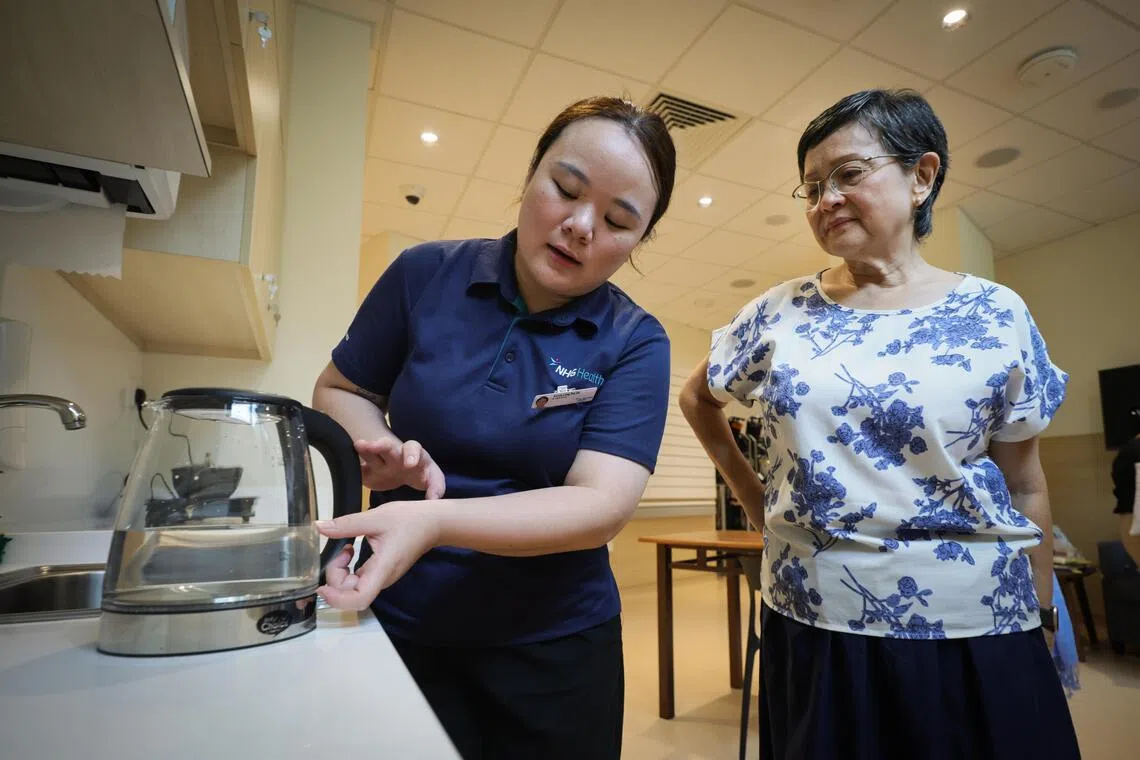
Retired teacher Wong (right) being trained by TTSH senior staff nurse Annie Ling on how to hydrate her mother to prevent delirium.
Published Sep 15, 2026, 06:50 PM
Updated Sep 15, 2026, 06:50 PM
Tan Tock Seng Hospital (TTSH) developed a home-based delirium care pathway within TTSH@Home, allowing elderly patients to receive hospital-level care safely at home and improving early delirium management.
Delirium is often mistaken for dementia worsening but is caused by medical conditions like infections; early recognition and treatment are crucial to prevent serious long-term effects such as dementia.
Since implementing the pathway, 28.4% of elderly patients received delirium diagnosis with low hospital readmission rates, and over 130 community caregivers were trained to support delirium awareness and care.
SINGAPORE – When the 95-year-old patient who has moderate dementia was discharged from hospital, she became increasingly confused and agitated.
Her daughters had initially thought the change in her behaviour was related to her dementia – that it had worsened.
“It was only during home monitoring by the Community Health Team that it was flagged that she had delirium due to a urinary tract infection (UTI). Before that, we had never heard of delirium. We just thought my mother’s dementia was getting worse,” said her daughter Wong, 68, who declined to give her full name.
Delirium, a state of sudden confusion and a severe change in mental function that reduces the ability to focus, sustain or shift attention, often gets missed and is frequently mistaken for normal ageing or a worsening of dementia.
“It is usually caused by underlying medical conditions, such as drugs, infections, electrolyte imbalances, constipation and UTI,” said geriatrician Lim Jun Pei from Tan Tock Seng Hospital (TTSH).
“It leads to adverse outcomes. Some of the patients would even describe it as a post-traumatic stress experience when they remember the episode they were going through. There was a loss of dignity, well-being, independence, and pain and suffering,” she added.
To lessen the burden and strengthen delirium care in the community, Lim and her team developed a new pathway within TTSH@Home, its alternative hospital service that delivers inpatient-level medical care directly to a patient’s home, enabling suitable patients to receive hospital-level care safely at home.
It is supported by specialist oversight and home-based clinical support from a team of nurses, who also provide caregiver education that includes different phrases to help caregivers remember information.
This pathway was implemented after the team visited the National Health Service of Greater Manchester in Britain, where they observed its community delirium programme demonstrating how suitable patients could be managed safely outside the hospital between February and March 2025.
The team that helped Wong (centre) manage her elderly mother’s delirium: (from left) geriatrician Lim Jun Pei, senior staff nurse Annie Ling, senior nurse clinician Joey Yeo and geriatrician Bao Minfang. ST PHOTO: GIN TAY
The team that helped Wong (centre) manage her elderly mother’s delirium: (from left) geriatrician Lim Jun Pei, senior staff nurse Annie Ling, senior nurse clinician Joey Yeo and geriatrician Bao Minfang.
Lim said a study by the team at TTSH found that more than one in 10 (11 per cent) patients aged 65 and above experienced delirium while admitted to hospital for surgery, and this risk was three times higher in people with dementia.
A separate study in Britain found that about three in 10 patients (31 per cent) who experienced delirium developed dementia within five years of the onset of delirium.
Both studies, she said, demonstrated the need for timely intervention to address the underlying causes.
Lim also added that the early results of the new pathway to recognise and manage delirium early within TTSH@Home “have been encouraging”.
The data from June to December 2025 found that three in 10 (28.4 per cent) of elderly patients aged 85 and above cared for under the programme had a diagnosis of delirium.
Lim said that while they generally needed 1.25 more days of care on average, the rate of returning to hospital remained similarly low.
While there is no specific national figure for the total annual healthcare cost attributed only to delirium in Singapore, in the US, it is higher than the costs of many other conditions common in the elderly.
The estimated annual national healthcare cost burden of delirium in the US is US$152 billion (S$194 billion), second only to cardiovascular disease, at US$258 billion, and higher than that of diabetes, at US$92 billion.
Beyond supporting patients at home, TTSH has also trained more than 130 people across 23 community partner organisations, including nursing homes, in delirium and dementia awareness.
Senior staff nurse Annie Ling teaching Wong how to use the word “evade” as a mnemonic to recognise signs of delirium in her elderly mother. ST PHOTO: GIN TAY
Senior staff nurse Annie Ling teaching Wong how to use the word “evade” as a mnemonic to recognise signs of delirium in her elderly mother.
Lim said apart from medical factors, environmental factors can also contribute to delirium.
“For some patients, familiar home surroundings, supported by trained caregivers and structured clinical oversight, may help patients remain calmer and more engaged in recovery,” she said.
For Wong, the home-based care for her elderly mother “made a world of difference”.
The coaching from the TTSH@Home nurses taught Wong to distinguish between delirium and dementia, and she now has the confidence to work with her domestic helpers to care for her mother.
“Learning to recognise the signs gave me the confidence to support her recovery at home. The helper now takes the initiative to record her blood pressure, temperature and oxygen levels regularly,” she said, adding that she is glad her mother has almost returned to her normal activities such as playing games like Swat the Fly.
Tan Tock Seng Hospital
退休教师黄(右)正在接受陈笃生医院高级护士林安妮的培训,学习如何给她的母亲补充水分以防止谵妄。
发布于2026年9月15日下午6:50
更新于2026年9月15日下午6:50
陈笃生医院 (TTSH) 在 TTSH@Home 中开发了以家庭为基础的谵妄护理路径,使老年患者能够在家庭中安全地接受医院级别的护理,并改善早期谵妄管理。
谵妄常被误认为是痴呆症恶化,但实际上是由感染等疾病引起的;早期识别和治疗对于预防痴呆症等严重的长期影响至关重要。
自实施该路径以来,28.4% 的老年患者被诊断为谵妄,医院再入院率较低,并且培训了 130 多名社区护理人员,以支持对谵妄的认识和护理。
新加坡——一名患有中度痴呆症的95岁患者出院后,变得越来越困惑和烦躁。
她的女儿们最初认为她行为的改变与她的痴呆症有关——病情恶化了。
“直到社区卫生团队进行居家监测时,才发现她因尿路感染而出现谵妄。在此之前,我们从未听说过谵妄这种病。我们只以为我母亲的痴呆症越来越严重了。”她68岁的女儿黄女士说道,她拒绝透露自己的全名。
谵妄是一种突然出现的意识混乱和精神功能严重改变的状态,会降低集中注意力、保持注意力或转移注意力的能力,这种状态常常被忽视,并经常被误认为是正常衰老或痴呆症恶化。
“这通常是由潜在的疾病引起的,例如药物、感染、电解质失衡、便秘和尿路感染,”陈笃生医院 (TTSH) 的老年病专家林俊培说。
“这会导致不良后果。有些患者回忆起当时的经历时,甚至会将其描述为创伤后应激障碍。他们失去了尊严、幸福感和独立性,承受了巨大的痛苦和折磨,”她补充道。
为了减轻负担并加强社区的谵妄护理,林和她的团队在TTSH@Home(一家替代医院服务,可将住院级别的医疗护理直接送到患者家中)中开发了一条新的途径,使合适的患者能够在家中安全地接受医院级别的护理。
该项目由一支护士团队提供专家监督和居家临床支持,该团队还会提供护理人员教育,其中包括帮助护理人员记住信息的不同短语。
该方案是在团队访问英国大曼彻斯特国家医疗服务体系后实施的。他们在那里观察了该机构的社区谵妄治疗方案,该方案展示了如何在 2025 年 2 月至 3 月期间安全地在医院外管理合适的患者。
帮助黄女士(中)照料其年迈母亲谵妄的医疗团队:(从左至右)老年病专家林俊佩、高级护士凌安妮、高级临床护士杨祖怡和老年病专家包敏芳。(海峡时报摄影:金泰)
帮助黄女士(中)照顾患有谵妄的老年母亲的团队:(从左至右)老年病专家林俊培、高级护士凌安妮、高级临床护士杨祖伊和老年病专家包敏芳。
林表示,陈笃生医院团队的一项研究发现,65 岁及以上患者中,超过十分之一(11%)的人在因手术入院期间出现谵妄,而患有痴呆症的人的这种风险要高出三倍。
英国的一项独立研究发现,约有十分之三(31%)的谵妄患者在谵妄发作后的五年内患上了痴呆症。
她说,这两项研究都表明,需要及时干预以解决根本原因。
林还补充说,TTSH@Home 中识别和早期处理谵妄的新途径的早期结果“令人鼓舞”。
2025 年 6 月至 12 月的数据显示,在该计划下接受护理的 85 岁及以上老年患者中,十分之三 (28.4%) 被诊断患有谵妄。
林医生表示,虽然他们平均需要额外 1.25 天的护理,但再次入院率仍然很低。
虽然新加坡没有专门针对谵妄症的年度医疗保健总费用的具体全国数据,但在美国,谵妄症的费用高于老年人常见的许多其他疾病的费用。
据估计,美国每年因谵妄造成的国家医疗保健成本负担为 1520 亿美元(1940 亿新元),仅次于心血管疾病(2580 亿美元),高于糖尿病(920 亿美元)。
除了为居家患者提供支持外,陈笃生医院还培训了 23 个社区合作伙伴组织(包括疗养院)的 130 多人,以提高他们对谵妄和痴呆症的认识。
资深护士Annie Ling正在教Wong如何使用“evade”(逃避)一词作为记忆口诀,以便识别她年迈母亲的谵妄症状。(海峡时报摄影:GIN TAY)
资深护士 Annie Ling 教 Wong 如何使用“evade”一词作为记忆口诀来识别她年迈母亲的谵妄迹象。
林医生表示,除了医疗因素外,环境因素也可能导致谵妄。
“对于一些患者来说,熟悉的家庭环境,加上训练有素的护理人员和结构化的临床监督,可能有助于患者保持冷静,并更积极地参与康复过程,”她说。
对于黄女士来说,居家护理对她年迈的母亲来说“意义非凡”。
在TTSH@Home护士的指导下,黄女士学会了区分谵妄和痴呆,现在她有信心与家里的帮佣一起照顾她的母亲。
“学会识别这些迹象让我更有信心在家帮助她康复。现在,护理人员会主动定期记录她的血压、体温和血氧饱和度,”她说,并补充道,她很高兴母亲几乎已经恢复了正常活动,比如玩“打苍蝇”之类的游戏。
陈笃生医院