Air Force Announces New Plans To Take Over Defending Its Own Bases From Aerial Attack美国空军宣布接管自身基地免受空中袭击防御的新计划
The Air Force's top officer acknowledged that a lack of organic base defense was a factor in the destruction caused by Iran.
Published Sep 15, 2026 7:00 AM EDT
Faced with a growing threat to their bases and personnel from missiles and drones and some recent hard-learned lessons, two top Air Force officials on Monday announced plans to increase protection. The statements were made during the Air & Space Forces Air, Space and Cyber Symposium that TWZ is attending. They were delivered as the service is seeking to improve its organic ability to defend its bases and has developed new doctrine to do so .
The war against Iran exposed gaps in how the U.S. can provide effective, sustained air defenses for its foreign installations and there are major concerns about a future fight against a peer competitor like China or Russia. Drone incursions at home have raised alarms about domestic base protection as has the war between Russia and Ukraine.
The following video shows a fatal Iranian attack on Muwaffaq Salti Air Base in Jordan in July.
Video captures the moment that several Iranian medium to intermediate-range ballistic missiles struck Muwaffaq Salti Air Base in Jordan overnight, killing at least two and injuring several other American Servicemembers. pic.twitter.com/cJz39E1LvP — OSINTdefender (@sentdefender) July 18, 2026
Video captures the moment that several Iranian medium to intermediate-range ballistic missiles struck Muwaffaq Salti Air Base in Jordan overnight, killing at least two and injuring several other American Servicemembers. pic.twitter.com/cJz39E1LvP
“For decades, American air and space power has often operated from a position of sanctuary. Those days are over,” Air Force Chief of Staff Gen. Kenneth S. Wilsbach said during a keynote speech. “We can no longer treat point defense as a side hustle. We must make it a core function of air and space power.”
He acknowledged the widespread damage Iran caused to U.S. bases and suggested that lack of base defense played a large role.
“So, if we had more robust base defense, perhaps those bases wouldn’t have been as damaged as they were,” the general admitted. “Look at Israel; they have a significantly layered, very robust defense of their country, and they didn’t take that many hits. Very few, in fact, and that shows you what a good defensive system can do, which can help you to operate not quite with impunity, but almost, and you can just keep generating air power, and your defensive systems take care of the incoming.”
Israel’s ‘Iron Dome’ air defense system responds to incoming Iranian ballistic missiles as seen from Tel Aviv, Israel on June 18, 2025. (Photo by Mostafa Alkharouf/Anadolu via Getty Images) Anadolu
Wilsbach offered some concrete suggestions about how to make improvements.
“First, we will establish the point defense weapon system, bringing together kinetic and non-kinetic capabilities to secure our air bases,” the general said. He did not offer any specifics.
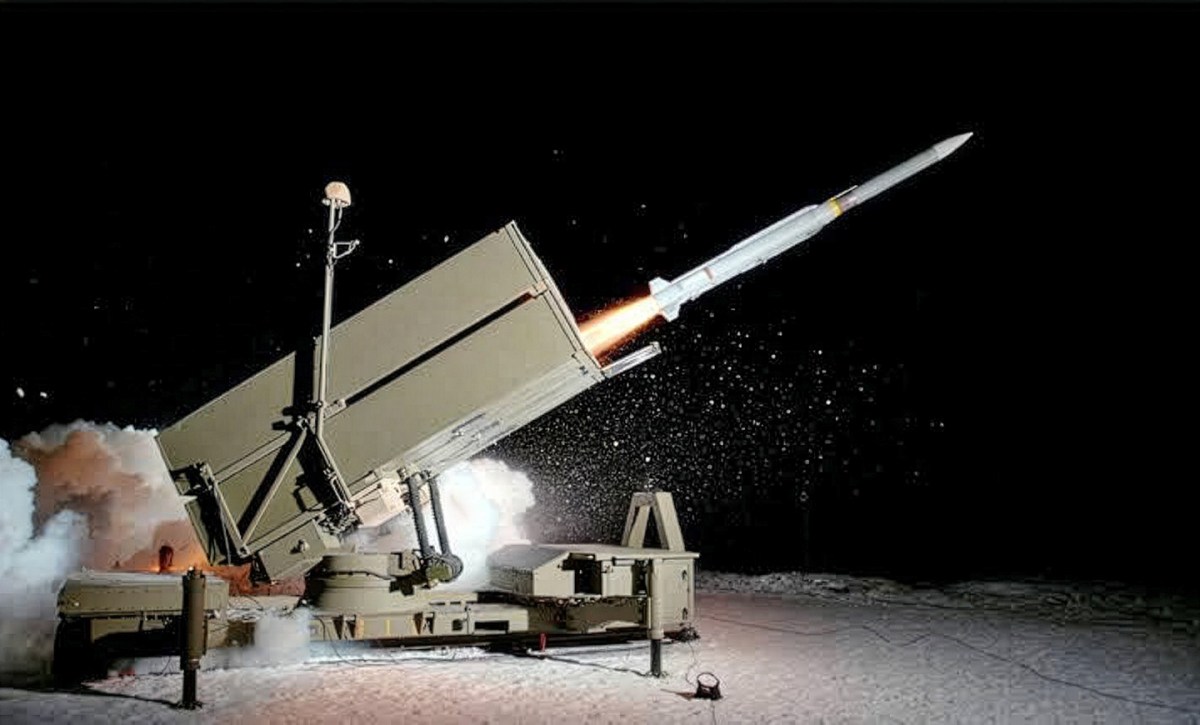
While Wilsbach offered no details about what a point defense weapons system would entail, we recently wrote that the Air Force is seeking an anti-aircraft gun system to help defend its air bases around the world from drones and cruise missiles. Introduced via a Request for Information (RFI) recently posted on the government’s contracting website, the gun system concept is part of a larger Air Force effort to play a greater role in air base defense via ground-based air defenses (GBADs). This role is largely performed by the U.S. Army, most notably with surface-to-air missile systems like Patriot and the Humvee-based Avenger system . The Terminal High Altitude Area Defense (THAAD) system can also provide broader area defense against incoming ballistic missiles. Other short-range systems optimized to swat down drones and even incoming rockets include the Centurion Counter-Rocket, Artillery, Mortar (C-RAM) system , Coyote counter-drone interceptors and more.
The Air Force currently has no such systems. Now it is set on changing that.
The Air Force is also looking at directed energy weapons like lasers for force protection and especially for defending bases overseas. While gaining traction across the services due in large measure to the much lower cost of delivering effects, these systems are still works in progress .
A U.S. Army Terminal High Altitude Area Defense (THAAD) in Guam. (U.S. Army)
It’s one thing to have equipment, but another to have experts that know how to use it, Wilsbach noted.
“Second, we have established a new career field of point defense airmen,” he added. “This new career field will be operational in two years. Together, these two new initiatives will strengthen our defenses, reinforce our ability to generate air and space power under fire, and protect our greatest advantage: our airmen and guardians.”
“Protecting the force and generating combat power are inseparable,” Wilsbach explained. “We need our airmen trained, equipped, and ready to fight from the opening moments of a conflict.”
“Don’t you think we ought to have them at every base?” he suggested when asked about point defenders during a media engagement at the symposium. “Because if every base is going to be threatened, we have to have somebody that knows how to defend it. So, obviously, that’s a long-term objective. But what I’ll tell you for right now is we’re going to develop the career field and push it forward to the critical bases that need protecting most, and then we’ll expand it beyond there.”
Airmen assigned to the 319th Reconnaissance Wing prepare to execute a Point Defense Battle Lab exercise on the flightline at Grand Forks Air Force Base, North Dakota, Feb. 13, 2026. (U.S. Air Force photo by Airman 1st Class Emma Teel) Airman Emma Funderburk
Though he wants the Air Force to come up with new defensive systems and personnel with the know-how to operate them, Wilsbach is not quite as sold on building out hardened aircraft shelters (HAS). This is his long-standing position that he reiterated on Monday.
“If you know where you’re going to fight from, hardened shelters aren’t that bad of an idea,” the general posited. “Deeply buried are even better. But if you are like us, and we don’t necessarily know where we’re going to fight from, if you build a hardened shelter and you don’t happen to be there, then you perhaps wasted that money.”
“So, given a resource-constrained environment, I would like to put my dollars in systems that can go anywhere in the world and protect you with basically the same level of security by shooting down incoming rounds versus making a hardened shelter that is impervious to an attack,” Wilsbach explained. “You have to put it 200 or 300 feet underground. Any hardened shelter that you show me that’s above the ground, I can blow up. So unless it’s really deeply buried, and then if it is, it’s expensive. And so that’s my logic: the best bang for the buck.”
A U.S. Air Force F-16 Fighting Falcon, assigned to the 480th Fighter Squadron, sits inside a hardened aircraft shelter during exercise Turbo Weasel at Spangdahlem Air Base, Germany, April 14, 2025. (U.S. Air Force photo by Senior Airman Demi M. Ebert) Senior Airman Demi M. Ebert
To speed up the fielding of defensive systems, the service is interested in building out a procurement process specifically designed to develop weapons and other equipment needed to defend bases.
“How do you make sure that [airmen] have the kit they need to do the job?” Air Force Secretary Troy Meink asked rhetorically at a separate symposium session.
The Air Force, he said, is considering creating a new base defense Portfolio Acquisition Executive (PAE). The service created PAEs at the beginning of the year as part of an overhaul of its acquisition process ordered by Defense Secretary Pete Hegseth.
“The creation of PAEs is a central element of that direction,” according to an Air Force memo on the topic. “By organizing acquisition leadership around portfolios of capability, rather than discrete programs alone, the Department seeks to improve integration, decision speed, and outcome-focused execution across the acquisition enterprise.”
Meink acknowledged that there are challenges to creating a new PAE, most notably the overhead cost of establishing a new office with its associated personnel and infrastructure.
“Probably not going to do it right away, but obviously I think we’re on a path to something like that in the future,” the secretary suggested. “But there definitely has to be a continually increasing focus on making sure we can defend our airmen and guardians wherever they are in the world. This is not just an overseas problem; it’s a U.S. problem as well.”
Though we have been raising the alarm for years about the need for domestic base protection, the issue came into sharp focus in December 2023 after Langley Air Force Base in Virginia was beset by mysterious drone incursions for much of that month. The nature of those flights, which we were the first to report , remains publicly unknown. Since then there have been incursions at several other bases in the U.S. , including Barksdale Air Force Base in Louisiana , home of B-52 Stratofortress bombers and nuclear weapons storage facilities , and a key part of the airborne leg of America’s nuclear triad. There have also been numerous incursions over U.S. bases in Europe , many of which we were the first to report .
As we noted earlier in this story, the U.S. is already facing a challenge defending against Iranian threats. A war with China would be more devastating and, when it comes to the Air Force protecting its bases, require more robust defenses and a lot more of them at many more locations. At the same time, the Air Force is still very early in the process of taking on more responsibility for protecting its assets.
Meanwhile, the Army has its issues when it comes to air defense. Its existing Patriot battalions have already been shown to be worryingly inadequate to meet heavy existing operational demands , something TWZ has been calling attention to for years now . We have also been raising concerns for a long time about its lack of SHORADS.
For the Air Force, recognizing the problem and taking steps to fix it are important steps. Whether these are the right approaches is something we will keep an eye on.
Contact the author: howard@twz.com
Comments couldn’t be loaded. Please refresh the page.
发布于美国东部时间2026年9月15日上午7:00
面对导弹和无人机对基地和人员日益增长的威胁,以及近期一些惨痛的教训,两位空军高级官员周一宣布了加强防御的计划。这些声明是在TWZ正在参加的空军与太空部队空中、太空和网络研讨会上发表的。与此同时,空军正寻求提升自身防御基地的能力,并为此制定了新的作战条令。
对伊战争暴露了美国在为其海外设施提供有效、持续防空能力方面的不足,人们对未来与中国或俄罗斯等势均力敌的竞争对手发生冲突深感担忧。国内无人机入侵事件以及俄乌战争都引发了人们对国内基地安全的警惕。
以下视频显示了伊朗于7月对约旦穆瓦法克·萨尔蒂空军基地发动的致命袭击。
视频记录了数枚伊朗中程至中远程弹道导弹夜间袭击约旦穆瓦法克·萨尔蒂空军基地的瞬间,造成至少两名美国军人死亡,另有数名美国军人受伤。 pic.twitter.com/cJz39E1LvP — OSINTdefender (@sentdefender) July 18, 2026
视频记录了数枚伊朗中程至中远程弹道导弹夜间袭击约旦穆瓦法克·萨尔蒂空军基地的瞬间,造成至少两名美国军人死亡,另有数名美国军人受伤。 pic.twitter.com/cJz39E1LvP
“几十年来,美国的空中和太空力量常常处于一种安全避难的状态。但那种日子已经结束了,”空军参谋长肯尼斯·S·威尔斯巴赫将军在一次主旨演讲中说道。“我们不能再把点防御当作副业,而必须将其作为空中和太空力量的核心职能。”
他承认伊朗对美国基地造成了广泛的破坏,并暗示基地防御不足是造成破坏的主要原因。
“所以,如果我们拥有更强大的基地防御系统,或许那些基地就不会遭受如此严重的破坏,”这位将军承认道。“看看以色列;他们拥有多层次、非常强大的国防体系,却没遭受多少打击。事实上,他们遭受的打击非常少。这足以说明一套完善的防御系统能发挥多大的作用,它能让你几乎完全不受惩罚地行动,你可以持续发展空中力量,而你的防御系统会帮你应对来袭的攻击。”
2025年6月18日,从以色列特拉维夫拍摄的照片显示,以色列的“铁穹”防空系统正在拦截来袭的伊朗弹道导弹。(图片来源:Mostafa Alkharouf/Anadolu via Getty Images)
威尔斯巴赫就如何改进提出了一些具体的建议。
“首先,我们将建立点防御武器系统,将动能和非动能能力结合起来,以确保我们空军基地的安全,”这位将军说道。但他没有提供任何具体细节。
尽管威尔斯巴赫并未透露点防御武器系统的具体细节,但我们此前曾报道,美国空军正在寻求一种防空炮系统,以帮助其在全球各地的空军基地抵御无人机和巡航导弹的攻击。该炮系统概念是通过近期在政府合同网站上发布的征求信息书(RFI)提出的,它是美国空军旨在通过地面防空系统(GBAD)在空军基地防御中发挥更大作用的更广泛计划的一部分。目前,这项任务主要由美国陆军承担,最显著的例子是“爱国者”地对空导弹系统和悍马车搭载的“复仇者”系统。末段高空区域防御系统(THAAD)也能提供更广泛的区域防御,抵御来袭的弹道导弹。其他一些针对拦截无人机甚至来袭火箭弹而优化的短程系统包括“百夫长”反火箭、炮弹、迫击炮(C-RAM)系统、“郊狼”反无人机拦截器等等。
空军目前还没有这类系统。现在,空军决心改变这一现状。
空军也在研究定向能武器,例如激光武器,用于部队防护,特别是用于保卫海外基地。虽然这些系统由于其作战成本远低于其他武器而逐渐受到各军种的青睐,但它们仍处于研发阶段。
位于关岛的美国陆军末段高空区域防御系统(THAAD)。(美国陆军)
威尔斯巴赫指出,拥有设备是一回事,但拥有知道如何使用这些设备的专家又是另一回事。
“其次,我们设立了新的近程防御空军人员职业领域,”他补充道。“这一新领域将在两年内投入运作。这两项新举措将共同加强我们的防御能力,增强我们在战火下运用空天力量的能力,并保护我们最大的优势:我们的空军人员和守护者。”
威尔斯巴赫解释说:“保护部队和增强战斗力是密不可分的。我们需要我们的空军人员训练有素、装备精良,并且从冲突爆发的第一时间起就做好战斗准备。”
“难道你不觉得我们应该在每个垒位都配备一名防守队员吗?”他在研讨会期间接受媒体采访时被问及防守队员的问题时说道。“因为如果每个垒位都面临威胁,我们就必须有人懂得如何防守。显然,这是一个长期目标。但就目前而言,我们可以说的是,我们将发展这一职业领域,并将其推广到最需要保护的关键垒位,然后再逐步扩展到其他垒位。”
2026年2月13日,隶属于第319侦察联队的空军人员在北达科他州大福克斯空军基地的飞行跑道上准备进行点防御作战实验室演习。(美国空军一等兵艾玛·蒂尔摄)空军士兵艾玛·芬德伯克
尽管威尔斯巴赫希望空军研发新的防御系统并培养具备操作这些系统所需技能的人员,但他对建造加固型飞机掩体(HAS)并不十分热衷。这是他长期以来的立场,他在周一重申了这一点。
“如果你知道要在哪里作战,建造加固掩体倒也不失为一个好主意,”将军说道。“深埋地下的掩体就更好了。但如果你像我们一样,并不一定知道要在哪里作战,那么即使你建造了加固掩体,结果却没在那里作战,那你可能就白花了这笔钱。”
“所以,在资源有限的情况下,我更愿意把钱花在能够部署到世界任何地方,并通过拦截来袭炮弹提供基本相同安全保障的系统上,而不是建造一个坚不可摧的坚固掩体,”威尔斯巴赫解释说。“你必须把它建在地下200到300英尺的地方。任何你给我看的地面上的坚固掩体,我都能炸掉。所以,除非它埋得非常深,但即便如此,造价也很昂贵。这就是我的逻辑:性价比最高。”
2025年4月14日,在德国施潘达勒姆空军基地举行的“涡轮鼬鼠”演习期间,一架隶属于美国空军第480战斗机中队的F-16“战隼”战斗机停放在一个加固的飞机掩体内。(美国空军高级飞行员黛米·M·埃伯特摄)
为了加快防御系统的部署,该军种有兴趣建立一个专门用于开发防御基地所需的武器和其他装备的采购流程。
“如何确保(空军人员)拥有完成工作所需的装备?”空军部长特洛伊·梅因克在另一次研讨会上反问道。
他说,空军正在考虑设立一个新的基地防御项目采购执行机构(PAE)。今年年初,作为国防部长皮特·赫格塞斯下令对其采购流程进行全面改革的一部分,空军设立了PAE。
根据空军一份关于此主题的备忘录,“创建能力组合是这一方向的核心要素”。“通过围绕能力组合而非仅仅是单个项目来组织采购领导层,国防部力求提高整个采购体系的整合性、决策速度和以结果为导向的执行力。”
Meink 承认,创建新的 PAE 存在挑战,最显著的是建立新办公室及其相关人员和基础设施的间接成本。
“可能不会马上就这么做,但显然我认为我们未来会朝着这个方向发展,”这位部长表示。“但我们必须持续加大力度,确保无论我们的空军人员和安保人员身处世界何地,我们都能保护他们。这不仅是海外问题,也是美国自身的问题。”
尽管我们多年来一直呼吁加强国内基地安全,但直到2023年12月,弗吉尼亚州兰利空军基地遭遇神秘无人机入侵事件后,这一问题才真正引起公众关注。我们率先报道了这些入侵事件,但其性质至今仍是个谜。此后,美国其他几个基地也相继遭到入侵,其中包括路易斯安那州的巴克斯代尔空军基地。该基地驻扎着B-52“同温层堡垒”轰炸机,并拥有核武器储存设施,是美国核三位一体空中力量的重要组成部分。此外,美国在欧洲的多个基地也多次遭到入侵,其中许多事件也是我们率先报道的。
正如我们在本文前面提到的,美国目前在应对伊朗威胁方面已经面临挑战。与中国的战争后果将更加惨重,而且就空军保护其基地而言,需要更强大的防御体系,并在更多地点部署更多防御设施。与此同时,空军在承担更多保护自身资产的责任方面仍处于起步阶段。
与此同时,陆军在防空方面也存在问题。其现有的“爱国者”导弹营已被证明不足以满足当前繁重的作战需求,这一点TWZ多年来一直关注。此外,我们也长期以来对其缺乏近程防空导弹系统表示担忧。
对空军而言,认识到问题并采取措施解决问题至关重要。至于这些方法是否正确,我们将密切关注。
联系作者:howard@twz.com
评论加载失败,请刷新页面。