US and UK teaming up to destroy underwater drones美国和英国联手摧毁水下无人机
America and Britain are joining forces to tackle the threat of underwater drones to ports and other critical infrastructure.
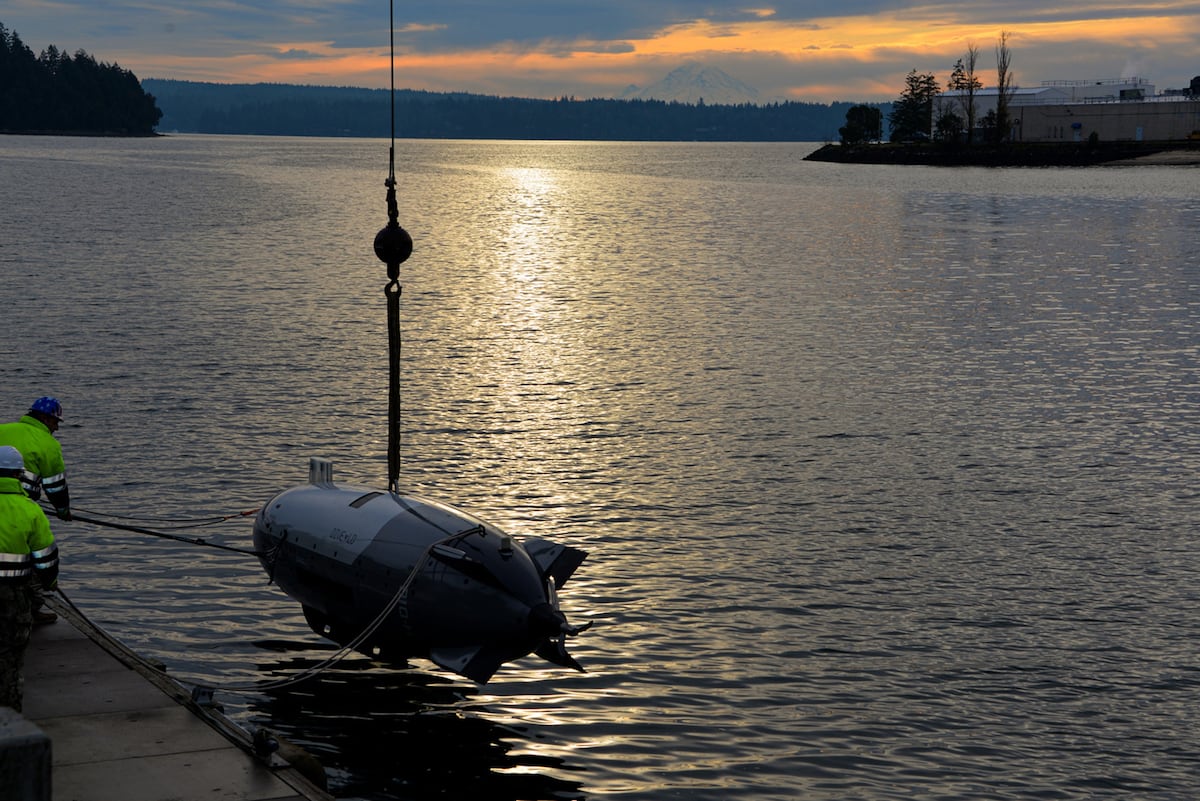
America and Britain are joining forces to tackle the threat of underwater drones to ports and other critical infrastructure, according to a solicitation by the Pentagon’s Defense Innovation Unit.
The two nations are seeking a comprehensive suite of commercial systems that can detect and destroy a variety of undersea robots, including unmanned underwater vehicles, remotely operated vehicles and semisubmersibles.
“Current solutions are fragmented, expensive, and limited in number,” warned the solicitation . The primary focus of the Robotic Exclusion and Engagement Framework, or REEF, project is to protect “ports and harbors from underwater threats of varying size and sophistication, while the broader goal is to protect all U.S. critical waterways.”
DIU envisions using off-the-shelf sensors, edge processing, active and passive sensors, sensor fusion, decoys and other technologies to create a stand-alone solution that can be quickly deployed as needed. This can include fixed systems such as moored buoys and buried cables, or mobile systems such as USVs, UUVs, UAVs and drifting buoys.
Sensors should be able to utilize artificial intelligence to discriminate between hostile undersea drones, versus nonthreats such as marine life, cargo ships and fishing vessels.
“The system must provide sufficient detection-to-response time for human in-the-loop decision-making such that underwater threats can be safely interdicted or neutralized,” the solicitation noted.
The system will employ kinetic and nonkinetic approaches to stop drones. Nonkinetic methods can include rapidly deployable nets, bubble curtains and synthetic barriers. Kinetic defenses can include kinetic payloads, acoustic directed energy and physical coupling devices.
Preference will be given to nonkinetic solutions, the solicitation said.
REEF will emphasize decoys to protect waterways and critical infrastructure. “Capabilities to confuse adversarial underwater craft are of high interest. These can be low-cost attritable systems or more technologically advanced systems that use signals to act as a decoy to prevent the successful completion of the adversary’s mission,” according to the solicitation.
REEF should require little training to operate, and use AI to provide users with suggestions. It must be compatible with existing U.S. command-and-control systems and common operating pictures.
Cooperation with the U.K. will be eased by a 2024 Department of Commerce interim final rule that allows some controlled items to be shared with Britain. British companies are eligible for export control relief under General Export Authorization No. 001.
Michael Peck is a correspondent for Defense News and a columnist for the Center for European Policy Analysis. He holds an M.A. in political science from Rutgers University. Find him at theuncommondefense.com. His email is mikedefense1@gmail.com.
据五角大楼国防创新部门发布的一份征求意见稿显示,美国和英国正在联手应对水下无人机对港口和其他关键基础设施构成的威胁。
两国正在寻求一套全面的商业系统,该系统能够探测和摧毁各种水下机器人,包括无人水下航行器、遥控航行器和半潜式航行器。
“目前的解决方案分散、昂贵且数量有限,”招标文件中警告说。机器人排除与对抗框架(REEF)项目的主要重点是保护“港口和码头免受各种规模和复杂程度的水下威胁,而更广泛的目标是保护美国所有重要水道。”
DIU设想利用现成的传感器、边缘处理、主动和被动传感器、传感器融合、诱饵和其他技术,打造一个可根据需要快速部署的独立解决方案。这可以包括固定系统,例如系泊浮标和埋地电缆,也可以包括移动系统,例如无人水面艇(USV)、无人水下航行器(UUV)、无人机(UAV)和漂流浮标。
传感器应该能够利用人工智能来区分敌对的水下无人机和非威胁目标,例如海洋生物、货船和渔船。
招标书中指出:“该系统必须提供足够的检测到响应时间,以便人类在回路中进行决策,从而能够安全地拦截或消除水下威胁。”
该系统将采用动能和非动能方法来拦截无人机。非动能方法包括快速部署网、气泡幕和合成屏障。动能防御措施包括动能载荷、声波定向能和物理耦合装置。
招标书中表示,将优先考虑非动力学解决方案。
REEF项目将重点发展诱饵系统,以保护水道和关键基础设施。招标文件中指出:“迷惑敌方水下舰艇的能力至关重要。这些系统可以是低成本的消耗型系统,也可以是技术更先进的系统,它们利用信号作为诱饵,阻止敌方任务的成功完成。”
REEF系统操作简便,只需少量培训即可上手,并利用人工智能为用户提供建议。它必须与现有的美国指挥控制系统和通用作战图兼容。
美国商务部将于2024年发布一项临时最终规则,允许与英国共享部分受管制物项,这将简化与英国的合作。英国公司可根据第001号通用出口授权享受出口管制豁免。
迈克尔·佩克是《防务新闻》的通讯员,也是欧洲政策分析中心的专栏作家。他拥有罗格斯大学政治学硕士学位。您可以在theuncommondefense.com找到他。他的邮箱是mikedefense1@gmail.com。