EXCLUSIVE: Pratt licenses Hermeus to build F100 fighter jet engine独家消息:普惠公司授权赫尔墨斯公司制造F100战斗机发动机
Hermeus CEO Zach Shore told Breaking Defense the company can now vertically integrate production of its Quarterhorse drone and serve as a second source of engines for Pratt’s F100-PW-229 powerplant.
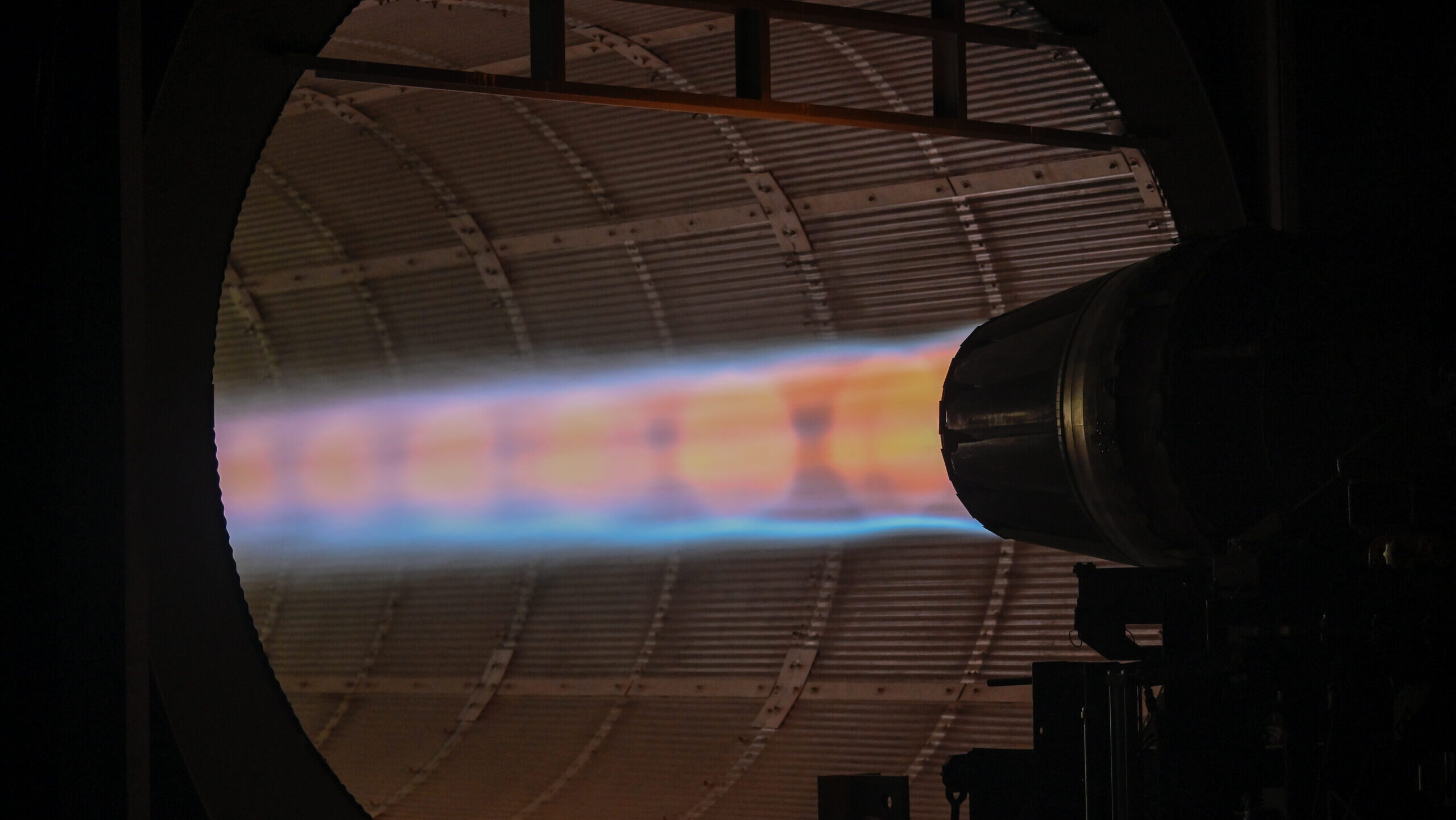
U.S. Airmen assigned to the 169th Maintenance Squadron conduct maintenance and an acceptance run on an F100-PW-229 jet engine in the hush house at McEntire Joint National Guard Base, South Carolina, Aug. 19-22, 2025. (U.S. Air National Guard photo by Airman 1st Class Alexis Goodman)
NATIONAL HARBOR, Md. — Engine maker Pratt & Whitney is licensing aircraft startup Hermeus to produce Pratt’s F100 fighter jet engine, the companies revealed to Breaking Defense, the first such license for a fellow American firm.
In an exclusive interview, Jill Albertelli, the president of Pratt’s military engines business, described the agreement as a natural one to boost the industrial base in the face of growing powerplant demand for existing aircraft and for in-development programs like the Air Force’s Collaborative Combat Aircraft project.
“So we look at it as like, yeah, why wouldn’t we do this? We are all aligned that the defense industrial base needs to be bigger than it is today, and this is a great opportunity together,” she said on the sidelines of the of the Air and Space Forces Association conference here.
The agreement covers the production of the F100-PW-229 turbofan, which entered service in 1992 and is used to power some versions of the F-15 and F-16.
In addition to potential CCA customers, the new license comes after an Air Force request for information in August said the government intends to “pursue a strategic competition requiring industry to innovate manufacturing and guarantee supply chain resiliency.” Engines will be needed to power aircraft like the F-15EX and F-16s for domestic and foreign aircraft, the notice says, which projects “peak demand” surpassing 180 engines annually by fiscal year 2034.
“We are very interest in the entire maket space,” Albertelli told Breaking Defense. CCA, especially, “has a very large range of what that might look like.”
Hermeus has a particular interest in the F100: it powers the company’s high-speed Quarterhorse drone. In an interview with Breaking Defense, Hermeus CEO Zach Shore said the deal means the company would additionally be the first vertically integrated aircraft manufacturer under the Quarterhorse program.
Beyond the Quarterhorse, Shore emphasized that a production outlook for the F100 engine and overall timeline would be driven by customer demand, and that the company will start making capital investments at scale accordingly to support engine manufacturing. “It’s not an if, it’s a when,” Shore said.
“There is a wide array of customers. I think right now we’re focused on domestic manufacturing, domestic builds, and certainly for supporting our program,” Shore continued, noting that initial production work would be done within the firm’s existing production footprints. “We see ourselves as just an extension of Pratt here to support engine manufacturing” as a second source of engines.
Shore clarified, however, that Hermeus’ overall “expansion path” is focused around airframes rather than engine production. “We’re not in the business of being a clean sheet engine manufacturer. That is a long way away,” he said. “So for us, to just do this work is plenty.”
Hermeus is iteratively developing the Quarterhorse drone and plans to fly the aircraft at speeds up to Mach 3 under a $219 million contract awarded by the Pentagon’s Defense Innovation Unit. Air Force Maj. Gen. Joseph Kunkel, the DIU’s military deputy, previously expressed strong support for the drone, stating that its mass production could create a “game-changing warfighting capability” with a “significant number of use cases where it can be used as a weapon.”
Hermeus is also building its own turbine-based combined cycle (TBCC) engine based on the F100. A TBCC engine combines a jet turbine with a ramjet engine to create an integrated propulsion system capable of flying at hypersonic speeds exceeding Mach 5. Hermeus’ TBCC concept, dubbed Chimera, would form the core of an envisioned hypersonic aircraft the company refers to as the Darkhorse.
Pratt’s selection of Hermeus to manufacture the F110 adds another industry heavyweight to the startup’s growing number of collaborators. Earlier this month, Hermeus and Anduril forged a partnership to pair Anduril’s mission autonomy suite with the Quarterhorse aircraft for upcoming flight testing, Breaking Defense previously reported .
Shore noted that the relationship may also position Hermeus to find new efficiencies in F100 manufacturing.
“We’ve been working with this engine for a long time, and there’s an opportunity for us to pull some cost out of the engine,” Shore said. Or, in other words, to “DOGE it, if you will, and help make the engine more competitive. We’re excited to become part of the Pratt family.”
2025年8月19日至22日,隶属于美国空军第169维护中队的空军人员在南卡罗来纳州麦克恩蒂尔联合国民警卫队基地的隔音室内对一台F100-PW-229喷气发动机进行维护和验收运行。(美国空军国民警卫队一等兵亚历克西斯·古德曼摄)
马里兰州国家港——发动机制造商普惠公司向《防务新闻》透露,该公司已授权飞机初创公司 Hermeus 生产普惠的 F100 战斗机发动机,这是美国公司首次获得此类授权。
在一次独家采访中,普惠公司军用发动机业务总裁吉尔·阿尔贝泰利表示,面对现有飞机和正在开发的项目(如空军的协同作战飞机项目)对动力装置日益增长的需求,这项协议是促进工业基础发展的必然之举。
“所以我们会想,是啊,为什么不做呢?我们都一致认为国防工业基础需要比现在更大,这是一个共同的好机会,”她在空军和太空部队协会会议间隙说道。
该协议涵盖 F100-PW-229 涡扇发动机的生产,该发动机于 1992 年投入使用,用于为某些型号的 F-15 和 F-16 提供动力。
除了潜在的CCA客户外,此次新许可证的颁发也源于美国空军8月份发布的一份信息征询书。该征询书指出,政府计划“开展一场战略竞争,要求业界在制造工艺方面进行创新,并确保供应链的韧性”。公告称,国内外飞机,例如F-15EX和F-16战斗机,都需要发动机来提供动力,预计到2034财年,“峰值需求”将超过每年180台发动机。
“我们对整个市场领域都非常感兴趣,”阿尔贝泰利告诉《防务新闻》。“尤其是CCA,它展现出了非常广阔的应用前景。”
Hermeus公司对F100发动机尤为感兴趣:它为该公司的高速“夸特霍斯”(Quarterhorse)无人机提供动力。Hermeus首席执行官扎克·肖尔在接受《防务新闻》(Breaking Defense)采访时表示,这项交易意味着该公司将成为“夸特霍斯”项目下首家垂直整合的飞机制造商。
除了Quarterhorse发动机项目之外,肖尔强调,F100发动机的生产前景和整体时间表将取决于客户需求,公司将据此开始大规模的资本投资,以支持发动机制造。“这不是会不会发生的问题,而是何时发生的问题,”肖尔说道。
“我们的客户群体非常广泛。我认为目前我们专注于国内制造、国内组装,当然也包括支持我们的项目,”肖尔继续说道,并指出初期生产工作将在公司现有的生产基地内进行。“我们把自己定位为普惠公司的延伸,作为发动机制造的第二供应商。”
不过,肖尔澄清说,赫尔墨斯的整体“扩张路径”侧重于机身而非发动机生产。“我们并非要成为一家全新设计的发动机制造商。那还很遥远,”他说。“所以对我们来说,做好这项工作就足够了。”
Hermeus公司正在迭代开发Quarterhorse无人机,并计划根据五角大楼国防创新部门授予的一份价值2.19亿美元的合同,使该无人机的飞行速度达到3马赫。国防创新部门的军事副主管、空军少将约瑟夫·昆克尔此前曾对该无人机表示强烈支持,称其大规模生产将创造“改变游戏规则的作战能力”,并“在众多应用场景中可将其用作武器”。
Hermeus公司也在基于F100发动机研发自己的涡轮联合循环(TBCC)发动机。TBCC发动机将喷气式涡轮发动机与冲压式喷气发动机相结合,形成一个能够以超过5马赫的高超音速飞行的集成推进系统。Hermeus公司的TBCC概念发动机被命名为“奇美拉”(Chimera),它将成为该公司设想中的高超音速飞行器“黑马”(Darkhorse)的核心部件。
普惠公司选择 Hermeus 公司生产 F110 无人机,为这家初创公司不断壮大的合作伙伴队伍又增添了一位业内巨头。据 Breaking Defense 此前报道,本月初,Hermeus 与 Anduril 公司达成合作,将 Anduril 的任务自主系统与 Quarterhorse 无人机配套,用于即将进行的飞行测试。
Shore指出,这种合作关系也可能使Hermeus在F100制造方面找到新的效率提升途径。
“我们已经研究这款发动机很长时间了,现在有机会降低它的成本,”肖尔说道。或者换句话说,就是“像DOGE那样进行优化,帮助提升发动机的竞争力。我们很高兴能成为普拉特大家庭的一员。”