Beijing sharpens tone over US missile launcher in the Philippines北京就美国在菲律宾部署导弹发射器一事态度强硬
Since April, the Typhon missile system has remained in one of the military bases in the country’s north after joint drills with the United States.
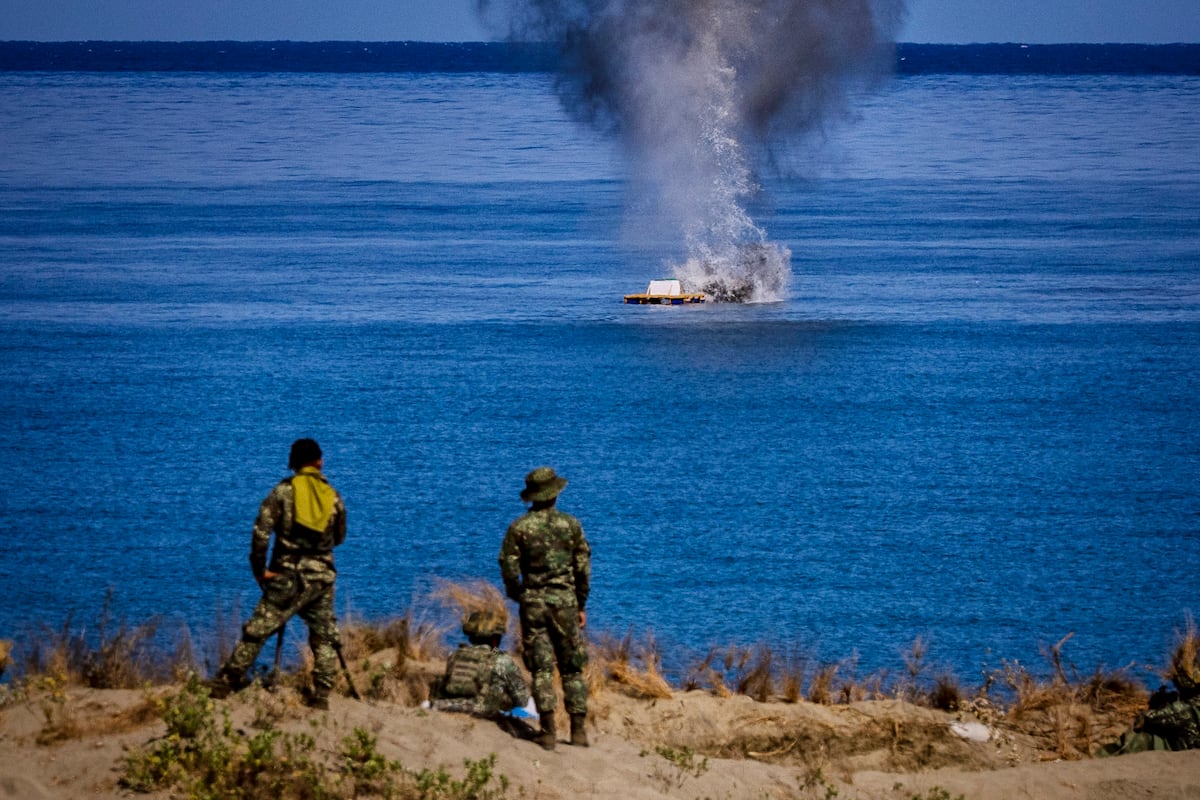
MANILA, Philippines — China rebuked anew the presence of a U.S. Typhon missile system in the Philippines, the latest in a series of verbal rows between Manila and Beijing over the deployment of the medium-range weapon in the Philippines.
Chinese defense spokesperson Senior Colonel Wu Qian reiterated in a press conference in Beijing last week that the deployment had “intensified geopolitical confrontation and escalated tensions in the region,” as he renewed calls for its withdrawal from Philippine shores.
Since April, the missile system has stayed in one of the military bases in the country’s north after annual joint military drills between the Philippines and the U.S. culminated as part of a long-held tradition as treaty allies.
In August, Chief of Staff Gen. Romeo Brawner told reporters he would prefer the mid-range missile systems to stay in the country permanently to bolster deterrence.
This comes after Chinese Coast Guard personnel armed with axes and knives attacked a contingent of Philippine coast guard and Navy vessels in June while on a monthly resupply mission to a naval outpost in Second Thomas Shoal. A Philippine Navy sailor lost a thumb during the confrontation.
Following this incident, Manila and Beijing reached a “provisional agreement” on July 21 which allows Philippine vessels to deliver supplies to Filipino troops in the outpost.
China voiced concerns over the ongoing deployment of the missile system here in Sept. 19 after defense secretary Gilberto Teodoro told reporters that the department has plans to acquire “similar capabilities” to the Typhon system.
The Philippines has an ongoing bid to buy High Mobility Artillery Rocket Systems (HIMARS) rocket launchers from American firm Lockheed Martin as part of its three-phase modernization buildup.
While the HIMARS acquisition has yet to be cleared by the U.S. State Department, the military here has nonetheless continued to beef up its missile arsenal.
The Philippines received its first set of BrahMos supersonic anti-ship cruise missiles in April and last month placed orders for testing 12 AT-1K Raybolt anti-tank missiles from South Korea’s LIGNex1 to be delivered in 2025.
Future frigates, corvettes, and patrol vessels will also arrive fitted with weapon systems upon delivery, the military said.
Acquiring more varieties of missiles for different platforms is a logical follow-up after expanding the country’s radar network for spotting threats, according to Benjamin Blandin, an associate researcher for the Sealight Project of the Gordian Knot Center for National Security Innovation of Stanford University.
“The Philippines is creating naval and air radar bubbles so to speak—a network,” Blandin told Defense News. “The Philippines is building both a coast and air shield. Now with this kind of capacity for radars, it makes sense for the Philippines to acquire missiles because it goes in pairs, it needs to go side-by-side,” he explained.
Since 2017, the Philippines has received radars capable of detecting fighter jets, ballistic missiles and vessels, with technology hailing from Japan, the United States, Germany, and Canada. This year, Manila received the last set of SPYDER air defense systems from Israel’s Rafael Systems.
Infrastructure upgrades on bases here have enabled the military to house and maintain missiles in compliance with NATO standards.
“Now is the right moment for the Philippines to start developing an expertise and a mastery in the acquisition, use, and maintenance of missiles,” Blandin said, adding that the acquisitions would give the Philippines a more credible defense posture.
Editor’s note : This story was updated on Dec. 5 to correct a reference to the speed, supersonic, of the BrahMos missile.
Leilani Chavez is an Asia correspondent for Defense News. Her reporting expertise is in East Asian politics, development projects, environmental issues and security.
菲律宾马尼拉——中国再次谴责美国在菲律宾部署“台风”导弹系统,这是马尼拉和北京之间就菲律宾部署这种中程武器发生的一系列口水战中的最新一起。
中国国防部发言人吴谦大校上周在北京举行的新闻发布会上重申,此次部署“加剧了地缘政治对抗,使该地区的紧张局势升级”,并再次呼吁美军从菲律宾海岸撤军。
自 4 月以来,这套导弹系统一直驻扎在该国北部的一个军事基地内。此前,菲律宾和美国之间一年一度的联合军事演习结束,这是两国作为条约盟友长期以来的传统。
8 月,美国参谋长罗密欧·布劳纳将军告诉记者,他希望中程导弹系统永久留在美国,以加强威慑力。
此前,中国海警人员于6月在仁爱礁二号海域袭击了一支菲律宾海岸警卫队和海军舰艇编队,当时这些舰艇正在该海域进行每月一次的补给任务。冲突中,一名菲律宾海军水兵失去了一根拇指。
事件发生后,马尼拉和北京于 7 月 21 日达成了一项“临时协议”,允许菲律宾船只向驻扎在该前哨的菲律宾军队运送物资。
9月19日,中国国防部长吉尔伯托·特奥多罗告诉记者,国防部计划获取与台风系统“类似能力”的导弹系统,之后中国对美国正在部署该导弹系统表示担忧。
菲律宾正在进行一项竞标,希望从美国洛克希德·马丁公司购买高机动性火箭炮系统(HIMARS)火箭发射器,作为其三阶段现代化建设计划的一部分。
尽管美国国务院尚未批准采购 HIMARS 导弹系统,但美军仍在继续加强其导弹武库。
菲律宾于 4 月接收了第一批布拉莫斯超音速反舰巡航导弹,并于上个月向韩国 LIGNex1 公司订购了 12 枚 AT-1K 雷博尔特反坦克导弹进行测试,这些导弹将于 2025 年交付。
军方表示,未来的护卫舰、轻型护卫舰和巡逻舰在交付时也将配备武器系统。
斯坦福大学戈尔迪安结国家安全创新中心“海光计划”副研究员本杰明·布兰丁表示,在扩大国家雷达网络以发现威胁之后,为不同平台获取更多种类的导弹是一个合乎逻辑的后续行动。
布兰丁告诉《防务新闻》:“菲律宾正在构建海空雷达网络,可以说是一个雷达屏障。菲律宾正在打造海岸和空中双重防御体系。如今,有了这种雷达能力,菲律宾采购导弹就显得合情合理了,因为导弹需要成对出现,需要协同作战。”
自2017年以来,菲律宾陆续接收了能够探测战斗机、弹道导弹和舰艇的雷达,这些雷达的技术分别来自日本、美国、德国和加拿大。今年,马尼拉又接收了以色列拉斐尔系统公司提供的最后一套SPYDER防空系统。
此处的基地基础设施升级使军方能够按照北约标准存放和维护导弹。
布兰丁表示:“现在是菲律宾开始发展导弹采购、使用和维护方面的专业知识和技能的最佳时机。”他还补充说,这些采购将使菲律宾拥有更可靠的防御态势。
编者按:本文已于 12 月 5 日更新,更正了有关布拉莫斯导弹速度为超音速的说法。
莱拉尼·查韦斯是《防务新闻》的亚洲记者。她的报道专长是东亚政治、发展项目、环境问题和安全。