Ukraine blinds Russian target seekers with drone-on-drone combat乌克兰利用无人机对无人机作战使俄罗斯目标搜索器失灵
Opinion: Ukrainian forces have found success in downing Russian spy drones with cheap, first-person-view drones, analyst Federico Borsari finds.
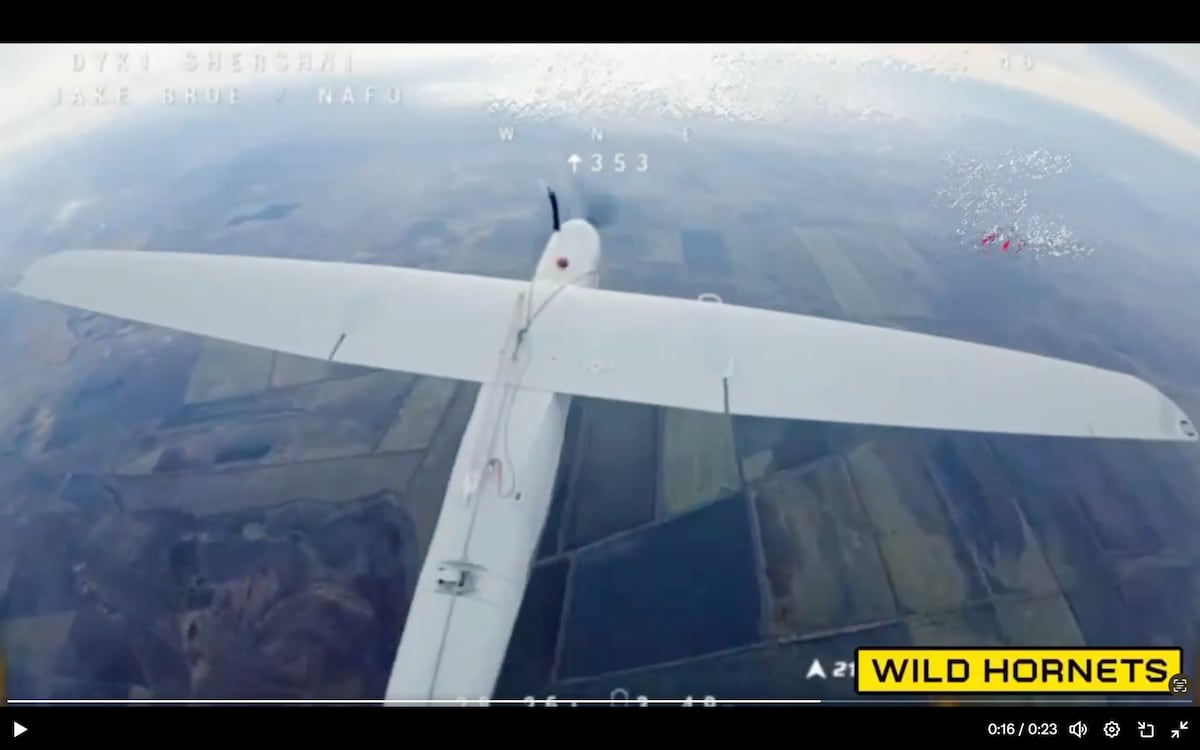
Necessity is the mother of invention, and Ukraine continues to push this adage to new heights of technical and tactical ingenuity in the use of aerial drone technology to fight the Russian invasion.
After having dramatically reshaped the tactical combat on land since their introduction by Ukrainian forces in the spring of 2023, highly maneuverable first-person view (FPV) drones have rapidly become a key asset in Ukraine’s counter-drone efforts as more and more Ukrainian units employ them to intercept Russian fixed-wing reconnaissance drones.
Since May 2024, this author has visually confirmed almost 650 interceptions of this type – mostly taking place at a distance of 1,000-3,000 meters – across the entire frontline using open-source information released by a variety of sources, including social media channels and accounts of Ukrainian units, humanitarian organizations, and more. Similarly, the Tochnyi collective project has recently documented and geolocated more than 850 interceptions of Russian drones by Ukrainian FPVs, further corroborating this trend. The real number of Russian unmanned aerial systems, or UAS, shot down with this technique is likely higher, considering that not all interceptions are recorded or publicly disclosed.
Despite receiving little attention across the mainstream media, Ukraine’s increasingly successful use of FPV drones as C-UAS interceptors is a highly consequential development because it directly removes Russia’s main ISR assets from the battlefield, eroding its forces’ situational awareness as well as ability to detect targets, breaking a key link in the Russian kill-chain.
Without sufficient and persistent “eyes” in the sky, Russia struggles to timely and regularly feed target information to its vast fires arsenal. This, in turn, offers Ukraine some respite from both Russian artillery and missile strikes against a variety of targets, including high-payoff ones at operational depth, such as ground-based air defenses and airfields, that Russia typically attacks with Iskander M tactical ballistic missiles.
This chart shows FVP interceptions of Russian drones over time, per analyst Federico Borsari. (Federico Borsari, CEPA)
At the same time, fewer drones in the skies negatively affect the use of other strike capabilities such as loitering munitions that directly or indirectly depend on live reconnaissance, rapid target acquisition and signal-relay functions. The progressive reduction in documented Lancet strikes in the past three months seems no mere coincidence, as this infamous loitering munition operates in hunter-killer teams with Zala reconnaissance drones from the same manufacturer. This is good news for Ukrainian formations operating along and near the frontline, in particular artillery units, which have suffered significant losses to Lancet strikes. Ukrainian FPV operators even managed to intercept a few Lancets, with 15 cases visually confirmed by this author.
Equally important, shooting down more Russian ISR drones also blunts Russia’s ability to conduct proper battle damage assessment, an essential task that is often overlooked in discussions.
Another major implication is the cost effectiveness and operational flexibility of using FPV drone interceptors, which are cheaper than any other kinetic solution at Ukraine’s disposal and easy to produce, distribute, and deploy even across a dispersed force. While the concept of using drones to kinetically defeat other drones is not new, Kyiv’s forces have been the first to employ it in real combat and at scale. The demand for FPV drones has never been so high and drone manufacturers such as the Wild Hornets along with many private crowdfunding initiatives are delivering thousands of platforms each month to frontline units.
The skyrocketing use of FPV drones has also fueled unprecedented combat experimentation and tactics refinement, resulting in the establishment of specialized FPV air defense units within several Ukrainian brigades and rapid technological iteration cycles. The flip side is that there is at least one human operator behind any single interception, making it a personnel-intensive process dependent on skilled operators. Flying an FPV drone requires extensive training and practice, particularly when conducting high-speed maneuvers or engaging moving targets.
This chart captures the percentage of Russian UAV types intercepted by Ukrainian FPV drones, per analyst Federico Borsari. (Federico Borsari, CEPA)
This is where automated terminal guidance should come into play to significantly expedite and improve the last-mile engagement process. Ukrainian forces are already using automated tools to detect, identify, and track Russian ISR drones, but they now need to integrate scalable AI-enabled computer vision in the terminal phase as Russia deploys more UAS. Such capabilities will also make the FPV drone more resilient against electronic warfare.
NATO and individual allies should take stock of these technological and tactical innovations and invest in drone-based, cost-effective interceptors to complement their C-UAS capabilities.
The analysis of collected data also provides some interesting insights into Russia’s drone capabilities and use as part of its current operations.
First, the Russian military relies on a largely standardized fleet of medium-size reconnaissance UAS for its tactical and operational ISR, centered around three main fixed-wing platforms: the Zala 421, the Supercam 350, and the Orlan family, which comprises the Orlan 10 and 30 variants. The Zala 421 accounts for the vast majority of Ukraine’s FPV-based interceptions (54%), making this model the new workhorse of Russia’s ISR drone fleet, followed by the Supercam (28%) and Orlan 10/30 (12%) family of systems. This standardized approach facilitates drone production on an industrial scale – much larger than the volumes any Western country is currently manufacturing – simplifies training and logistics, and reduces the likelihood of interoperability issues across the Russian military. In this respect, it’s hard not to appreciate the lesson for the United States and NATO allies.
Second, the Russian forces are not standing idly by and are starting to mimic Ukrainian solutions – albeit on a much smaller scale – while also taking precautions to protect their ISR drones from Ukrainian FPVs. Their countermeasures, however, seem to have little success so far. These range from simple camouflage and fake Ukrainian color schemes to more sophisticated tools such as small radio-frequency jammers installed on drones in order to disrupt the video link between the operator and the FPV interceptor as it approaches the Russian UAS. The Russians are also equipping some of their drones with rear-looking wide-angle cameras to detect incoming Ukrainian FPV drones and give the pilot enough time to use evasive maneuvers to avoid the interceptor and escape using its longer endurance. Still, Ukrainian counter-tactics are also evolving and include the launch of tandem interceptors to maximize chances of success and attack Russian drones with fast-ascending maneuvers from below to remain outside the drone cameras’ field of view.
Ukraine’s current advantage in the use of FPV drones is proving critical but may be short-lived as Russia develops new countermeasures.
Federico Borsari is a resident fellow in the Transatlantic Defense and Security program at the Center for European Policy Analysis.
需要是发明之母,乌克兰不断将这句谚语推向技术和战术创新的新高度,利用无人机技术对抗俄罗斯的入侵。
自 2023 年春季乌克兰军队引入以来,高机动性的第一人称视角 (FPV) 无人机极大地改变了陆地战术作战格局,并迅速成为乌克兰反无人机行动的关键资产,越来越多的乌克兰部队使用它们来拦截俄罗斯固定翼侦察无人机。
自2024年5月以来,笔者已通过目视确认了近650起此类拦截事件——大多发生在1000至3000米的距离内——这些事件遍布整个前线,信息来源包括社交媒体渠道、乌克兰部队和人道主义组织的官方账号等。同样,“Tochnyi”集体项目近期也记录并定位了超过850起乌克兰FPV无人机拦截俄罗斯无人机的事件,进一步证实了这一趋势。考虑到并非所有拦截事件都会被记录或公开披露,实际被此类技术击落的俄罗斯无人机数量可能更高。
尽管乌克兰越来越多地成功地使用 FPV 无人机作为反无人机拦截器,但这在主流媒体上却鲜有关注,因为这直接将俄罗斯的主要 ISR 资产从战场上移除,削弱了其部队的态势感知能力和目标探测能力,从而破坏了俄罗斯杀伤链中的一个关键环节。
由于缺乏足够且持续的空中侦察力量,俄罗斯难以及时、定期地向其庞大的火力库提供目标信息。这反过来又使乌克兰得以暂时免受俄罗斯针对各种目标(包括作战纵深的高回报目标,例如地面防空系统和机场)的炮击和导弹袭击,而俄罗斯通常使用“伊斯坎德尔M”战术弹道导弹攻击这些目标。
分析师 Federico Borsari 表示,该图表显示了一段时间内俄罗斯无人机的 FVP 拦截情况。 (费德里科·博尔萨里,CEPA)
与此同时,空中无人机数量的减少也对其他打击能力的使用产生了负面影响,例如巡飞弹,这些能力直接或间接地依赖于实弹侦察、快速目标捕获和信号中继功能。过去三个月记录在案的“柳叶刀”导弹袭击次数的逐步减少似乎并非巧合,因为这种臭名昭著的巡飞弹与同一制造商生产的“扎拉”侦察无人机组成猎杀小组。这对在前线及其附近作战的乌克兰部队,特别是遭受“柳叶刀”导弹袭击而损失惨重的炮兵部队来说,无疑是个好消息。乌克兰的FPV操作员甚至成功拦截了几枚“柳叶刀”导弹,其中15起案例经笔者目视确认。
同样重要的是,击落更多俄罗斯 ISR 无人机也会削弱俄罗斯进行适当战斗损伤评估的能力,这是一项在讨论中经常被忽视的重要任务。
另一个重要意义在于使用FPV无人机拦截器的成本效益和作战灵活性。FPV无人机比乌克兰目前可用的任何其他动能解决方案都更便宜,而且易于生产、分发和部署,即使是分散部署的部队也能轻松应对。虽然使用无人机以动能方式击败其他无人机的概念并不新鲜,但基辅的部队是第一个在实战中大规模运用这一技术的。目前对FPV无人机的需求空前高涨,像“野黄蜂”(Wild Hornets)这样的无人机制造商以及许多私人众筹项目每月都在向前线部队交付数千架无人机。
FPV无人机的爆炸式增长也推动了前所未有的作战试验和战术改进,促使乌克兰多个旅级单位组建了专门的FPV防空部队,并实现了快速的技术迭代。但另一方面,每次拦截行动背后至少需要一名操作员,因此这是一个高度依赖熟练操作人员的密集型过程。驾驶FPV无人机需要大量的训练和练习,尤其是在进行高速机动或攻击移动目标时。
根据分析师费德里科·博尔萨里(Federico Borsari)的数据,这张图表显示了乌克兰FPV无人机拦截的俄罗斯无人机类型百分比。(费德里科·博尔萨里,CEPA)
在此,自动化终端制导将发挥作用,显著加快并改进“最后一公里”作战流程。乌克兰军队目前已在使用自动化工具探测、识别和跟踪俄罗斯情报、监视与侦察(ISR)无人机,但随着俄罗斯部署更多无人机系统(UAS),他们现在需要将可扩展的人工智能计算机视觉技术集成到终端阶段。这些能力还将增强第一人称视角(FPV)无人机抵御电子战的能力。
北约及其盟国应评估这些技术和战术创新,并投资于基于无人机的、经济高效的拦截器,以补充其反无人机系统能力。
对收集到的数据进行分析,也为了解俄罗斯无人机的能力及其在当前行动中的使用提供了一些有趣的见解。
首先,俄罗斯军方主要依靠一套高度标准化的中型侦察无人机系统(UAS)进行战术和作战情报、监视与侦察(ISR)行动,该系统以三种主要的固定翼平台为核心:Zala 421、Supercam 350 和 Orlan 系列(包括 Orlan 10 和 30 型号)。Zala 421 占据了乌克兰大部分基于第一人称视角(FPV)的拦截任务(54%),使其成为俄罗斯 ISR 无人机机队的主力机型,其次是 Supercam(28%)和 Orlan 10/30(12%)系列系统。这种标准化方法有助于大规模工业化生产无人机——其产量远超任何西方国家目前的生产规模——简化了训练和后勤保障,并降低了俄罗斯军方内部出现互操作性问题的可能性。在这方面,美国及其北约盟国无疑可以从中汲取经验教训。
其次,俄军并未袖手旁观,而是开始效仿乌克兰的解决方案——尽管规模小得多——同时采取预防措施,保护其情报、监视和侦察(ISR)无人机免受乌克兰FPV无人机的攻击。然而,迄今为止,他们的反制措施似乎收效甚微。这些措施包括简单的伪装和仿制乌克兰涂装,以及更复杂的工具,例如在无人机上安装小型射频干扰器,以干扰操作员与接近俄罗斯无人机的FPV拦截器之间的视频链路。俄罗斯还在部分无人机上配备了后视广角摄像头,用于探测来袭的乌克兰FPV无人机,以便飞行员有足够的时间进行规避机动,避开拦截器并利用其更长的续航时间逃脱。不过,乌克兰的反制策略也在不断发展,包括发射串联拦截器以最大限度地提高成功几率,以及从下方快速上升机动攻击俄罗斯无人机,以保持在无人机摄像头视野之外。
乌克兰目前在使用FPV无人机方面的优势至关重要,但随着俄罗斯开发新的反制措施,这种优势可能不会持续太久。
Federico Borsari 是欧洲政策分析中心跨大西洋防务与安全项目的常驻研究员。