Stealth destroyer to be home for 1st hypersonic weapon on a US warship隐形驱逐舰将成为美国军舰上首款高超音速武器的母舰。
The U.S. is working to catch up with Russia and China in developing hypersonic weapons that travel beyond Mach 5.
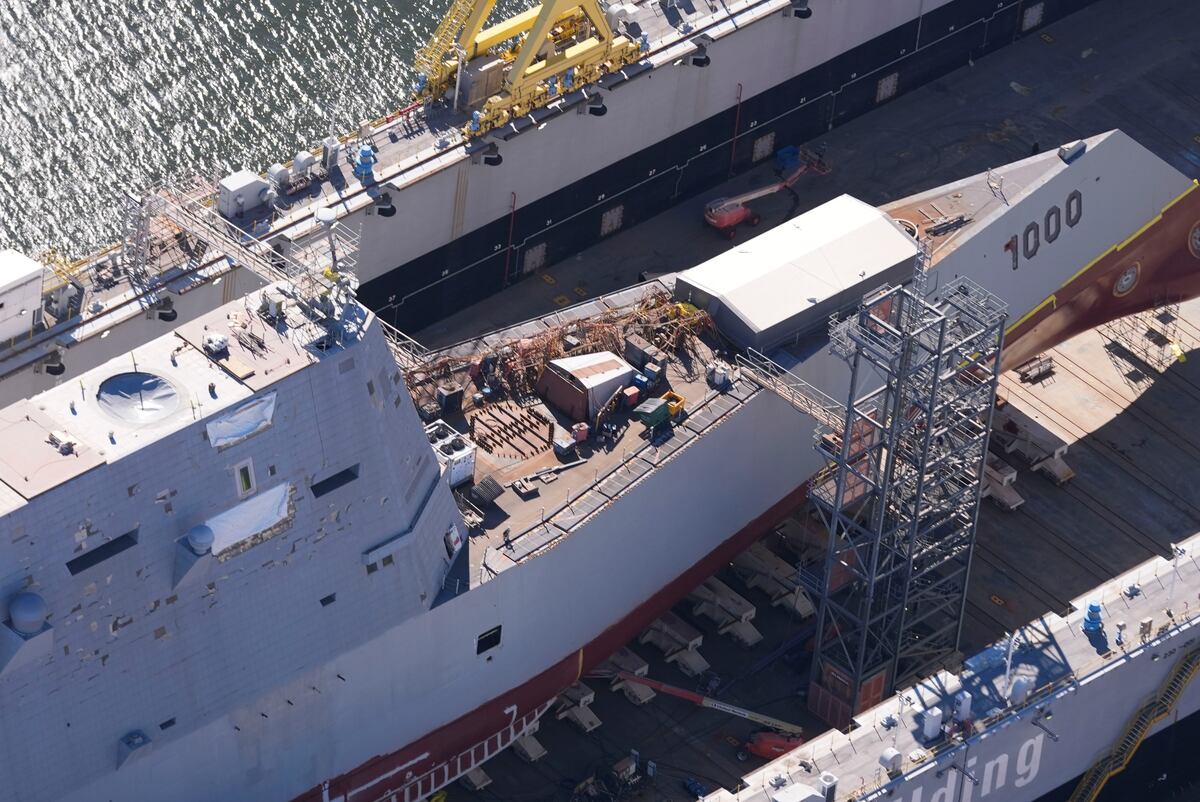
The U.S. Navy is transforming a costly flub into a potent weapon with the first shipborne hypersonic weapon, which is being retrofitted aboard the first of its three stealthy destroyers.
The guided-missile destroyer Zumwalt is at a Mississippi shipyard where workers have installed missile tubes that replace twin turrets from a gun system that was never activated because it was too expensive. Once the system is complete, the Zumwalt will provide a platform for conducting fast, precision strikes from greater distances, adding to the usefulness of the warship.
“It was a costly blunder. But the Navy could take victory from the jaws of defeat here, and get some utility out of them by making them into a hypersonic platform,” said Bryan Clark, a defense analyst at the Hudson Institute.
The U.S. has had several types of hypersonic weapons in development for the past two decades, but recent tests by both Russia and China have added pressure to the U.S. military to hasten their production.
Hypersonic weapons travel beyond Mach 5, five times the speed of sound, with added maneuverability making them harder to shoot down.
Last year, The Washington Post reported that among the documents leaked by former Massachusetts Air National Guard member Jack Teixeira was a Defense Department briefing that confirmed China had recently tested an intermediate-range hypersonic weapon called the DF-27. While the Pentagon had previously acknowledged the weapon’s development, it had not recognized its testing.
One of the U.S. programs in development and planned for the Zumwalt is the “Conventional Prompt Strike.” It would launch like a ballistic missile and then release a hypersonic glide vehicle that would travel at speeds seven to eight times faster than the speed of sound before hitting the target. The weapon system is being developed jointly by the Navy and Army. Each of the Zumwalt-class destroyers would be equipped with four missile tubes, each with three of the missiles for a total of 12 hypersonic weapons per ship.
In choosing the Zumwalt, the Navy is attempting to add to the usefulness of a $7.5 billion warship that is considered by critics to be an expensive mistake despite serving as a test platform for multiple innovations.
The Zumwalt was envisioned as providing land-attack capability with an Advanced Gun System with rocket-assisted projectiles to open the way for Marines to charge ashore. But the system featuring 155mm guns hidden in stealthy turrets was canceled because each of the rocket-assisted projectiles cost between $800,000 and $1 million.
Despite the stain on its reputation, the three Zumwalt-class destroyers remain the Navy’s most advanced surface warship in terms of new technologies . Those innovations include electric propulsion, an angular shape to minimize radar signature, an unconventional wave-piercing hull, automated fire and damage control and a composite deckhouse that hides radar and other sensors.
The Zumwalt arrived at the Huntington Ingalls Industries shipyard in Pascagoula, Mississippi, in August 2023 and was removed from the water for the complex work of integrating the new weapon system. It is due to be undocked this week in preparation for the next round of tests and its return to the fleet, shipyard spokeswoman Kimberly Aguillard said
A U.S. hypersonic weapon was successfully tested over the summer and development of the missiles is continuing. The Navy wants to begin testing the system aboard the Zumwalt in 2027 or 2028, according to the Navy.
The U.S. weapon system will come at a steep price. It would cost nearly $18 billion to buy 300 of the weapons and maintain them over 20 years, according to the Congressional Budget Office.
Critics say there is too little bang for the buck.
“This particular missile costs more than a dozen tanks. All it gets you is a precise non-nuclear explosion, some place far, far away. Is it really worth the money? The answer is most of the time the missile costs much more than any target you can destroy with it,” said Loren Thompson, a longtime military analyst in Washington, D.C.
But they provide the capability for Navy vessels to strike an enemy from a distance of thousands of kilometers — outside the range of most enemy weapons — and there is no effective defense against them, said retired Navy Rear Adm. Ray Spicer, CEO of the U.S. Naval Institute, an independent forum focusing on national security issues, and former commander of an aircraft carrier strike force.
Conventional missiles that cost less aren’t much of a bargain if they are unable to reach their targets, Spicer said, adding the U.S. military really has no choice but to pursue them.
“The adversary has them. We never want to be outdone,” he said.
The U.S. is accelerating development because hypersonics have been identified as vital to U.S. national security with “survivable and lethal capabilities,” said James Weber, principal director for hypersonics in the Office of the Assistant Secretary of Defense for Critical Technologies.
“Fielding new capabilities that are based on hypersonic technologies is a priority for the defense department to sustain and strengthen our integrated deterrence, and to build enduring advantages,” he said.
美国海军正在将一次代价高昂的失误转化为一种强大的武器,首款舰载高超音速武器正在其三艘隐形驱逐舰中的第一艘上进行改装。
导弹驱逐舰“朱姆沃尔特”号目前停泊在密西西比州的一家造船厂,工人们正在安装导弹发射管,以取代原先因造价过高而从未启用的双联装舰炮系统。该系统安装完毕后,“朱姆沃尔特”号将具备从更远距离进行快速、精确打击的能力,从而提升这艘战舰的作战效能。
“这是一个代价惨重的错误。但海军可以从失败的边缘扭转局面,通过将它们改造成高超音速平台来获得一些利用价值,”哈德逊研究所的国防分析师布莱恩·克拉克说。
过去二十年来,美国一直在研发多种类型的高超音速武器,但俄罗斯和中国最近的试验给美国军方带来了更大的压力,迫使其加快高超音速武器的生产。
高超音速武器的飞行速度超过 5 马赫(音速的五倍),并且具有更高的机动性,因此更难被击落。
去年,《华盛顿邮报》报道称,前马萨诸塞州空军国民警卫队成员杰克·特谢拉泄露的文件中包含一份国防部简报,证实中国近期测试了一种名为东风-27的中程高超音速武器。虽然五角大楼此前已承认该武器的研发,但并未承认其测试。
美国正在研发并计划为“朱姆沃尔特”级驱逐舰配备的武器系统之一是“常规快速打击”。该系统将像弹道导弹一样发射,然后释放一枚高超音速滑翔飞行器,该飞行器将以七到八倍音速的速度飞行,最终击中目标。该武器系统由海军和陆军联合研发。每艘“朱姆沃尔特”级驱逐舰将配备四个导弹发射管,每个发射管装有三枚导弹,每艘舰艇共计12枚高超音速武器。
海军选择“朱姆沃尔特”号,意在提升这艘价值 75 亿美元的军舰的实用性。尽管这艘军舰作为多项创新技术的试验平台,但批评人士认为它仍然是一个昂贵的错误。
“朱姆沃尔特”级战列舰最初的设计理念是配备先进火炮系统,利用火箭助推炮弹为陆上攻击开辟道路,从而为海军陆战队登陆作战创造条件。然而,由于每枚火箭助推炮弹的成本高达80万至100万美元,这套配备隐藏在隐蔽炮塔内的155毫米火炮的系统最终被取消。
尽管声名狼藉,但三艘朱姆沃尔特级驱逐舰在新技术方面仍然是海军最先进的水面战舰。这些创新包括电力推进、旨在最大限度降低雷达反射截面积的棱角分明的舰体、非常规的穿浪船体、自动化的火灾和损管系统,以及隐藏雷达和其他传感器的复合材料甲板室。
朱姆沃尔特级驱逐舰于2023年8月抵达位于密西西比州帕斯卡古拉的亨廷顿·英格尔斯工业造船厂,并被吊出水面进行复杂的新武器系统集成工作。造船厂发言人金伯利·阿吉拉德表示,该舰将于本周出水,为下一轮测试和重返舰队做准备。
美国高超音速武器于今年夏季成功试射,导弹研发工作仍在继续。据海军方面称,海军计划于2027年或2028年开始在“朱姆沃尔特”号航母上进行该系统的测试。
美国这套武器系统价格不菲。据国会预算办公室估计,购买300套该型武器并维持20年,总成本将近180亿美元。
批评人士认为性价比太低。
“这枚导弹造价超过十几辆坦克。它所能做的只是在遥远的地方造成一次精确的非核爆炸。它真的值这个价吗?答案是,大多数情况下,导弹的成本远远超过它所能摧毁的任何目标,”华盛顿特区资深军事分析家洛伦·汤普森说道。
但它们使海军舰艇能够从数千公里外打击敌人——超出大多数敌方武器的射程——而且没有有效的防御手段,美国海军学会首席执行官、专注于国家安全问题的独立论坛成员、前航空母舰打击部队指挥官、退役海军少将雷·斯派塞表示。
斯派塞表示,如果无法击中目标,那么成本较低的常规导弹就谈不上划算,他还补充说,美国军方实际上别无选择,只能继续研发这些导弹。
“对手掌握了这些信息。我们绝不想落后于人,”他说。
美国正在加快高超音速武器的研发,因为高超音速武器已被认定为对美国国家安全至关重要,具有“生存能力和致命能力”,国防部负责关键技术的助理部长办公室高超音速武器首席主任詹姆斯·韦伯表示。
他说:“部署基于高超音速技术的新能力是国防部的优先事项,目的是维持和加强我们的综合威慑,并建立持久优势。”