Here’s what’s in the Corps’ new training and education plan以下是海军陆战队新的训练和教育计划的内容。
New ranges, tougher swimming. Inside the Corps' new training blueprint.
Lt. Col. Clinton Hall enlisted in the Marine Corps in December 1997, midway through a first semester in college that wasn’t going well.
He went through boot camp — right at the time the Marine Corps was rolling out the final boot camp event, the Crucible, at recruit training — and then infantry school. Hall went on two deployments and became a scout sniper.
After getting out of the Marine Corps and working in security for several months, and not liking it very much, he reenlisted. On his second enlistment, he filed an application for the Marine Corps Enlisted Commissioning Education Program.
“I chose to apply for a commission because I recognized that the chain of command quickly departs from the enlisted ranks and runs through officers,” he said in a recent news release. “My ability to make an impact would be best realized as an officer.”
Hall received his commission, and, newly an officer, the infantryman reported to 1st Battalion, 5th Marine Regiment, 1st Marine Division, in 2007.
“It was rewarding but also somewhat like a daunting task,” he told Marine Corps Times. “Like, ‘Oh, now there’s more expectation. There’s more responsibility.’ So there’s also a little bit of increased weight of what you must do, but also the training has been proven over multiple decades, if not centuries, on how to prepare our young officers.”
His training and education didn’t end with The Basic School or Infantry Officer Course. He went on to the Marine Corps University’s Expeditionary Warfare School and the Army’s Command and General Staff College.
“It’s vital,” he said of professional military education. “It makes one just pause for a minute and then think and reflect and broaden their horizons.”
Now, Hall is the commanding officer of 2nd Battalion, 5th Marine Regiment — the same regiment he started out in.
In coming years, it’s likely that more Marines than before will have opportunities like Hall’s, from enlisted-to-officer commissioning programs to professional military education. That’s just one component of the Marine Corps’ new training and education plan.
The Marine Corps is in the middle of a sweeping modernization effort, called Force Design 2030, particularly aimed at adapting the service to a potential conflict with adversaries like the Chinese military. But the Corps has acknowledged that its current training and education aren’t sufficient to prepare Marines for that modernization.
That’s where Training and Education 2030 comes in. The planning document, released in January, looks to address some of the gaps in the preparation Marines receive.
It calls for new doctrine on topics like drone and cyber operations. It emphasizes the role of training simulators for even junior Marines. And, taking “every clime and place” to heart, it indicates the Corps needs to find new training grounds (Alaska, anyone?) and double down on swimming skills.
Other initiatives, like increasing the number of seats in ongoing education and enlisted-to-officer programs, are supposed to give Marines incentives to stay in. That has been a top priority for the Corps in recent years: retaining Marines in the right jobs so that they’re prepared for increasingly complex modern warfare.
“We must transform our training and education continuum,” Lt. Gen. Kevin Iiams, commander of Training and Education Command, said in a news release. “We owe it to our Marines and the American people as the premier force in readiness.”
Lace up your intense cold weather boots: The Marine Corps is considering training its troops in Alaska.
In the training planning document, the service notes the need to explore options to expand “unit and service-level training into Alaska” and whether the service requires a more permanent presence there.
Included in the report is a direction to analyze whether the cold, remote environment of Alaska could offer Marines a new style of terrain they have not regularly had the opportunity to train with.
Currently, the Marine Corps Mountain Warfare Training Center in Bridgeport, California , is one of the only installations to offer Marines training in mountainous, cold-weather environments.
Iiams said during a roundtable event with reporters at the Pentagon in January, “Our cold weather training range up at … Bridgeport, while large, is nowhere near as large as the training ranges in Alaska.”
“You can put much larger forces into the field and exercise them then we can at our small training facility ... at Bridgeport.”
Marines also have conducted cold-weather training on deployments to Norway.
Lace up your intense cold weather boots: The Marine Corps is considering training its troops in Alaska. (Staff Sgt. Sean Callahan/Army)
“The current T&E system is not preparing the Marine Corps for the future operating environment,” the report said, noting that Marines need to be better equipped to handle all types of domains.
With a renewed focus on the Indo-Pacific, and continual threats from countries like Russia, North Korea and China, the service is eager to resolve that dilemma.
“Every clime, every place,” Col. Mark Smith, the director of Training and Education Command’s Range Training Programs Division, said at the roundtable.
A further timeline on when the evaluation of using Alaska for Marine Corps training purposes has yet to be announced, though Iiams said at the roundtable that an annual update on the training report, similar to the other planning documents, is likely.
Further changes to ranges and training areas for Marines — including guidance on updates to various education courses offered — were laid out in another recent report, called Installations and Logistics 2030.
By April, the Marine Corps says it will “identify supplemental ranges, training areas, and federated [virtual simulator] venues” to offer all types of training for troops, the training document notes.
Service leaders are especially interested in using high-tech simulators as a modern means of training troops and are looking to operationalize what they call Project Tripoli to connect Marine Corps, joint and partnered nation units around the globe.
“If we think Marines will encounter either an enemy capability or a situation on tomorrow’s battlefield, then we want to ensure our Marine experiences it first within our training environments,” Col. Mark Smith, Director, Range Training Program Division, said in a statement to Marine Corps Times. “It’s the old saying of ‘a pint of sweat will save a gallon of blood.’”
Live-fire training is vital, Smith said, but it’s also limited by safety constraints and the lack of a free-thinking enemy. Advanced weapon systems come with additional complications because of the long ranges or the effects of the munition, he added.
Marines across installations will be able to jump into a virtual space and interact with one another in order to practice simulated missions, according to Iiams, meaning a lance corporal wearing ocular lenses on a range somewhere can look up and see a plane flying overhead operated by a pilot using another simulator.
The training document notes that the Corps will have a cost estimate for the project by March and that it will be fully employed by September 2024.
The report also calls out the need to evaluate the service’s airspace needs in support of expanded training across its installations.
A “rigorous” advanced rifle qualification course after entry-level training is being piloted and is “progressing toward full operational capability,” Col. Eric Quehl, Training and Education Command’s director for policy and standards, shared in other training news from the roundtable.
A servicewide memo in February added that a plan that supports implementing an advanced marksmanship training program throughout the infantry training continuum will also be developed.
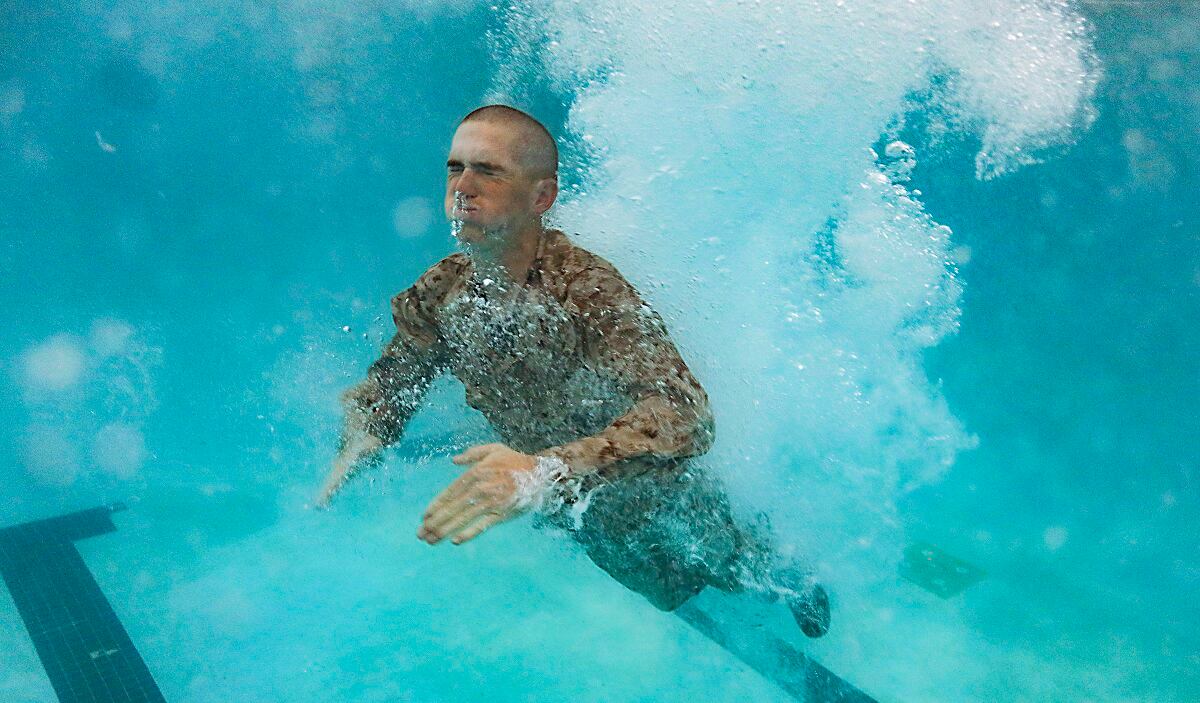
Marines are soon going to need to pull out their goggles and brush up on their breaststroke.
“All Marines should expect the standards to be elevated and require additional training in the water,” the planning document said.
Included in the report is a direction for updated Marine Corps Water Survival Training policies.
“What we have found through our analysis is that we need to get Marines more comfortable in the water,” Quehl said.
“So what can Marines expect out of this? We’re definitely going to have some more rigorous training,” he said, adding the changes to standards will likely take place in the next six to eight months.
Marines across all military occupational specialties, from entry-level troops through the fleet Marine force, can expect their standards to be reevaluated, Quehl said, but troops serving as assault amphibian operators or pilots can expect still higher qualification requirements. His team even explored the possibility of further training in the open water as a regular, repeatable training exercise, he said.
“Modern equipment and manpower models go a long way, but Training and Education 2030 enables the critical final steps for creating a smarter, more capable, more lethal force,” Commandant Gen. David Berger said in a press release about the new document.
The report directs an update on water-training policies to be published in May and for the deputy commandant for installations and logistics to develop a list of water-training facilities required to be built or modified for the expansion of swim training by June.
As the military shifts its focus from operating in the desert environment of the Middle East and Afghanistan to the Indo-Pacific, Marine leaders want to ensure troops are prepared to handle an aquatic environment.
“We actually want to build confidence and capability in the water, so they are ready for the Pacific theater,” Iiams said during the roundtable.
The move for revised water safety standards comes following concern over the swimming abilities of the force.
In 2022, at least two Marines drowned during recreational swimming, and another drowned during a training incident, Marine Corps Times previously reported from Naval Safety Center data.
The Marine Corps also is planning to look closely at the professional military education it offers, including to sailors.
The Marine Corps University, in Quantico, Virginia, has in recent years placed increased emphasis on naval warfighting, according to the training report. That comes as the Corps is focusing more on amphibious operations that require greater green-blue integration.
If it’s offering more content related to the Navy, Marine Corps University should have more faculty and students from the Navy, the report says.
The Corps also is launching an assessment of the university faculty and “provide recommendations for changes in resourcing, policies, or structure.” Meanwhile, the fleet will offer feedback to the university and other professional military education institutions about the curricula they offer.
“As we prepare for the future fight, we need Marines who possess the intellectual ability to out-think their adversaries,” the report states. “We hone this ability through deep and active engagement with the brightest minds and the most challenging material, which forces Marines to contend with their assumptions, perceptions, and concepts.”
The Corps will expand the number of slots at professional military education schools, as well as “special duty assignment opportunities, Army Airborne school quotas, degree completion and certification programs, retraining in another primary MOS (PMOS), and enlisted-to-officer commissioning programs.”
In fiscal year 2022, 187 officer accessions came from enlisted-to-officer commission programs, according to spokeswoman Yvonne Carlock. The Corps is looking at increasing that number to 279 in fiscal year 2023.
Historically, enlisted-to-officer programs have accounted for approximately 10% of Marine officer accessions, Carlock said. Although the service hasn’t settled on targets for fiscal year 2024, it anticipates the percentage to remain well above 10%.
Marine Corps leaders said they are hopeful the updates to training and education will not only create a better prepared force but also encourage more Marines to stay in or join the service.
Sgt. Daisy Swiney, 21, told Marine Corps Times moments after reenlisting early at a ceremony in February that she became a Marine to give herself a better future.
She started out as a food service specialist. But, after standing out from her peers and receiving additional training, Swiney became the legal chief and national color bearer. In July 2024, she heads to drill instructor school, one of her longtime goals. A proud Marine, she said she’s excited to make future Marines.
In total, the Corps is looking to retain at least roughly 12,000 active-duty service members this fiscal year and another roughly thousand Reserve troops, according to spokesman Maj. Jordan Cochran.
“The Marine Corps is on-track to exceed its aggregate retention mission and much earlier than [last fiscal year]. “We’ll use the remainder of ... this year to target reenlistments within key skills that still have retention or lateral move opportunities, some of which have very substantial available bonuses.”
In February, the service already met its infantry reenlistment goals, and first-term retention of top-performing Marines was up 72%. The Marine Corps also plans to recruit 28,900 active-duty enlisted Marines over the course of this fiscal year, Cochran said. That is about 300 more service members than it recruited last fiscal year. It additionally aims to bring in 5,093 new Reserve troops, also higher than the accession target it met in 2022 of 4,602 enlisted troops.
The Corps already is planning for its fiscal year 2024 retention campaign, which will begin on the first day of June, according to a Feb. 6 memo.
Hall, the prior-enlisted lieutenant colonel, said that he thinks most Marines want the opportunity to deepen their knowledge of their military occupational specialties, as well as broaden their horizon. That kind of ongoing education makes Marines more likely to stay in. “Marines like to be challenged,” he said. ■
克林顿·霍尔中校于 1997 年 12 月加入海军陆战队,当时他的大学第一学期过半,而且学业并不顺利。
他参加了新兵训练营——当时海军陆战队正在新兵训练中推出最后的训练项目“熔炉”——然后又去了步兵学校。霍尔曾两次被派往海外作战,并成为了一名侦察狙击手。
从海军陆战队退役后,他做了几个月的保安,但不太喜欢这份工作,于是又重新入伍。第二次入伍时,他申请了海军陆战队士官委任教育计划。
“我选择申请军官委任,是因为我意识到指挥链很快就会从士兵层级向下延伸到军官层级,”他在最近的一份新闻稿中说道。“作为一名军官,我才能最大程度地发挥我的影响力。”
霍尔获得了委任状,成为一名新晋军官后,这位步兵于 2007 年向第一海军陆战师第五海军陆战团第一营报到。
“这既令人欣慰,也颇具挑战性,”他告诉《海军陆战队时报》。“就像,‘哦,现在期望更高了,责任也更大了。’所以,你必须做的事情也更重了,但几十年来,甚至几个世纪以来,这种训练方式已经证明了它对于培养年轻军官的有效性。”
他的训练和教育并没有止步于基础学校或步兵军官课程。他还继续深造,进入海军陆战队大学远征作战学校和陆军指挥与参谋学院。
“这至关重要,”他谈到职业军事教育时说。“它能让人停下来思考片刻,然后进行反思,拓宽视野。”
现在,霍尔是海军陆战队第5团第2营的指挥官——而这正是他最初加入的团。
未来几年,可能会有比以往更多的海军陆战队员拥有像霍尔这样的机会,从士兵晋升军官的委任计划到专业的军事教育。这只是海军陆战队新训练和教育计划的一个组成部分。
美国海军陆战队正在进行一项名为“2030部队设计”的全面现代化计划,其主要目标是使该部队适应与中国军队等对手可能发生的冲突。但海军陆战队也承认,目前的训练和教育不足以使海军陆战队员为这项现代化计划做好准备。
这就是“2030年训练与教育计划”的意义所在。这份于1月份发布的规划文件旨在解决海军陆战队员训练准备方面的一些不足。
它呼吁制定无人机和网络作战等领域的新理论。它强调了训练模拟器在海军陆战队训练中的作用,即使是对初级海军陆战队员也是如此。而且,它认真考虑“各种气候和地点”,指出海军陆战队需要寻找新的训练场地(比如阿拉斯加?),并加倍重视游泳技能。
其他举措,例如增加继续教育和士官晋升军官项目的名额,旨在激励海军陆战队员留队。近年来,海军陆战队一直将留住合适的海军陆战队员作为首要任务,以确保他们能够应对日益复杂的现代战争。
“我们必须改革我们的训练和教育体系,”训练与教育司令部司令凯文·伊姆斯中将在新闻稿中表示。“作为一支战备状态一流的部队,我们有责任为我们的海军陆战队员和美国人民做到这一点。”
系好你的御寒靴:海军陆战队正在考虑在阿拉斯加训练部队。
在训练计划文件中,该部门指出需要探索将“单位和服务级别的训练扩展到阿拉斯加”的方案,以及该部门是否需要在那里设立更永久的驻地。
报告中包含一项指示,即分析阿拉斯加寒冷偏远的环境是否能为海军陆战队员提供一种他们以前没有机会进行训练的新型地形。
目前,位于加利福尼亚州布里奇波特的美国海军陆战队山地作战训练中心是为数不多的几个能够为海军陆战队员提供在山区寒冷气候环境下进行训练的基地之一。
伊姆斯在1月份于五角大楼与记者举行的圆桌会议上说:“我们在布里奇波特的寒冷天气训练场虽然很大,但远不及阿拉斯加的训练场大。”
“你们可以在战场上投入比我们位于布里奇波特的小型训练基地多得多的兵力进行演习。”
海军陆战队员也曾在部署到挪威期间进行过寒冷气候训练。
系好你的御寒靴:美国海军陆战队正在考虑在阿拉斯加进行部队训练。(陆军参谋军士肖恩·卡拉汉/陆军)
报告指出,“目前的测试与评估体系无法让海军陆战队为未来的作战环境做好准备”,并强调海军陆战队员需要更好地装备自己,以应对各种类型的领域。
随着对印太地区的重新关注,以及来自俄罗斯、朝鲜和中国等国家的持续威胁,该部门渴望解决这一困境。
“无论何种气候,无论何处,”训练与教育司令部靶场训练项目部主任马克·史密斯上校在圆桌会议上说道。
关于何时对使用阿拉斯加进行海军陆战队训练目的进行评估的进一步时间表尚未公布,不过伊姆斯在圆桌会议上表示,可能会像其他规划文件一样,每年更新一次训练报告。
另一份名为《2030 年设施和后勤》的近期报告进一步阐述了海军陆战队靶场和训练区域的变更,包括对各种教育课程的更新指导。
海军陆战队表示,到 4 月份,它将“确定补充靶场、训练区域和联合[虚拟模拟器]场所”,以便为部队提供各种类型的训练,训练文件指出。
各军种领导人对使用高科技模拟器作为训练部队的现代化手段特别感兴趣,并希望将他们所谓的“的黎波里计划”付诸实施,以连接全球各地的海军陆战队、联合部队和伙伴国家部队。
“如果我们认为海军陆战队员在未来的战场上会遇到敌方能力或某种情况,那么我们希望确保我们的海军陆战队员首先在训练环境中体验到这些情况,”靶场训练项目部主任马克·史密斯上校在给《海军陆战队时报》的一份声明中说。“正如那句老话所说,‘一滴汗能省一加仑血’。”
史密斯表示,实弹训练至关重要,但也受到安全限制以及缺乏自由思考的敌人的制约。他还补充说,先进武器系统由于射程远或弹药效应等原因,会带来额外的复杂性。
据伊亚姆斯称,各个基地的海军陆战队员将能够进入虚拟空间并相互互动,以练习模拟任务,这意味着在某个靶场上戴着目镜的下士可以抬头看到一架飞机从头顶飞过,而这架飞机是由使用另一个模拟器的飞行员操控的。
培训文件指出,陆军工程兵团将在 3 月份完成该项目的成本估算,并将于 2024 年 9 月全面投入使用。
该报告还指出,需要评估该部门的空域需求,以支持其各设施扩大训练规模。
训练与教育司令部政策与标准主管埃里克·奎尔上校在圆桌会议的其他训练新闻中分享说,一项“严格的”高级步枪资格课程在入门级训练后正在试行,并且“正朝着全面作战能力迈进”。
二月份的一份全军备忘录补充说,还将制定一项计划,以支持在整个步兵训练过程中实施高级射击训练计划。
海军陆战队员很快就需要戴上泳镜,重新练习蛙泳了。
“所有海军陆战队员都应该预料到标准会提高,并且需要在水上进行额外的训练,”规划文件指出。
报告中包含了更新海军陆战队水上生存训练政策的方向。
“我们的分析发现,我们需要让海军陆战队员在水中更加适应,”奎尔说。
“那么海军陆战队员们能从中期待些什么呢?我们肯定会面临更严格的训练,”他说道,并补充说,标准的改变可能会在未来六到八个月内发生。
奎尔表示,从新兵到海军陆战队舰队,所有海军陆战队员的军事职业标准都将重新评估,但担任两栖突击车操作员或飞行员的士兵将面临更高的资格要求。他还说,他的团队甚至探讨了在开阔水域进行进一步训练的可能性,将其作为一项常规的、可重复的训练演习。
“现代化的装备和人力资源模式固然重要,但《2030 年训练与教育》能够实现打造一支更智能、更有能力、更致命的部队的关键最后步骤,”司令官大卫·伯杰将军在一份关于这份新文件的新闻稿中说道。
该报告指示在 5 月份发布有关水上训练政策的更新,并指示设施和后勤副司令在 6 月份之前制定一份水上训练设施清单,以扩大游泳训练规模,这些设施需要建造或改造。
随着美军将作战重心从中东和阿富汗的沙漠环境转移到印太地区,海军陆战队领导人希望确保部队做好应对水生环境的准备。
“我们实际上希望增强他们在水上的信心和能力,以便他们为太平洋战区做好准备,”伊姆斯在圆桌会议上说。
此次修订水上安全标准的举措源于对警员游泳能力的担忧。
据《海军陆战队时报》此前援引海军安全中心的数据报道,2022年至少有两名海军陆战队员在休闲游泳时溺水身亡,另有一名海军陆战队员在训练事故中溺水身亡。
海军陆战队也计划仔细审视其提供的专业军事教育,包括对水兵的教育。
根据训练报告,位于弗吉尼亚州匡蒂科的海军陆战队大学近年来更加重视海军作战。这与海军陆战队日益关注需要更强绿蓝协同作战能力的两栖作战行动密切相关。
报告称,如果海军陆战队大学提供的课程内容与海军相关,那么它就应该有更多来自海军的教职员工和学生。
海军陆战队还将对大学师资队伍进行评估,并“就资源配置、政策或结构方面的改进提出建议”。与此同时,舰队将就大学和其他专业军事教育机构提供的课程设置提供反馈意见。
报告指出:“在为未来战争做准备的过程中,我们需要具备超越对手的智力能力的海军陆战队员。我们通过与最杰出的头脑和最具挑战性的资料进行深入而积极的交流来磨练这种能力,这迫使海军陆战队员重新审视他们的假设、认知和概念。”
海军陆战队将扩大专业军事教育学校的招生名额,以及“特殊任务分配机会、陆军空降兵学校配额、学位完成和认证计划、其他主要军事职业专长 (PMOS) 的再培训,以及士兵晋升军官计划”。
据发言人伊冯娜·卡洛克称,2022财年,共有187名军官通过士兵转军官委任计划加入海军陆战队。海军陆战队计划在2023财年将这一数字增加到279人。
卡洛克表示,历史上,通过士兵晋升军官计划招收的海军陆战队军官约占总人数的10%。虽然海军陆战队尚未确定2024财年的目标,但预计这一比例仍将远高于10%。
海军陆战队领导人表示,他们希望训练和教育的更新不仅能打造一支准备更充分的部队,还能鼓励更多海军陆战队员留在部队或加入部队。
21 岁的中士黛西·斯威尼 (Daisy Swiney) 在 2 月份的一次仪式上提前续签服役合同后不久告诉《海军陆战队时报》,她成为一名海军陆战队员是为了给自己一个更美好的未来。
她最初是一名餐饮服务专员。但凭借出色的表现和额外的培训,斯威尼成为了法律主管和国家旗手。2024年7月,她将前往新兵训练学校,这是她长久以来的目标之一。作为一名自豪的海军陆战队员,她说她很期待培养未来的海军陆战队员。
据发言人乔丹·科克伦少校称,海军陆战队希望在本财政年度保留至少约 12,000 名现役军人和约 1,000 名预备役军人。
“海军陆战队有望提前完成总体留任目标,比上个财政年度提前得多。我们将利用今年剩余的时间,重点争取那些仍有机会留任或横向调动的关键技能人员续签合同,其中一些职位还提供非常丰厚的奖金。”
今年2月,海军陆战队已提前完成步兵续签目标,表现优异的海军陆战队员首期服役留任率也提高了72%。科克伦表示,海军陆战队还计划在本财年招募28900名现役士兵,比上财年招募人数多出约300人。此外,海军陆战队还计划招募5093名新预备役士兵,这一数字也高于2022年设定的4602人的入伍目标。
根据 2 月 6 日的一份备忘录,陆军工程兵团已经在为 2024 财年的留任活动做准备,该活动将于 6 月 1 日开始。
曾任海军陆战队中校的霍尔表示,他认为大多数海军陆战队员都渴望有机会加深对自身军事职业专长的了解,并拓宽视野。这种持续的教育能提高海军陆战队员的留队率。“海军陆战队员喜欢接受挑战,”他说。■