Sanctions further delay Russian missile early warning program in space制裁进一步延缓了俄罗斯太空导弹预警计划的实施。
Russia wants at least 10 Tundra satellites in high-elliptical orbit to support its ballistic missile-tracking capabilities.
MOSCOW — Russia launched its sixth Tundra early warning satellite in November and has four more to go before reaching its goal of 10 total by 2024. But sources say production problems and sanctions are among the issues delaying the space program .
The Defence Ministry’s Kupol constellation of satellites — an integrated space-based detection and combat control system — was designed to help the country track ballistic missile launches. Also known as EKS, Kupol serves as a replacement to the Soviet-era Oko and Oko-1 systems, which were operational from 1982 to 2019.
Russia wants at least 10 Tundra satellites in high-elliptical orbit — as well as a number of geostationary satellites — to support EKS. In late 2016, then-First Deputy Commander of the Aerospace Forces Lt. Gen. Pavel Kurachenko said the service planned to have all 10 in orbit by 2020.
But that year, the government-published newspaper Rossiyskaya Gazeta reported the Defence Ministry had plans to deploy a total of 10 by 2022. And around the same time as that report, a ministerial newspaper cited the commander of the Russian Aerospace Forces, then-Col. Gen. Sergei Surovikin, as saying the deployment of a group of orbital spacecraft for EKS is envisaged by 2024.
“The launch rate will be dictated by the need to replace aging or defunct satellites,” according to Bart Hendrickx, a longtime observer of Russia’s space program. “The minimum constellation they need for round-the-clock coverage is four. But it’s always good to have some redundancy, not only to safeguard against satellite malfunctions but also to reduce the chance of false alarms.”
Following the launch of the fourth Tundra satellite in May 2020, the general director of local aerospace company Energia announced the EKS constellation had reached “the minimum standard strength.”
While development of the EKS system began in 2000, it wasn’t until seven years later that the government signed a contract with Energia to supply the system. But repeated changes by the ministry to tactical and technical requirements caused production delays, according to the company.
Hendrickx said the main reason for delays “must be production issues.”
“And one can be fairly sure that these have to do largely with the sanctions,” he told Defense News, referring to economic restrictions placed on Russia as a result of its ongoing invasion of Ukraine .
Russia launched its first Tundra satellite in November 2015 on a Soyuz-2.1b rocket with a Fregat upper stage. The country planned to launch two satellites per year, but only launched one each in 2017, 2019, 2020, 2021 and 2022.
A Soyuz-2.1b rocket carrying a Russian meteorological satellite lifts off near the Russia city of Uglegorsk on Nov. 28, 2017. (Kirill Kudryavtsev/AFP via Getty Images)
Part of the production problem involves microelectronics, which are critical for satellites. Russia is heavily dependent on foreign components for space technology, which in and of itself causes delays, a manager of a Russian defense company told Defense News.
“Due to constant changes in suppliers and components, it is necessary to conduct new tests of systems every time, and evaluate them for the required characteristics of the Defence Ministry. This entails delays,” the source said, speaking on the condition of anonymity due to the sensitivity of the topic.
“At first it was Western electronics; after 2014, it became electronics from China and Southeast Asia to a greater extent,” the source said. “In some cases, Chinese devices were purchased, from which microelectronics were extracted and installed on Russian devices.”
In January, the head of Russian space agency Roscosmos , Yuriy Borisov, claimed that despite Western sanctions preventing the supply of microelectronics to the country, China has agreed to sell components meant for rocket and space-related technology. As for completely replacing foreign equipment on satellites, Nikolai Sevostyanov, adviser to the director general of Roscosmos, estimated it will take at least five years.
Another issue for the Russian government is the quality of the Soyuz-2.1b rocket’s Fregat upper stage, which has encountered at least five technical problems over the past nine years.
Pavel Luzin , an independent expert on space militarization, said it’s unlikely Russia will deploy the entirety of Tundra satellites by 2024.
“Rather, one launch per year will be continued. That is, they will complete the launch of satellites into the Molniya orbit no earlier than 2026,” he predicted, referring to a medium Earth orbit best for observing high latitudes.
According to NASA, a satellite in that orbit takes 12 hours to complete its orbit, but spends about eight hours of that over one hemisphere. In the Molniya orbit, a satellite moves in an extreme ellipse with the Earth close to one edge.
An integrated space system, like the EKS, performs best with satellites both in a high-elliptical orbit and a geostationary one. According to Surovikin, “the deployment of a high-orbit space reconnaissance system should begin from 2023.”
But Russian production of geostationary satellites is lagging behind other advanced nations. In Energia’s annual report for 2017, the company suggested the satellites were still in their design stage.
“Geostationary satellites seem to have a different payload and may even have a fundamentally different design. That may also be causing problems,” Hendrickx said.
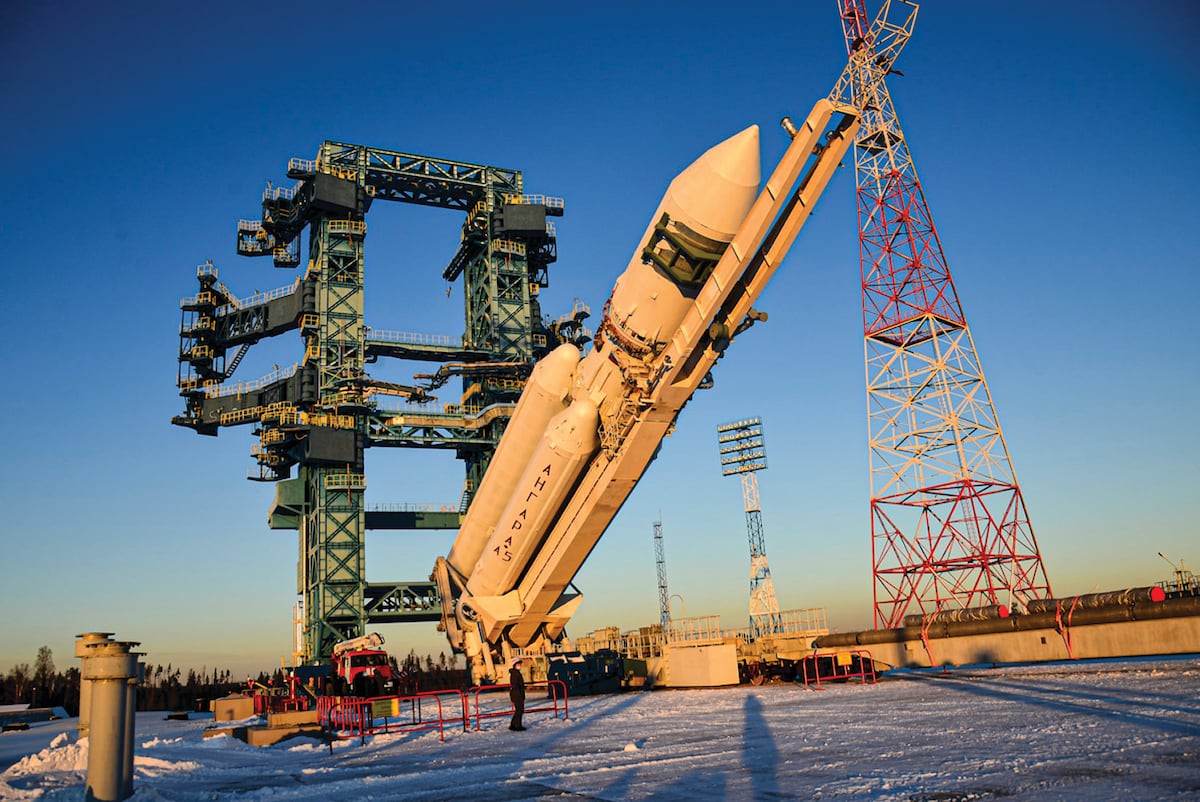
Russia chose the Angara launch vehicle to send the EKS constellation’s geostationary satellites into space to complement the Tundra systems. In 2020, the Defence Ministry signed a deal with space launch vehicle manufacturer Khrunichev Center for the production of four Angara-A5 rockets during the 2022-2024 time frame.
But when the ministry didn’t receive any rockets in 2022, it sued the center. The courts have so far ruled that the company pay the government nearly a third of the ministry’s monetary claim.
The ministry also sued Energia in 2019 over development disruptions related to a new Persei-KV upper stage for the Angara-A5. The court has since ruled in the government’s favor, though not to the extent sought by the ministry.
During the last launch of an Angara-A5 in 2021, the designers tested a Persei upper stage, but it was unsuccessful.
Russian President Vladimir Putin, center, looks at a Khrunichev facility with its CEO Alexei Varochko and Roscosmos chief Dmitry Rogozin on Sept. 6, 2019. (Mikhail Klimentyev/Sputnik/AFP via Getty Images)
In September 2022, a representative of Khrunichev Center said full-fledged serial production of the Angara family would begin in the city of Omsk by 2024.
It was announced in 2015 that production would move from Moscow to Omsk. Vladimir Nesterov, who provided design services to Khrunichev and died late last year, wrote in his book “Space rocket complex Angara: History of creation,” published in 2018, about the impact of the move.
“The established production cycle was disrupted, three large enterprises numbering about 16,000 people were withdrawn from the developer, production ties were undermined, development work suffered,” according to the engineer.
But despite delays and the absence of geostationary satellites for EKS, Russia’s defense minister said the launch of the sixth Tundra satellite means the country can now continuously monitor priority areas “in the Northern Hemisphere” — a subtle reference to the United States and its North Atlantic allies.
“At the same time, the current generation of satellites has a guaranteed period of at least seven years,” Luzin said. “But they can serve further beyond the warranty period.
“The problems are likely to be with their planned renewal, which in any case will need to start [around] 2025-2030.”
Maxim Starchak is a Russia correspondent for Defense News. He previously worked as an editor for the Russian Defence Ministry and as an expert for the NATO Information Office in Moscow. He has covered Russian nuclear and defense issues for the Atlantic Council, the Center for European Policy Analysis, the Royal United Services Institute and more.
莫斯科——俄罗斯于11月发射了第六颗“苔原”预警卫星,距离2024年实现共10颗卫星的目标还有四颗需要发射。但消息人士称,生产问题和制裁是导致该太空计划延误的原因之一。
国防部的“库波尔”(Kupol)卫星星座——一套综合性的天基探测与作战控制系统——旨在帮助德国追踪弹道导弹发射。“库波尔”系统又称EKS,用于取代苏联时代的“奥科”(Oko)和“奥科-1”(Oko-1)系统,后者于1982年至2019年间服役。
俄罗斯希望至少有10颗“苔原”(Tundra)卫星进入高椭圆轨道,以及若干颗地球静止轨道卫星,以支持EKS系统。2016年底,时任俄罗斯空天军第一副司令帕维尔·库拉琴科中将表示,空天军计划在2020年前将所有10颗卫星送入轨道。
但同年,官方报纸《俄罗斯报》报道称,国防部计划到 2022 年部署共计 10 艘。大约在同一时间,一份部级报纸援引时任俄罗斯空天军司令谢尔盖·苏罗维金上将的话说,预计到 2024 年将部署一批 EKS 轨道航天器。
长期关注俄罗斯太空计划的巴特·亨德里克斯表示:“发射频率将取决于替换老旧或失效卫星的需求。他们实现全天候覆盖所需的最小星座是四颗卫星。但拥有一定的冗余总是好的,这不仅可以防止卫星故障,还可以降低误报的概率。”
2020 年 5 月,第四颗 Tundra 卫星发射升空后,当地航天公司 Energia 的总经理宣布 EKS 星座已达到“最低标准强度”。
EKS系统的研发工作始于2000年,但直到七年后,政府才与Energia公司签署了系统供应合同。然而,据该公司称,由于国防部反复修改战术和技术要求,导致生产延误。
亨德里克斯表示,延误的主要原因“一定是生产问题”。
“可以相当肯定,这些都与制裁有很大关系,”他告诉《防务新闻》,指的是由于俄罗斯持续入侵乌克兰而对其施加的经济限制。
俄罗斯于2015年11月使用联盟-2.1b火箭和弗雷盖特上面级发射了第一颗“苔原”卫星。该国计划每年发射两颗卫星,但在2017年、2019年、2020年、2021年和2022年每年只发射了一颗。
2017年11月28日,一枚搭载俄罗斯气象卫星的联盟-2.1b火箭在俄罗斯乌格列戈尔斯克市附近升空。(Kirill Kudryavtsev/AFP via Getty Images)
生产问题的一部分涉及微电子元件,而微电子元件对卫星至关重要。俄罗斯一家国防公司的经理告诉《防务新闻》,俄罗斯在航天技术方面严重依赖外国零部件,这本身就会导致延误。
“由于供应商和零部件不断变化,每次都需要对系统进行新的测试,并根据国防部的要求对其进行评估。这必然会造成延误,”消息人士表示,由于话题敏感,该消息人士要求匿名。
消息人士称:“起初是西方电子产品;2014年以后,更多地来自中国和东南亚的电子产品。在某些情况下,他们购买中国产设备,从中提取微电子元件,然后安装到俄罗斯产设备上。”
今年1月,俄罗斯航天局局长尤里·鲍里索夫声称,尽管西方制裁阻碍了微电子产品对俄罗斯的供应,但中国已同意向俄罗斯出售用于火箭和航天技术的零部件。至于彻底替换卫星上的外国设备,俄罗斯航天局局长顾问尼古拉·谢沃斯季亚诺夫估计至少需要五年时间。
俄罗斯政府面临的另一个问题是联盟-2.1b火箭的弗雷盖特上面级的质量,该上面级在过去九年中至少遇到了五次技术问题。
太空军事化独立专家帕维尔·卢津表示,俄罗斯不太可能在 2024 年前部署全部“苔原”卫星。
“相反,每年一次的发射计划将继续进行。也就是说,最早也要到 2026 年才能完成向闪电轨道发射卫星的工作,”他预测道,闪电轨道是中地球轨道,最适合观测高纬度地区。
据美国宇航局称,在该轨道上运行的卫星需要12小时完成一次公转,但其中大约有8小时位于一个半球上。在莫尔尼亚轨道上,卫星沿一个极端的椭圆轨道运行,地球靠近椭圆轨道的一侧边缘。
像EKS这样的综合空间系统,在同时搭载高椭圆轨道和地球静止轨道卫星的情况下才能发挥最佳性能。苏罗维金表示,“高轨道空间侦察系统的部署应该从2023年开始。”
但俄罗斯地球静止轨道卫星的生产落后于其他发达国家。能源航天公司在其2017年年度报告中表示,这些卫星仍处于设计阶段。
亨德里克斯说:“地球静止轨道卫星的有效载荷似乎不同,甚至其设计也可能从根本上有所不同。这可能也是造成问题的原因之一。”
俄罗斯选择安加拉运载火箭将EKS星座的地球静止轨道卫星送入太空,以补充“苔原”卫星系统。2020年,俄罗斯国防部与航天运载火箭制造商赫鲁尼切夫中心签署协议,在2022年至2024年期间生产四枚安加拉-A5型火箭。
但2022年该部没有收到任何火箭,于是起诉了这家中心。法院目前已裁定该公司需向政府支付该部索赔金额的近三分之一。
2019年,能源部还就安加拉-A5火箭新Persei-KV上级火箭的研发中断问题起诉了Energia公司。法院随后作出有利于政府的裁决,但并未达到能源部所要求的程度。
在 2021 年最后一次 Angara-A5 火箭发射期间,设计人员测试了 Persei 上面级,但测试并不成功。
2019年9月6日,俄罗斯总统弗拉基米尔·普京(中)与赫鲁尼切夫航天中心首席执行官阿列克谢·瓦罗奇科和俄罗斯航天局局长德米特里·罗戈津一同视察该中心。(图片来源:Mikhail Klimentyev/Sputnik/AFP via Getty Images)
2022 年 9 月,赫鲁尼切夫中心的一位代表表示,安加拉一家将于 2024 年在鄂木斯克市开始全面系列生产。
2015 年宣布,生产将从莫斯科转移到鄂木斯克。曾为赫鲁尼切夫航天中心提供设计服务的弗拉基米尔·涅斯捷罗夫于去年年底去世,他在 2018 年出版的《安加拉航天火箭综合体:创建史》一书中,写到了此次搬迁的影响。
据这位工程师称,“既定的生产周期被打乱,三家大型企业(约 16,000 人)从开发商处撤出,生产关系遭到破坏,开发工作受到影响。”
尽管发射延迟,而且 EKS 缺乏地球静止卫星,但俄罗斯国防部长表示,第六颗苔原卫星的发射意味着该国现在可以持续监测“北半球”的优先区域——这显然是在暗指美国及其北大西洋盟友。
卢津说:“与此同时,目前这一代卫星的保证寿命至少为七年。但它们的使用寿命可以超过保修期。”
“问题可能出在他们的续约计划上,无论如何,续约都需要在2025-2030年左右开始。”
马克西姆·斯塔恰克是《防务新闻》的俄罗斯特派记者。他曾任俄罗斯国防部编辑,也曾担任北约驻莫斯科新闻办公室专家。他还曾为大西洋理事会、欧洲政策分析中心、皇家联合军种研究所等机构报道俄罗斯核问题和国防问题。