Commentary: Making room for helpers in small flats leads to uncomfortable questions评论:在小公寓里为帮佣腾出空间会引发一些令人尴尬的问题
Singapore families caring for children and the elderly may have the strongest reason for hiring a helper, but also struggle the most with space, says writer Annie Tan.
新闻视频
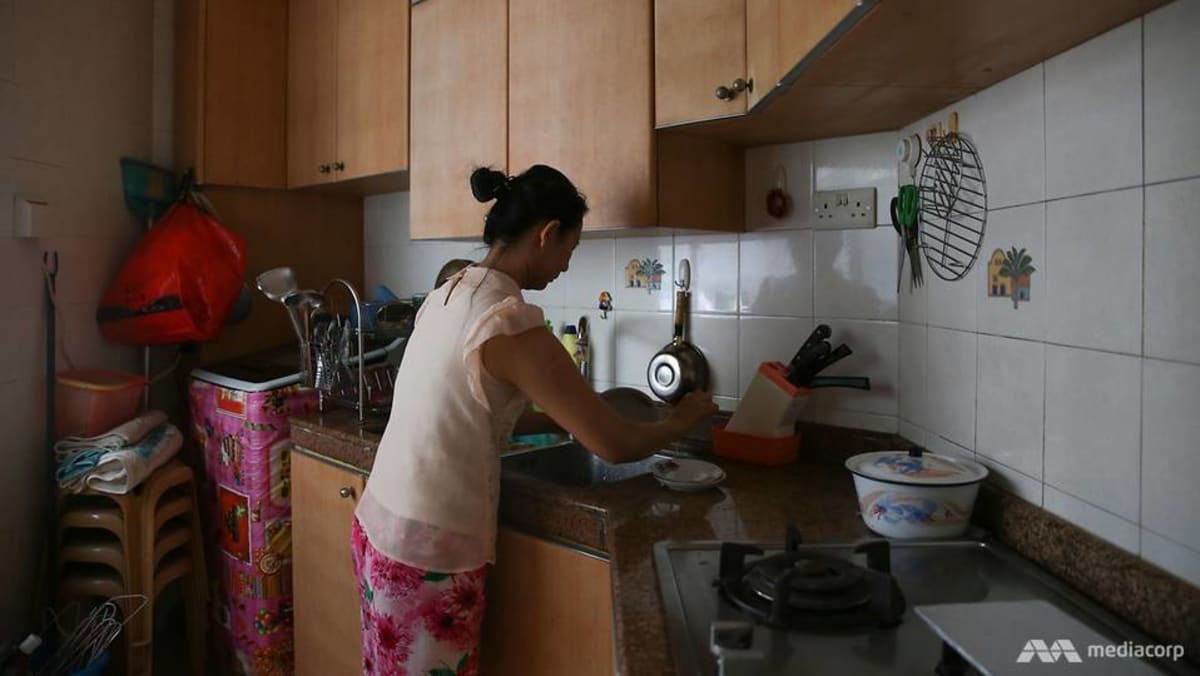
Singapore families caring for children and the elderly may have the strongest reason for hiring a helper, but also struggle the most with space, says writer Annie Tan.
File photo of a foreign domestic helper. (Photo: TODAY/Najeer Yusof)
This audio is generated by an AI tool.
SINGAPORE: In a recent viral post, a woman showed how she set up her domestic worker’s quarters in her 4-room Build-To-Order (BTO) flat, by putting a bed in the home office and adding a partition between the bed and work desk.
Netizens reacted harshly, bringing up issues of the helper’s welfare, privacy and dignity.
The woman clarified that the work desk is only used during the day, and her helper has full use of the room at night. She felt this arrangement would be better than the helper sharing the room with the baby, so that the helper can rest undisturbed.
The internet was unappeased. A few users argued that if families do not have a spare room for a helper, they should not hire one.
CNA Games Guess Word Crack the word, one row at a time Buzzword Create words using the given letters Mini Sudoku Tiny puzzle, mighty brain teaser Mini Crossword Small grid, big challenge Word Search Spot as many words as you can Show More Show Less But one wonders if it is precisely dual-income households, in average-sized flats with young kids or elderly parents, who benefit most from hiring live-in help.
But one wonders if it is precisely dual-income households, in average-sized flats with young kids or elderly parents, who benefit most from hiring live-in help.
WHAT MATTERS WHEN SPACE IS LIMITED
The Ministry of Manpower (MOM) states that employers should provide domestic workers with a separate room, but if that is not possible, employers must ensure they have adequate space and privacy.
In the absence of a dedicated room for the helper, what matters is that whatever available space gets divided with care and respect.
A family I know lives in a multi-generational household with two young children, one of whom has special needs. The family employs more than one helper to share the caregiving load. Because of limited space, one helper shares a room with a child, and the other helper sleeps in the study.
My own set-up is somewhat similar. I live in a four-room flat with two young children and my 86-year-old father. The kids sleep in my room where beds take up most of the available space, my dad occupies one room, and my helper’s room doubles up as the kids’ study and playroom. My helper has full use of the room after 9.30pm when the kids sleep.
This arrangement was discussed with my helper before we hired her. And it has worked for us – she has been with us for seven years now and is a valued member of our family.
However, where space is limited, boundaries are even more important. We respect my helper’s rest time and do not involve her in tasks after work hours. If my son throws up on himself and the bedsheets at night, we will do our own clean-ups.
WHY FAMILIES VALUE LIVE-IN HELP
The treatment of domestic workers continues to be a hot-button topic, especially when reports emerge of employers not giving helpers adequate food or rest .
This is indefensible. But it does not represent all Singapore employers, many of whom employ domestic workers to manage the demands of work and caregiving, but struggle with space constraints.
According to the MOM, nearly three in four households employing helpers benefit from the concessionary levy, meaning they have a child under 16, a senior aged 67 and above, or a person with disabilities in the household.
The concessionary levy reflects the government’s recognition of the role helpers play in supporting such households.
Of course, other options for caregiving exist, such as senior homes and childcare, though these can involve higher costs.
For instance, in Singapore, the monthly cost of nursing home care starts from S$3,900 before subsidies, with care for persons with dementia generally costing more .
Full-day infant care at government-supported preschools currently costs S$746 to S$1,256 monthly after basic subsidies, though the government announced in August that fees will progressively be reduced to S$300 by 2030.
But one of the most valuable things a helper offers a family is the flexibility to balance work and caregiving. Take childcare, for instance. Some workplaces do not support leaving at 6pm sharp to make it to childcare pickup by 7pm.
A helper can also provide a crucial buffer when family emergencies crop up. Three weeks ago, my father had a fall outside and was rushed to the hospital. I can only imagine the mayhem at home if my helper had not been there to hold the fort with my kids.
Singapore is a super-aged society, with one in five citizens aged 65 and above, so these issues may become more common in future.
SOMETHING’S GOT TO GIVE
Space has often been an emotional topic in Singapore because it is our most finite resource. The question has always been: Who should get priority?
The average sandwiched-generation Singaporean is torn in different directions – as children to aged parents whom they want to care for, parents to young children, employees at work and employers at home.
There are no easy solutions, only more uncomfortable questions.
As a society, we should continue to build better caregiving infrastructure and social support to reduce our reliance on live-in helpers. Because if helpers are part of Singapore’s care infrastructure, but space is scarce in Singapore homes, something’s got to give.
Annie Tan is a freelance writer based in Singapore.
Get our pick of top stories and thought-provoking articles in your inbox
Stay updated with notifications for breaking news and our best stories
Join our channel for the top reads for the day on your preferred chat app
作家安妮·谭表示,新加坡有孩子和老人的家庭可能最有理由雇佣帮手,但他们也最苦于空间不足。
(图片来源:TODAY/Najeer Yusof)
这段音频由人工智能工具生成。
新加坡:最近,一位女士在社交媒体上发布了一则帖子,展示了她如何在自己的四房式预购组屋(BTO)中布置家政工人的住所,她将一张床放在家庭办公室里,并在床和办公桌之间加装了隔断。
网友反应强烈,纷纷提出帮手的福利、隐私和尊严等问题。
这位女士解释说,办公桌只在白天使用,晚上房间完全由她的帮佣使用。她觉得这样的安排比让帮佣和婴儿共用一个房间要好,这样帮佣可以不受打扰地休息。
网络上对此议论纷纷。一些用户认为,如果家庭没有多余的房间给保姆住,就不应该雇佣保姆。
CNA游戏 猜词游戏 逐行破解单词 流行词游戏 用给定的字母组成单词 迷你数独 小谜题,强大的脑力挑战 迷你填字游戏 小方格,大挑战 单词搜索 尽可能多地找出单词 显示更多 显示更少 但人们不禁要问,是否正是那些住在普通大小公寓里、有年幼孩子或年迈父母的双职工家庭,从雇用住家保姆中获益最多。
但人们不禁要问,是不是那些有年幼孩子或年迈父母的双职工家庭,住在普通大小的公寓里,最能从雇佣住家保姆中受益呢?
空间有限时,什么才是最重要的?
人力部表示,雇主应为家庭佣工提供单独的房间,但如果无法做到这一点,雇主必须确保她们有足够的空间和隐私。
如果没有专门为帮手准备的房间,重要的是要用心和尊重来分配任何可用的空间。
我认识的一户人家是多代同堂,有两个年幼的孩子,其中一个有特殊需求。为了分担照护工作,他们雇佣了不止一位保姆。由于空间有限,一位保姆和其中一个孩子共用一个房间,另一位保姆则睡在书房里。
我的情况也差不多。我和两个年幼的孩子以及我86岁的父亲住在一套四房式的公寓里。孩子们睡在我的房间里,床几乎占了整个房间的空间;我父亲住一间;保姆的房间则兼作孩子们的书房和游戏室。晚上9点半孩子们睡着后,保姆就可以完全使用这间房间了。
这种安排在我们雇佣她之前就和她商量过了。事实证明,这种安排对我们来说很合适——她已经和我们一起工作七年了,是我们家庭中不可或缺的一员。
然而,在空间有限的情况下,界限就显得尤为重要。我们尊重保姆的休息时间,不会让她在下班后参与任何工作。如果我的儿子晚上吐在自己身上或床单上,我们会自己清理。
为什么家庭重视住家保姆
家政工人的待遇问题一直是一个备受关注的热点话题,尤其是有报道称雇主没有给家政工人提供足够的食物或休息。
这令人无法接受。但这并不能代表所有新加坡雇主的情况,许多雇主雇用家政工人来兼顾工作和照顾家庭的需求,但却苦于空间有限。
根据人力部的数据,近四分之三雇用帮佣的家庭享受优惠税,这意味着这些家庭中有 16 岁以下的儿童、67 岁及以上的老人或残疾人士。
这项优惠税费体现了政府对帮佣在支持这类家庭方面所发挥的作用的认可。
当然,还有其他照护选择,例如养老院和托儿所,但这些可能涉及更高的费用。
例如,在新加坡,养老院护理的每月费用从 3900 新元起(不含补贴),而痴呆症患者的护理费用通常更高。
目前,政府资助的幼儿园全日制婴儿保育服务每月费用为 746 新元至 1256 新元(含基本补贴),不过政府在 8 月份宣布,到 2030 年,费用将逐步降低至 300 新元。
但帮手能为家庭提供的最宝贵价值之一,就是能够灵活平衡工作和照顾家庭。以托儿服务为例,有些工作场所并不支持员工下午6点准时下班,以便在7点前接孩子。
保姆在家庭突发紧急情况时也能起到至关重要的作用。三周前,我父亲在外面摔了一跤,被紧急送往医院。我简直不敢想象,如果没有保姆在家照看孩子,家里会变成什么样子。
新加坡是一个超老龄化社会,五分之一的公民年龄在 65 岁及以上,因此这些问题在未来可能会变得更加普遍。
总得有所改变
在新加坡,空间一直是一个备受争议的话题,因为它是我们最有限的资源。问题始终是:谁应该优先获得空间?
新加坡的“夹心一代”平均而言在不同的方向上感到左右为难——既是想要照顾年迈父母的子女,又是想要照顾年幼子女的父母,既是工作上的员工,又是家里的雇主。
没有简单的解决办法,只有更多令人不安的问题。
作为一个社会,我们应该继续完善照护基础设施和社会支持体系,以减少对住家保姆的依赖。因为如果保姆是新加坡照护体系的一部分,而新加坡的家庭空间又十分有限,那么就必须做出一些调整。
Annie Tan是一位居住在新加坡的自由撰稿人。
订阅我们的邮件,即可获取精选热点新闻和引人深思的文章。
订阅通知,第一时间获取突发新闻和精彩报道。
加入我们的频道,即可在您常用的聊天应用上获取当日热门文章。