Dutch military adds railway steel to rush troops to NATO’s east flank荷兰军方增援铁路钢材,以便向北约东翼快速部署部队。
“Deployment in anger is not something that is planned, that always comes up suddenly, so you need some kind of minimum own capacity."
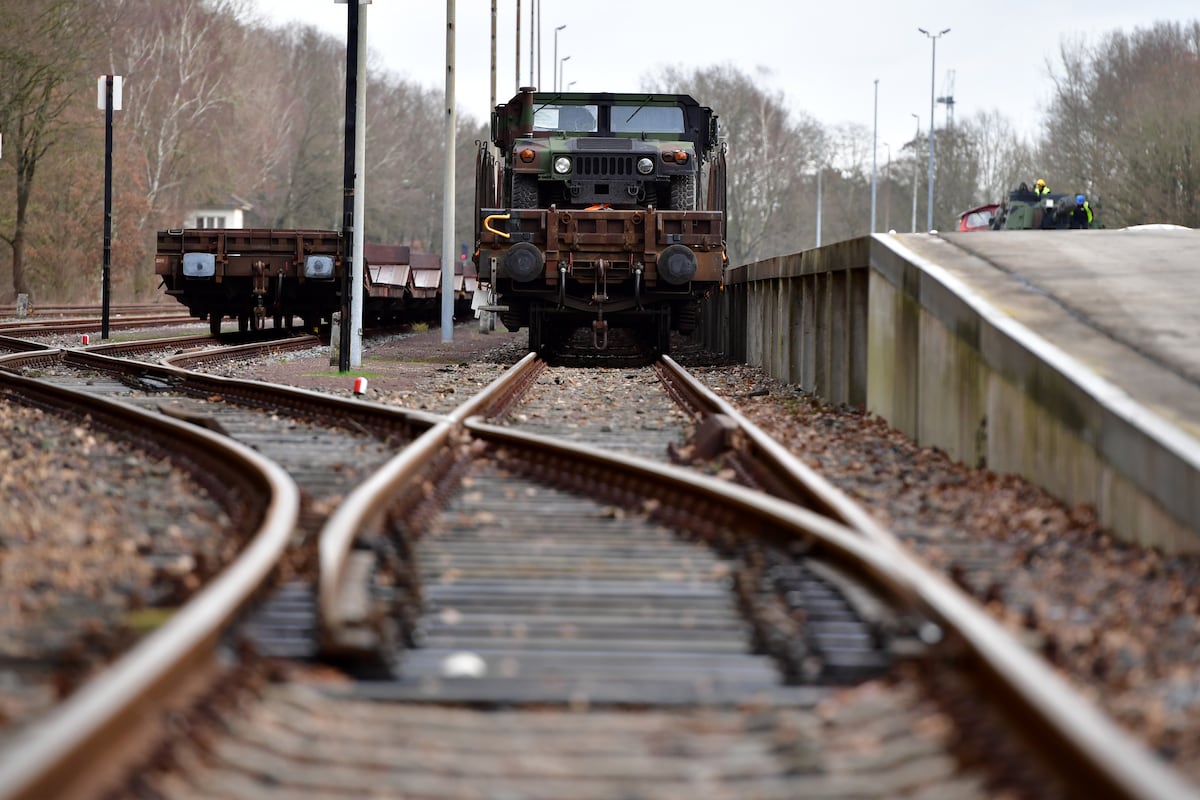
PARIS — The Netherlands Ministry of Defence is investing in steel to defend NATO’s eastern flank. That means adding tanks and armored vehicles, but also expanding a fleet of railway wagons that allows Dutch military planners to rush armor and supplies across Europe.
The ministry’s Joint Support Command received 75 new wagons in December and January, a 20% increase of its fleet. That makes the Dutch less reliant on commercial providers, and shortens reaction times should troops need to deploy in anger, Defence Movement and Transport Organisation (DVVO) Commander Col. Merlijn Heiligers told Defense News.
As NATO has stepped up exercises and deployments in response to Russia’s invasion of Ukraine, there’s renewed emphasis on the role of rail to rapidly move combat forces in support of alliance members. Yet European armies looking to rent wagons face scarcity on rising demand and the legacy of falling spending on military rail after the Cold War – something the Dutch are addressing with their growing fleet of rolling stock.
“Of course we see a changing geopolitical situation in Europe, and then we want to be less dependent on the market, and partly provide those capacities ourselves,” Heiligers said.
“Deployment in anger is not something that is planned, that always comes up suddenly, so you need some kind of minimum own capacity to be able to start taking action.”
The Netherlands has a “substantial” position in military rail transport in Europe and is one of the few countries to own a fleet of wagons, together with France and Germany. Several smaller EU countries are now also looking at buying wagons, according to the Dutch MoD.
The new wagons from manufacturer Greenbrier Europe are specialized 60-ft container transporters, a unique capability among European militaries, according to the ministry. The Dutch armed forces are also alone in Europe in having their own low-loader wagons for wheeled vehicles.
The new rolling stock was bought specifically to move large amounts of containerized supplies, including ammunition and fuel. Transporting military goods by container has become the norm within NATO, and it’s an area where DVVO no longer wants to depend on the private market, according to Heiligers.
The DVVO boss said containerization has been one of the big logistics trends during his 32 years in the Dutch armed forces. That reflects developments in the commercial freight sector, with the volume of container traffic handled in ports around the world increased 3.7-fold between 2000 and 2022, according to World Bank statistics .
“It’s really just become the norm,” Heiligers said. “Whatever we can transport in containers, we really make maximum use of that.”
The military transport organization is investing in fuel containers that can be loaded on trains, trucks or vessels, providing greater flexibility than tanker wagons limited to the rail network.
Col. Merlijn Heiligers commands the Dutch Defence Movement and Transport Organisation (DVVO). (Dutch MOD)
DVVO now owns 448 freight wagons, including 125 flatbed wagons with a lowered floor used for wheeled-vehicle transport acquired since 2022 . The Dutch military also owns a little over 200 flatbed wagons that can carry heavy armor including Leopard 2 tanks, Panzerhaubitze self-propelled howitzers or CV90 armored combat vehicles.
Only a few companies in Europe rent out wagons for military vehicle transport, according to Heiligers. Germany’s DB Cargo is the main player, with Switzerland’s Transwaggon another logistics company offering wagons to move heavy armor. Some militaries in Eastern Europe have access to vehicles from their former state railway companies, according to the MoD.
To put the Dutch fleet in perspective, DB Cargo says it owns, leases or rents 83,000 freight wagons, while Transwaggon says its fleet consists of 13,500 wagons, of which 1,700 are flat wagons.
“There is still capacity, but we deliberately chose to invest ourselves, because we seeing that there’s going to be insufficient capacity,” Heiligers said. “What you see is indeed scarce supply.”
Similar to its efforts to guarantee rail capacity in a tight market for wagons, DVVO signed a 10-year lease on a roll-on-roll-off vessel in 2022 to address difficulties securing strategic sea lift, with a lease on a second RoRo vessel signed in April last year.
Strategy decides where action is to be taken, but logistics gets the troops there and in place, military theorist Antoine-Henri Jomini wrote in 1837.
NATO is asking countries to ensure short response times and faster ability to reach deployment areas, and rail transport capacity is part of the Dutch commitment, with speed of deployment and independence from private operators being key, Heiligers said.
With wagons parked at ‘t Harde army base in the central Netherlands, a train can be loaded and be off within a day, according to the DVVO commander. Relying on a commercial operator such as DB Cargo requires having a contract in place, and pulling available wagons from all over Europe before assembling a train, a process which Heiligers says could take multiple days.
“That’s why we want that independence. Of course you can make all kinds of agreements with those companies about that, but you just want that certainty.”
Having wagons and a shunting locomotive at ‘t Harde additionally allows for a “significant reduction” in CO2 emissions, by avoiding the environmental impact of driving empty stock across the continent to the Netherlands, Heiligers said.
While road is used more often for Army transports, the tonnages shipped by rail and sea are comparable, according to Heiligers. Rail is typically favored over road for large volumes and weights across longer distances, and as the quantities of equipment that need to be moved increase, so does the importance of rail, he said.
The ministry’s Joint Support Command received 75 new cargo rail cars in December 2024 and January 2025. (Netherlands MOD)
According to U.S. Army officials and doctrine, rail is the most cost-effective and speedy way to move large amounts of material such as tanks and ammo over long distances. Deployed U.S. Army units move about two-thirds of their equipment to a shipping port by rail, according to a 2021 report by the U.S. Government Accountability Office.
“The moment I have to start transporting an armored-infantry battalion with CV90s, that’s obviously a huge burden on the civilian network,” Heiligers said. “I might need 50 or 60 trucks, whereas I might be able to do it with one or two trains. In that sense, the societal burden from railroads is lower.”
Using rail also avoids congested roads, requires less personnel, and is a more sustainable option, the commander said.
Still, military transport remain a niche use of the Dutch railway network, and DVVO’s more than 100 trains in all of 2023 compare with an average of more than 1,500 commercial freight trains chugging across the Netherlands every week , according to the country’s statistics office.
The Netherlands, which handles more maritime freight than any other European economy, likes to call itself as the gateway to Europe. The country fulfills that role for military movement, with 80% to 90% of military train traffic in the Netherlands either going abroad or coming back from a cross-border trip, Heiligers said.
Rotterdam was one of the major ports for the U.S. Army during the Cold War, and U.S. combat brigades still regularly use Dutch ports for rotations in Europe. While the Dutch armed forces are the main user of the rail fleet, DVVO together with DB Cargo handles “a lot of transit” of American equipment for troop rotations of units in Poland.
Dutch wagons also bring large amounts of military equipment to Eastern Europe in support of Ukraine, according to Heiligers.
Railway capacity is made available to allies when not in use by DVVO, and the Netherlands also swaps capabilities with a partner country such as Belgium, which is more invested in air transport.
“Things are getting tense and you want to be able to react and be less dependent on the market,” Heiligers said. “That’s not to say the market is not doing well, but you want to be able to make that first move yourself. You want to have freedom of action.”
Rudy Ruitenberg is a Europe correspondent for Defense News. He started his career at Bloomberg News and has experience reporting on technology, commodity markets and politics.
巴黎——荷兰国防部正在投资钢铁,以保卫北约东翼。这意味着不仅要增加坦克和装甲车,还要扩充铁路货车车队,以便荷兰军事策划人员能够迅速向欧洲各地运送装甲车辆和补给品。
国防部联合支援司令部在去年12月和今年1月接收了75辆新货车,车队规模增加了20%。国防运输组织(DVVO)司令梅林·海利格斯上校告诉《防务新闻》,这使得荷兰对商业供应商的依赖性降低,并在部队需要紧急部署时缩短了反应时间。
随着北约为应对俄罗斯入侵乌克兰而加强演习和部署,铁路在快速运送作战部队支援盟国方面的作用再次受到重视。然而,由于需求不断增长以及冷战后军用铁路经费削减的遗留问题,欧洲各国军队在租赁车厢方面面临着短缺的困境——荷兰正通过不断扩充其铁路车辆车队来应对这一挑战。
“我们当然看到欧洲的地缘政治形势正在发生变化,因此我们希望减少对市场的依赖,并部分地自己提供这些能力,”海利格斯说。
“实战部署并非事先计划好的,它总是突然发生的,所以你需要具备一定的最低能力才能开始采取行动。”
荷兰在欧洲军用铁路运输领域占据“举足轻重”的地位,是少数几个拥有军用铁路货车车队的国家之一,其他拥有此类车队的国家还包括法国和德国。据荷兰国防部称,一些欧盟小国目前也在考虑购买军用铁路货车。
据荷兰国防部称,制造商 Greenbrier Europe 生产的新型货车是专门用于运输 60 英尺集装箱的,这在欧洲军队中独一无二。荷兰武装部队也是欧洲唯一拥有用于运输轮式车辆的低平板货车的军队。
据海利格斯称,新购置的铁路车辆专门用于运输大量集装箱式物资,包括弹药和燃料。在北约内部,使用集装箱运输军需品已成为常态,而德国铁路车辆运输公司(DVVO)也不愿再依赖私营市场。
荷兰货运代理公司(DVVO)负责人表示,在他32年的荷兰军队服役生涯中,集装箱运输一直是物流领域的一大趋势。这反映了商业货运领域的发展,根据世界银行的统计数据,2000年至2022年间,全球港口的集装箱吞吐量增长了3.7倍。
“这真的已经成了常态,”海利格斯说。“凡是能用集装箱运输的东西,我们都会最大限度地利用起来。”
军事运输机构正在投资建设燃料集装箱,这种集装箱可以装载到火车、卡车或轮船上,比只能在铁路网络上运行的油罐车具有更大的灵活性。
Merlijn Heiligers 上校负责指挥荷兰国防运动和运输组织 (DVVO)。 (荷兰MOD)
荷兰车辆运输公司(DVVO)目前拥有448辆货车,其中包括自2022年以来购置的125辆用于运输轮式车辆的低底板平板货车。荷兰军方还拥有200多辆平板货车,可以运输包括豹2坦克、Panzerhaubitze自行榴弹炮或CV90装甲战车在内的重型装甲车辆。
据海利格斯称,欧洲只有少数几家公司出租货车用于军用车辆运输。德国的DB Cargo是主要参与者,瑞士的Transwaggon是另一家提供货车运输重型装甲车辆的物流公司。英国国防部表示,东欧一些国家的军队可以从其前国有铁路公司获得车辆。
为了更好地了解荷兰的车队规模,DB Cargo 表示,它拥有、租赁或租用了 83,000 辆货车,而 Transwaggon 表示,其车队由 13,500 辆货车组成,其中 1,700 辆是平板货车。
海利格斯说:“目前仍有产能,但我们特意选择自行投资,因为我们预见到产能将会不足。你现在看到的确实是供应短缺。”
与为确保货车市场紧张情况下的铁路运力所做的努力类似,DVVO 于 2022 年签署了一份为期 10 年的滚装船租赁合同,以解决战略海运运输方面的困难,并于去年 4 月签署了第二艘滚装船的租赁合同。
军事理论家安托万-亨利·若米尼在 1837 年写道:“战略决定在哪里采取行动,而后勤则将部队送到那里并部署到位。”
海利格斯表示,北约要求各国确保反应时间短、能够更快地到达部署区域,铁路运输能力是荷兰承诺的一部分,部署速度和独立于私人运营商是关键。
据荷兰铁路货运协会(DVVO)指挥官称,货车停放在荷兰中部哈德陆军基地,一天之内即可完成装车并出发。而如果依赖像德国铁路货运公司(DB Cargo)这样的商业运营商,则需要签订合同,并从欧洲各地调集可用的货车,然后才能组装列车。海利格斯表示,这个过程可能需要数天时间。
“所以我们才想要这种独立性。当然,你可以和那些公司就此达成各种协议,但你想要的只是确定性。”
海利格斯表示,在哈德拥有货车和调车机车还可以“显著减少”二氧化碳排放,因为这样可以避免将空车厢运送到荷兰,从而减少对环境的影响。
海利格斯表示,虽然陆军运输更常使用公路,但铁路和海运的吨位相当。他指出,对于大批量、大重量的货物长途运输,铁路通常比公路更受欢迎;随着需要运输的装备数量增加,铁路的重要性也日益凸显。
荷兰国防部联合支援司令部于2024年12月和2025年1月接收了75节新的货运铁路车厢。(荷兰国防部)
根据美国陆军官员和相关理论,铁路运输是长途运输坦克、弹药等大量物资最经济快捷的方式。美国政府问责局2021年的一份报告显示,部署中的美国陆军部队约有三分之二的装备是通过铁路运输到港口的。
“一旦我需要用CV90运输车运送一个装甲步兵营,那显然会对民用铁路网络造成巨大负担,”海利格斯说。“我可能需要50到60辆卡车,而用火车可能只需要一两列火车就够了。从这个意义上讲,铁路给社会带来的负担要小。”
指挥官表示,使用铁路还可以避免道路拥堵,需要的人员更少,而且是一种更可持续的选择。
不过,军事运输仍然是荷兰铁路网络的一个特殊用途,据荷兰统计局的数据,DVVO 在 2023 年全年开行的 100 多列军用列车,与每周平均超过 1500 列商业货运列车在荷兰境内穿梭相比,数量相当可观。
荷兰的海运货运量超过任何其他欧洲经济体,并自诩为欧洲门户。海利格斯表示,荷兰在军事运输方面也扮演着这一角色,该国80%至90%的军用列车运输量要么是出国,要么是跨境运输返回。
冷战时期,鹿特丹是美国陆军的主要港口之一,如今美国作战旅仍经常使用荷兰港口进行欧洲轮换。虽然荷兰武装部队是铁路运输的主要用户,但荷兰铁路货运公司(DVVO)与德国铁路货运公司(DB Cargo)共同承担了大量美国装备的过境运输,用于驻波兰部队的轮换部署。
据海利格斯称,荷兰的货车也向东欧运送了大量军事装备,以支援乌克兰。
当荷兰铁路运输公司 (DVVO) 不使用铁路运力时,会将其提供给盟友。此外,荷兰还会与比利时等伙伴国家交换运力,因为比利时在航空运输方面投入更多。
海利格斯说:“局势变得紧张,你需要能够做出反应,减少对市场的依赖。这并不是说市场表现不好,而是说你需要能够自己采取先发制人的行动。你需要行动的自由。”
鲁迪·鲁伊滕贝格是《防务新闻》的欧洲记者。他的职业生涯始于彭博新闻社,拥有报道科技、大宗商品市场和政治方面的经验。