Outgoing Leonardo boss touts ‘Michelangelo Dome,’ cyber tack as key achievements即将离任的莱昂纳多老板称“米开朗基罗穹顶”和网络安全战略是其主要成就
Asked what he plans to do next, Cingolani said, “I am getting on my motorbike and will travel around Europe for a while.”
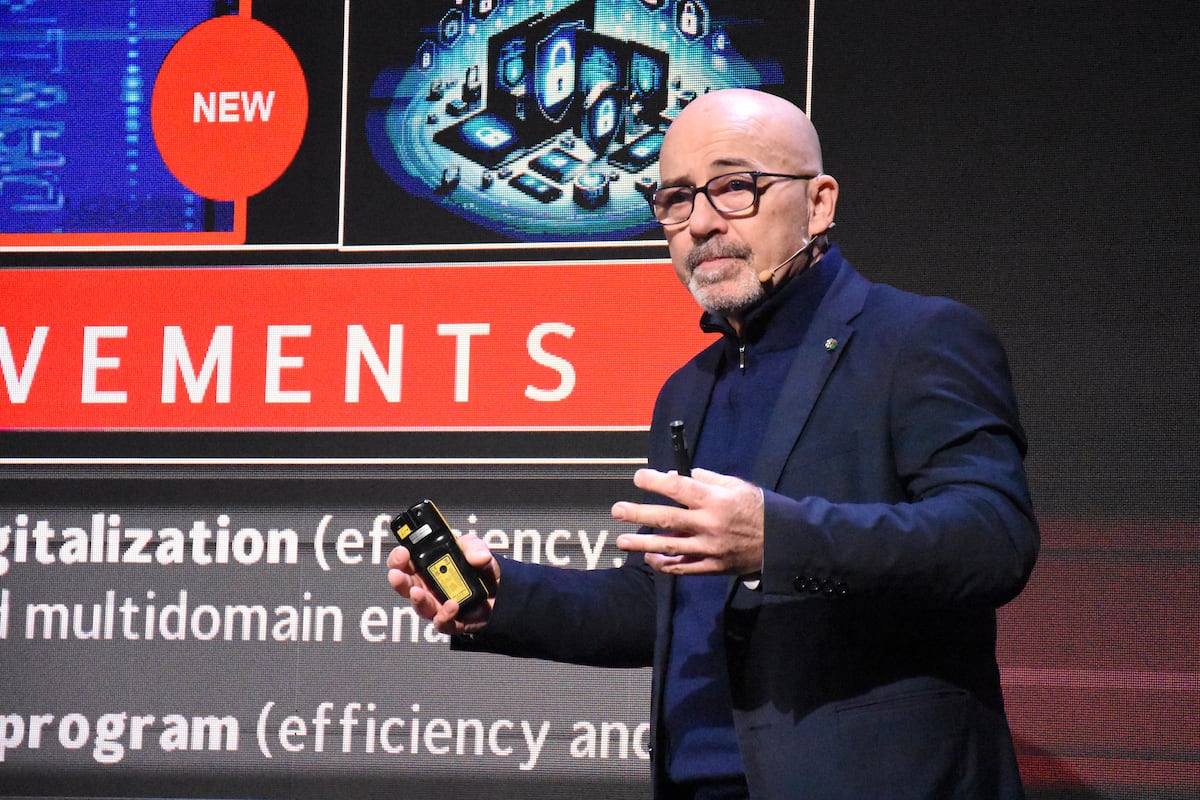
ROME — Outgoing Leonardo CEO Roberto Cingolani has given a candid final press conference in which he warned his successor not to tinker with his strategies and said the three-year mandate handed him by the Italian government had not been long enough.
After overseeing rapid growth at the state-controlled firm following his appointment in 2023, Cingolani was released last month when the Italian government decided not to give him a second three-year mandate, surprising industry experts.
Instead the top job was given to Lorenzo Mariani, a former co-general manager at Leonardo and effectively Cingolani’s former number two, who moved a year ago to run MBDA’s Italian operation.
In an online press briefing on Wednesday “to say goodbye” to journalists, Cingolani recalled how Leonardo had added 20,000 staff and grown its share price from 10 to 64 euros on his watch.
Growth at the firm had been “unprecedented”, he said.
On Wednesday, Leonardo reported a 33% year-on-year rise in first-quarter core earnings.
Cingolani, 64, said the firm’s industrial plan was “rolling”, adding, “The strategy is built, capitalized and contracted. The job now is execution not strategy. Deviation from the plan could be detrimental to the success of Leonardo in the future.”
As an example of a new product roll-out, Cingolani cited the Michelangelo Dome, an air-defense system designed with open architecture to allow partner countries to link existing assets and make them interoperable.
The system will be tested in Ukraine against drone attacks in November, he announced.
Cingolani defended his “bullets and bytes” strategy which focused on turning Leonardo “from a defense company to a global security company” specializing in cyber, energy and infrastructure security.
Some experts have suggested that Cingolani fell out of favor in government circles because he was seen as not prioritizing the mass production of munitions and hardware needed as war rages on Europe’s border.
Cingolani however took pride in his focus on digitalizing operations at Leonardo. “We were a non-digital company. Now we have one terrabyte of memory per employee,” he said, adding, “We were creating a digital brand.”
Despite seeing his time at Leonardo truncated by the Italian government, Cingolani said he approved of government stakes in defense firms.
“I believe that you cannot consider a defense company to be 100 percent independent of the state,” he said. “If we pursue only profit and we are independent of public institutions we could decide to sell assets to an enemy country. A state stake in a defense company is justified in ensuring the firm behaves according to the alliances the state approves of,” he added.
“I might not be happy to not be renewed on the one hand, but on the other I understand the state supervises such a delicate issue as defense,” he said.
That said, Cingolani said he believed five-year rather than three-year mandates would be better at the top of Leonardo.
“Three years is too short because this is a mid-term or long-term strategy industry. It is not beneficial for the company. It could be beneficial to extend the mandate,” he said.
Asked why his mandate had not been renewed, Cingolani said, “It is not necessary that I understand. The state can do whatever is needed.”
He added, “Sometimes good results are not enough.”
During his mandate, Cingolani created alliances with Germany’s Rheinmetall and Turkish drone maker Baykar, helped by his friendships with top managers at the firms. Asked if those alliances could suffer due to his departure, he said, “There is a risk but a multi-national company like Leonardo cannot depend on an individual. Those alliances were facilitated by personal relationships built on shared knowledge, vision and strategy. Once that is written in the industrial plan and approved by the board it is no longer a personal point of view.”
He added: “Governance avoids a personalization of the company.”
Asked what he plans to do next, Cingolani said, “I am getting on my motorbike and will travel around Europe for a while.”
Tom Kington is the Italy correspondent for Defense News.
罗马——即将卸任的莱昂纳多首席执行官罗伯托·辛戈拉尼举行了一次坦率的最后一次新闻发布会,他在会上警告继任者不要随意更改他的战略,并表示意大利政府赋予他的三年任期还不够长。
在 2023 年上任后,辛戈拉尼领导这家国有控股公司实现了快速增长。但上个月,意大利政府决定不给他第二个三年任期,辛戈拉尼因此被解职,这令业内专家感到惊讶。
相反,最高职位交给了洛伦佐·马里亚尼,他曾是莱昂纳多公司的联合总经理,实际上是辛戈拉尼之前的二把手,一年前他调任负责MBDA在意大利的业务。
周三,辛戈拉尼在一次线上新闻发布会上向记者们“告别”,回顾了在他任职期间,莱昂纳多公司如何增加了 2 万名员工,股价如何从 10 欧元增长到 64 欧元。
他表示,公司的增长是“前所未有的”。
周三,莱昂纳多公布第一季度核心收益同比增长 33%。
64岁的辛戈拉尼表示,公司的产业规划正在“稳步推进”,并补充道:“战略已经制定、资金到位并签订了合同。现在的重点是执行,而不是制定战略。偏离计划可能会对莱昂纳多未来的成功造成不利影响。”
作为新产品推出的一个例子,辛戈拉尼提到了米开朗基罗穹顶,这是一个采用开放式架构设计的防空系统,旨在让伙伴国家能够连接现有资产并使其互操作。
他宣布,该系统将于11月在乌克兰进行无人机袭击测试。
辛戈拉尼为他的“子弹和字节”战略辩护,该战略旨在将莱昂纳多“从一家国防公司转变为一家全球安全公司”,专门从事网络、能源和基础设施安全。
一些专家认为,辛戈拉尼之所以失宠于政府高层,是因为他被认为没有优先考虑大规模生产欧洲边境战乱所需的弹药和装备。
然而,辛戈拉尼对他在莱昂纳多公司专注于运营数字化感到自豪。“我们以前是一家非数字化公司。现在我们每位员工都拥有1TB的内存,”他说道,并补充道,“我们正在打造一个数字化品牌。”
尽管意大利政府缩短了辛戈拉尼在莱昂纳多公司的任期,但他表示赞成政府持有国防企业的股份。
“我认为不能把国防公司视为百分之百独立于国家之外,”他说。“如果我们只追求利润,并且独立于公共机构之外,我们就有可能把资产卖给敌国。国家持有国防公司股份是合理的,这样才能确保公司按照国家认可的联盟行事,”他补充道。
“一方面,我可能对未能获得续约感到不高兴,但另一方面,我也理解国家要监管国防这样敏感的问题,”他说。
尽管如此,辛戈拉尼表示,他认为莱昂纳多集团高层的任期为五年而不是三年会更好。
“三年时间太短了,因为这是一个中长期战略行业。这对公司不利。延长授权期限或许更有利,”他说道。
当被问及为何他的任期未获续签时,辛戈拉尼说:“我不需要理解。国家可以采取任何必要的措施。”
他补充说:“有时候,好的结果还不够。”
在任期间,辛戈拉尼凭借与德国莱茵金属公司和土耳其无人机制造商拜卡公司的高管们的良好关系,促成了双方的合作联盟。当被问及他的离任是否会对这些联盟造成影响时,他表示:“确实存在风险,但像莱昂纳多这样的跨国公司不能依赖个人。这些联盟的建立得益于基于共同知识、愿景和战略的私人关系。一旦这些内容被写入产业规划并经董事会批准,就不再是个人观点了。”
他补充道:“公司治理可以避免公司个人化。”
当被问及下一步计划时,辛戈拉尼说:“我打算骑上摩托车,在欧洲旅行一段时间。”
汤姆·金顿是《防务新闻》驻意大利记者。