Lockheed Once Pitched the Massive C-5 as a Flying Command Center洛克希德公司曾将巨型C-5运输机定位为飞行指挥中心。
The company told the Air Force the massive airlifter could be a super-sized replacement for the EC-135 doomsday plane.
By Joseph Trevithick
Updated Jul 3, 2020 4:15 AM EDT
Since its introduction in 1970, Lockheed’s C-5 Galaxy has been the U.S. Air Force’s largest cargo plane. In the late 1980s, the famous plane maker suggested its massive airlifter could take on a new role: airborne command post.
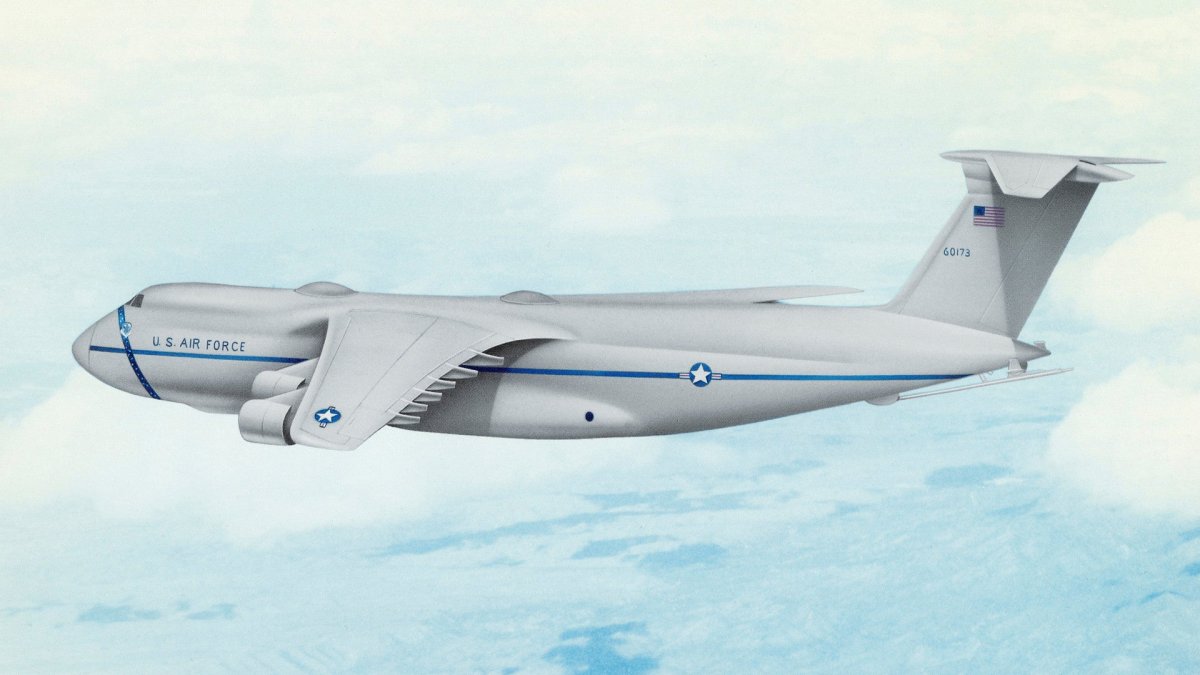
On March 2, 2017, Lockheed posted artwork of this proposed model, unofficially known as the EC-5B. The firm intended it to be a replacement for the earlier EC-135C Looking Glass flying command centers, which would issue orders to the Air Force’s nuclear forces in a doomsday scenario where a major attack destroyed similar facilities on the ground.
“Promotional literature noted the EC-5B is capable of accommodating all current and future [command, control, and communications] mission electronics, battle staff, support personnel, consumables, rolling stock, maintenance equipment, and spares,’” according to the caption Lockheed provided for the art, which is dated circa 1990.
This configuration would replicate and improve upon the basic capabilities of the existing Looking Glass aircraft, which had first entered service in 1963. The EC-135Cs were just one of many variants of the prolific C-135 series, including the KC-135 tanker, all of which were relatives of the iconic Boeing 707 airliner.
An Air Force EC-135C Looking Glass., USAF
Lockheed would have been keen to try and snatch the contract away from one of its biggest competitors. By using the existing C-5B, which was still in production at the time, the company clearly hoped to offer benefits no Boeing product could match.
For one, the EC-5B doomsday plane concept featured a rear-mounted aerial refueling boom. But along with its long-range communications gear, all the EC-135Cs had this equipment in order to perform this function on a limited basis in an emergency. This could have been critical to keeping the planes on airborne alert if a sneak attack blasted other supporting aircraft or if the demands of any counter-attack required additional tankers.
However, unlike the smaller Boeing aircraft, Lockheed’s proposal envisioned a plane that could perform its function in the sky or on the ground. In its transport configuration, the KC-135 can carry up to 83,000 pounds of cargo. The standard C-5B could accommodate more than three times that payload.
As a result, the previously cargo-carrying EC-5B would have space for “life support provisions for autonomous operations over a protracted period from small, austere dispersal airfields,” the art’s caption noted. In short, crews could decide to land the aircraft at safer, remote locations and continue operations without immediate outside support. This is where the C-5’s huge size may have been advantageous as it could theoretically sit on the ground at an austere location, even operating in a pressurized state for long periods of time during a nuclear crisis or exchange. The jet’s ability to get back into the air again is a whole other issue considering the C-5’s notoriously low mission capable rate.
Ultimately, the Air Force decided not to buy Lockheed’s super-sized flying command post. On July 24, 1990, the service stopped its continuous Looking Glass missions, instead keeping the EC-135C fleet on the ground on 24 hour alert.
A standard C-5B cargo plane., USAF
Then, in 1998, the Pentagon decided the U.S. Navy’s E-6B Mercury , another Boeing 707 derivative, would take over the mission as part of the expanding role of the centralized U.S. Strategic Command (STRATCOM). Previously, these naval airborne command centers had only been responsible for maintaining contact with ballistic missile submarines if an attack knocked out other communications systems, a mission known as Take Charge and Move Out (TACAMO).
The Pentagon is aware that their collection of 707-derivatives will finally be nearing the end of their lifetimes in the coming decades. The Navy accepted the first E-6A in 1989 and then began transforming the entire fleet into the improved B models eight years later. The E-6s are among the last 707 derivatives Boeing ever built. Among various communication equipment and other systems, these aircraft now carry the airborne launch control system , which can issue fire commands to troops in missile silos down below.
The last set of major E-6 upgrades, which Boeing completed in 2003, is supposed to keep the Mercuries operational through 2038. The Air Force is hoping to replace its E-3 Airborne Warning and Control System (AWACS) and E-8 Joint Surveillance Target Attack Radar System (JSTARS) radar planes, as well as the OC-135B Open Skies surveillance aircraft well before 2040. By 2018, new Boeing KC-46A tankers should be starting to take over for the older KC-135s.
The E-6Bs have received other minor updates since 2003, too. In 2014 , one touched down at Patrick Air Force base sporting an additional dome, possibly housing a new communications antenna. On Feb. 7, 2017 , another left Edwards Air Force Base in California after testing a set of three new antenna radomes , a modification that will likely become standard across the fleet.
The most recent series of upgrades for the E-6B saw its outer mold line change with extra bumps on top and bottom., USAF
Still, it takes time to develop and test new aircraft in general. This is especially true for specialized planes intended for critical missions such as the E-6.
“We’re only 20 years from 2038, but if you’re going to build large aircraft with huge command and control you need to start thinking about those things right now,” Air Force General John Hyten, head of STRATCOM, told reporters on March 8, 2017. “That’s what the Navy is starting to do. I’ve requested that they start looking at defining what comes next.”
Hyten also suggested it would be smart for the Air Force to team up with the Navy to figure out what an upgrade or replacement for the E-6Bs might look like in the end. “The requirements on the Air Force side – the size and shape of the airplane, the capacity, the endurance – are very similar missions,” the general said.
Both services will undoubtedly want a plane with state-of-the-art communications and defensive gear, shielded against everything from nuclear explosions to cyber-attacks . Ever more fuel-efficient engines to help keep flying costs down and endurance up will also be a must have for any Mercury replacement.
Though Lockheed could partner with another firm to offer a proposed replacement, the company does not currently make a readily suitable aircraft for this mission itself. With the Galaxy long out of production, and seeing as those that are still flying, even in the modernized C-5M form, are expensive machines to operate, it is all but certain we will never see the EC-5 airborne command post concept become a reality.
Contact the author: joe@thedrive.com
Comments couldn’t be loaded. Please refresh the page.
作者:约瑟夫·特雷维西克
更新于美国东部时间2020年7月3日凌晨4:15
自1970年投入使用以来,洛克希德公司的C-5“银河”运输机一直是美国空军最大的运输机。20世纪80年代末,这家著名的飞机制造商提出,其巨型运输机可以承担一个新的角色:空中指挥所。
2017年3月2日,洛克希德公司发布了这款拟议模型的示意图,该模型非正式名称为EC-5B。该公司计划用它取代早期的EC-135C“镜子”飞行指挥中心,后者将在世界末日情景下,即地面类似设施遭到重大袭击被摧毁时,向空军核力量下达指令。
根据洛克希德公司提供的这幅画的说明文字(日期约为 1990 年),“宣传资料指出 EC-5B 能够容纳所有当前和未来的[指挥、控制和通信]任务电子设备、作战人员、支援人员、消耗品、车辆、维护设备和备件”。
这种配置将复制并改进现有的 Looking Glass 飞机的基本功能,该飞机于 1963 年首次投入使用。EC-135C 只是产量丰富的 C-135 系列的众多型号之一,其中包括 KC-135 加油机,所有这些型号都与标志性的波音 707 客机有关。
美国空军 EC-135C“镜子”侦察机。
洛克希德公司肯定很想从其最大的竞争对手之一手中抢走这份合同。该公司显然希望通过使用当时仍在生产的C-5B运输机,提供波音产品无法比拟的优势。
首先,EC-5B末日飞机概念机配备了后置空中加油吊杆。但所有EC-135C飞机都配备了该设备以及远程通信设备,以便在紧急情况下有限地执行空中加油任务。如果遭遇突袭导致其他支援飞机受损,或者反击需要额外的加油机,这项功能对于保持飞机空中警戒至关重要。
然而,与波音公司较小的飞机不同,洛克希德公司的方案设想了一种既能在空中也能在地面执行任务的飞机。KC-135在运输模式下可运载高达83,000磅的货物。标准的C-5B的有效载荷是其三倍以上。
因此,正如图注所述,原本用于货运的EC-5B将腾出空间,搭载“生命维持设备,以便在小型、简陋的分散机场长时间自主运行”。简而言之,机组人员可以选择将飞机降落在更安全、更偏远的地点,并在没有外部即时支援的情况下继续执行任务。C-5庞大的体积或许正是其优势所在,理论上它可以在简陋的地面停留,甚至在核危机或核战争期间以加压状态长时间运行。考虑到C-5出了名的低任务执行率,它能否再次升空则是另一个问题了。
最终,空军决定不购买洛克希德公司的大型飞行指挥所。1990年7月24日,空军停止了持续的“镜中世界”(Looking Glass)任务,改为让EC-135C机队保持24小时待命状态。
一架标准的C-5B运输机,美国空军
随后,在1998年,五角大楼决定由美国海军的E-6B“水星”预警机(波音707的另一款衍生机型)接手这项任务,作为美国战略司令部(STRATCOM)职能不断扩展的一部分。此前,这些海军空中指挥中心仅负责在其他通信系统遭到攻击而瘫痪时,与弹道导弹潜艇保持联系,这项任务被称为“接管并撤离”(TACAMO)。
五角大楼意识到,其707系列衍生机型将在未来几十年内逐渐退役。海军于1989年接收了首架E-6A,并在八年后开始将整个机队更新换代为改进型B型。E-6是波音公司制造的最后几款707衍生机型之一。除了各种通信设备和其他系统外,这些飞机现在还配备了机载发射控制系统,该系统可以向下方导弹发射井中的部队发出发射指令。
波音公司于2003年完成的最后一批E-6“水星”预警机重大升级,预计将使其服役至2038年。美国空军希望在2040年之前完成E-3空中预警与控制系统(AWACS)和E-8联合监视目标攻击雷达系统(JSTARS)预警机以及OC-135B“开放天空”侦察机的更新换代。到2018年,新型波音KC-46A加油机应该开始逐步取代老旧的KC-135。
自2003年以来,E-6B预警机还进行过其他一些小幅升级。2014年,一架E-6B降落在帕特里克空军基地,机身加装了一个圆顶,可能用于安装新的通信天线。2017年2月7日,另一架E-6B从加利福尼亚州的爱德华兹空军基地起飞,此前该机测试了一套包含三个新型天线罩的装置,这种改装很可能成为该机队的标准配置。
E-6B最近一次升级改造中,其外形轮廓线发生了变化,顶部和底部增加了额外的凸起。(美国空军)
然而,研发和测试新型飞机通常都需要时间。对于像E-6这样用于执行关键任务的专用飞机来说,更是如此。
“距离2038年只有20年了,但如果你要建造配备庞大指挥控制系统的大型飞机,现在就必须开始考虑这些问题,”美国空军战略司令部司令约翰·海顿上将2017年3月8日对记者说。“海军已经开始着手这项工作了。我已经要求他们开始着手制定下一步计划。”
海顿将军还建议,空军最好与海军合作,共同探讨E-6B预警机的最终升级或替换方案。“空军方面的需求——飞机的尺寸和外形、载员能力、续航能力——与海军的任务非常相似,”这位将军说道。
毫无疑问,两国都需要配备最先进的通信和防御设备的飞机,能够抵御从核爆炸到网络攻击等各种威胁。此外,燃油效率更高的发动机也是必不可少的,这有助于降低飞行成本并延长续航时间,从而取代水星飞机。
尽管洛克希德公司可以与其他公司合作提出替代方案,但该公司目前并没有现成的飞机可用于执行这项任务。由于“银河”运输机早已停产,而且即使是现代化后的C-5M型仍在服役,运营成本也十分昂贵,因此几乎可以肯定,EC-5空中指挥所的概念永远无法成为现实。
联系作者:joe@thedrive.com
评论加载失败,请刷新页面。