This Isn’t A Sci-Fi Prop, It’s A Doomsday Navigator For America’s Deadliest Cold War ICBM这不是科幻道具,而是美国冷战时期最致命洲际弹道导弹的末日导航仪。
The Peacemaker missile's navigation suite featured the most precise and complex self-contained gyro system ever built. It had 19,000 individual parts.
新闻视频
Updated Dec 1, 2019 6:03 AM EST
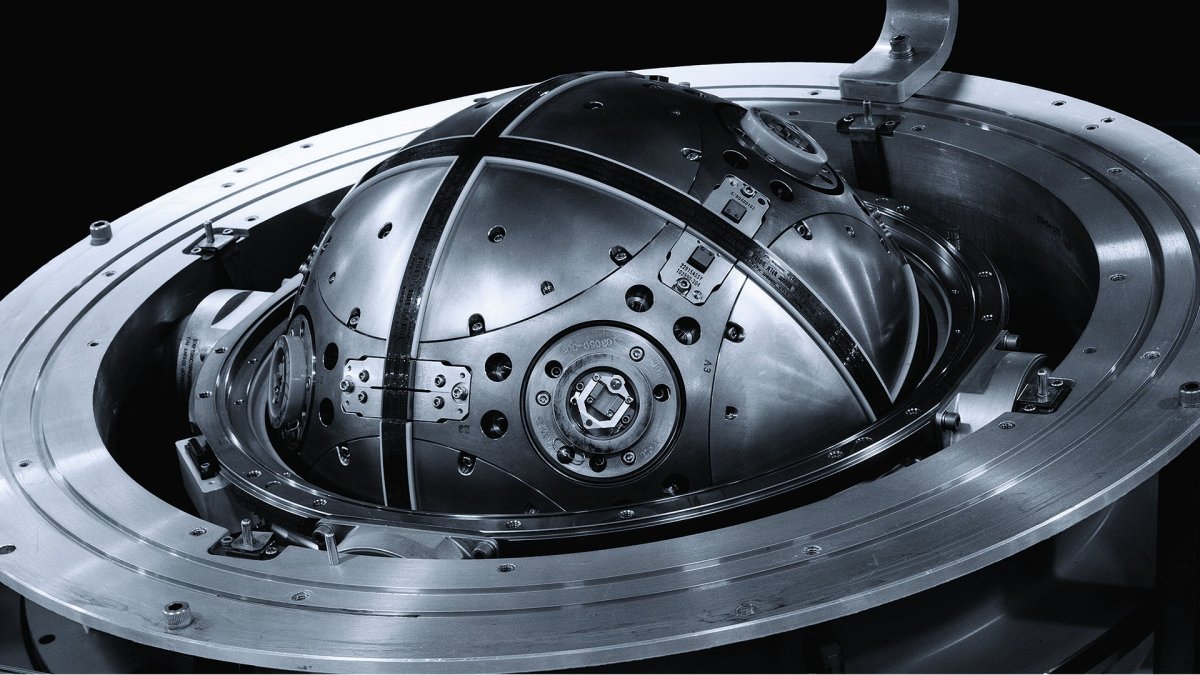
The subject in the striking image above looks like the centerpiece prop in a high-end sci-fi flick, but it is anything but. What you are looking at is the Advanced Inertial Reference Sphere (AIRS) guidance system that was designed to be used as the navigational heart of the highly-accurate LGM-118A Peacekeeper intercontinental ballistic missile (ICBM), also known as the MX (Missile Experimental). Peacekeeper represented the pinnacle of Cold War-era American ICBM technology, but it came at a very high price and with a less than favorable developmental timeline. Even though it dwarfed its Minuteman III stablemate, and it was advanced in many ways, AIRS was by far the most exquisite piece of technology associated with the MX/Peacemaker program. In fact, the system’s existence was a major factor in the Peacekeeper’s reason for being.
The masterful image was taken by photographer and author Martin Miller who had taken up the task of capturing Cold War weaponry in dramatic fashion. The photo seen in its entirety below was featured in Miller’s book Weapons Of Mass Destruction : Specters Of The Nuclear Age .
In the book, Miller describes Peacekeeper’s super INS of sorts as such:
The inertial guidance module used by the Peacekeeper missile, technically called an Advanced Inertial Reference Sphere (AIRS). The AIRS redefined the concept of accuracy possible for ICBMs. Rather than being gimbal-mounted, the sphere floats in a fluorocarbon fluid within an outer shell. The gyroscopes and accelerometers are positioned within the sphere as are the three hydraulic thrust valves and turbopump used to maintain stable orientation of the sphere. The labor to assemble its 19,000 individual parts was enormous .
So yeah, this thing was really something. In fact, some would argue it was among the most incredible pieces of technology that came out of the Cold War. AIRS was critical in lowering the circular error probable (CEP, aka accuracy) of the missile down to 40 meters. The Minuteman III, which remains in service today, has a CEP of roughly six times that. The very idea that an ICBM could be so accurate was a major factor in bringing the Peacekeeper to life in the first place under what was then known as the MX program.
Nuclearweaponsarchive.org has a more detailed description of AIRS:
The AIRS (Advanced Inertial Reference Sphere) is the most accurate inertial navigation (INS) system ever developed, and perhaps marks the end of a long process of continuous refinement of INS technology. This immensely complex and expensive INS unit has “third generation” accuracy as defined by Dr. Charles Stark Draper, the leading force in the development of hyper-accurate inertial guidance. This translates into INS drift rates of less than 1.5 x 10^-5 degrees per hour of operation. This drift rate is so low that the AIRS contributes on the order of only 1% of the Peacekeeper missile’s inaccuracy, and is thus effectively a perfect guidance system (i.e. a zero drift rate would not measurably improve the Peacekeeper’s performance). Very little of the precision of this guidance system is even exploited during a ballistic missile flight, it is mostly used simply to maintain guidance system alignment on the ground during missile alert without needing an external reference through precision gyrocompassing. Most ICBMs require an external alignment system to keep the INS in synch with the outside world prior to launch. The AIRS is probably as good as any INS for ICBM guidance needs to get. The penalty for this extreme level of accuracy is tremendous complexity and cost. The AIRS has 19,000 parts. In 1989 a single accelerometer used in the AIRS (there are three) cost $300,000 and took six months to manufacture. There are very few applications requiring such precise guidance and independence from external references. In fact, beyond ICBM guidance, none have been identified. If the requirement for complete autonomy is eliminated, extreme guidance accuracy is available at a small fraction of its cost and weight. For example, the advent of satellite positioning systems like GPS (Global Positioning System) and GLONASS, which permit centimeter-level accuracy over unlimited periods of operation with only a light inexpensive receiver. NASA spcecraft require extreme guidance precision, but use external navigation cues to obtain it. Even new nuclear weapon guidance programs have shown a willingness to sacrifice autonomy for cost and weight. The proposed BIOS (Bomb Impact Optimization System), a glide-bomb adaptation of the B-61, has proposed using GPS for guidance instead of an INS. Given the competition from advanced external reference-based approaches, INS technology has probably reached the end of the line as far as accuracy goes.
The AIRS (Advanced Inertial Reference Sphere) is the most accurate inertial navigation (INS) system ever developed, and perhaps marks the end of a long process of continuous refinement of INS technology.
This immensely complex and expensive INS unit has “third generation” accuracy as defined by Dr. Charles Stark Draper, the leading force in the development of hyper-accurate inertial guidance. This translates into INS drift rates of less than 1.5 x 10^-5 degrees per hour of operation. This drift rate is so low that the AIRS contributes on the order of only 1% of the Peacekeeper missile’s inaccuracy, and is thus effectively a perfect guidance system (i.e. a zero drift rate would not measurably improve the Peacekeeper’s performance).
Very little of the precision of this guidance system is even exploited during a ballistic missile flight, it is mostly used simply to maintain guidance system alignment on the ground during missile alert without needing an external reference through precision gyrocompassing. Most ICBMs require an external alignment system to keep the INS in synch with the outside world prior to launch. The AIRS is probably as good as any INS for ICBM guidance needs to get.
The penalty for this extreme level of accuracy is tremendous complexity and cost. The AIRS has 19,000 parts. In 1989 a single accelerometer used in the AIRS (there are three) cost $300,000 and took six months to manufacture.
There are very few applications requiring such precise guidance and independence from external references. In fact, beyond ICBM guidance, none have been identified. If the requirement for complete autonomy is eliminated, extreme guidance accuracy is available at a small fraction of its cost and weight. For example, the advent of satellite positioning systems like GPS (Global Positioning System) and GLONASS, which permit centimeter-level accuracy over unlimited periods of operation with only a light inexpensive receiver. NASA spcecraft require extreme guidance precision, but use external navigation cues to obtain it. Even new nuclear weapon guidance programs have shown a willingness to sacrifice autonomy for cost and weight. The proposed BIOS (Bomb Impact Optimization System), a glide-bomb adaptation of the B-61, has proposed using GPS for guidance instead of an INS. Given the competition from advanced external reference-based approaches, INS technology has probably reached the end of the line as far as accuracy goes.
Left: A display of the AIRS. Other images: AIRS in various stages of development. , Far left image: Fastfission/wikicommons. Other images: Public Domain
The last paragraph is right on the money. Today, ring-laser gyro INS systems with embedded GPS come in tiny packages and can sustain massive G forces allowing them to be packed into everything from missiles to artillery shells. You can read all about these fascinating systems in this past piece of mine .
A modern ring-laser gyro system. , Honeywell
Before GPS was available to correct for drift, it’s amazing the lengths engineers went through to make inertial navigation systems as accurate as possible. Beyond making a near-perfect mechanical gyro-based INS at virtually all costs, other forms of navigation were used to help update less capable INS systems. Maybe the most capable were astronavigation units that found their way onto strategic aircraft like the SR-71 Blackbird and B-2. Even the Trident SLBM uses astronavigation to update its less capable INS. You can read all about these incredible systems here . The idea that Peacekeeper just used AIRS alone to be able to deliver up to a dozen nuclear warheads as far as some 9,000 miles from its launch point is a technological triumph that is far larger than it is given credit for.
Even though the fact that AIRS was even possible helped bring Peacekeeper into existence, it also hurt its chances at wider deployment, among a number of other major factors. Even though it was literally the heart of the missile’s concept, its extreme complexity meant that the “operational” missiles that were deployed starting in 1986 didn’t even have an INS installed. They were useless. It wasn’t till 1988 that the missiles began to be fitted with this critical component.
A Peacekeeper’s MIRVs impacting near Kwajalein Atoll during a long-range test launch., DoD
Just 50 operational LGM-118As were ever deployed. They finally left the inventory entirely in 2005. In all reality, the START II treaty had a huge impact on the missile’s utility. If each missile was to be fitted with only a single warhead, the Minuteman III was a far cheaper way of sustaining America’s somewhat questionable ‘nuclear sponge.’ Also, the idea behind the Peacekeeper was being able to accurately hit Soviet warhead-packed ICBMs in their individual silos, something Minuteman wasn’t precise enough to do. The fact that Peacekeeper was never deployed under a survivable concept as originally envisioned also hurt its career. But Peacekeeper still stands as a technological marvel, with its incredibly complex, but incredibly capable AIRS being its true triumph in technology and made the missile concept worth pursuing at all during the twilight of the Cold War.
Hat tip to @atomicarchive who inadvertently prompted this interesting little journey into the Peacekeer’s past. Also, I want to give a big thanks to Martin Miller for allowing us to share his awesome image. Make sure to check out his website linked here.
Contact the author: Tyler@thedrive.com
Comments couldn’t be loaded. Please refresh the page.
更新于美国东部时间2019年12月1日上午6:03
上图中引人注目的物体看起来像是高端科幻电影中的核心道具,但实际上并非如此。您看到的是先进惯性参考球(AIRS)制导系统,它被设计为高精度LGM-118A“和平缔造者”洲际弹道导弹(ICBM,也称MX导弹实验型)的导航核心。“和平缔造者”代表了冷战时期美国洲际弹道导弹技术的巅峰,但其研发成本极高,且研发周期并不理想。尽管AIRS比其同系列的“民兵III”导弹体型更大,并且在许多方面都更先进,但它无疑是MX/“和平缔造者”计划中最精妙的技术。事实上,该系统的存在是“和平缔造者”导弹得以诞生的关键因素之一。
这张精湛的照片出自摄影师兼作家马丁·米勒之手,他致力于以震撼人心的方式记录冷战时期的武器装备。下方完整展示的照片收录于米勒的著作《大规模杀伤性武器:核时代的幽灵》中。
在书中,米勒这样描述“和平卫士”的超级INS系统:
“和平卫士”导弹使用的惯性制导模块,技术上称为先进惯性参考球(AIRS)。AIRS重新定义了洲际弹道导弹的精度。它并非采用万向节安装,而是漂浮在外壳内的氟碳液体中。陀螺仪、加速度计、三个液压推力阀以及用于维持球体稳定姿态的涡轮泵都位于球体内部。组装其19000个独立部件的工作量极其巨大。
没错,这玩意儿确实非同凡响。事实上,有人甚至认为它是冷战时期最不可思议的技术之一。AIRS系统在将导弹的圆概率误差(CEP,也就是精度)降低到40米方面发挥了至关重要的作用。如今仍在服役的民兵III型导弹的CEP大约是它的六倍。洲际弹道导弹能够达到如此高的精度,正是促成“和平卫士”导弹(当时被称为MX计划)诞生的重要因素。
Nuclearweaponsarchive.org网站对AIRS有更详细的描述:
AIRS(先进惯性参考球)是迄今为止最精确的惯性导航(INS)系统,或许标志着INS技术漫长而持续改进过程的终结。这款极其复杂且昂贵的INS装置拥有“第三代”精度,正如超高精度惯性制导领域领军人物查尔斯·斯塔克·德雷珀博士所定义的那样。这意味着INS的漂移率低于每小时运行1.5 x 10⁻⁵度。如此低的漂移率使得AIRS对“和平卫士”导弹精度的贡献仅占1%左右,因此它实际上是一种完美的制导系统(即零漂移率不会显著提高“和平卫士”的性能)。在弹道导弹飞行过程中,该制导系统的精度几乎不会被充分利用,它主要用于在导弹警戒期间通过精密陀螺罗盘在地面保持制导系统的对准,而无需外部参考。大多数洲际弹道导弹都需要外部对准系统,以确保惯性导航系统(INS)在发射前与外部环境保持同步。AIRS系统或许是洲际弹道导弹制导所需INS系统的最佳选择。然而,如此高的精度也带来了巨大的复杂性和成本。AIRS系统包含19000个部件。1989年,AIRS系统中使用的单个加速度计(共三个)造价高达30万美元,制造周期长达六个月。极少有应用需要如此精确的制导和对外部参考的完全依赖。事实上,除了洲际弹道导弹制导之外,目前尚未发现其他类似应用。如果无需完全自主运行,只需极低的成本和重量即可获得极高的制导精度。例如,GPS(全球定位系统)和GLONASS等卫星定位系统的出现,仅需轻便廉价的接收器即可实现厘米级精度,且运行时间不受限制。NASA的航天器也需要极高的制导精度,但它们依靠外部导航信息来实现这一目标。即使是新型核武器制导项目也表现出为了降低成本和减轻重量而牺牲自主性的意愿。例如,拟议中的BIOS(炸弹撞击优化系统)是B-61滑翔炸弹的改进型,它提议使用GPS制导而非惯性导航系统(INS)。鉴于来自先进的外部参考制导方法的竞争,就精度而言,INS技术可能已经走到了尽头。
AIRS(先进惯性参考球)是迄今为止开发的最精确的惯性导航(INS)系统,或许标志着 INS 技术不断改进的漫长过程的结束。
这款极其复杂且造价昂贵的惯性导航系统(INS)装置拥有查尔斯·斯塔克·德雷珀博士定义的“第三代”精度,德雷珀博士是超高精度惯性制导领域的领军人物。这意味着INS的漂移率低于每小时运行1.5 x 10^-5度。如此低的漂移率使得自动瞄准系统(AIRS)对“和平卫士”导弹精度的贡献仅占1%左右,因此它实际上是一种完美的制导系统(即零漂移率不会显著提高“和平卫士”导弹的性能)。
在弹道导弹飞行过程中,这种制导系统的精度几乎得不到充分利用,它主要用于在导弹警戒期间,通过精密陀螺罗盘在地面保持制导系统对准,而无需外部参考。大多数洲际弹道导弹都需要外部对准系统,以确保惯性导航系统在发射前与外部环境保持同步。对于洲际弹道导弹的制导而言,AIRS 的精度可能已经达到了惯性导航系统所需的最高水平。
这种极高的精度带来的代价是极其复杂的结构和高昂的成本。AIRS系统由19000个零件组成。1989年,AIRS系统中使用的单个加速度计(共三个)造价高达30万美元,制造周期长达六个月。
极少有应用需要如此精确的制导和完全摆脱外部参考。事实上,除了洲际弹道导弹制导之外,尚未发现其他类似应用。如果取消完全自主制导的要求,就能以极低的成本和重量获得极高的制导精度。例如,GPS(全球定位系统)和GLONASS等卫星定位系统的出现,仅需轻便廉价的接收器即可实现厘米级精度,且运行时间不受限制。NASA的航天器需要极高的制导精度,但它们依靠外部导航信息来实现。即使是新的核武器制导项目也表现出愿意为了降低成本和减轻重量而牺牲自主性。拟议的BIOS(炸弹撞击优化系统)是B-61滑翔炸弹的改进型,它提议使用GPS进行制导,而不是使用惯性导航系统(INS)。鉴于来自先进的基于外部参考的制导方法的竞争,就精度而言,INS技术可能已经达到了极限。
左图:AIRS 的展示图。其他图片:AIRS 的不同开发阶段。最左侧图片:Fastfission/wikicommons。其他图片:公共领域
最后一段说得完全正确。如今,内置GPS的环形激光陀螺仪惯性导航系统体积非常小巧,能够承受巨大的过载,因此可以安装在从导弹到炮弹的各种装备中。您可以在我之前的一篇文章中了解更多关于这些引人入胜的系统的信息。
霍尼韦尔公司生产的现代环形激光陀螺仪系统。
在GPS出现以修正漂移之前,工程师们为了尽可能提高惯性导航系统的精度所付出的努力令人惊叹。除了不惜一切代价制造出近乎完美的机械陀螺仪式惯性导航系统(INS)之外,他们还利用其他导航技术来升级性能较弱的INS系统。其中性能最强大的或许是天文导航装置,它们被安装在SR-71“黑鸟”和B-2等战略飞机上。甚至连“三叉戟”潜射弹道导弹也使用天文导航来升级其性能稍逊的INS系统。您可以在这里阅读有关这些卓越系统的全部内容。“和平卫士”导弹仅使用AIRS系统就能将多达12枚核弹头投放到距离发射点约9000英里(约14500公里)的远距离目标,这本身就是一项远超人们认知的技术壮举。
尽管AIRS系统本身的存在促成了“和平卫士”导弹的诞生,但诸多其他重要因素也阻碍了其更广泛部署的可能性。AIRS系统是该导弹概念的核心,但其极高的复杂性意味着1986年开始部署的“作战”导弹甚至没有安装惯性导航系统(INS)。它们形同虚设。直到1988年,这些导弹才开始加装这一关键部件。
一枚“维和者”导弹的多弹头分导式导弹在远程试射中击中夸贾林环礁附近。(美国国防部)
LGM-118A导弹仅部署了50枚,并于2005年彻底退役。事实上,《第二阶段削减战略武器条约》(START II)对该导弹的效用产生了巨大影响。如果每枚导弹只能携带一枚核弹头,那么“民兵III”导弹无疑是维持美国略显可疑的“核海绵”能力的更经济的选择。此外,“和平卫士”导弹的设计理念是能够精确打击苏联装载核弹头的洲际弹道导弹发射井,而“民兵”导弹的精度不足以做到这一点。“和平卫士”导弹从未按照最初设想的生存能力进行部署,这也对其发展造成了不利影响。但“和平卫士”导弹至今仍是一项技术奇迹,其极其复杂但性能卓越的自动拦截系统(AIRS)才是其真正的技术成就,也正是这些系统使得在冷战末期,该导弹概念的研发具有了意义。
感谢 @atomicarchive,是他无意间开启了这段有趣的和平卫士历史探索之旅。同时,我也要衷心感谢 Martin Miller 允许我们分享他那张精彩的照片。请务必访问他的网站(链接在此)。
联系作者:Tyler@thedrive.com
评论加载失败,请刷新页面。