Airborne assault comes to Super Garuda Shield exercise in Indonesia印尼“超级迦楼罗之盾”演习引入空降突击战术
Super Garuda Shield in Indonesia expands with new participants and demonstrates new joint, combined operational capabilities.
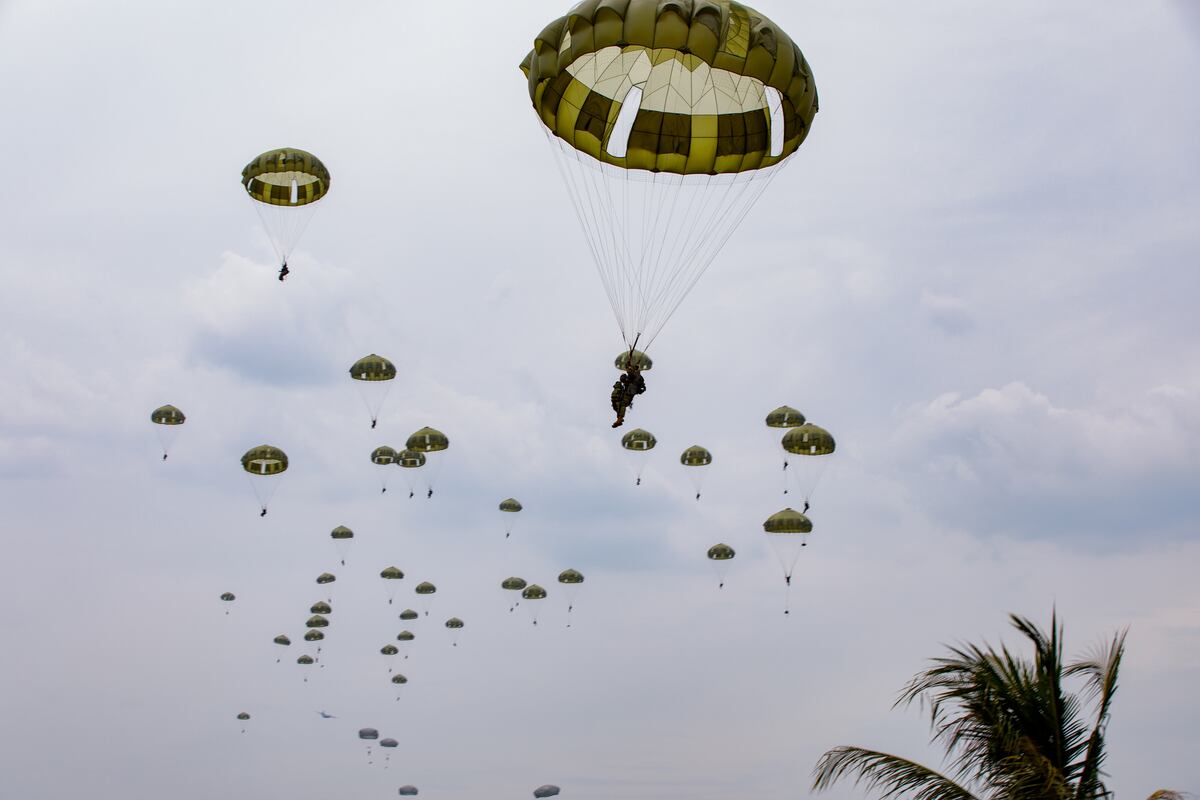
The U.S. Army and the National Indonesian Armed Forces, along with other allies and partners, coordinated a complex airborne assault mission into South Sumatra for the first time as part of Super Garuda Shield that wrapped up earlier this month.
A battalion out of the 11th Airborne Division based in Alaska conducted the airborne assault operation amid a variety of other operations taking place throughout Indonesia that were mostly centered in Java.
“We definitely expanded our reach. For me to go and command and control the airborne operation, that took me four hours of flying to get up to the operation,” Brig. Gen. Kevin Williams, the Army’s 25th Infantry Division’s commanding general for operations, told Defense News in a recent interview. “You’re talking about inter-theater operational reach, which was pretty amazing.”
In previous iterations of Super Garuda Shield, the participating forces would focus on one area at a time, Williams explained, such as Java or Sumatra, “but we’ve expanded that to test how we command and control this as a joint force and with a partner.”
Japanese and Indonesians participated in the airborne assault to test joint entry operations as well, according to Williams.
The exercise also expanded in overall participation this year, Williams said. In 2015, 200 Indonesian soldiers participated along with just 300 U.S. soldiers. Williams was one of them.
Garuda Shield now has over 2,500 U.S. participants from the joint force. Partner nation participation nearly doubled that.
“That is a huge increase in the complexity and scale of what we’re doing,” Williams said.
The multinational element has greatly expanded, with eight full participating nations not including the U.S. and Indonesia – Australia, Canada, France, Japan, Singapore, South Korea, United Kingdom and New Zealand. Twelve other nations provided observers who also participated in a staff exercise.
Also new this year, with the Air Force bringing in assets like C-130 aircraft and the 25th ID bringing a Combat Aviation Brigade with two CH-47F Chinook cargo helicopters, the exercise had a fully combined Aviation Task Force that helped in critical operations like pushing the logistics tail in the archipelago.
A large emphasis was placed on forming a Combined Task Force Operations Center to build interoperable operational command and control, Williams noted.
And the 25th ID brought the Army’s new Integrated Tactical Network and more mission command nodes across the joint force, which helped set conditions to see a common operating picture.
The exercise allowed participants to test logistics capabilities, over-the-horizon communications infrastructure and the ability to tie together assets.
Garuda Shield included a joint strike exercise in Java where the U.S. Army brought in its High Mobility Artillery Rocket System, the Marine Corps brought its attack aviation, and partner nations flew F-16 fighter jets and incorporated other missile systems to evaluate the ability to use any sensor or shooter across air, sea, and ground platforms to take out a series of targets, Williams described.
The Marine Corps, along with Indonesia, Japan and Singapore, conducted an amphibious assault using three different platforms including an assault craft from Singapore and the amphibious transport dock Green Bay.
“We were able to demonstrate our ability to combine doing an amphibious assault on a beachhead with reconnaissance, utilize long-range fires to set those conditions and then also conduct another air assault operation using the [Marine Corps V-22] Osprey [tiltrotor aircraft] to get the forces on the ground with the partners and then exfil[trate],” Williams said.
Williams said prior to the culminating event, the Army would conduct a combined arms live fire operation in a “pretty complex scenario using ground maneuver with the partners.”
Garuda Shield is just one example of many exercises within the Army’s Operation Pathways series in the Indo-Pacific that has seen significant expansion in recent years as the service focuses on building its relationships with nations in the theater while also ensuring the ability for countries to rapidly come together to conduct complex operations seamlessly in a potential conflict.
“It goes back to building this readiness and interoperability, this realistic training and really these repetitions that we’ve done during Super Garuda Shield and across all our Operation Pathways [exercises],” Williams said, “It really just provides capable, ready land forces that allow us to be positioned throughout the Indo-Pacific. It does bolster our allies and partners with that trust and it really just ensures we and Indonesia are prepared for any contingency or conflict or disaster that comes along.”
Jen Judson is an award-winning journalist covering land warfare for Defense News. She has also worked for Politico and Inside Defense. She holds a Master of Science degree in journalism from Boston University and a Bachelor of Arts degree from Kenyon College.
美国陆军和印度尼西亚国民武装部队,以及其他盟友和伙伴,首次协调了一次复杂的空降突击任务,进入南苏门答腊,这是“超级迦楼罗之盾”行动的一部分,该行动于本月初结束。
驻扎在阿拉斯加的第 11 空降师的一个营执行了空降突击行动,与此同时,印尼各地还开展了各种其他行动,这些行动大多集中在爪哇岛。
“我们的作战范围确实扩大了。就我个人而言,要指挥和控制空降作战,我需要飞行四个小时才能到达作战地点,”陆军第25步兵师作战司令凯文·威廉姆斯准将在最近接受《防务新闻》采访时表示。“这相当于跨战区作战,这相当了不起。”
威廉姆斯解释说,在之前的“超级迦楼罗之盾”演习中,参演部队一次只会专注于一个区域,例如爪哇岛或苏门答腊岛,“但我们已经扩大了范围,以测试我们如何作为联合部队与伙伴一起指挥和控制这一区域。”
据威廉姆斯称,日本和印度尼西亚也参与了空降突击行动,以测试联合突击作战。
威廉姆斯说,今年的演习参与人数也有所增加。2015年,有200名印尼士兵和300名美军士兵参加了演习,威廉姆斯本人也是其中一员。
“迦楼罗之盾”演习目前已有超过2500名美军联合部队人员参与。伙伴国的参与人数几乎是这个数字的两倍。
威廉姆斯说:“这意味着我们所做的事情在复杂性和规模上都大大增加了。”
多国参与规模大幅扩大,除美国和印度尼西亚外,共有八个国家正式参与——澳大利亚、加拿大、法国、日本、新加坡、韩国、英国和新西兰。另有十二个国家派出观察员,并参与了参谋演练。
今年也有新的变化,空军调来了 C-130 飞机等装备,第 25 步兵师调来了一个战斗航空旅,配备两架 CH-47F 支奴干运输直升机,此次演习组建了一支完全联合的航空特遣部队,协助开展了关键行动,例如在群岛推进后勤保障。
威廉姆斯指出,重点是组建联合特遣部队作战中心,以建立可互操作的作战指挥和控制。
第 25 步兵师将陆军新的综合战术网络和更多任务指挥节点引入联合部队,这有助于创造条件,从而看到共同的作战图景。
此次演习使参与者能够测试后勤能力、超视距通信基础设施以及整合资源的能力。
威廉姆斯描述道,“加鲁达之盾”演习包括在爪哇岛举行的一次联合打击演习,美国陆军出动了高机动性火箭炮系统,海军陆战队出动了攻击航空兵,伙伴国家则出动了F-16战斗机,并整合了其他导弹系统,以评估利用空中、海上和地面平台上的任何传感器或发射装置摧毁一系列目标的能力。
美国海军陆战队与印度尼西亚、日本和新加坡一起,使用三种不同的平台进行了两栖突击,其中包括来自新加坡的突击艇和两栖船坞运输舰“绿湾”号。
威廉姆斯说:“我们能够展示我们有能力将两栖登陆作战与侦察相结合,利用远程火力创造条件,然后使用(海军陆战队 V-22)鱼鹰倾转旋翼机进行另一次空中突击行动,将部队与伙伴部队一起部署到地面,然后撤离。”
威廉姆斯表示,在最终演习之前,陆军将与合作伙伴在“相当复杂的场景中使用地面机动”进行联合兵种实弹射击行动。
“迦楼罗之盾”只是陆军在印太地区开展的“行动路径”系列演习中的一个例子。近年来,随着陆军致力于加强与该地区各国的关系,同时确保各国能够在潜在冲突中迅速团结起来,无缝地开展复杂行动,印太地区的“行动路径”系列演习得到了显著扩展。
威廉姆斯说:“这要追溯到我们建立战备和互操作性的基础,以及我们在‘超级迦楼罗之盾’演习和所有‘行动路径’演习中进行的实战训练和反复演练。这真正确保了我们拥有一支能力强、随时待命的陆军部队,使我们能够部署在整个印太地区。这增强了我们盟友和伙伴之间的信任,也真正确保了我们和印尼能够应对任何突发事件、冲突或灾难。”
珍·贾德森是一位屡获殊荣的记者,为《防务新闻》报道陆地战争。她也曾为《政治报》和《内幕防务》工作。她拥有波士顿大学新闻学硕士学位和凯尼恩学院文学学士学位。