USAF Assessing Feasibility Of Restarting C-17 Production As Part Of Its Future Airlift Vision美国空军正在评估重启C-17运输机生产的可行性,作为其未来空运愿景的一部分。
The USAF is about to kick off a larger review of next-generation airlift options, and is still refining requirements for new tankers.
新闻视频
By Joseph Trevithick
Published Sep 16, 2026 3:08 PM EDT
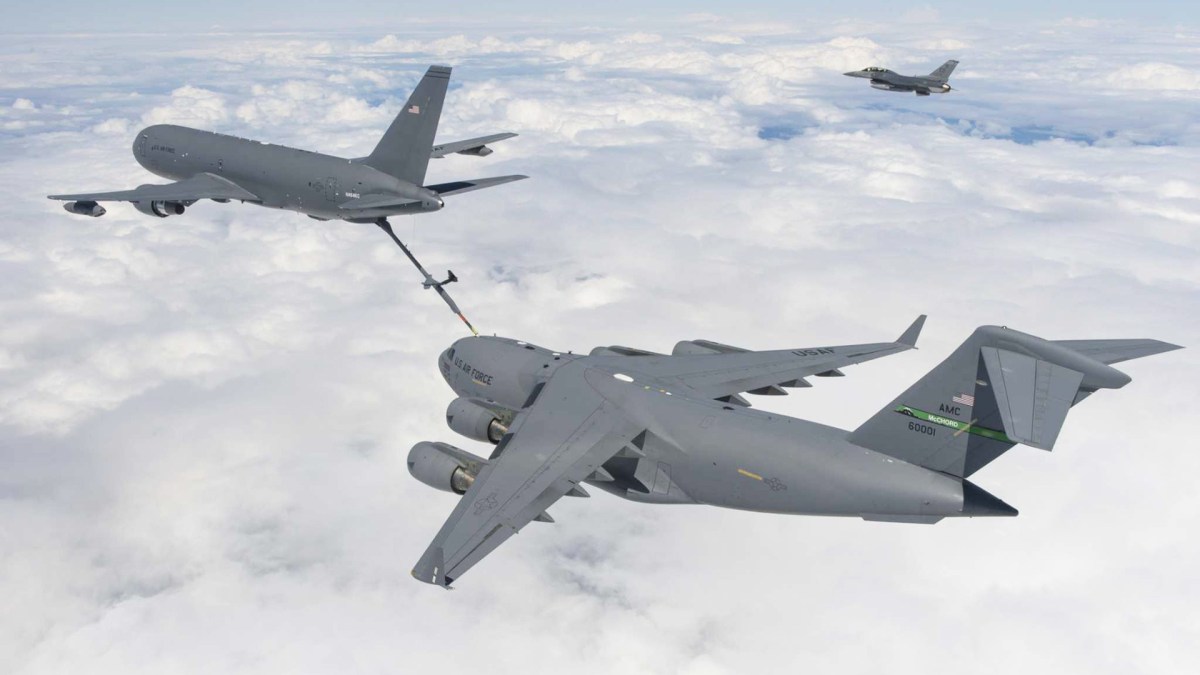
Paul Weatherman/Boeing
The U.S. Air Force has been taking a new look at the feasibility of restarting production of the C-17 Globemaster III cargo plane as part of its still-evolving next-generation airlift plans. The service also continues to explore a wide range of next-generation aerial refueling concepts, including new stealthy and/or uncrewed tankers , but a firm vision for the way forward there has yet to emerge.
Air Force Lt. Gen. Daniel Tulley, head of Air Mobility Command (AMC), shared new details about future airlift and aerial refueling efforts, with TWZ and other outlets at a roundtable at the Air & Space Forces Association’s (AFA) 2026 Air, Space & Cyber Conference .
On the airlift side, the Air Force’s stated plan to date is to replace both the C-17A and C-5M Galaxy with a single Next-Generation Airlift (NGAL) platform , starting in the mid-2040s. Separately, the service is pursuing what could be a family of future aerial refueling capabilities under what is now called the Advanced Tanker Systems (ATS) program. Very broadly speaking, ATS presents a path toward what might come after the retirement of the aging KC-135 tanker fleet , though those aircraft are still expected to keep flying for years to come. The Air Force is also moving to further expand its fleet of newer KC-46A tankers in the interim, but persistent technical and other issues with that design continue to present hurdles .
A US Air Force C-5, at left, together with one of the sevice’s C-17s, at right. USAF
A KC-135, at right, prepares to link with a KC-46, at left, during a test. USAF
At the roundtable today, Lt. Gen. Tulley was asked explicitly about restarting C-17 production. The manufacturer of those aircraft, Boeing, shuttered that line in 2015. The company also just marked the 35th anniversary of the design’s first flight yesterday.
“Heck yeah, but with a caveat, right?” Tulley said in response. “So we were just asking this question over the course of last week, and it’s in the context of next-generation airlift. So we are about to embark on the Analysis of Alternatives to replace the C-17 and replace the C-5. All options are on the table.”
“There’s always the option to service life extend the C-17, but the [production restart] question came up,” he continued. “I’ve heard this my entire career. Once we terminate an assembly line, can we ever bring it back? Does somebody store all the machinery and the dies and whatnot, and can you bring that out? So we’re asking that question.”
“But then whatever that answer is from the vendors, what will be the price tag associated with that?” he added. “You have to ask yourself, okay, is rebuilding a C-17 even if you make improvements – and there’s a loose analogy with the C-130J , [a] much more modern, capable variant of the C-130E [author’s note: the C-130J evolved more directly from the C-130H variant] I first learned to fly – if you do that with the C-17, is that the best move? Or are there new technologies that we can incorporate into it so that it can defend itself, so that it’s connected, it’s networked, it does all the things that maybe the current C-17 doesn’t do?”
“We’re looking into it as part of the Analysis of Alternatives. I’m hopeful that we’ll get to answer that question.”
In June, the House Armed Services Committee also directed the U.S. Air Force to prepare a formal briefing on the matter of new C-17 production in a report accompanying a draft of the annual defense policy bill, or National Defense Authorization Act (NDAA), for Fiscal Year 2027.
The RAND Corporation did conduct a detailed, independent analysis more than a decade ago that assessed the costs and complexities that could come from Boeing building more C-17As, as well as other variants and derivatives of the design. RAND’s conclusion was that any of the courses of action would require billions of dollars of new investment and entail risks, as you can read more about in more detail here .
Foreign participation in a new C-17 production run could help at least defray costs. Australia, Canada, India, Kuwait, Qatar, the United Arab Emirates, and the United Kingdom all currently fly Globemaster IIIs. The Strategic Airlift Capability (SAC) initiative, a multinational arrangement with several European members, as well as the United States, also operates three of these aircraft.
Boeing told TWZ directly in June that unnamed C-17 operators had been reaching out about the prospect of restarting the production line, and that the company was “encouraged” by those discussions.
As Lt. Gen. Tulley stressed, there are significant questions about whether buying new-production C-17s, even with substantial improvements, is not only feasible, but a good use of resources. The Air Force’s Globemaster III fleet today continues to prove itself to be critical to the U.S. military’s ability to project power globally , and is in very high demand right now, especially amid the ongoing conflict with Iran .
The Air Force’s desire to replace both the C-17 and C-5, which are very different aircraft in form and function , could still easily lead the service down a different route. Boeing is not the only one looking at future NGAL opportunities. Another company, Radia, has been very actively pitching a clean-sheet design that is physically bigger than either the C-17 and the C-5, and that is geared toward greater operational flexibility, at the Air Force. Radia is targeting a first flight of its aircraft, called Windrunner , by the end of the decade, but it is still in a very aspirational stage at present.
A rendering of Radia’s Windrunner design. Radia
Many questions also still remain about how the Air Force will ultimately proceed on the next-generation aerial refueling front.
“So thinking beyond the current KC-46 buy and the program extension, whatever that next tanker looks like, our Advanced Tanker System, it’s got to be connected. It’s got to be able to defend itself,” Lt. Gen. Tulley said at the roundtable. “But it begs the question: does it need to be manned? Could it be optionally manned? Could it be autonomous? Or is there a family of solutions maybe that would answer that question? So I do not believe that it has to be manned.”
The AMC head was responding to a specific question about how autonomy could play into the Air Force’s future aerial refueling plans, which included a reference ot the U.S. Navy’s MQ-25 Stingray tanker drone . The Navy just announced its first low-rate initial production contract for MQ-25s on Monday.
“I think you’re seeing that with the MQ-25 and the Navy’s work, but then, how do we, the U.S. Air Force, bring that to bear in scope, scale, and range?” Tulley continued. “An optionally manned or an unmanned tanker, at range, the ranges we need to operate at, it’s a very large aircraft. And we’re not yet to where we’re employing fully autonomous large aircraft, but the technology, I would say, is there and rapidly getting there if it’s not.”
The MQ-25 is another Boeing product, and that company has shown a rendering of a larger, land-based derivative in the past. Lockheed Martin’s Skunk Works has also put forward several advanced tanker concepts in the past, including stealthy and potentially uncrewed designs .
A rendering of a larger, land-based derivative of the MQ-25, depicted refueling from a KC-46 tanker. Boeing
One of the advanced tanker concepts Lockheed Martin’s Skunk Works has shared publicly in recent years. Lockheed Martin Skunk Works
“We will be going after how to make the tanker survive,” William Bailey, the Air Force official currently performing the duties of the Assistant Secretary of the Air Force for Acquisition, Technology and Logistics, had also told TWZ and other outlets at a separate roundtable at the Air, Space & Cyber Conference yesterday. Bailey was responding to a direct question about whether the service was moving away from the idea of a stealthy tanker as part of the ATS plan.
“So, lots of work around what do we do in the future for our tankers, and we spent a pretty dedicated effort to go through and look at what do we think those design solutions could look like,” Bailey also said. “We looked internally. We went out to industry, had those guys come back with their thoughts on how to provide a more survivable aircraft.”
“The stuff that was coming in for me might have been an incremental improvement, but [it was] not clear that that represented the next step, the next phase,” he added. “What you’ll see is we’ll take our efforts, and we’ll look at, hey, if the real question is tanker access, then let’s not constrain ourselves to just the aircraft itself and trying to make a stealthy tanker. We need a tanker to have access, so we’ll talk about all those systems that it would take to protect that tanker.”
Bailey said the question of operational “access” applied to next-generation discussions, as well.
As is the case with the Air Force’s airlift fleets, the service tankers are in high demand due to the conflict with Iran and other current operational requirements. Stress on the existing tanker force, compounded by the ever-advancing age of the KC-135s, has been a steadily growing point of concern for years now . U.S. military officials have long been drawing attention to the limits of available aerial refueling capacity to meet even routine peacetime demands. The Air Force, as well as the U.S. Navy, have also expanded their use of contractor-owned and operated tankers to perform certain non-combat aerial refueling missions to help ease this strain.
This ex-French Air Force KC-135FR tanker, now operated by private contractor Metrea, is an example of the outside aerial refueling capacity the U.S. military has been increasingly leveraging in recent years. Metrea
In the meantime, the Air Force is still pursuing upgrades for its existing airlift and tanker fleets, with heavy focus on increased network connectivity and improved self-protection capabilities .
Greater connectivity “can be a game changer, and it has been a game changer in Operation Epic Fury [against Iran],” Lt. Gen. Tulley said at today’s roundtable. “The ability for air crews to communicate, to coordinate tanker orbits and rendezvous, to pass threat information, to save lives and save aircraft has been everything we expected it to be and more.”
“We have MAF NEXUS that we’re pursuing. The goal is to have this on all mobility aircraft, whether they’re future-built and it’s incorporated, or it’s an add-on capability to existing aircraft,” he continued. “It brings edge compute, the ability to then employ AI [artificial intelligence] and much more computing core power forward on the aircraft, and it does network with the rest of the joint force and the Air Force’s battle management system.”
A picture of a US Air Force KC-135 tanker spotted earlier this year with a new large satellite communications antenna (further highlighted in the inset), underscoring work underway now to improve the network connectivity of those aircraft. Alessandro Ledda
When it comes to new options for protecting existing tankers, “nothing’s off the table,” the AMC boss added. “Whether it’s [in the] electromagnetic spectrum, whether it’s kinetic self-defense , a layered approach, we’re looking at everything to come up with what might be the best system. But it’s got to be a system that we can afford, and it’s got to be one that we can put on all the aircraft we have and the ones we’re about to build.”
Using Collaborative Combat Aircraft (CCA) or other types of drones to help provide localized defense for airlifters and tankers could be another option. The Air Force has already experimented with this , at least to a degree.
The Air Force is otherwise still clearly continuing to shape its future airlift and aerial fueling visions. As part of that work, the service is now at least considering is again the possibility of rebooting C-17 production.
Contact the author: joe@twz.com
Comments couldn’t be loaded. Please refresh the page.
作者:约瑟夫·特雷维西克
发布于美国东部时间2026年9月16日下午3:08
保罗·韦瑟曼/波音
作为其仍在不断完善的下一代空运计划的一部分,美国空军正在重新审视重启C-17“环球霸王III”运输机生产的可行性。空军也在持续探索各种下一代空中加油方案,包括新型隐形和/或无人加油机,但目前尚未形成明确的发展方向。
空军中将丹尼尔·图利(Daniel Tulley)是空军机动司令部(AMC)的负责人,他在空军与太空部队协会(AFA)2026 年航空、航天与网络会议的圆桌会议上,与 TWZ 和其他媒体分享了有关未来空运和空中加油工作的最新细节。
在空运方面,空军迄今为止的既定计划是从2040年代中期开始,用单一的下一代空运(NGAL)平台取代C-17A和C-5M“银河”运输机。与此同时,空军正在推进一项名为“先进加油机系统”(ATS)的项目,旨在研发一系列未来的空中加油能力。从广义上讲,ATS为老旧的KC-135加油机退役后的发展指明了方向,尽管这些飞机预计在未来几年仍将继续服役。在此期间,空军也在进一步扩充其新型KC-46A加油机的机队,但该机型持续存在的技术和其他问题仍然是阻碍其发展的障碍。
左侧为美国空军的C-5运输机,右侧为该军种的一架C-17运输机。美国空军
在一次测试中,一架KC-135(右)准备与一架KC-46(左)对接。美国空军
在今天的圆桌会议上,塔利中将直接被问及重启C-17运输机生产的问题。该机型的制造商波音公司于2015年关闭了这条生产线。该公司昨天刚刚庆祝了该机型首飞35周年。
“当然,但有个前提条件,对吧?”塔利回应道。“我们上周一直在讨论这个问题,这是关于下一代空运的。我们即将启动C-17和C-5替代方案的分析。所有方案都在考虑范围内。”
“C-17的服役寿命始终是一个可行的选择,但(重启生产)的问题又出现了,”他继续说道。“我整个职业生涯都在听这个问题。一旦我们终止了一条装配线,我们还能让它恢复生产吗?是否有人保存了所有的机器、模具等等,我们还能把它们搬回来吗?所以我们正在考虑这个问题。”
“但是,无论供应商给出什么答案,最终的价格又会是多少呢?”他补充道。“你必须扪心自问,即便对C-17进行改进——这有点像C-130J,它是C-130E(作者注:C-130J是由我最初学习驾驶的C-130H型直接发展而来)的更现代化、更强大的改进型——如果对C-17也进行同样的改进,这真的是最佳选择吗?或者,我们是否可以将一些新技术融入其中,使其具备自卫能力,实现互联互通,并完成当前C-17可能无法完成的所有任务?”
“我们正在将此纳入备选方案分析的范畴进行研究。我希望我们最终能够找到这个问题的答案。”
6 月,众议院军事委员会还指示美国空军准备一份关于新型 C-17 生产问题的正式简报,该简报将作为 2027 财年年度国防政策法案(即《国防授权法案》)草案的附件提交。
兰德公司十多年前曾进行过一项详细的独立分析,评估了波音公司生产更多C-17A运输机及其其他衍生机型可能带来的成本和复杂性。兰德公司的结论是,任何方案都需要数十亿美元的新投资,并且存在风险,您可以在这里阅读更多详细信息。
外国参与新一轮C-17生产至少有助于降低成本。澳大利亚、加拿大、印度、科威特、卡塔尔、阿联酋和英国目前都在使用“环球霸王III”运输机。“战略空运能力”(SAC)计划是一项多国合作项目,成员包括多个欧洲国家以及美国,该计划也运营着三架此类飞机。
波音公司在 6 月份直接告诉 TWZ,一些未透露姓名的 C-17 运营商一直在就重启生产线的可能性与他们联系,该公司对这些讨论感到“鼓舞”。
正如塔利中将强调的那样,即便经过大幅改进,采购新生产的C-17运输机是否可行,以及是否合理利用资源,仍然存在诸多疑问。空军的“环球霸王III”机队如今依然是美军全球投射力量的关键力量,并且目前需求量极大,尤其是在与伊朗持续冲突的背景下。
空军希望替换C-17和C-5这两款外形和功能截然不同的飞机,这很可能导致空军走上另一条道路。波音并非唯一一家关注未来下一代空中运输机(NGAL)机遇的公司。另一家公司Radia一直在积极向空军推销一款全新设计的飞机,该飞机在尺寸上大于C-17和C-5,并旨在提供更大的作战灵活性。Radia的目标是在本十年末实现其名为“风行者”(Windrunner)的飞机的首飞,但目前仍处于非常初步的阶段。
这是Radia设计的风行者造型效果图。Radia
关于空军最终将如何推进下一代空中加油技术,仍然存在许多疑问。
“所以,抛开目前的KC-46采购和项目延期不谈,无论下一代加油机是什么样子,我们的先进加油机系统,它都必须具备联网能力,必须具备自卫能力,”塔利中将在圆桌会议上说道。“但这引出了一个问题:它需要有人驾驶吗?可以采用可选有人驾驶吗?可以实现自主飞行吗?或者是否存在一系列解决方案可以回答这个问题?所以我认为它不一定需要有人驾驶。”
美国空军机动司令部(AMC)负责人是在回答一个关于自主技术将如何融入空军未来空中加油计划的具体问题时做出上述表态的,其中提到了美国海军的MQ-25“黄貂鱼”加油无人机。海军刚刚在周一宣布了其首份MQ-25的低速初始生产合同。
“我认为MQ-25和海军的工作已经体现了这一点,但问题是,我们美国空军该如何将其应用到规模、范围和航程上呢?”塔利继续说道,“无论是有人驾驶还是无人驾驶的加油机,在我们需要的航程范围内,它都是一种非常庞大的飞机。我们目前还没有完全掌握并运用完全自主的大型飞机,但我认为这项技术已经存在,即使尚未完全掌握,也正在迅速发展。”
MQ-25是波音公司的另一款产品,该公司过去曾展示过一款更大尺寸的陆基衍生机型的效果图。洛克希德·马丁公司的臭鼬工厂也曾提出过几款先进的加油机概念,包括隐形和潜在的无人驾驶设计。
图中展示了MQ-25的陆基衍生型号(尺寸更大)正在接受KC-46加油机空中加油的场景。波音公司
这是洛克希德·马丁公司臭鼬工厂近年来公开展示的先进油轮概念之一。洛克希德·马丁公司臭鼬工厂
“我们将着重研究如何提高加油机的生存能力,”空军官员威廉·贝利(William Bailey)昨天在空军、航天与网络会议期间的另一场圆桌会议上告诉TWZ和其他媒体。贝利目前代理空军助理部长(负责采购、技术和后勤)的职务。贝利是在回答一个直接问题时做出上述表态的,该问题涉及空军是否正在放弃将隐形加油机纳入空中交通管制(ATS)计划的想法。
“所以,我们做了很多关于未来加油机发展方向的工作,投入了大量精力去研究和探讨各种设计方案,”贝利还说。“我们进行了内部调研,也咨询了业界人士,让他们提出关于如何打造更具生存能力的飞机的想法。”
他补充道:“我当时看到的那些东西或许只是渐进式的改进,但并不清楚这是否代表着下一步、下一个阶段。你们将会看到,我们会继续努力,然后研究,如果真正的问题是加油机的进出通道,那么我们就不能仅仅局限于飞机本身,也不能试图制造一架隐形加油机。我们需要加油机能够进入目标区域,所以我们会讨论保护加油机所需的所有系统。”
贝利表示,操作上的“准入”问题也适用于下一代讨论。
与空军的运输机队一样,由于与伊朗的冲突以及其他当前的作战需求,加油机的需求量也居高不下。现有加油机部队的压力,加上KC-135机龄的不断增长,多年来一直是人们日益关注的问题。美国军方官员长期以来一直强调,现有的空中加油能力甚至难以满足和平时期的常规需求。为了缓解这种压力,空军和海军都增加了使用承包商拥有和运营的加油机,以执行某些非战斗空中加油任务。
这架前法国空军的KC-135FR加油机,现由私人承包商Metrea公司运营,是美国军方近年来日益重视并充分利用的外部空中加油能力的一个例证。
与此同时,空军仍在对其现有的空运和加油机机队进行升级,重点是提高网络连接性和增强自卫能力。
“更强的互联互通能力可以改变战局,而且在‘史诗狂怒行动’(针对伊朗的行动)中,它确实改变了战局,”塔利中将在今天的圆桌会议上说。“机组人员之间的通信能力,协调加油机的飞行路线和会合,传递威胁信息,拯救生命和飞机的能力,其作用不仅完全符合我们的预期,而且超出了预期。”
“我们正在推进MAF NEXUS项目。目标是让所有机动飞机都配备这项技术,无论是未来建造的飞机直接搭载,还是现有飞机的附加功能,”他继续说道。“它将边缘计算能力、人工智能应用能力以及更强大的计算核心能力带到飞机上,并且能够与联合部队的其他成员以及空军的作战管理系统联网。”
今年早些时候,一架美国空军KC-135加油机被发现安装了新型大型卫星通信天线(插图中进一步突出显示),这凸显了目前正在进行的提升此类飞机网络连接能力的工作。亚历山德罗·莱达
谈到保护现有加油机的新方案时,美国空军机动司令部(AMC)负责人补充说:“一切皆有可能。无论是电磁频谱防御、动能自卫,还是多层防御,我们都在研究各种方案,力求找到最佳系统。但这套系统必须是我们能够负担得起的,而且必须能够安装在我们现有的所有飞机以及即将建造的飞机上。”
使用协同作战飞机(CCA)或其他类型的无人机为运输机和加油机提供局部防御可能是另一种选择。空军已经对此进行过一定程度的试验。
空军显然仍在继续制定其未来的空运和空中加油计划。作为这项工作的一部分,空军目前至少正在重新考虑重启C-17运输机生产的可能性。
联系作者:joe@twz.com
评论加载失败,请刷新页面。