Cessna Cuts Cockpit Out Of SkyCourier Cargo Hauler For Uncrewed Logistics塞斯纳公司为无人物流运输机拆除了SkyCourier货运飞机的驾驶舱
After China moves at warp speed on uncrewed aerial logistics, Textron is offering a similar solution to the Pentagon with SkyCourier UX.
新闻视频
Published Sep 16, 2026 7:19 PM EDT
A new drone collaboration by Cessna owner Textron and autonomy provider Merlin Labs aims to offer the U.S. military a hot production line and a familiar platform for uncrewed aerial logistics, including in contested environments.
The product is SkyCourier UX, a drone version of the Cessna 408 SkyCourier that has flown for FedEx, foreign special operations forces and small remote commercial airlines during its six years of active service. TWZ previously covered how the SkyCourier would likely end up taking on military applications when it was first announced, which you can read here .
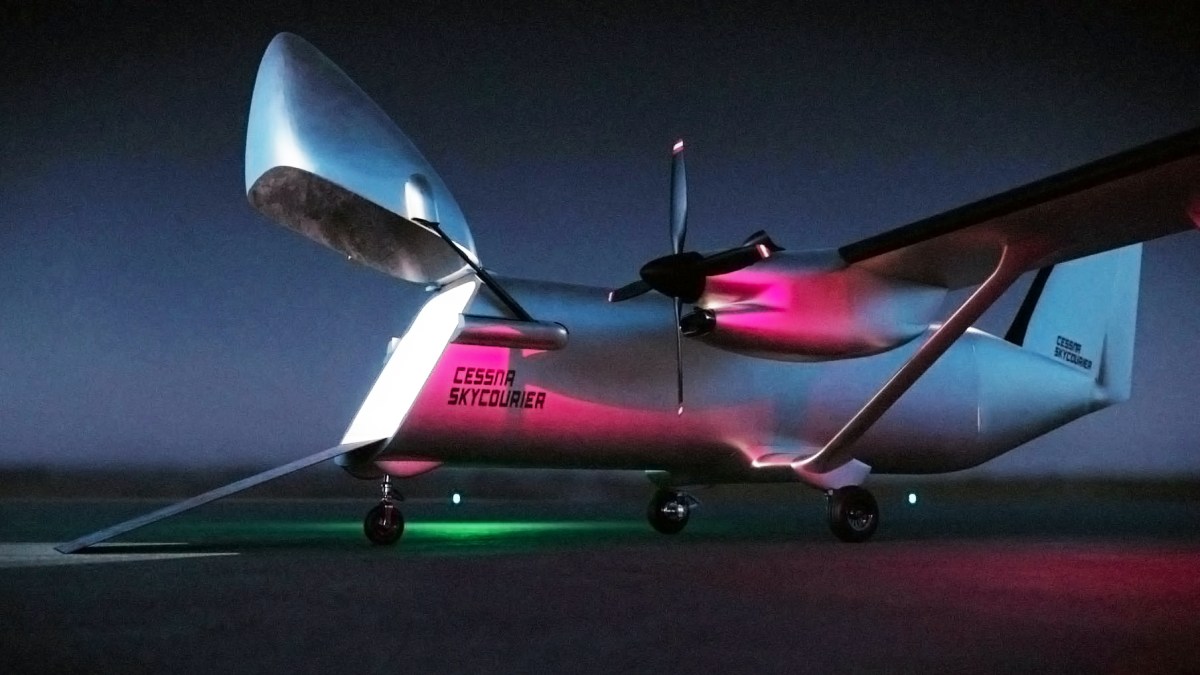
A partial full-size model on the show floor at the Air & Space Forces Association’s Air, Space & Cyber Conference in Washington, D.C., this week showed a nose that opened with hydraulics to a cargo bay in lieu of a cockpit. We have seen this same front door conversion concept for uncrewed cargo-carrying helicopters as of late. This allows for easy loading of outsized cargoes without specialized equipment, according to the company, though it does not increase the payload. Like the original SkyCourier, it’s good for about 6,000 pounds, or three standard containers.
The form factor of the uncrewed SkyCourier variant is otherwise identical to its crewed counterpart, with twin turboprops, a high-wing configuration and an aluminum body.
As with the base SkyCourier, a major advantage of the aircraft is its optimization for loading and carrying standard pallets. This means that cargoes don’t necessarily have to be downloaded, broken up and repackaged for movement to forward positions. This is a big logistical plus and can speed the flow of critical supplies to where they are needed most.
The aircraft’s range is about 900 nautical miles, which the makers say suits it well for Pacific island-hopping, allowing for refueling stops on austere runways. It can take off on runways as short as 3,300 feet and land in just 2,500 feet, according to a spec sheet.
SkyCourier can hold three standard LD3 pallets. (Textron)
The Textron/Merlin collaboration aims to differentiate itself with proven capability in the missions it intends to fulfill, along with the ability to roll out a new drone variant fast and sustain it consistently. Bob Gibbs, Textron’s vice president of special missions sales, told reporters in a Monday briefing that the conventional SkyCourier was now fulfilling new orders, not previously announced, to deliver modified aircraft to foreign nations for medical evacuation, casualty evacuation and environmental protection.
“The aircraft’s being operated literally from the Arctic to the Amazon,” Gibbs said. “There are three different island nations in the Pacific that have airline fleets of them. We support our aircraft in 170 countries around the world. So, just like a Cessna Caravan or a Beechcraft King Air, they’re ubiquitous. You find them anywhere, and we support them anywhere in the world.”
While the 900-mile range can’t take the loaded-up aircraft the nearly 2,000-mile stretch between the first and second island chains, Merlin and Textron executives said they don’t need to accomplish that to make it effective.
“This is the ability to disperse the forces among the second island chain … to do the island-hopping to be able to get to, whether it’s Palau, Tinian, Saipan, pick your various islands there,” Kyle Kremer, a retired Air Force major general who now advises Merlin, said. “With the range that it has, it has the ability to agilely move through there” and connect logistics pipelines.
SkyCouriers are flying all over the world, including in some very harsh environments. (Textron)
The autonomy package, Merlin Pilot, is already in use under a $105 million U.S. Special Operations Command contract to develop autonomy for the C-130J Super Hercules transport aircraft. It’s been flown aboard four different single and multi-engine airframes, the company says . A promotional web page for Merlin Pilot shows tanker-class and commercial cargo applications with developing and future capabilities.
Merlin has also teamed with the Air Force to develop an AI copilot for KC-135 tankers that can decrease crew workload and even possibly fly the aircraft on its own in the future. TWZ reported on planned tests for these autonomy-enabled tankers in 2024, with the flights set to begin the following year.
However, the Air Force has not confirmed the completion of any flight tests for the effort since. And on Wednesday, Lt. Gen. Daniel Tulley, commander of Air Force Mobility Command, appeared to confirm that the tests had never taken place.
“There’s some companies out there who have offered to develop things where they can bring a carry-on kit onto old KC-135s and other aircraft, but we haven’t seen them test those successfully,” he said.
He added that autonomy technology may lack the maturity needed for tanker missions.
“An optionally manned or an unmanned tanker at range, [at] the ranges we needed to operate at. It’s a very large aircraft, and we’re not yet to where we’re employing fully autonomous large aircraft. But the technology, I would say, is there and rapidly getting there,” he said.
Tulley did stress that the Air Force saw a need for unmanned aircraft in the last-tactical-leg delivery.
“I’m wrestling with that as we develop an AMC strategy,” he said. “There is absolutely room for some sort of autonomous or other small light lift capability, and that’s just one domain in the air, right? This could be by sea, could be by land, but there is absolutely some requirement for distribution from those major points of debarkation.”
In addition to autonomous takeoff, landing and navigation, and protection of the flight envelope, Merlin Pilot, the company says, has digital copilot human-machine teaming characteristics that include pilot health monitoring, gaze tracking and fatigue detection; pilot incapacitation and contingency response; and flight monitoring and assistance.
A military variant concept of the SkyCourier. (Textron)
Some of Textron’s new features are making light steps toward autonomy already. Gibbs pointed out that the company’s Cessna Citation Gen3 business jets now include standard Garmin auto-land technology.
“Obviously, it’s a different scale than what Merlin’s doing as far as automation,” he said. “But … as we develop new products, we try to future-proof them, and so that’s where you get this nice transition between us.”
The SkyCourier can cost up to $8.5 million, depending on modifications, and while the SkyCourier UX sports GPS-denied navigation and the ability to seek different flight paths to avoid danger, it doesn’t have other built-in defenses. For contested logistics missions, it’s not clear how much risk the services are willing to tolerate for a relatively small logistics payload capability. Kremer maintained, though, that a drone of this size could be a mission-saving capability when dispatched to austere locations. And, in a Pacific conflict, it may reduce demand on already-stretched C-130 transports, now the smallest platform capable of carrying standard containers and long overtasked.
A U.S. Military C-130 prepares for takeoff at Pohakuloa Training Grounds, Hawaii, Oct 28, 2022. (U.S. Army photo by Pfc. Wyatt Moore / 28th Public Affairs Detachment) Spc. Wyatt Moore
“If you can’t get the spare tire, if you can’t get the component, that small thing where you need it in these dispersed operations, they don’t keep the big logistic supply chain built up in these locations,” Kremer said. “You have to be able to get it where you need it, when you need it, and that’s what this provides.”
Nonetheless, the Air Force has a clear appetite for a capability like this. Last year, it signed a $17.5 million contract to put a Reliable Robotics autonomy package on a Cessna 208B Caravan.
On Monday, Air Force Chief of Staff Gen. Ken Wilsbach reiterated the Air Force’s interest in unmanned aerial logistics platforms.
“We’re doing testing on them,” he said in response to an audience question. “We believe that there’s some value in that as well. It certainly could be valuable in the Pacific with the ranges that we’re talking about, and so we’re looking at several different options and evaluating them. But I would say nothing, no program of records just yet, but [we’re] certainly taking a look at some demonstrators and the like to see what’s available to us.”
Notably, China has made significant advancements in developing logistic drone capabilities, with reported successful flight tests of massive heavy-lift uncrewed aircraft, including a 7-ton cargo plane that’s currently the world’s largest uncrewed freighter to take flight. Among them is China’s CH-YH1000 , a medium-altitude cargo drone developed by the China Academy of Aerospace Aerodynamics that boasts, like SkyCourier UX, a hatch in lieu of a cockpit for ease of flat-pallet loading up to a weight of 1.2 tons. These are just some of an increasing number of similar systems being developed in China that aim at taking the crew out of lower-end logistical missions over short, medium, and long distances.
China’s big CY-8 uncrewed logistics aircraft undergoing testing. (Chinese Internet)
Though Textron and Merlin have yet to build a SkyCourier UX prototype, Merlin CEO Matt George emphasized that the company had chosen to partner with Textron because they could start delivering aircraft fast.
“You’ll see over the course of the show a lot of concept aircraft. You’ll see a lot of renders. You’ll see a lot of people who have big empty factories all around the country,” he said. “But I also want to be very clear about the fact that none of this matters without production … There’s 14,000 Americans working in Wichita, Kansas, on a production line where these aircraft, at least in the crewed configuration, are coming off the production line. So when we talk about capability, we’re talking about that capability and bringing that capability to bear soon, rather than in the future.”
Next in the development process, executives say, will be an optionally piloted version of SkyCourier that will allow users to develop comfort with the platform and open the door to further iteration.
The Textron/Merlin team is also leaving its options open in terms of which U.S. military customer might find its platform most useful.
“I hope [the Army and Air Force] fight over it,” Gibbs said.
Contact the editor: Tyler@twz.com
Comments couldn’t be loaded. Please refresh the page.
发布于美国东部时间2026年9月16日晚上7:19
塞斯纳飞机所有者德事隆公司与自主系统供应商梅林实验室合作,旨在为美国军方提供一条高效的生产线和一个熟悉的无人空中后勤平台,包括在对抗环境中。
这款产品名为 SkyCourier UX,是塞斯纳 408 SkyCourier 的无人机版本。SkyCourier 在过去六年的服役生涯中,曾为联邦快递、外国特种部队和小型偏远地区商业航空公司提供服务。TWZ 此前曾报道过 SkyCourier 在首次发布时可能会被用于军事用途,您可以在这里阅读相关文章。
本周在华盛顿特区举行的美国航空航天部队协会(ASFA)航空航天网络大会上,展出了一架部分全尺寸模型,该模型展示了一种液压开启式机头,其内部空间可通往货舱,取代了传统的驾驶舱。我们最近也看到过类似的无人货运直升机前门改装方案。据该公司称,这种改装方案无需专用设备即可轻松装载超大尺寸货物,但不会增加有效载荷。与原版SkyCourier一样,其有效载荷约为6000磅,相当于三个标准集装箱的容量。
无人驾驶的 SkyCourier 型号的外形与有人驾驶的型号基本相同,采用双涡轮螺旋桨发动机、高翼布局和铝制机身。
与基础型SkyCourier一样,该机型的一大优势在于其针对标准托盘的装载和运输进行了优化。这意味着货物无需卸下、拆分和重新包装即可运往前线。这极大地提高了物流效率,能够加快关键物资的运输速度,使其更快到达最需要的地方。
该飞机的航程约为900海里,制造商表示这非常适合在太平洋岛屿间进行短途飞行,并允许其在简易跑道上进行加油。根据规格表,它可以在短至3300英尺的跑道上起飞,并在仅2500英尺的跑道上降落。
SkyCourier 可容纳三个标准 LD3 托盘。(德事隆集团)
德事隆/梅林合作旨在凭借其在既定任务中久经考验的能力脱颖而出,并具备快速推出新型无人机并持续维护的能力。德事隆特种任务销售副总裁鲍勃·吉布斯在周一的新闻发布会上告诉记者,常规型“空中快递”(SkyCourier)无人机目前正在执行此前未公布的新订单,这些订单将向外国交付改装后的飞机,用于医疗后送、伤员撤离和环境保护。
吉布斯说:“这些飞机的航线遍布全球,从北极到亚马逊都有它们的身影。太平洋上有三个岛国拥有自己的航空公司机队。我们在全球170个国家为我们的飞机提供支持。所以,就像塞斯纳大篷车或比奇空中国王一样,它们无处不在。无论你在哪里,都能看到它们的身影,而我们在世界各地也为它们提供支持。”
虽然900英里的航程无法让满载的飞机飞越第一和第二岛链之间近2000英里的距离,但梅林和德事隆的高管表示,他们并不需要做到这一点才能使其有效。
“这种能力可以将兵力分散部署在第二岛链上……进行跳岛作战,从而能够抵达帕劳、天宁岛、塞班岛,或者其他任何你想去的岛屿,”退役空军少将、现任梅林顾问的凯尔·克雷默说道。“凭借其航程,它能够灵活地穿梭于这些岛屿之间”,并连接后勤补给线。
SkyCourier 飞机在全球各地飞行,包括一些非常恶劣的环境。(德事隆集团)
Merlin Pilot自主控制系统已投入使用,该项目是美国特种作战司令部价值1.05亿美元的合同的一部分,旨在为C-130J“超级大力神”运输机开发自主系统。该公司表示,该系统已在四种不同的单引擎和多引擎飞机上进行了试飞。Merlin Pilot的宣传网页展示了其在加油机和商用货运飞机上的应用,以及正在开发和未来的发展方向。
梅林公司还与美国空军合作,为KC-135加油机开发人工智能副驾驶系统,该系统可以减轻机组人员的工作负荷,甚至未来有可能实现飞机自主飞行。TWZ曾报道,这些具备自主飞行能力的加油机计划于2024年进行测试,试飞预计将于次年开始。
然而,空军至今尚未确认该项目已完成任何飞行测试。周三,空军机动司令部司令丹尼尔·图利中将似乎也证实,这些测试从未进行过。
他说:“有些公司提出可以开发出一些设备,可以将随身携带的套件带到老旧的 KC-135 和其他飞机上,但我们还没有看到他们成功测试过这些设备。”
他还补充说,自主技术可能还不够成熟,无法满足加油机任务的要求。
“我们需要一种可选择有人或无人驾驶的远程加油机,能够达到我们所需的作战距离。这是一种非常大型的飞机,我们目前还没有完全掌握并运用全自动大型飞机。但我认为,这项技术已经存在,并且正在快速发展,”他说道。
塔利强调,空军认为在最后一段战术投送过程中需要无人机。
“在制定空中机动司令部战略时,我一直在思考这个问题,”他说。“绝对需要某种自主式或其他小型轻型运输能力,而这只是空中领域的一部分,对吧?运输方式可以是海运,也可以是陆运,但从这些主要卸货点进行物资分发是绝对必要的。”
除了自主起飞、着陆和导航以及飞行包线保护之外,据该公司称,Merlin Pilot 还具有数字副驾驶人机协作功能,包括飞行员健康监测、视线追踪和疲劳检测;飞行员失能和应急响应;以及飞行监控和协助。
SkyCourier的军用版本概念图。(德事隆集团)
德事隆的一些新功能已经在向自主飞行迈出了坚实的一步。吉布斯指出,该公司生产的赛斯纳奖状Gen3公务机现在标配了佳明自动着陆技术。
“显然,这和梅林在自动化方面的规模不同,”他说。“但是……我们在开发新产品时,会努力使其具有前瞻性,这就是我们之间能够顺利过渡的原因。”
根据改装情况,SkyCourier 的造价最高可达 850 万美元。虽然 SkyCourier UX 具备 GPS 干扰导航和寻找不同飞行路线以规避危险的能力,但它没有其他内置防御措施。对于对抗激烈的后勤任务,目前尚不清楚各军种愿意为相对较小的后勤有效载荷承担多大的风险。不过,克雷默坚持认为,这种尺寸的无人机在部署到条件艰苦的地区时,可以成为挽救任务的关键。而且,在太平洋冲突中,它或许可以减轻本已不堪重负的 C-130 运输机的压力——C-130 目前是能够运输标准集装箱的最小平台,长期以来一直处于超负荷运转状态。
2022年10月28日,一架美军C-130运输机在夏威夷波哈库洛亚训练场准备起飞。(美国陆军下士怀亚特·摩尔/第28公共事务分队摄) 下士怀亚特·摩尔
克雷默说:“如果你在分散的作业环境中找不到备胎、找不到所需的零部件,找不到那些小东西,那么这些地方就无法维持庞大的物流供应链。你必须能够在需要的时候,把东西送到需要的地方,而这正是它所提供的。”
尽管如此,空军对这类能力显然有着强烈的需求。去年,空军签署了一份价值1750万美元的合同,为一架塞斯纳208B“大篷车”飞机安装可靠机器人公司的自主飞行系统。
周一,空军参谋长肯·威尔斯巴赫将军重申了空军对无人机后勤平台的兴趣。
“我们正在对它们进行测试,”他在回答观众提问时说道。“我们认为这其中也蕴含着一定的价值。就我们讨论的太平洋战区而言,它们无疑会发挥重要作用,因此我们正在研究并评估几种不同的方案。但我不能透露任何消息,目前还没有任何正式的计划,但我们确实在考察一些演示样机之类的设备,看看有哪些方案可供选择。”
值得注意的是,中国在发展物流无人机能力方面取得了显著进展,据报道,中国已成功进行多架大型重型无人机的飞行测试,其中包括一架目前世界上最大的无人货运飞机——7吨级货机。其中就包括中国航天空气动力技术研究院研制的CH-YH1000中空货运无人机。与SkyCourier UX一样,该无人机也采用舱门代替驾驶舱,以便于装载重量达1.2吨的平板托盘货物。这些只是中国正在研发的众多类似系统中的一部分,这些系统旨在将机组人员从短途、中途和长途的低端物流任务中解放出来。
中国大型CY-8无人后勤运输机正在进行测试。(中国互联网)
尽管德事隆和梅林尚未建造 SkyCourier 用户体验原型,但梅林首席执行官 Matt George 强调,该公司选择与德事隆合作是因为他们可以快速开始交付飞机。
“在展会期间,你会看到很多概念飞机,很多效果图,还有很多公司在全国各地拥有大型空置工厂,”他说道。“但我也想非常明确地指出,没有生产,这一切都毫无意义……在堪萨斯州威奇托市,有14000名美国人在生产线上工作,这些飞机,至少是有人驾驶配置的飞机,正在那里下线。所以,当我们谈论能力时,我们指的是这种能力,以及如何尽快将这种能力付诸实践,而不是遥遥无期。”
高管们表示,下一步的开发流程将是推出 SkyCourier 的可选试用版本,让用户熟悉该平台,并为进一步迭代打开大门。
Textron/Merlin 团队也尚未决定其平台最适合哪家美国军方客户。
吉布斯说:“我希望陆军和空军为此争斗。”
联系编辑:Tyler@twz.com
评论加载失败,请刷新页面。