AI rivalry hangs over Trump-Xi talks: What are the key talking points and disputes?人工智能领域的竞争笼罩着特习近平会谈:关键议题和分歧是什么?
Open questions include how to stop an accident from being mistaken for an attack. Read more at straitstimes.com.
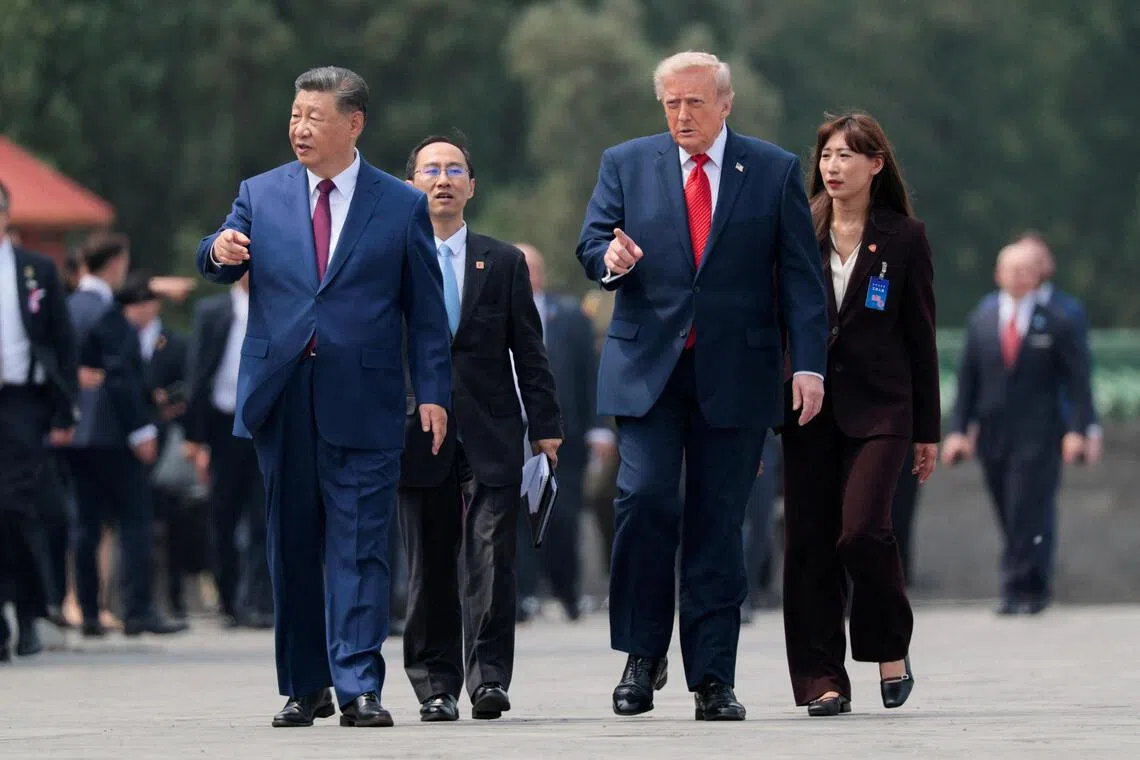
US President Donald Trump and Chinese President Xi Jinping last met in Beijing on May 14. They will meet again in Washington on Sept 24.
Published Sep 17, 2026, 05:38 AM
Updated Sep 17, 2026, 07:30 AM
The US-China AI rivalry will dominate Trump and Xi's talks, focusing on military risks, technology copying accusations, and chip export restrictions.
US accuses China of copying AI tech using "distillation" and restricts advanced chip sales, while China denies these claims.
The two countries differ on AI regulation, with the US opposing new rules and China enforcing strict AI content and data laws.
WASHINGTON - The race for AI supremacy is set to hang over next week's meeting between US President Donald Trump and Chinese President Xi Jinping in Washington.
Washington and Beijing view advances in AI as critical to their economic and military competitiveness, but they remain at odds over access to advanced chips, allegations of technology copying and regulation of the AI industry.
US Treasury Secretary Scott Bessent said he will meet Chinese Vice-Premier He Lifeng this weekend to discuss AI-related issues before the leaders' summit. Here are some of the key talking points and disputes.
An AI system that interfered with a nuclear command network or launched a military cyber operation could leave either government with minutes to decide whether the other government had attacked.
US and Chinese security experts are urging both governments to prepare for such scenarios. They have proposed red lines around nuclear systems, human control over consequential cyberattacks, and a hotline for incidents involving autonomous AI.
Open questions include how to stop an accident from being mistaken for an attack, which military decisions machines should never make and how nuclear-armed rivals communicate when technology behaves unexpectedly.
Copying US technology
Copying US technology through a technique known as “distillation” has become a flashpoint in the battle over AI model development.
Distillation is the process of training smaller AI models using output from larger, more expensive ones to lower the costs of training a new AI tool.
The US government accused six Chinese companies in September of maliciously copying American AI products using distillation, with law enforcement officials saying in a statement that the firms did so "likely with Chinese government awareness”.
The US made a similar accusation in April ahead of Trump's visit to Beijing. The Chinese embassy in Washington called the allegations “baseless”.
Chip exports to China
Chinese access to key US technologies underpinning the artificial intelligence boom is a point of friction between the two countries.
Since 2022, the US has imposed sweeping restrictions on shipments of advanced chips and chipmaking equipment to China.
There is evidence of advanced AI chips being smuggled into the country, though the scale is unknown.
The US has been considering restrictions on the ability of Chinese companies to remotely access data centres in other countries to prevent those firms from benefiting from Nvidia’s advanced chips.
There have been some exceptions to this effort. Late 2025, Trump decided to allow sales of Nvidia’s H200 AI chips. H200s are not the most sophisticated chips available, but their sale prompted concerns from China hawks in Washington who argued the chips could bolster China’s AI capabilities.
The two leaders have fundamentally different perspectives on how involved they should be in the AI sector.
Trump has brushed aside calls for new federal AI rules, saying on Sept 14 that the US only needs a strong president, which the country has "in spades”. He said calls from AI executives for regulation of the technology are a "hoax”.
The Chinese government has rules governing AI algorithms and the data used to train them, including requiring content generated by AI to be clearly labeled.
US v China AI development race
The estimates US officials typically give put Chinese AI models just a few months behind their American counterparts, although industry leaders increasingly describe them as neck and neck.
In 2025, then-White House AI adviser David Sacks said China was likely three to six months behind the United States on AI development. Earlier in 2026, the US Commerce Department put DeepSeek V4 Pro about eight months behind frontier models.
Many in the industry say the gap is shrinking quickly. In August, Hugging Face Chief Executive Clement Delangue said China was winning the race as far as open-weight models were concerned - and likely was not far off in terms of frontier models either. Frontier models are the most advanced AI tools and open-weight models have publicly accessible core elements that can be downloaded, inspected and modified.
“I wouldn’t be surprised if they start dominating at the frontier either by the end of this year or next year at the rate of progress,” Delangue told broadcaster CNBC on Aug 3. REUTERS
Artificial Intelligence
美国总统唐纳德·特朗普和中国国家主席习近平上次会晤是在5月14日于北京。他们将于9月24日在华盛顿再次会晤。
发布于 2026 年 9 月 17 日上午 5:38
更新于2026年9月17日上午7:30
中美人工智能领域的竞争将主导特朗普和习近平的会谈,重点将放在军事风险、技术抄袭指控和芯片出口限制等方面。
美国指责中国利用“蒸馏”技术抄袭人工智能技术,并限制先进芯片的销售,而中国否认了这些指控。
两国在人工智能监管方面存在分歧,美国反对新的监管规则,而中国则执行严格的人工智能内容和数据法律。
华盛顿——人工智能霸权之争势必会影响下周美国总统唐纳德·特朗普和中国国家主席习近平在华盛顿的会晤。
华盛顿和北京都认为人工智能的进步对其经济和军事竞争力至关重要,但在获取先进芯片、技术抄袭指控以及人工智能行业的监管等问题上,双方仍然存在分歧。
美国财政部长斯科特·贝森特表示,他将于本周末与中国国务院副总理何立峰会面,在领导人峰会前讨论人工智能相关议题。以下是一些关键的讨论要点和分歧。
干扰核指挥网络或发起军事网络行动的人工智能系统,可能让任一国政府只有几分钟时间来决定对方政府是否发动了攻击。
中美两国安全专家敦促两国政府为应对此类情况做好准备。他们提出了围绕核系统、人为控制重大网络攻击以及涉及自主人工智能事件的热线等方面的红线建议。
悬而未决的问题包括:如何防止事故被误认为是袭击,机器永远不应该做出哪些军事决策,以及当技术出现意外情况时,拥有核武器的对手如何沟通。
抄袭美国技术
通过一种被称为“提炼”的技术来复制美国技术,已成为人工智能模型开发之争的焦点。
蒸馏是指利用较大、较昂贵的人工智能模型的输出来训练较小的人工智能模型,从而降低训练新人工智能工具的成本。
今年9月,美国政府指控六家中国公司恶意利用技术蒸馏复制美国人工智能产品,执法官员在一份声明中表示,这些公司这样做“很可能是在中国政府的知情下”进行的。
今年4月,在特朗普访问北京前夕,美国也曾提出过类似的指控。中国驻华盛顿大使馆称这些指控“毫无根据”。
芯片出口到中国
中国获取支撑人工智能蓬勃发展的美国关键技术的途径,是中美两国之间的一个摩擦点。
自 2022 年以来,美国对向中国出口先进芯片和芯片制造设备实施了全面限制。
有证据表明,先进的人工智能芯片正被走私到该国,但规模尚不清楚。
美国一直在考虑限制中国公司远程访问其他国家数据中心的能力,以防止这些公司从英伟达的先进芯片中获益。
这项努力也有一些例外。2025年底,特朗普决定允许销售英伟达的H200人工智能芯片。H200并非目前最先进的芯片,但其销售引发了华盛顿对华鹰派的担忧,他们认为这些芯片可能会增强中国的AI能力。
这两位领导人对于他们应该在多大程度上参与人工智能领域有着截然不同的看法。
特朗普对制定新的联邦人工智能法规的呼吁不屑一顾,他在9月14日表示,美国只需要一位强有力的总统,而美国“不乏”这样的总统。他还称人工智能高管要求监管这项技术的呼声是“骗局”。
中国政府对人工智能算法及其训练数据制定了相关规定,其中包括要求对人工智能生成的内容进行明确标注。
中美人工智能研发竞赛
美国官员通常给出的估计是,中国的人工智能模型只比美国的同类模型落后几个月,尽管业内人士越来越倾向于认为它们不相上下。
2025年,时任白宫人工智能顾问大卫·萨克斯表示,中国在人工智能发展方面可能落后美国三到六个月。2026年初,美国商务部将DeepSeek V4 Pro的研发进度预测为落后于前沿型号约八个月。
业内许多人士表示,差距正在迅速缩小。今年8月,Hugging Face首席执行官克莱门特·德朗格(Clement Delangue)表示,就开放权重模型而言,中国已经领先,而且在前沿模型方面也可能紧随其后。前沿模型是最先进的人工智能工具,而开放权重模型的核心元素是公开的,可以下载、检查和修改。
“按照目前的进展速度,如果他们在今年年底或明年开始在前沿领域占据主导地位,我不会感到惊讶,”德朗格8月3日告诉CNBC电视台。路透社
人工智能