With more NATO allies, will the US store arms in Europe’s High North?随着北约盟友增多,美国会在欧洲北部储存武器吗?
With two new NATO countries in Northern Europe, the U.S. Army is examining the possibility of placing pre-positioned stock there to bolster defenses.
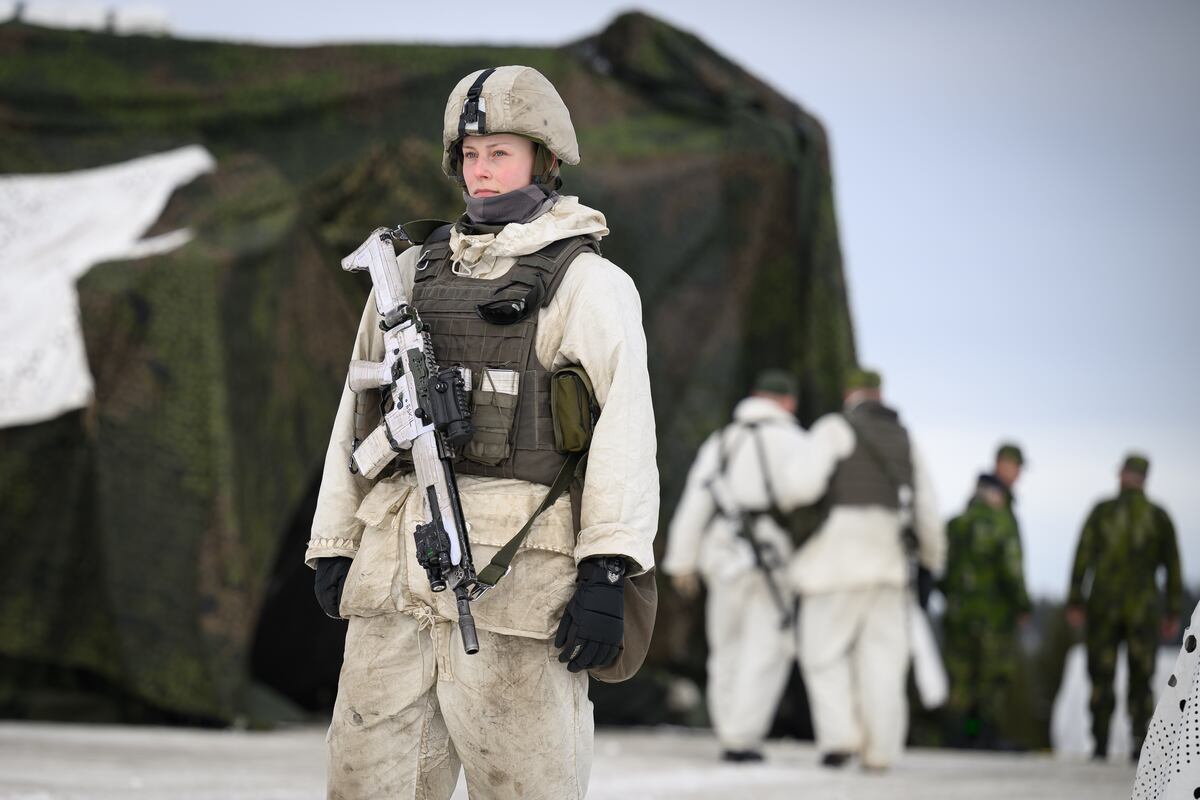
HUNTSVILLE, Ala. — The U.S. Army is considering pre-positioning stock in Europe’s High North amid Finland and Sweden officially joining NATO , according to the deputy chief of Army Materiel Command.
“We’ve incorporated two new NATO allies. So what does that mean for the High North in particular, and is there an expansion on the horizon for the High North from an [Army pre-positioned stock] standpoint?” Lt. Gen. Chris Mohan told Defense News in a March 27 interview at the Association of the U.S. Army’s Global Force Symposium here.
Army Materiel Command would be in charge of placing the service’s pre-positioned stock in the region, should the strategy dictate such a move. The command is contributing to the decision-making process, Mohan said, but the Army’s Pentagon-based team in charge of plans, operations and training is in charge of developing an Army pre-positioned stock strategy for the region.
Storing equipment and weapons in the region near the Arctic Circle would mean the Army could learn more about how extremely cold weather impacts materials and what the service would need to do in order to winterize capabilities, Mohan said.
Whether or not the Army decides to place stock in Scandinavia, it is still expanding its pre-positioned stock on the continent to reach a division-sized set.
Fiscal 2025 budget documents show the Army plans to spend $536 million to enhance the pre-positioning of its stock with the division set to include corps-level enablers with two armored brigade combat teams, fires, air defense, engineer, sustainment and medical units.
In order to build out a division-level set, Mohan said, continued expansions will be made at existing Army pre-positioned stock locations. He noted the service will modernize equipment as new capability becomes available, such as tube-launched artillery. The Army will also consider other locations for expansion.
Some of the equipment, like tube-launched artillery and rocket artillery sent to Ukraine, is being back-filled into the Army’s pre-positioned stock as it comes off the production line, Mohan added.
The Europe-based stock has received a heavy workout since Russia launched its full-scale invasion of Ukraine in early 2022. Initially the U.S. Army moved a heavy brigade set from southern Germany to four positions in Poland as well as sites in the Baltic region for the 3rd Infantry Division to use, according to Mohan. The effort included multiple virtual rehearsals, which contributed to a streamlined process, he noted.
While that capability has since gone back to Germany, the Army is permanently moving an entire brigade set of equipment to Powidz, Poland, to a base built and funded by the host country and NATO. The infrastructure at the base was already significant; there is an airfield that is big enough to land a space shuttle, Mohan said.
But for the U.S. Army’s pre-positioned stock, Poland built a state-of-the-art facility there, upgraded rail lines and power infrastructure, and will conduct some standard maintenance on the equipment, he said.
The service is now preparing to issue its pre-positioned stock for this year’s Defender Europe, a large-scale annual U.S. Army exercise in Europe .
The Army’s pre-positioned stock historically has been designed so troops can rapidly draw from it in response to a regional conflict, but the service took a new approach roughly five years ago to use the equipment in military exercises in order to train more effectively how to draw the equipment as well as move it across challenging distances and a variety of borders.
“We want to focus [Army pre-positioned stock] as much on great power competition, to use those stocks in great power competition as much as we had planned on using those stocks for great power conflict,” Gen. Edward Daly, then-Army Materiel Command chief, said in 2020. He explained that meant the Army would exercise its pre-positioned stock much more.
Jen Judson is an award-winning journalist covering land warfare for Defense News. She has also worked for Politico and Inside Defense. She holds a Master of Science degree in journalism from Boston University and a Bachelor of Arts degree from Kenyon College.
阿拉巴马州亨茨维尔——据美国陆军物资司令部副司令称,随着芬兰和瑞典正式加入北约,美国陆军正在考虑在欧洲北部地区预先部署物资。
“我们新增了两个北约盟国。那么,这对北纬高地地区意味着什么?从陆军预置库存的角度来看,北纬高地地区未来是否会有扩张?”克里斯·莫汉中将在3月27日于此地举行的美国陆军协会全球力量研讨会上接受《防务新闻》采访时表示。
如果战略需要,陆军物资司令部将负责将陆军在该地区的预置物资部署到位。莫汉表示,该司令部正在参与决策过程,但负责制定该地区陆军预置物资战略的是位于五角大楼的陆军计划、作战和训练小组。
莫汉表示,在北极圈附近的地区储存装备和武器意味着陆军可以更多地了解极寒天气对物资的影响,以及陆军需要做些什么才能使装备和武器具备过冬能力。
无论陆军是否决定在斯堪的纳维亚半岛部署库存,它仍在扩大其在欧洲大陆的预置库存,以达到一个师级规模的库存。
2025 财年预算文件显示,陆军计划花费 5.36 亿美元加强其物资的预先部署,该师将包括军级支援力量,包括两个装甲旅战斗队、火力部队、防空部队、工程部队、后勤保障部队和医疗部队。
莫汉表示,为了建立师级装备体系,陆军将在现有的预置库存地点持续扩建。他指出,随着新技术的出现,例如管式发射火炮,陆军将对现有装备进行现代化改造。陆军还将考虑其他扩建地点。
莫汉补充说,一些运往乌克兰的装备,如管式火炮和火箭炮,正在从生产线下线后被补充到陆军的预置库存中。
自2022年初俄罗斯全面入侵乌克兰以来,这家总部位于欧洲的军队承受了巨大的压力。据莫汉称,最初,美军将一个重型旅从德国南部调往波兰的四个地点以及波罗的海地区的几个地点,供第三步兵师使用。他指出,这项工作包括多次虚拟演练,这有助于简化流程。
虽然这项能力后来已归还德国,但陆军正将一整个旅的装备永久转移到波兰波维兹,该基地由波兰和北约共同建设和出资。莫汉说,该基地的基础设施已经相当完善;那里有一个足以让航天飞机起降的大型机场。
他说,但对于美国陆军的预置库存,波兰在那里建造了最先进的设施,升级了铁路和电力基础设施,并将对这些设备进行一些标准维护。
该部门目前正准备发放其为今年的“欧洲卫士”演习(美国陆军在欧洲举行的大规模年度演习)预先部署的库存。
陆军的预置库存历来是为了让部队能够迅速从中调取物资以应对地区冲突,但大约五年前,陆军采取了一种新方法,在军事演习中使用这些装备,以便更有效地训练如何调取这些装备以及如何跨越具有挑战性的距离和各种边界进行运输。
“我们希望将(陆军预置库存)的重点放在大国竞争上,像我们原计划在大国冲突中使用这些库存一样,在大国竞争中使用这些库存,”时任陆军物资司令部司令的爱德华·戴利将军在2020年表示。他解释说,这意味着陆军将更多地使用其预置库存。
珍·贾德森是一位屡获殊荣的记者,为《防务新闻》报道陆地战争。她也曾为《政治报》和《内幕防务》工作。她拥有波士顿大学新闻学硕士学位和凯尼恩学院文学学士学位。