The Violinist shows Singapore stories can resonate without losing their identity《小提琴家》这部作品表明,新加坡的故事既能引起共鸣,又不会失去其独特性。
Set against Singapore and Malaya before and during the Japanese Occupation, award-winning animated film The Violinist doesn't dilute its local history for international audiences. Minor spoilers ahead.
新闻视频
Set against Singapore and Malaya before and during the Japanese Occupation, award-winning animated film The Violinist doesn't dilute its local history for international audiences. Minor spoilers ahead.
The Violinist follows a story set in Singapore during the Japanese Occupation in the 1940s. (Photo: Robot Playground Media)
This audio is generated by an AI tool.
When Singapore-produced animated film The Violinist won the Cristal for a Feature Film , the top feature prize at the Annecy International Animation Film Festival, the historic achievement inspired pride, joy, excitement and even shock back home.
Not only did the film receive one of animation's biggest international honours, it also remained unapologetically Singaporean while doing so.
Co-directed by Singaporean Ervin Han and Spanish animator Raul Garcia, and set largely in Singapore and Malaya before and during the Japanese Occupation, The Violinist doesn't shy away from the specificity of its setting. Its characters have Singaporean accents. Its streets reflect the communities that lived there. Its historical figures and events are woven into the story without explaining every reference for international audiences.
None of that makes the film's emotional core difficult to understand. The Violinist is proof that Singapore stories don't necessarily have to strip themselves of their Singaporean-ness to resonate beyond our shores – they just need to make us feel.
WELL-DEVELOPED, INTENTIONAL CHARACTERS
The Violinist begins with a stellar violin performance in the Esplanade Theatre and a curious Spanish journalist trying to understand the history behind an old instrument. This curiosity eventually brings us to Fei and Kai, childhood friends and gifted violinists growing up in pre-war Singapore.
Fei (voiced by Fang Rong as a young woman and Tan Kheng Hua as an older adult) is a Peranakan girl raised to play the violin from a young age. Kai (voiced by Ayden Sng), comes from a far poorer background but possesses an exceptional ear and instinctive talent for music. Their shared love of the violin draws them together, before war tears their lives and ambitions apart.
While their circumstances are specific to Singapore in the 1930s and 1940s, their motivations feel universal.
We understand Kai's wonder when someone recognises and nurtures a talent he never had the means to develop. We understand Fei's heartbreak when someone she loves feels compelled to leave to protect his loved ones from the war.
The Japanese soldier Takashi is voiced by the Japanese actor Kazuya Tanabe. (Photo: Robot Playground Media)
Even the Japanese soldier Takeshi (voiced by Kazuya Tanabe) is given moments that remind us that he's also a person displaced by war, and someone who misses music, his wife and his children. His character doesn't absolve the violence of the Japanese Occupation, nor does the film attempt to. It allows all its characters to remain human even as they are caught on vastly different sides of history.
The film rarely needs its characters to deliver grand speeches explaining what war, separation, resistance or sacrifice mean to them. Their decisions, relationships and losses do much of the work instead.
And that is precisely why their emotions remain legible even to someone who has never experienced wartime Singapore – or, for that matter, visited Singapore at all.
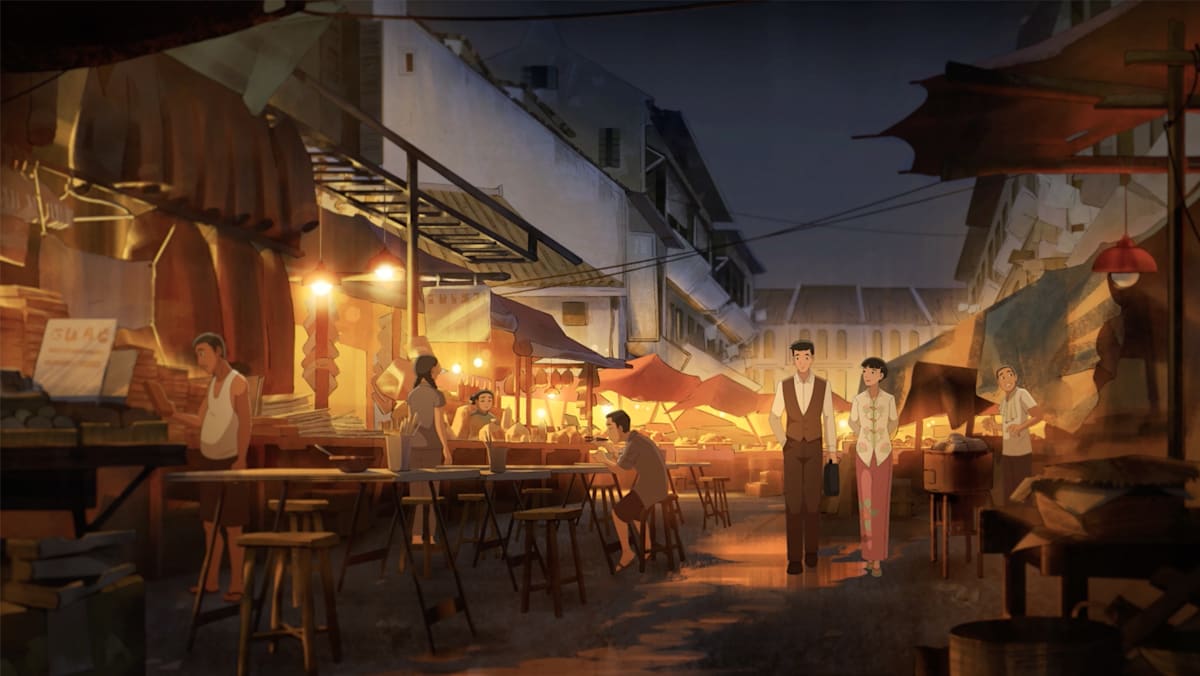
The Violinist does not shy away from its specific portrayal of Singapore during and before the Japanese Occupation. (Photo: Robot Playground Media)
THE DISTINCT, LIVED-IN BACKDROP OF SINGAPORE
In a good story, a setting isn't merely a place for characters to stand. It has its own soul and personality, shaping the people moving through it.
Old Singapore in The Violinist feels lived in.
There are Chinese coolies, Indian labourers, Arab merchants, Malay men in sarongs, women in kebayas, and many people from the different communities that populated the trading port. The attention to detail that the film gives these characters, even if they are largely only in the background, breathes more life into the Singapore of the 1940s.
The historical references go deeper still. Lim Bo Seng, voiced by Singaporean actor Adrian Pang , and Force 136, the British-led resistance network operating in Japanese-occupied Southeast Asia, enter the narrative as Kai becomes increasingly drawn into the war effort. For viewers familiar with Singapore history – and particularly Lim's eventual fate – their presence immediately raises the stakes.
The film also depicts the brutality inflicted upon people resisting the Japanese Occupation without allowing that violence to overwhelm the larger story it is trying to tell.
Lim Bo Seng, a resistance fighter in Singapore and Malaya during World War II, is voiced by Singaporean actor Adrian Pang. (Photo: Robot Playground Media)
Even Singapore isn't treated as an island unto itself.
Penang, Jakarta and other parts of the region become part of Fei and Kai's journeys, situating their personal story within a wider Southeast Asia being transformed by war and its aftermath.
When the story moves to present-day Singapore, recognisable landmarks such as the Esplanade and Victoria Concert Hall appear not simply as obligatory establishing shots, but as parts of a city that has grown around the memories the film is exploring.
While there may be details that both local and international viewers do not immediately recognise, their presence offers an entry point into what that era was like in Singapore.
Popular narratives of World War II often centre on Europe, Nazi Germany and the Allied powers, while the experiences of Singapore and Southeast Asia may be less familiar to audiences elsewhere.
By placing its characters firmly within the history of this side of the world, The Violinist offers viewers another perspective on the war and, for those interested enough to look further, a starting point to discover the real people, places and events woven into its story.
THE UNIVERSAL APPEAL OF LOVE, MUSIC AND LOSS
Ultimately, at the heart of The Violinist is love.
And not simply the love between Fei and Kai as friends and lovers. But also their shared love of music. There is love for family, for friends, for home and country. There is the longing of a soldier for the family he left behind, and the love that allows people separated by war and decades to remain connected through memory.
And then there is the violin itself.
The Violinist explores themes of love, loss, longing and resilience. (Photo: Robot Playground Media)
Music becomes one of the film's most effective universal languages because viewers don't need to understand the history behind every scene to recognise what a melody is doing to the people in it.
Through Ricky Ho's original score (which also won the SACEM Award for Best Original Soundtrack at Annecy), The Violinist trusts its audience enough not to translate every emotion into dialogue: longing, nostalgia, loss, betrayal, memories, and resilience.
That's why the film's Singaporean-ness never feels like an obstacle that needs to be overcome. Singapore is what gives the story its texture, history and identity, but the emotions are what allow everyone else in.
The international reception to The Violinist – including its selection for the 2026 Toronto and Busan international film festivals – doesn't mean that every Singapore story will resonate simply by being local. But neither should filmmakers feel compelled to sand away recognisable landmarks, Singlish phrases or historical references in search of a supposedly universal version of Singapore.
The Violinist offers the delicate balance: Be specific about where your characters come from, and make us understand why they love, hurt, hope and hold on.
The Violinist opens in Singapore cinemas on Sep 17.
A single handpicked story that we think you shouldn't miss. Just one a day.
这部屡获殊荣的动画电影《小提琴家》以日本占领时期前后的新加坡和马来亚为背景,并没有为了迎合国际观众而淡化其本土历史。以下内容可能包含轻微剧透。
《小提琴家》的故事背景设定在20世纪40年代日本占领时期的新加坡。(图片:Robot Playground Media)
这段音频由人工智能工具生成。
新加坡制作的动画电影《小提琴家》荣获安纳西国际动画电影节最高奖项——水晶奖,这一历史性成就令新加坡举国上下感到自豪、喜悦、兴奋,甚至震惊。
这部电影不仅获得了动画界最大的国际荣誉之一,而且在获奖过程中也毫不掩饰地保持了新加坡特色。
由新加坡导演韩恩文和西班牙动画师劳尔·加西亚联合执导,故事主要发生在日据时期前后的新加坡和马来亚,《小提琴家》毫不掩饰其独特的时代背景。片中人物操着一口新加坡口音,街道也反映了当时当地居民的生活风貌。历史人物和事件巧妙地融入故事之中,而没有对每个典故都进行解释,让国际观众也能轻松理解。
但这并不妨碍我们理解这部电影的情感核心。《小提琴家》证明,新加坡的故事并不一定需要剥离其新加坡特色才能引起海外观众的共鸣——它们只需要触动人心。
精心塑造、用心刻画的角色
《小提琴家》以滨海艺术中心剧院一场精彩绝伦的小提琴演奏开篇,一位好奇的西班牙记者试图探寻一件古老乐器的历史。这份好奇最终将我们引向费和凯,这对儿时好友,也是战前新加坡成长起来的两位才华横溢的小提琴家。
菲(少女时期由方蓉配音,成年时期由陈庆华配音)是一位土生华裔女孩,从小学习小提琴。凯(由宋慧乔配音)出身贫寒,却拥有超凡的音乐天赋和敏锐的听觉。他们对小提琴的共同热爱将他们紧紧联系在一起,然而战争却将他们的生活和梦想彻底摧毁。
虽然他们的处境是20世纪30年代和40年代新加坡的特殊情况,但他们的动机却具有普遍意义。
我们能理解凯的喜悦,当有人发现并培养他从未有机会发展的才能时,他感到多么欣慰。我们也能理解菲的痛苦,当她所爱的人为了保护家人免受战火蹂躏而不得不离开时,她感到多么心碎。
日本士兵高志的配音演员是日本演员田边和也。(图片:Robot Playground Media)
即使是日本士兵武(田边和也配音),影片中也穿插着一些片段,提醒我们他也是一位因战争而流离失所的人,一个思念音乐、妻子和孩子的人。他的角色并没有为日本占领时期的暴行开脱,影片也无意如此。它让所有角色即使身处历史截然不同的两面,依然保持着人性的光辉。
这部电影很少需要角色发表长篇大论来解释战争、分离、抵抗或牺牲对他们的意义。他们的抉择、人际关系和失去本身就足以说明一切。
正因如此,即使是从未经历过战时新加坡的人,或者根本没去过新加坡的人,也能感受到他们的情感。
《小提琴家》毫不避讳地描绘了日本占领时期及之前新加坡的真实面貌。(图片:Robot Playground Media)
新加坡独特的、充满生活气息的背景
好的故事中,场景不仅仅是人物站立的地方。它有自己的灵魂和个性,塑造着在其中穿梭的人们。
《小提琴家》中的老新加坡给人一种真实生活的感觉。
影片中有中国苦力、印度劳工、阿拉伯商人、身着纱笼的马来男子、穿着卡巴雅的女子,以及来自这个贸易港口各个社群的众多居民。尽管这些人物大多只是背景角色,但影片对这些人物的细致刻画,却为20世纪40年代的新加坡注入了更多鲜活的生命力。
历史典故远不止于此。由新加坡演员彭德兰配音的林宝生,以及在日占东南亚地区活动的英国领导的抵抗组织“136部队”,随着凯逐渐被卷入战争,也逐渐进入剧情。对于熟悉新加坡历史——尤其是林宝生最终命运——的观众来说,他们的出现无疑提升了故事的紧张感。
影片也描绘了反抗日本占领的人们所遭受的残酷暴行,但并没有让这种暴力掩盖它试图讲述的更宏大的故事。
二战期间在新加坡和马来亚从事抵抗运动的林茂生一角,由新加坡演员彭德兰配音。(图片:Robot Playground Media)
即使是新加坡,也没有被视为一个与世隔绝的岛屿。
槟城、雅加达和该地区的其他部分都成为了费和凯的旅程的一部分,将他们的个人故事置于一个因战争及其后果而发生改变的更广泛的东南亚背景下。
当故事转移到现代新加坡时,滨海艺术中心和维多利亚音乐厅等标志性建筑不再仅仅是作为必要的场景镜头出现,而是作为这座城市的一部分,这座城市围绕着电影所探索的记忆而发展起来。
虽然有些细节可能不为本地和国际观众所熟知,但它们的存在提供了一个了解新加坡那个时代的切入点。
二战的流行叙事往往以欧洲、纳粹德国和盟军为中心,而新加坡和东南亚的经历对于其他地方的观众来说可能不太熟悉。
《小提琴家》将人物牢牢地置于世界这一边的历史背景中,为观众提供了看待战争的另一种视角,对于那些有兴趣深入了解的人来说,它也是一个起点,可以去发现故事中交织的真实人物、地点和事件。
爱、音乐和失去的普世魅力
归根结底,《小提琴家》的核心是爱。
这不仅仅是菲和凯之间作为朋友和恋人的爱,还有他们对音乐的共同热爱。其中也包含着对家人、朋友、家乡和祖国的爱。有士兵对远在他乡的家人的思念,也有让因战争和数十年分离的人们通过记忆保持联系的爱。
然后还有小提琴本身。
《小提琴家》探讨了爱、失去、渴望和韧性等主题。(图片:Robot Playground Media)
音乐成为电影中最有效的通用语言之一,因为观众不需要了解每个场景背后的历史就能明白一段旋律对电影中人物的影响。
通过瑞奇·霍的原创配乐(该配乐还获得了安纳西国际动画电影节最佳原创配乐奖),《小提琴家》充分信任观众,没有将每一种情感都转化为对话:渴望、怀旧、失落、背叛、回忆和韧性。
正因如此,影片中的新加坡元素才丝毫没有成为需要克服的障碍。新加坡赋予了故事质感、历史和身份认同,而情感的流露则让其他元素得以融入其中。
《小提琴家》在国际上获得的赞誉——包括入选2026年多伦多和釜山国际电影节——并不意味着所有新加坡故事只要具有本土特色就能引起共鸣。但电影制作人也不应该为了追求所谓的“普世新加坡”而刻意抹去那些标志性建筑、新加坡式英语短语或历史典故。
《小提琴家》展现了一种微妙的平衡:要具体说明你的角色来自哪里,并让我们理解他们为什么爱、为什么受伤、为什么抱有希望和为什么坚持下去。
《小提琴家》将于9月17日在新加坡影院上映。
每天一篇,我们精心挑选一篇您不容错过的精彩故事。