UN announces global strategy to protect people from extreme heat at inaugural conference in S’pore联合国在新加坡举行的首届会议上宣布了保护人们免受极端高温影响的全球战略。
This was announced in Singapore at the inaugural Global Cooling Pledge Assembly. Read more at straitstimes.com.
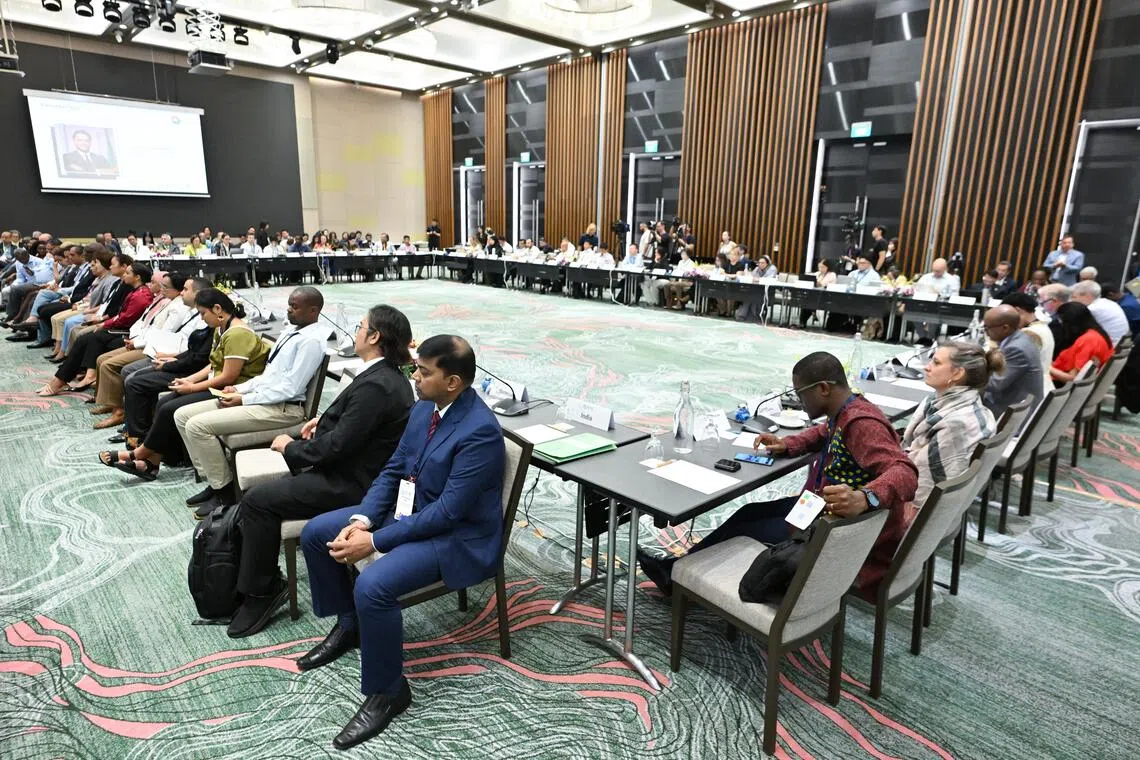
Country officials and the UN gathered at the inaugural Global Cooling Pledge Assembly at Parkroyal on Beach Road on Sept 17.
ST PHOTO: LIM YAOHUI
Published Sep 17, 2026, 12:05 PM
Updated Sep 17, 2026, 12:05 PM
SINGAPORE - The United Nations (UN) is looking to work with countries, including Singapore, to chart out a strategy to protect people from extreme heat, one of the deadliest and fastest-growing climate risks worldwide.
This strategy – called the Global Heat Resilience Roadmap – will also set out practical approaches to safeguard water and food security, schools, hospitals, workplaces, and energy infrastructure during heatwaves.
This was announced by the UN on Sept 17 at a forum held at the Parkroyal on Beach Road hotel in Singapore.
The UN Environment Programme had convened over 60 countries at the inaugural Global Cooling Pledge Assembly, to develop ways to cut carbon emissions from air-conditioning.
Expanding access to alternative cooling strategies that do not guzzle much electricity, especially for vulnerable groups like farmers, was also discussed.
Examples of such passive cooling efforts can include developing building designs to maximise natural ventilation, planting trees for shade and optimising wind flow when building new estates.
Part of the strategy is to also ensure that cooling solutions do not inadvertently lead to a rise in greenhouse gas emissions due to excessive reliance on air-conditioning. Cooling already accounts for about 20 per cent of global electricity use, and demand is expected to more than triple by 2050.
The aim is to cut emissions from cooling by 68 per cent by 2050, a target set by UNEP and signatory countries in 2023 when the Global Cooling Pledge was introduced.
The signatory countries, which includes Singapore, are collectively called the Intergovernmental Committee on Cooling, which comprises more than 70 nations. Other signatories include Nigeria, the Philippines and the United Kingdom.
When there is a sudden surge in air conditioning use, especially during a heatwave, the power grids can get overwhelmed, leading to blackouts. During the Europe heatwave in June, a a transformer failure occurred, leaving around 68,000 households out of power at Finistere in France.
The launch of this initiative comes as the ongoing warming El Nino phenomenon is set to intensify into a very strong event in the coming months, with higher risks of drought and extreme heat.
Over the first two days of the forum, which started on Sept 15 , policymakers, academics and businesses explored how sustainable cooling and heat-resilience solutions can work in dense cities through roundtables, training and site visits.
Briefly introducing the plans for the roadmap on Sept 15, UNEP’s global chief heat officer Eleni Myrivili said countries first need the political mandate to recognise severe heat as a disaster and have policies in place to make the country more heat resilient.
Countries then have to think about the greatest risks that severe heat can pose to them, and the suite of solutions that are most appropriate.
Those solutions can include changing behaviour – such as opening the windows for cross ventilation – having a park next to an urban neighbourhood, using fans and energy-efficient air conditioning, and also have emergency plans in place to save lives during a heatwave.
She also urged delegates to think about the most suitable ways to finance these solutions for their countries, and unlocking finance for cooling is a key theme at the assembly . Some solutions floated include mobilising finance from governments and philanthropic partners .
To ensure the roadmap is eventually implemented well, processes should be in place to track outcomes and progress, said Myrivili.
More details about building up the strategy will be revealed on Sept 18, and participating countries – which have not been confirmed – have a couple of years to develop it, said UNEP.
The strategy will also build on existing national plans.
For example, Singapore recently set up a Heat Resilience Policy Office to oversee heat management efforts across the country by coordinating action, overseeing research and representing Singapore internationally.
It had also earlier announced a response plan to heatwaves, where the Republic will open more than 300 cooling centres during such episodes.
The centres will be air-conditioned, and they include community centres, selected Residents’ Committee or Residents’ Network centres, and some indoor sports halls.
With policies such as imposing minimum energy performance standards on air-conditioners sold here, the average energy efficiency of air-conditioners in Singapore has improved by more than 60 per cent, said Minister for Sustainability and the Environment Grace Fu at the the assembly on Sept 17.
Planning must be backed by policy and laws so that solutions can be implemented at scale, she added.
“Heat affects public health, increases the risks of heat-related and infectious diseases, puts vulnerable groups at greater risk, and disrupts business operations. No single agency or sector can address these effects alone,” said Fu.
On Sept 17, Singapore also received the inaugural Cool Leaders award from UNEP, in recognition fo r its leadership in heat resilience and passive cooling.
This award serves to highlights outstanding leadership advancing sustainable cooling across policy and innovation, according to UNEP.
Receiving the award, Fu said: “We received this award with the greatest humility. Singapore might have started the planning process early, but we are not there at all. We’re just starting in the process.
“There are many challenges ahead of us. It is not just about cooling the place, but to cool it in a sustainable way, in a way that is comfortable for our people, but also in a way that’s resilient for our businesses.”
The other recipients are the United Arab Emirates – which is a co-chair of the Intergovernmental Committee on Cooling – and Dong Mingzhu, chairwoman of the world’s largest specialised air conditioning manufacturer Gree Electric Appliances.
Dong spearheaded the development of ultra-efficient, low-carbon cooling technologies, including the zero carbon source air-conditioning system. The system combines solar power, energy storage, and advanced technologies to cut the air conditioner’s carbon emissions by around 85 per cent.
Shabana Begum is a correspondent, with a focus on environment and science, at The Straits Times.
9月17日,各国官员和联合国代表齐聚海滩路柏悦酒店,参加首届全球降温承诺大会。
ST 照片:林耀辉
发布于 2026 年 9 月 17 日下午 12:05
更新于2026年9月17日下午12:05
新加坡——联合国正寻求与包括新加坡在内的各国合作,制定一项战略,以保护人们免受极端高温的影响。极端高温是全球最致命、增长最快的气候风险之一。
这项名为“全球抗热能力路线图”的战略还将制定切实可行的措施,以保障热浪期间的水和粮食安全、学校、医院、工作场所和能源基础设施。
联合国于9月17日在新加坡海滩路宾乐雅酒店举行的论坛上宣布了这一消息。
联合国环境规划署召集了 60 多个国家参加首届全球制冷承诺大会,旨在制定减少空调碳排放的方法。
会议还讨论了如何扩大使用不耗电的替代降温策略的途径,特别是对于农民等弱势群体而言。
被动式降温措施的例子包括:设计建筑以最大限度地利用自然通风、种植树木遮荫以及在建造新住宅区时优化风流。
该战略的一部分还在于确保制冷解决方案不会因过度依赖空调而无意中导致温室气体排放量增加。目前,制冷已占全球电力消耗的约20%,预计到2050年,这一需求将增长三倍以上。
目标是到 2050 年将制冷排放量减少 68%,这是联合国环境规划署和签署国在 2023 年推出《全球制冷承诺》时设定的目标。
包括新加坡在内的签署国统称为政府间降温委员会,该委员会由70多个国家组成。其他签署国包括尼日利亚、菲律宾和英国。
当空调使用量突然激增时,尤其是在热浪期间,电网可能会不堪重负,导致停电。今年6月欧洲热浪期间,法国菲尼斯泰尔省发生变压器故障,导致约6.8万户家庭断电。
这项倡议的推出正值持续变暖的厄尔尼诺现象预计将在未来几个月内加剧,成为一次非常强烈的事件,干旱和极端高温的风险也会更高。
在9月15日开幕的论坛的前两天,政策制定者、学者和企业通过圆桌会议、培训和实地考察,探讨了可持续制冷和耐热解决方案如何在人口密集的城市中发挥作用。
联合国环境规划署全球首席热能官员埃莱妮·米里维利在9月15日简要介绍了该路线图的计划,她表示,各国首先需要获得政治授权,承认严重高温是一种灾害,并制定政策使国家更具抗热能力。
各国随后必须考虑极端高温可能给它们带来的最大风险,以及最合适的解决方案。
这些解决方案包括改变行为——例如打开窗户进行交叉通风——在城市居民区旁边建公园,使用风扇和节能空调,以及制定应急计划以在热浪期间挽救生命。
她还敦促与会代表思考如何以最合适的方式为各自国家提供这些解决方案的资金,而为制冷项目筹集资金是本次大会的一个关键议题。一些提出的解决方案包括调动政府和慈善伙伴的资金。
Myrivili表示,为了确保路线图最终能够顺利实施,应该建立相应的流程来跟踪结果和进展。
联合国环境规划署表示,有关制定该战略的更多细节将于9月18日公布,参与国(尚未确认)有几年的时间来制定该战略。
该战略还将以现有的国家计划为基础。
例如,新加坡最近设立了高温适应政策办公室,通过协调行动、监督研究和代表新加坡参与国际事务,来监督全国的高温管理工作。
此前,该国还宣布了一项应对热浪的计划,届时将开放 300 多个避暑中心。
这些中心将配备空调,其中包括社区中心、部分居民委员会或居民网络中心以及一些室内体育馆。
新加坡永续发展及环境部长傅海燕在9月17日的国会上表示,通过对在新加坡销售的空调实施最低能效标准等政策,新加坡空调的平均能效提高了60%以上。
她补充说,规划必须有政策和法律的支持,这样解决方案才能大规模实施。
“高温影响公众健康,增加中暑和传染病的风险,使弱势群体面临更大的风险,并扰乱商业运营。没有任何一个机构或部门能够独自应对这些影响,”傅先生说。
9 月 17 日,新加坡还获得了联合国环境规划署颁发的首届“酷领袖”奖,以表彰其在耐热性和被动冷却方面的领导地位。
根据联合国环境规划署的说法,该奖项旨在表彰在政策和创新方面推进可持续制冷的杰出领导力。
傅先生在领奖时说:“我们怀着无比谦卑的心情接受这个奖项。新加坡或许很早就开始了规划进程,但我们远未达到目标。我们才刚刚起步。”
“我们面前有很多挑战。这不仅仅是给场所降温的问题,而是要以可持续的方式降温,既要让员工感到舒适,又要保证我们业务的韧性。”
其他获奖者包括阿拉伯联合酋长国(政府间制冷委员会的联合主席国)和世界最大的专业空调制造商格力电器董事长董明珠。
董教授率先开发了超高效、低碳制冷技术,其中包括零碳源空调系统。该系统结合了太阳能、储能和先进技术,可将空调的碳排放量减少约85%。
沙巴娜·贝古姆是《海峡时报》的记者,主要关注环境和科学领域。