At least 20 species could be new to science after NUS-OceanX deep-sea expedition新加坡国立大学-OceanX深海考察后,至少有20个物种可能是科学界的新发现。
More than 6,000 sq km of the Indian Ocean’s deep sea was newly mapped during the expedition, which also brought back over 2,000 specimens for researchers to study.
新闻视频
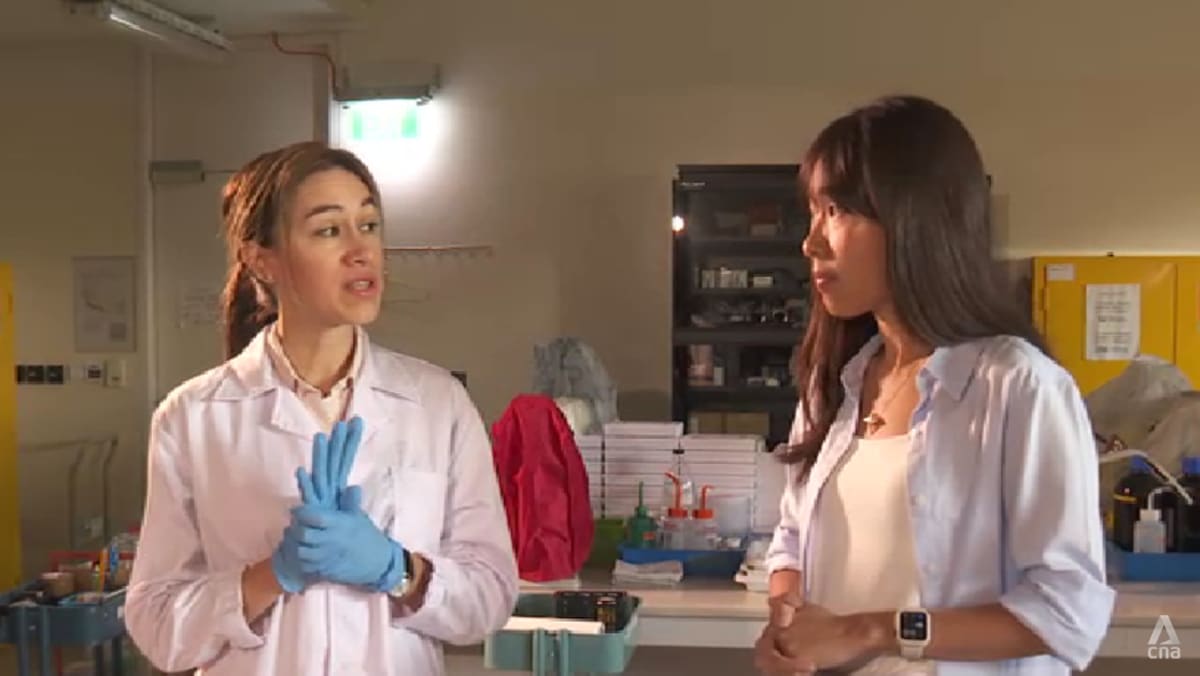
More than 6,000 sq km of the Indian Ocean’s deep sea was newly mapped during the expedition, which also brought back over 2,000 specimens for researchers to study.
Dr Allison Miller (left) showing CNA's Caitlin Ng (right) sea cucumbers brought back from the expedition. (Image: CNA)
This audio is generated by an AI tool.
SINGAPORE: At least 20 species found during an expedition into a little-explored part of the Indian Ocean could be new to science, with researchers saying there may be more discoveries to come.
The 24-day expedition, co-led by the National University of Singapore (NUS) and nonprofit ocean exploration initiative OceanX, was conducted in October last year. It mapped a total of 6,050 sq km of the deep sea and brought back over 2,000 specimens.
An estimated 100 to 200 species were documented, many of which have yet to be fully described.
The advanced research vessel OceanXplorer explored the Monsoon Rise, a largely unexplored seamount chain in the eastern Indian Ocean.
CNA Games Guess Word Crack the word, one row at a time Buzzword Create words using the given letters Mini Sudoku Tiny puzzle, mighty brain teaser Mini Crossword Small grid, big challenge Word Search Spot as many words as you can Show More Show Less
One of the manned submersibles aboard the OceanXplorer. (Image: CNA)
THOUSANDS OF METRES BENEATH THE SURFACE
The OceanXplorer is equipped with laboratories, sonar systems, manned submersibles and remotely operated vehicles (ROVs).
The manned submersibles provide a rare front-row seat to the deep sea, allowing scientists to observe marine life, study fragile habitats and see how ocean ecosystems are changing.
One of the team’s main tools was Chimera, an ROV capable of descending more than 6,000m.
Chimera carries cameras, sensors and sampling equipment, allowing scientists to collect samples from the Monsoon Rise’s seamounts.
ROV pilot Ewan Bason described the Chimera as a “Swiss Army knife” because of the wide range of sampling and scientific equipment it carries.
“We try and keep as much gear on board the ROV as possible,” Mr Bason said. “It can do many things once it gets underwater.”
Thousands of metres below the surface, researchers observed corals and other cnidarians clinging to underwater mountain slopes, as well as crustaceans moving across the seabed.
One of the team’s main tools was Chimera, an ROV capable of descending more than 6,000m. (Image: CNA)
Some animals could not immediately be identified. Selected specimens were carefully collected, brought onboard the vessel, then photographed and preserved for further study.
But what scientists were able to explore represents only a fraction of the vast area below.
"We only explored a small segment of the seamounts,” said Dr Jose Christopher E Mendoza, deputy chief scientist of the expedition and senior curator of crustacea and other marine arthropoda at the Lee Kong Chian Natural History Museum.
The summit area of one of the seamounts is about the size of Singapore, he added.
“The height of the seamount, even though the summit does not reach the surface of the sea, is on average about 3,000m. These are very big mountains."
Among the specimens brought back were 20 sea cucumbers.
But only four could be confidently identified to species level, said Dr Allison Miller, a research fellow with NUS’ Reef Ecology Lab.
Another 10 are believed to be unidentified species that had also been encountered on previous research cruises.
The remaining six specimens could represent animals never previously observed.
“Six specimens we think are the first ones that anyone's ever seen, and we've seen alive, which is really neat,” said Dr Miller.
Determining exactly what they are will require further comparison and analysis.
But identifying the animals is about more than simply putting names to unusual-looking creatures.
Six specimens from the sea cucumbers brought back could represent animals never previously observed, said Dr Miller. (Image: CNA)
Sea cucumbers can help scientists understand the conditions on the seabed and how the deep-sea ecosystem functions.
“A lot of people know them as the shallow water blobs that don't do much in the ocean, but they're really actually very important bioturbators and nutrient recyclers,” said Dr Miller.
“I call them the little vacuums of the ocean.”
Researchers are also examining crustaceans, fish, sponges and anemones collected during the expedition.
Each of these creatures provides yet another clue to the biodiversity of the Monsoon Rise.
FINDING SPECIES WITHOUT SEEING THEM
Physical specimens can only reveal part of what lives thousands of metres beneath the surface.
Researchers are also analysing environmental DNA to detect organisms they may have never seen or collected.
Animals constantly shed traces of genetic material into their surroundings. By analysing water or sediment samples, researchers can detect those traces and build a broader picture of the ecosystem.
Specimens were carefully collected, then brought aboard the vessel, photographed and preserved for further study. (Image: OceanX)
Preliminary results have already detected organisms absent from the expedition's physical samples.
For some groups, the genetic evidence points to more species than the specimens alone revealed.
"I really hope that this can be a baseline data for the biodiversity in these particular places,” said Dr Dita Cahyani from the biology department at Indonesia's Universitas Diponegoro.
“If another expedition comes and they see more species, that would be great. But if they see the depletion of some of the species, that might be something that we have to be worried about,” she said.
That baseline gives scientists a way to measure future changes and could also help shape how these waters are used.
Dr Mendoza said during the expedition, they observed abundant numbers of a particular deep-sea crab at one section of the seamount they were studying.
He also noted fishing trawlers operating near the area.
“If we know what organisms are found in these areas, areas that could potentially be used by us, exploited by us right for our own benefit, we would be better able to manage them, use them sustainably,” he said.
The expedition brought together researchers from Singapore and across the region, with teams studying different parts of the deep-sea ecosystem.
Their work continues in laboratories, where specimens, genetic samples and other data are still being analysed.
Having explored only a fraction of the Monsoon Rise, researchers say the findings so far may represent just a glimpse of what remains to be discovered in its depths.
Get our pick of top stories and thought-provoking articles in your inbox
Stay updated with notifications for breaking news and our best stories
Join our channel for the top reads for the day on your preferred chat app
此次考察期间,印度洋深海超过 6000 平方公里的区域被重新绘制成地图,同时还带回了 2000 多个标本供研究人员研究。
艾莉森·米勒博士(左)向亚洲新闻台记者凯特琳·吴(右)展示考察带回的海参。(图片:亚洲新闻台)
这段音频由人工智能工具生成。
新加坡:在一次对印度洋鲜为人知区域的考察中,至少发现了 20 种科学界未知的物种,研究人员表示,未来可能还会有更多发现。
这项为期24天的考察由新加坡国立大学(NUS)和非营利海洋探索组织OceanX共同领导,于去年10月进行。考察共绘制了6050平方公里深海的地图,并带回了2000多个标本。
据估计,已记录在案的物种有 100 至 200 种,其中许多物种尚未得到充分描述。
先进的研究船 OceanXplorer 探索了季风隆起,这是印度洋东部一条尚未被充分探索的海山链。
CNA游戏 猜词游戏 逐行破解单词 流行词游戏 用给定的字母组成单词 迷你数独 小小谜题,挑战你的大脑 迷你填字游戏 小方格,大挑战 单词搜索 尽可能多地找出单词 显示更多 显示更少
海洋探索者号上的一艘载人潜水器。(图片:中央社)
地表以下数千米
OceanXplorer 配备了实验室、声呐系统、载人潜水器和遥控潜水器 (ROV)。
载人潜水器为科学家们提供了一个难得的近距离观察深海的机会,使他们能够观察海洋生物、研究脆弱的栖息地,并了解海洋生态系统的变化。
该团队的主要工具之一是 Chimera,这是一款能够下潜超过 6000 米的 ROV。
奇美拉号载有摄像头、传感器和采样设备,使科学家能够从季风隆起的海山采集样本。
ROV 驾驶员 Ewan Bason 将 Chimera 形容为“瑞士军刀”,因为它携带了种类繁多的采样和科学设备。
巴森先生说:“我们尽量让水下机器人携带尽可能多的设备。它一旦潜入水下,就能做很多事情。”
在水下数千米处,研究人员观察到珊瑚和其他刺胞动物附着在水下山坡上,以及甲壳类动物在海底移动。
该团队的主要工具之一是“奇美拉”号水下机器人,它能够下潜到6000米以上的深度。(图片:中央社)
有些动物无法立即辨认。我们小心地采集了一些标本,带上船,拍照并保存起来,以供进一步研究。
但科学家们能够探索的区域仅代表下方广袤区域的一小部分。
“我们只探索了海山的一小部分,”探险队副首席科学家、李光前自然历史博物馆甲壳类动物和其他海洋节肢动物高级馆长何塞·克里斯托弗·E·门多萨博士说。
他还补充说,其中一座海山的山顶面积与新加坡差不多大。
“虽然海山的山顶没有到达海面,但其平均高度约为3000米。这些都是非常高的山峰。”
带回的标本中有20只海参。
但新加坡国立大学珊瑚礁生态实验室的研究员艾莉森·米勒博士表示,只有四种珊瑚可以被自信地鉴定到物种级别。
另有 10 种被认为是未识别物种,这些物种也曾在之前的研究航行中遇到过。
其余六个标本可能代表以前从未观察到的动物。
“我们认为这六个标本是人类首次见到的,而且我们还亲眼见过活体,这真是太棒了,”米勒博士说。
要确定它们究竟是什么,还需要进一步的比较和分析。
但识别动物不仅仅是给外形奇特的生物命名。
米勒博士表示,带回的六个海参样本可能代表了此前从未被发现过的物种。(图片:CNA)
海参可以帮助科学家了解海底状况以及深海生态系统的运作方式。
“很多人认为它们是浅水区的生物团,在海洋中作用不大,但实际上它们是非常重要的生物扰动者和营养物质循环者,”米勒博士说。
“我称它们为海洋中的小真空吸尘器。”
研究人员还在研究考察期间收集的甲壳类动物、鱼类、海绵和海葵。
每一种生物都为我们了解季风隆起的生物多样性提供了又一条线索。
不亲眼所见也能找到物种
实物标本只能揭示地表以下数千米生物的一部分。
研究人员还在分析环境DNA,以检测他们可能从未见过或收集过的生物体。
动物会不断地将遗传物质痕迹释放到周围环境中。通过分析水样或沉积物样本,研究人员可以检测到这些痕迹,并构建更全面的生态系统图景。
标本被小心采集后带上船,拍照并保存起来以供进一步研究。(图片:OceanX)
初步结果已经检测到了考察队采集的实物样本中没有发现的生物体。
对于某些类群而言,基因证据表明其物种数量比仅从标本中发现的数量要多。
“我真心希望这能成为这些特定地区生物多样性的基线数据,”印度尼西亚迪波内戈罗大学生物系的迪塔·卡亚尼博士说。
“如果另一支考察队到来,发现更多物种,那当然很好。但如果他们发现某些物种数量减少,那可能就是我们应该担心的事情了,”她说。
这一基线为科学家提供了一种衡量未来变化的方法,也有助于塑造这些水资源的利用方式。
门多萨博士说,在考察期间,他们在研究的海山的一个区域观察到了大量的特定深海蟹。
他还注意到附近海域有渔船作业。
他说:“如果我们知道这些地区有哪些生物,这些地区有可能被我们利用,被我们为了自身利益而开发,我们就能更好地管理它们,可持续地利用它们。”
此次考察汇集了来自新加坡和该地区的科研人员,各个团队分别研究深海生态系统的不同部分。
他们的工作仍在实验室中继续,在那里,标本、基因样本和其他数据仍在进行分析。
研究人员表示,他们目前只探索了季风隆起的一小部分,迄今为止的发现可能只是其深处仍有待发现的冰山一角。
订阅我们的邮件,即可获取精选热点新闻和引人深思的文章。
订阅通知,第一时间获取突发新闻和精彩报道。
加入我们的频道,即可在您常用的聊天应用上获取当日热门文章。