How talk of ‘war’ tipped Turkey’s stance on closing warship traffic through its straits关于“战争”的讨论如何改变了土耳其关闭海峡军舰通行的立场
For Turkey there had to be a limit to the delicate balancing between Russia and Ukraine: The pair of straits connecting the Mediterranean Sea to the Black Sea.
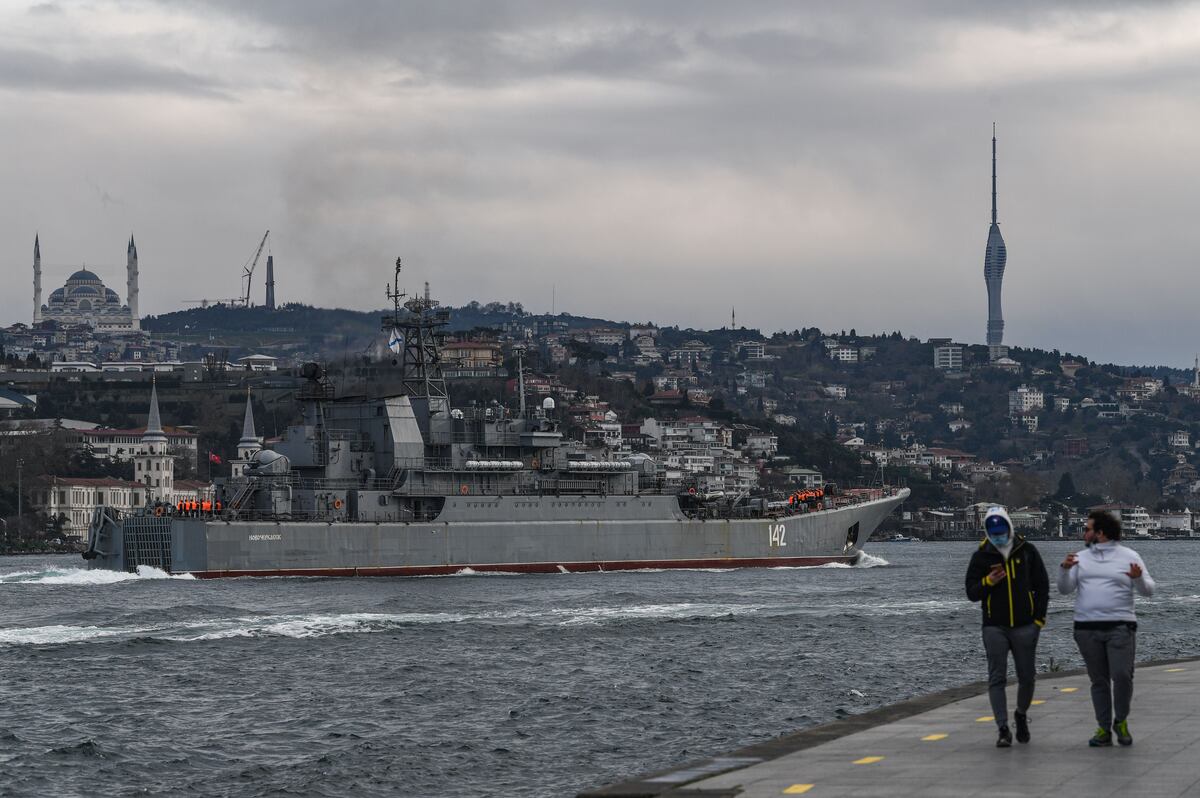
ANKARA— Turkey has been caught off guard as its strategic partner Russia invaded its other strategic partner, Ukraine.
Russia is Turkey’s biggest energy supplier. Russia and Ukraine together are Turkey’s biggest tourist markets and grain suppliers. Turkey faced suspension from the U.S.-led, multinational program that builds the F-35 Lightening II as it insisted on becoming the first NATO ally to deploy on its soil the Russian-made S-400 long-range, air-defense system. Turkey supplies armed drones to Ukraine.
Turkey says it supports Ukraine’s territorial integrity and calls the Russian invasion “unacceptable.” Yet Turkey also abstained on Feb. 25 from voting on suspending Russia’s membership in most bodies of the Council of Europe.
But there had to be a limit to this act of delicate balancing: The pair of straits connecting the Mediterranean Sea to the Black Sea, a maritime chokepoint of immense importance.
Ukraine asked Turkey to block the passage of Russian military vessels from the Dardanelles and Bosphorus straits. At least six Russian warships and a submarine transited Turkey’s straits in February.
But that is a matter concerning the articles of the 1936 Montreux Convention that permits Turkey to limit naval transit of its straits during wartime, or if threatened. Is this, technically and legally, a war?
In a rhetorical shift, Turkey on Feb. 28 called Russia’s assault on Ukraine a “war.” That paved the way for the Ankara government to implement parts of the Montreux Convention, potentially limiting the transit of Russian warships from the Mediterranean to the Black Sea.
“It is not a couple of air strikes now, the situation in Ukraine is officially a war… We will implement the Montreux Convention,” Mevlut Cavusoglu, Turkey’s foreign minister, said on February 27.
Cavusoglu reiterated that Turkey cannot block all Russian warships accessing the Black Sea due to a clause in the pact exempting those returning to their registered base. “There should not be any abuse of this exemption. Ships that declare returning to their bases and passing through the straits should not be involved in the war,” Cavusoglu said.
But on Feb. 28 Cavusoglu warned all Black Sea littoral or non-littoral countries against transiting naval vessels through the Turkish straits.
He said, citing the Montreux Convention, that “In the event of war to which Turkey is not a party, Turkey has the right to block naval shipping traffic through the straits.”
On March 1, Cavusoglu told Haber Turk TV that Moscow on Feb. 27 and 28 requested transit passage rights for four naval vessels. Three of the vessels were registered at Russia’s Black Sea ports and one was not.
“Through dialogue with our Russian partners we advised against the transit for all four ships,” the minister said. “The Russians agreed.”
Editor’s note: This story was updated on March 2 to include a March 1 statement by the Turkish foreign minister.
Burak Ege Bekdil was the Turkey correspondent for Defense News.
安卡拉——土耳其的战略伙伴俄罗斯入侵了其另一个战略伙伴乌克兰,这让土耳其措手不及。
俄罗斯是土耳其最大的能源供应国。俄罗斯和乌克兰是土耳其最大的旅游市场和粮食供应国。土耳其曾因坚持成为首个在其领土上部署俄罗斯制造的S-400远程防空系统的北约盟国,而被美国主导的F-35“闪电II”战斗机多国合作项目暂停参与。土耳其还向乌克兰提供武装无人机。
土耳其表示支持乌克兰领土完整,并称俄罗斯入侵“不可接受”。然而,在2月25日关于暂停俄罗斯在欧洲委员会大多数机构成员资格的投票中,土耳其也投了弃权票。
但这种微妙的平衡行为必须有个限度:连接地中海和黑海的两条海峡,是极其重要的海上咽喉要道。
乌克兰要求土耳其阻止俄罗斯军舰通过达达尼尔海峡和博斯普鲁斯海峡。今年2月,至少有6艘俄罗斯军舰和1艘潜艇通过了土耳其海峡。
但这涉及到1936年《蒙特勒公约》的条款,该公约允许土耳其在战时或受到威胁时限制其海峡的海上通行。从技术和法律角度来看,这算不算一场战争?
2月28日,土耳其在措辞上发生转变,称俄罗斯对乌克兰的袭击是“战争”。这为安卡拉政府实施《蒙特勒公约》的部分条款铺平了道路,可能限制俄罗斯军舰从地中海进入黑海。
“现在不是几次空袭了,乌克兰局势已经正式成为战争……我们将执行《蒙特勒公约》。”土耳其外交部长梅夫吕特·恰武什奥卢于2月27日表示。
恰武什奥卢重申,由于条约中有一项条款豁免返回注册基地的俄罗斯军舰进入黑海,土耳其不能阻止所有俄罗斯军舰进入黑海。“这项豁免条款不应被滥用。声明返回基地并途经海峡的舰船不应卷入战争,”恰武什奥卢说。
但2月28日,恰武什奥卢警告所有黑海沿岸或非沿岸国家,不要派遣海军舰艇通过土耳其海峡。
他援引《蒙特勒公约》表示,“如果发生土耳其并非参战国的战争,土耳其有权阻止海军船只通过海峡。”
3月1日,恰武什奥卢在接受哈伯尔·图尔克电视台采访时表示,莫斯科于2月27日和28日申请了四艘海军舰艇的过境通行权。其中三艘舰艇在俄罗斯黑海港口注册,另一艘则没有。
这位部长说:“通过与俄罗斯伙伴的对话,我们建议这四艘船都不要过境。俄罗斯方面同意了。”
编者按:本文于 3 月 2 日更新,加入了土耳其外交部长 3 月 1 日的声明。
布拉克·埃格·贝克迪尔是《防务新闻》的土耳其记者。