Construction robots on trial in Singapore could be deployed as early as 2028新加坡正在试用的建筑机器人最早可能在2028年投入使用。
Traditional machines are retrofitted with new technology to carry out assigned tasks independently. Read more at straitstimes.com.
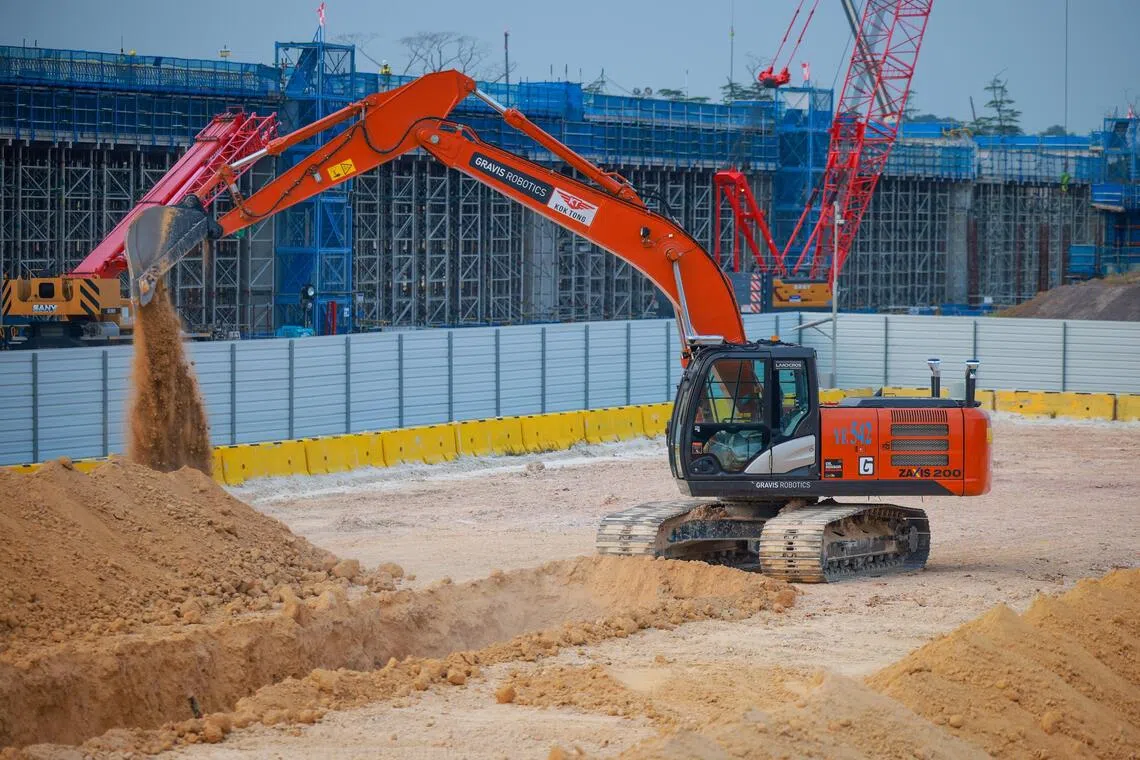
An autonomous excavator during a trial at Bulim autonomous yard on Sept 16, as the JTC-Kajima project aims to halve skilled operator needs and keep workers out of hazard zones.
ST PHOTO: JASON QUAH
Published Sep 17, 2026, 04:00 PM
Updated Sep 17, 2026, 04:00 PM
SINGAPORE – What if the next machine on Singapore’s new construction sites had nobody sitting behind its controls?
A pilot, launched by JTC Corporation and Kajima, is putting autonomous excavators and compactors to the test at Bulim autonomous yard in Jurong Innovation District, with the machines performing tasks under real site conditions. They can carry out assigned tasks independently, while operators monitor and oversee them remotely from a nearby control room.
The project will explore how autonomous heavy construction equipment can help address manpower constraints and improve workplace safety.
Calvin Chung, assistant chief executive of engineering and operations at JTC, said: “If the pilot succeeds, we will deploy autonomous heavy construction equipment across suitable projects in our pipeline and support wider industry adoption.”
The first phase of the project started in January and includes four machines: two excavators and two compactors. It is set to end in early 2027.
The second pilot will then begin, introducing autonomous bulldozers and dump trucks to create a coordinated fleet. Once the trials are complete, the machines may be pushed out to JTC’s sites, specifically within the Jurong Innovation District, by 2028.
This is the first project at JTC’s new 1ha sandbox, announced by National Development Minister Chee Hong Tat at ConTech@PDD in July. It is being conducted in partnership with the Public Sector Science & Technology Policy & Plans Office and Housing Board.
Improving productivity with fewer workers
Productivity is crucial as JTC is looking at a pipeline of at least 800ha of earthworks projects over the next five years.
According to the Building and Construction Authority (BCA), Singapore’s total construction demand is projected to reach $53 billion in 2026, while industry reports show the sector faces a persistent manpower shortfall of nearly 15 per cent across various roles.
Besides excavators, compactors are also being tested at JTC’s sandbox for validating autonomous construction equipment under real site conditions. ST PHOTO: JASON QUAH
Besides excavators, compactors are also being tested at JTC’s sandbox for validating autonomous construction equipment under real site conditions.
“Adding more manpower is not a sustainable way to meet Singapore’s future construction needs,” Chung said.
JTC is targeting a reduction in operator manpower by half, with one operator overseeing two machines from a control room away from the construction zone.
Under the trial, an operator assigns tasks and sets virtual boundaries for each machine from an operating room 20m from the sandbox.
Using sensors and artificial intelligence, the machines then perform the tasks without an operator seated inside or near the cabin. The activities are monitored remotely by staff who have a line of sight to the machines and will intervene whenever an issue occurs.
For this trial, two operators from local contractor Kok Tong Construction (KTC) travelled to Japan to be trained by Kajima’s operators on how to use the robots. Lessons from this pilot are also being documented for the rest of the industry.
Project engineer Tosh Chin Kah Woo, who oversees activities from the control room, underwent training in Japan for one week, where he learnt how to operate and supervise the robots. In the past, he had to physically cordon off the work area for the excavator, but now, the commands and boundaries are built into the system, he said.
KTC project engineer Tosh Chin Kah Woo managing autonomous construction equipment from a control room during a trial on Sept 16. ST PHOTO: JASON QUAH
KTC project engineer Tosh Chin Kah Woo managing autonomous construction equipment from a control room during a trial on Sept 16.
If these machines are deployed, foreign workers, who make up nearly 90 per cent of the manual semi-skilled workforce in Singapore’s construction industry, may get the chance to upskill and become more productive.
Many migrant workers have already been trained to use robotics at construction sites, including robots that are used for painting, JTC said in response to queries. It added that workers’ suitability for this training will depend on their skill level and aptitude.
For this trial, JTC is aiming for a 20 per cent to 30 per cent increase in construction speed compared with traditional machines, said Cheong Jiawen, director of JTC’s future of building and infrastructure. He added that the trial looks very promising so far and JTC is looking to further improve productivity.
Additionally, construction robots reduce workers’ exposure to some on-site safety hazards by decreasing the need for personnel to operate machinery or work closely with moving equipment.
JTC is also working with the Manpower Ministry to develop operating guidelines and safeguards for the deployment of these machines. These include virtual fences to contain the machines, sensors to detect people and obstacles, and emergency-stop controls on site and in the control room.
Retrofitting traditional machines
To create construction robots, traditional machines are retrofitted with technology from multiple partners. Retrofitting existing machines with new technology allows for easier and more cost-effective adoption as contractors can upgrade machines they already own, rather than replace entire fleets.
To automate digging, the excavator uses technology from Gravis Robotics, a Zurich-based start-up developing autonomous software and hardware for earth-moving equipment. The compactor, which presses down construction material, runs on Kajima’s automated construction system, A4CSEL. This is the first deployment of the system outside Japan.
Kajima is working with KTC and equipment provider Tractors Singapore on the retrofitting process.
Luke Wu, managing director of The GEAR by Kajima, said the system is suited to large-area operations, based on its use in Japan. For example, during the construction of Naruse Dam in Akita prefecture, three operators based 400km away managed a total of 14 robots, which ran continuously for up to 70 hours at one point.
Yoshihiko Riho, senior executive officer of Kajima, said: “We believe the combination of Kajima’s technologies and Singapore’s innovation-driven environment will help realise the next generation of construction.”
Beyond the pilot, JTC will be collaborating with public agencies, contractors, equipment providers, research institutions and technology companies to conduct more autonomous construction trials at its Bulim sandbox.
AI/artificial intelligence
9 月 16 日,在 Bulim 的自主挖掘机试验场,一台自主挖掘机正在进行试验。JTC-Kajima 项目旨在将熟练操作员的需求减少一半,并使工人远离危险区域。
《海峡时报》摄影:JASON QUAH
发布于2026年9月17日下午4:00
更新于2026年9月17日下午4:00
新加坡——如果新加坡新建工地上的下一台机器没有操作员在后面,会怎么样?
由裕廊集团(JTC Corporation)和鹿岛建设(Kajima)联合发起的一项试点项目,正在裕廊创新区武林(Bulim)的自动化作业场对自主挖掘机和压路机进行测试。这些机器在真实的施工现场条件下执行任务,能够独立完成分配的任务,而操作员则在附近的控制室进行远程监控。
该项目将探索自主式重型建筑设备如何帮助解决人力限制问题并提高工作场所安全。
裕廊集团工程及运营助理首席执行官钟嘉文表示:“如果试点成功,我们将在我们正在筹备的合适项目中部署自主重型建筑设备,并支持更广泛的行业采用。”
该项目的第一阶段于1月份启动,包括四台机器:两台挖掘机和两台压路机。预计将于2027年初结束。
第二阶段试点将随即启动,引入自动驾驶推土机和自卸卡车,组建一支协同作业的车队。试验完成后,这些设备有望在2028年前部署到裕廊集团旗下的各个项目场地,特别是裕廊创新区内的项目场地。
这是裕廊集团(JTC)新建的1公顷试验田的首个项目,该项目由国家发展部长徐芳达于7月在公共事业发展局科技大会(ConTech@PDD)上宣布。该项目由裕廊集团与公共部门科技政策及规划办公室和建屋发展局合作开展。
用更少的工人提高生产率
生产力至关重要,因为裕廊集团 (JTC) 计划在未来五年内开展至少 800 公顷的土方工程项目。
根据新加坡建设局(BCA)的数据,预计到 2026 年,新加坡的建筑总需求将达到 530 亿美元,而行业报告显示,该行业在各个岗位上都面临着持续的人力短缺,缺口接近 15%。
除了挖掘机,压路机也在裕廊集团的试验场进行测试,以验证自主施工设备在真实工地条件下的性能。(海峡时报照片:JASON QUAH)
除了挖掘机,JTC 的沙箱试验场也在测试压路机,以验证自主施工设备在真实工地条件下的性能。
钟先生表示:“增加人手并不是满足新加坡未来建设需求的可持续方式。”
裕廊集团的目标是将操作员人数减少一半,由一名操作员在远离施工现场的控制室中监督两台机器。
在试验中,操作员在距离沙箱 20 米的操作室内,为每台机器分配任务并设置虚拟边界。
利用传感器和人工智能技术,这些机器无需操作员坐在驾驶室内或附近即可执行任务。工作人员通过远程监控系统对机器进行监控,并在出现问题时立即介入。
为了进行此次试验,本地承包商国塘建设(KTC)的两名操作员前往日本,接受鹿岛建设操作员的机器人操作培训。此次试点项目的经验教训也将被记录下来,供业内其他公司借鉴。
项目工程师 Tosh Chin Kah Woo 负责在控制室监督各项活动,他曾在日本接受了一周的培训,学习如何操作和监控机器人。他表示,过去他需要手动划定挖掘机作业区域,但现在,指令和边界都已内置于系统中。
9月16日,KTC项目工程师Tosh Chin Kah Woo在控制室操控自主施工设备进行试验。(海峡时报摄影:JASON QUAH)
9 月 16 日,KTC 项目工程师 Tosh Chin Kah Woo 在试验期间通过控制室管理自主施工设备。
如果这些机器投入使用,占新加坡建筑业半熟练工人近 90% 的外籍工人将有机会提升技能,提高生产力。
裕廊集团在回复询问时表示,许多外籍劳工已经接受过建筑工地机器人操作培训,包括油漆机器人。裕廊集团补充说,工人是否适合接受此类培训将取决于他们的技能水平和天赋。
裕廊集团未来建筑及基建总监张家文表示,此次试验的目标是使施工速度比传统机械提高20%至30%。他还补充道,目前试验结果非常理想,裕廊集团正寻求进一步提高生产效率。
此外,建筑机器人减少了工人接触一些现场安全隐患的机会,因为它减少了人员操作机械或与移动设备密切接触的需求。
裕廊集团也正与人力部合作,制定这些机器部署的操作指南和安全措施。这些措施包括设置虚拟围栏以限制机器活动范围,安装传感器以检测人员和障碍物,以及在现场和控制室配备紧急停止控制装置。
对传统机器进行改造
为了打造建筑机器人,传统机械需要进行改造,并采用来自多个合作伙伴的技术。这种改造方式使得现有机械更容易、更经济高效地应用新技术,因为承包商只需升级现有设备,而无需更换整个车队。
为了实现挖掘自动化,这台挖掘机采用了总部位于苏黎世的初创公司Gravis Robotics的技术,该公司致力于为土方设备开发自主软硬件。压路机则使用鹿岛机械的A4CSEL自动化施工系统,用于压实建筑材料。这是该系统在日本以外的首次应用。
鹿岛正与 KTC 和设备供应商 Tractors Singapore 合作进行改造升级。
鹿岛建设公司旗下GEAR部门的总经理吴卢克表示,根据在日本的应用经验,该系统适用于大面积作业。例如,在秋田县成濑大坝的建设过程中,三名操作员在400公里外远程操控了14台机器人,这些机器人一度连续运行长达70小时。
鹿岛建设高级执行官里穗义彦表示:“我们相信,鹿岛建设的技术与新加坡创新驱动的环境相结合,将有助于实现下一代建筑。”
除了试点项目外,裕廊集团还将与公共机构、承包商、设备供应商、研究机构和科技公司合作,在其布林沙箱进行更多自主施工试验。
人工智能