North-South Corridor delayed by two years, will open in phases from 2029南北走廊项目延期两年,将于2029年起分阶段开放。
Unexpectedly challenging ground conditions have required more complex construction methods and set back the timeline, the Land Transport Authority says.
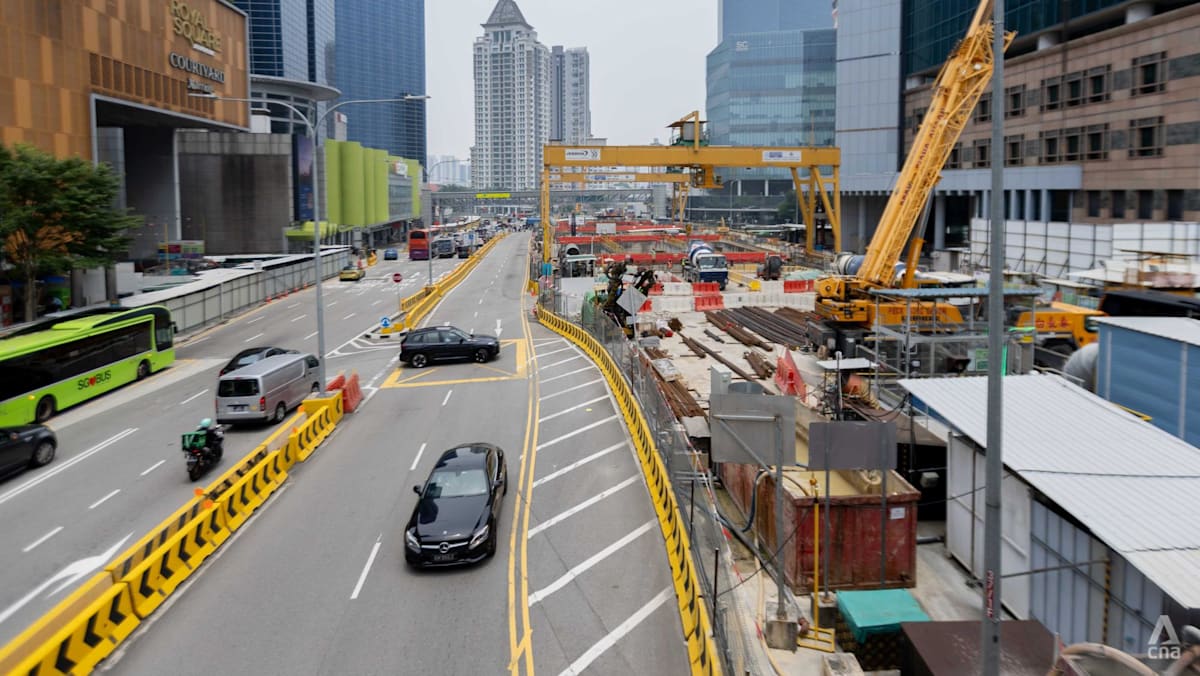
Unexpectedly challenging ground conditions have required more complex construction methods and set back the timeline, the Land Transport Authority says.
The North-South Corridor construction site at Novena on Sep 15, 2026. (Photo: CNA/Ili Mansor)
This audio is generated by an AI tool.
SINGAPORE: The opening of the North-South Corridor has been delayed by two years due to unexpectedly challenging ground conditions, the Land Transport Authority (LTA) said on Thursday (Sep 17).
The viaduct section, from Admiralty Road West to Lentor Avenue, is now expected to open in phases from 2029, instead of 2027 as previously announced.
The tunnel section, from Lentor Avenue to East Coast Parkway (ECP), is now expected to open in phases from 2031, instead of 2029.
Commuters and motorists along the corridor can expect travel conditions to improve as major structural works are completed, LTA said. Roads, footpaths and other adjacent areas occupied by construction will be progressively reinstated for public use from 2028.
CNA Games Guess Word Crack the word, one row at a time Buzzword Create words using the given letters Mini Sudoku Tiny puzzle, mighty brain teaser Mini Crossword Small grid, big challenge Word Search Spot as many words as you can Show More Show Less For more technically challenging stretches, such as around Thomson Road near the Pan Island Expressway (PIE) interchange where major tunnel works remain ongoing, reinstatement is expected to take place from 2030, it said. LTA added that it will continue to review progress and restore affected areas for public use as soon as it is safe and practicable to do so. “This means that as works are completed, construction disamenities can be reduced when spaces along the corridor are progressively reinstated ahead of the North-South Corridor's opening,” it said. The agency said earlier this month that construction was entering its “ most technically demanding ” phase. Spanning more than 20km, the corridor is a multi-modal transport link designed to improve connectivity between the northern region and the city, serving towns such as Sembawang, Yishun, Ang Mo Kio, Toa Payoh, Novena and Rochor while relieving traffic along Singapore’s north-south transport axis. The project comprises two major structures: an 8.8km elevated viaduct and a 12.3km underground tunnel section. Construction has been ongoing since 2018 and LTA previously said the corridor would open in stages from 2027.
For more technically challenging stretches, such as around Thomson Road near the Pan Island Expressway (PIE) interchange where major tunnel works remain ongoing, reinstatement is expected to take place from 2030, it said.
LTA added that it will continue to review progress and restore affected areas for public use as soon as it is safe and practicable to do so.
“This means that as works are completed, construction disamenities can be reduced when spaces along the corridor are progressively reinstated ahead of the North-South Corridor's opening,” it said.
The agency said earlier this month that construction was entering its “ most technically demanding ” phase.
Spanning more than 20km, the corridor is a multi-modal transport link designed to improve connectivity between the northern region and the city, serving towns such as Sembawang, Yishun, Ang Mo Kio, Toa Payoh, Novena and Rochor while relieving traffic along Singapore’s north-south transport axis.
The project comprises two major structures: an 8.8km elevated viaduct and a 12.3km underground tunnel section.
Construction has been ongoing since 2018 and LTA previously said the corridor would open in stages from 2027.
LTA highlighted three work sites where challenges have delayed the construction timeline.
At Novena, the corridor's tunnels intersect with the North-South Line MRT tunnels.
Due to space constraints, the corridor's southbound tunnel runs above the MRT tunnels and its northbound tunnel below.
The southbound tunnel has been completed. But work on the northbound tunnel ran into unexpected fractured rock and groundwater inflows.
Tunnelling works on the upper half of the northbound tunnel in the North-South Corridor construction site at Novena on Sep 15, 2026. (Photo: CNA/Ili Mansor)
As a result, a more precise and time-intensive mining method was adopted, with excavation carried out in smaller sections instead of using the direct tunnelling method originally planned.
The fractured rock was also found along the lower half of the northbound tunnel, requiring the work to proceed in two phases.
Tunnelling through the softer ground in the upper half began last month and is expected to be completed by the end of this year. Excavation of the lower half will begin in 2027 and continue through 2028, using controlled blasting.
LTA said the revised approach takes longer as workers have to remove rock, carry out grouting and install supports as excavation advances, but this was necessary to prevent soil movement or settlement that would have affected MRT operations and traffic in Novena.
THOMSON AND WOODLANDS
Site investigations also found harder-than-expected rock formations where the tunnels were to be built.
Rock volume equivalent to seven Olympic-sized swimming pools had to be excavated, meaning tunnel structures that would have taken a week to build without the rocks instead took a month.
For the viaduct section at Gambas Avenue and Woodlands Avenue 8, fractured rock and other challenging ground conditions meant some piles had to be driven deeper than planned.
Asked why such challenging ground conditions were not detected before construction began, LTA said extensive investigations and engineering studies were carried out during the planning, design and construction stages.
"However, underground conditions can vary significantly over short distances, and it is not possible to fully characterise every part of a long and complex underground corridor before construction begins," it said.
This is particularly difficult in a densely built-up environment like Thomson Road and Novena, where investigations have to be carried out around live traffic, existing utilities, structures and operational MRT infrastructure.
"Closing the full traffic corridor to carry out additional investigations would have caused significant disruption and was not feasible. Some investigations therefore had to be carried out progressively as access and space became available during construction."
Experts said the North-South Corridor is Singapore's "most significant transport infrastructure project" in recent decades. (Photo: CNA/Raj Nadarajan)
REINSTATEMENT OF SURFACE STREETS
Construction of the North-South Corridor has led to multiple traffic diversions and mitigation measures such as noise barriers in areas such as Novena, Bugis, Ang Mo Kio, Marymount and Woodlands.
From 2027, works will progressively move underground, and residents and businesses can expect a gradual reduction in construction noise.
From 2028, surface streets will be reinstated in the interim, with roads and footpaths completed in stretches and noise barriers removed.
From 2029, commuter connectivity will be improved, with cycling paths implemented in phases and pedestrian overhead bridges reinstated.
LTA said it will continue to deploy additional manpower and equipment where effective, and will optimise construction sequences and prioritise critical activities to make up time where feasible.
The southbound tunnel in North-South Corridor construction site at Novena on Sep 15, 2026. (Photo: CNA/Ili Mansor)
It added that it will keep residents, businesses and other stakeholders updated on upcoming works and traffic arrangements.
“We recognise that the revised timeline will prolong construction impact for residents, businesses, motorists and commuters along the North-South Corridor, and appreciate the public’s patience and support as we work through these challenges,” said LTA.
Get our pick of top stories and thought-provoking articles in your inbox
Stay updated with notifications for breaking news and our best stories
Join our channel for the top reads for the day on your preferred chat app
陆路交通管理局表示,意想不到的复杂地质条件需要更复杂的施工方法,并导致工期延误。
2026年9月15日,诺维娜的南北走廊施工现场。(图片:CNA/Ili Mansor)
这段音频由人工智能工具生成。
新加坡:陆路交通管理局(LTA)周四(9月17日)表示,由于地面条件出乎意料地具有挑战性,南北走廊的开通将推迟两年。
从海军部道西到伦多大道的高架桥路段预计将从 2029 年开始分阶段开放,而不是此前宣布的 2027 年。
从伦托大道到东海岸公园大道(ECP)的隧道段预计将从 2031 年开始分阶段开放,而不是原计划的 2029 年。
陆路交通管理局表示,随着主要结构工程的完工,沿线通勤者和驾车人士的出行条件有望得到改善。施工占用的道路、人行道和其他周边区域将从2028年起逐步恢复供公众使用。
CNA游戏 猜词游戏 逐行破解单词 流行词游戏 用给定的字母组成单词 迷你数独 小小的谜题,强大的脑力挑战 迷你填字游戏 小方格,大挑战 单词搜索 尽可能多地找出单词 显示更多 显示更少 对于技术难度更高的路段,例如汤申路附近泛岛高速公路(PIE)交汇处一带,目前主要隧道工程仍在进行中,预计恢复工作将于2030年开始。陆路交通管理局(LTA)补充说,将继续评估工程进展,并在安全可行的情况下尽快恢复受影响区域的公共使用。“这意味着,随着工程的完成,在南北走廊开通之前,沿线空间将逐步恢复,从而减少施工带来的不便。”该机构表示。本月初,该机构曾表示,工程建设正进入“技术难度最高”的阶段。这条全长超过20公里的多式联运走廊旨在改善北部地区与市区之间的交通连接,服务于三巴旺、义顺、宏茂桥、大巴窑、诺维娜和梧槽等城镇,同时缓解新加坡南北交通干线的交通压力。该项目包含两大主要结构:一段8.8公里长的高架桥和一段12.3公里长的地下隧道。工程自2018年开始建设,陆路交通管理局此前表示,该走廊将从2027年起分阶段开通。
公告称,对于技术难度更高的路段,例如汤申路靠近泛岛高速公路 (PIE) 交汇处附近,那里的主要隧道工程仍在进行中,预计恢复通行工作将于 2030 年开始。
陆路交通管理局补充说,将继续评估进展情况,并在安全可行的情况下尽快恢复受影响区域的公共使用。
“这意味着随着工程的完成,在南北走廊开通之前,沿线空间将逐步恢复原状,从而减少施工带来的不便,”声明中写道。
该机构本月早些时候表示,施工正进入“技术要求最高”的阶段。
该走廊全长超过 20 公里,是一条多式联运交通连接线,旨在改善北部地区与城市之间的连通性,服务于三巴旺、义顺、宏茂桥、大巴窑、诺维娜和罗卓等城镇,同时缓解新加坡南北交通轴线的交通压力。
该项目包括两个主要结构:一条 8.8 公里的高架桥和一段 12.3 公里的地下隧道。
该项目自 2018 年以来一直在建设中,陆路交通管理局此前表示,该走廊将从 2027 年开始分阶段开放。
陆路交通管理局重点介绍了三个因各种挑战而延误工期的工地。
在诺维娜,该走廊的隧道与南北线地铁隧道相交。
由于空间限制,该走廊的南行隧道位于地铁隧道上方,北行隧道位于地铁隧道下方。
南向隧道已竣工。但北向隧道施工过程中遇到了意想不到的岩层破裂和地下水涌入问题。
2026年9月15日,诺维娜南北走廊施工现场北行隧道上半段的隧道施工正在进行中。(图片:CNA/Ili Mansor)
因此,采用了一种更精确、更耗时的采矿方法,将开挖工作分段进行,而不是采用原计划的直接隧道开挖法。
在北行隧道的下半部分也发现了断裂的岩石,因此工程需要分两个阶段进行。
上半部分较软地层的隧道掘进工作已于上月开始,预计将于今年年底完成。下半部分的开挖工作将于2027年开始,并持续到2028年,采用控制爆破法进行施工。
陆路交通管理局表示,由于工人们需要随着挖掘的进行移除岩石、进行灌浆和安装支撑,修订后的施工方法耗时更长,但这是为了防止土壤移动或沉降,以免影响诺维娜的地铁运营和交通。
汤姆森和伍德兰兹
现场勘察还发现,隧道拟建地点的岩层比预期的要坚硬。
需要挖掘相当于七个奥运会标准游泳池体积的岩石,这意味着原本只需一周就能建成的隧道结构,现在却需要一个月的时间才能建成。
在甘巴斯大道和伍德兰兹大道 8 号的高架桥段,由于岩石破碎和其他具有挑战性的地质条件,一些桩基不得不比计划打得更深。
当被问及为何在施工开始前没有发现如此具有挑战性的地质条件时,陆路交通管理局表示,在规划、设计和施工阶段进行了广泛的调查和工程研究。
“然而,地下条件在短距离内可能会发生显著变化,在施工开始之前,不可能完全确定漫长而复杂的地下走廊的每个部分的具体情况,”声明中写道。
在汤申路和诺维娜这样人口密集的地区,调查工作尤其困难,因为必须在繁忙的交通、现有的公用设施、建筑物和运营中的地铁基础设施周围进行。
“封闭整条交通走廊进行额外调查会造成严重干扰,而且也不可行。因此,一些调查只能在施工期间,随着通道和空间的开放,逐步进行。”
专家表示,南北走廊是新加坡近几十年来“最重要的交通基础设施项目”。(图片:CNA/Raj Nadarajan)
恢复地面街道
南北走廊的建设导致了多项交通改道措施和缓解措施,例如在诺维娜、武吉士、宏茂桥、玛丽蒙和兀兰等地区设置隔音屏障。
从 2027 年起,工程将逐步转移到地下进行,居民和企业可以期待施工噪音逐渐减少。
从 2028 年开始,地面街道将逐步恢复,道路和人行道将分段完工,隔音屏障将被拆除。
从 2029 年起,通勤交通将得到改善,自行车道将分阶段实施,人行天桥也将恢复通行。
陆路交通管理局表示,将继续在有效的情况下部署额外的人力和设备,并将优化施工顺序,优先开展关键活动,以尽可能弥补工期延误。
2026年9月15日,位于诺维娜的南北走廊施工现场的南行隧道。(图片:CNA/Ili Mansor)
该公司还表示,将及时向居民、企业和其他利益相关者通报即将进行的工程和交通安排。
陆路交通管理局表示:“我们意识到,修订后的时间表将延长南北走廊沿线居民、企业、驾车者和通勤者受到的施工影响,感谢公众在我们克服这些挑战时给予的耐心和支持。”
订阅我们的邮件,即可获取精选热点新闻和引人深思的文章。
订阅通知,第一时间获取突发新闻和精彩报道。
加入我们的频道,即可在您常用的聊天应用上获取当日热门文章。