France is two years from fielding drone swarms in its armed forces法国距离在其武装部队部署无人机群还有两年时间。
“Obviously, in a dehumanized combat, there’s a sort of coldness behind it all that somewhat gives you goosebumps," a French Army official predicted.
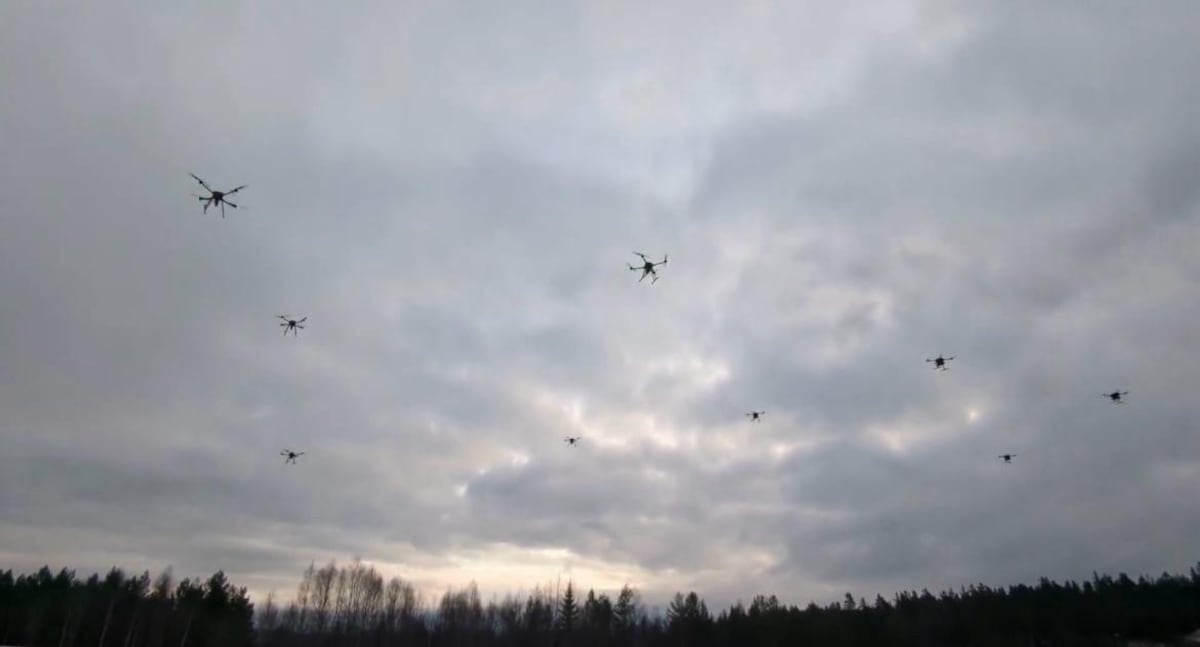
PARIS — Military units will start using drone swarms within the next two years as the underlying technology matures, according to the colonel in charge of exploring new defense technology and tactics for the French Army, as well as the Thales executive in charge of drone warfare.
“Within two years, we’ll indeed have real use cases deployed in certain units, and widespread adoption will quickly follow, because the benefits of these swarms will be quite obvious,” said Eric Lenseigne, vice president for drone warfare at defense firm Thales, speaking at the Forum Innovation Défense in Paris last week.
Drone swarms can circumvent two characteristics of today’s battlefield, access-denial strategies and the “hyper-lethality” of the frontline contact zone, said Col. Philippe Bignon, head of the Exploration Bureau at the French Army’s Future Combat Laboratory.
While several European NATO members are testing drone-swarm technology, and Ukraine has reportedly used small swarms of several drones on the battlefield, today’s unmanned systems typically still require a dedicated operator per unit. Swarm concepts envisage AI-enabled autonomous teams of drones that can sense, decide and act collectively with minimal human control.
Lenseigne said Thales experiments on swarm technology “show that we are on the verge” of having systems that will allow for true implementation of swarms, and he said all or almost all of the necessary technological building blocks for swarm use already exist.
Bignon said the first military capabilities will be available within two years, with more widespread rollout within five years.
France is working on the country’s first autonomous robot combat unit in the Pendragon project, combining land and air drones and AI-based command, with a first demonstration planned for 2026 and operational deployment the following year.
Swarms reduce risk by multiplying effectors, with only a few vectors in the drone swarm or pack able to accomplish the mission, according to Bignon. Artificial intelligence will allow the role of the swarm leader to be managed dynamically if the leader is lost, he said.
To circumvent access-denial strategies, Bignon described a scenario of “fairly complex swarm raids” combining suppression of enemy defenses, electromagnetic jamming, and attacks on communication and logistics supply lines and command nodes, which then allow for exploitation.
“There is a whole strategy for the use of swarms to be developed around penetration actions,” Bignon said. “This is undoubtedly one of the keys to breaking the tactical deadlock that we are seeing in Ukraine today.”
While new use cases for drones have emerged in Ukraine, the mode of operation has changed little for now, with pilots in most cases controlling a drone via a data link from beginning to end of a mission, according to Lenseigne.
“I don’t get the impression that this particular issue of swarms is progressing particularly quickly in Ukraine,” Lenseigne said. “In fact, what is striking in Ukraine is the very large number of drones that require a very large number of operators, and we are not seeing this capacity emerge.”
Though Ukraine is working on the technology, the country is not yet using swarms on a massive scale, according to Bignon. He said what will appear first is packs of five to 10 drones, which Ukrainians are working on, rather than swarms “in the sense that we might imagine them” of thousands of vectors.
Another use of swarms might be to resupply troops stuck in combat positions because of what Bignon called the hyper-lethality of the battlefield, with anything spotted moving near the frontline in Ukraine potentially destroyed within minutes. Swarms could also be used for deception maneuvers, the colonel said.
Swarms will accelerate the robotization and automation along the frontline in Ukraine, where there is already an area “where humans almost don’t intervene any more, only machines,” said Bignon. That will create a zone of “very high lethality” and “undoubtedly, the appearance of combat zones without humans,” he said.
Lenseigne said a future battlefield might be a place where “a rapidly dwindling number of inhabited platforms, highly sophisticated and very expensive, will coexist with an ever-increasing number of uninhabited objects that move around in swarms.”
One challenge will be ethical, because “swarms equal artificial intelligence,” according to Bignon. Operators will both have to understand possible deviations of AI and retrain their swarm system if necessary, as well as take responsibility, including legal, he said.
An underestimated aspect of swarms may be the psychological impact on soldiers who deploy them or face enemy swarms, Bignon said, comparing swarm warfare to the “dehumanized combat” some French troops have faced in the face of suicide commandos. “Obviously, in a dehumanized combat, there’s a sort of coldness behind it all that somewhat gives you goosebumps.”
The human factor could slow down the adoption of swarm technology, as people will have to adapt to “enormous changes in the way we approach combat, systems, and how we handle all of this,” said Lenseigne at Thales. “And that is something that man must fully integrate.”
Other potential obstacles to deploying hundreds or thousands of drones are the logistics required, as well as hardware integration, from packing drones in containers to figuring out how to power them until they’re sent on a mission, the executive said. There will be “a whole field that will have to be developed” to support swarms, according to Lenseigne.
“All these aspects seem trivial in terms of the difficulties compared to something like a highly intelligent system, but in reality, it’s hard, it’s physical,” Lenseigne said.
Rudy Ruitenberg is a Europe correspondent for Defense News. He started his career at Bloomberg News and has experience reporting on technology, commodity markets and politics.
巴黎——据负责探索法国陆军新国防技术和战术的陆军上校以及泰雷兹公司负责无人机作战的高管称,随着相关技术的成熟,军事单位将在未来两年内开始使用无人机群。
“两年内,我们确实会在某些部队部署真正的应用案例,并且会很快得到广泛采用,因为这些无人机群的好处将非常明显,”国防公司泰雷兹负责无人机作战的副总裁埃里克·伦塞涅上周在巴黎举行的国防创新论坛上表示。
法国陆军未来作战实验室探索局局长菲利普·比尼翁上校表示,无人机群可以绕过当今战场的两个特点:拒止进入战略和前线接触区的“超致命性”。
虽然一些欧洲北约成员国正在测试无人机集群技术,据报道乌克兰也已在战场上使用过小型无人机集群,但目前的无人系统通常仍需要每架无人机配备一名专职操作员。集群概念设想的是具备人工智能的自主无人机团队,它们能够感知、决策并协同行动,只需极少的人工干预。
伦塞涅表示,泰雷兹公司在集群技术方面的实验“表明我们即将”拥有能够真正实现集群应用的系统,他还表示,集群应用所需的全部或几乎所有技术基础模块都已经存在。
比尼翁表示,首批军事能力将在两年内投入使用,五年内将进行更广泛的推广。
法国正在“潘德拉贡”项目中研发该国首个自主机器人作战单元,该项目结合了陆地和空中无人机以及基于人工智能的指挥系统,计划于 2026 年进行首次演示,并于次年投入使用。
比尼翁表示,集群作战通过增加执行器数量来降低风险,无人机集群或编队中只需少数几个飞行器即可完成任务。他还说,如果领航员丢失,人工智能将能够动态地管理领航员的角色。
为了规避拒绝访问策略,比尼翁描述了一种“相当复杂的集群袭击”场景,该场景结合了压制敌方防御、电磁干扰以及对通信和后勤补给线和指挥节点的攻击,从而可以进行利用。
比尼翁说:“围绕渗透行动,我们需要制定一整套集群作战战略。这无疑是打破目前乌克兰战术僵局的关键之一。”
据 Lenseigne 称,虽然无人机在乌克兰出现了新的用途,但其操作模式目前变化不大,大多数情况下,飞行员仍然通过数据链路从任务开始到结束控制无人机。
伦塞涅表示:“我感觉乌克兰在应对无人机集群问题上进展并不迅速。事实上,乌克兰真正引人注目的是数量庞大的无人机,这需要大量的操作员,但我们并没有看到相应的能力出现。”
比尼翁表示,虽然乌克兰正在研发这项技术,但该国尚未大规模使用无人机集群。他说,首先出现的将是5到10架无人机组成的小队,乌克兰人正在研究这种无人机,而不是我们想象中由成千上万架无人机组成的“集群”。
集群运输机的另一个用途可能是为被困在作战阵地的部队提供补给,因为比尼翁称战场的杀伤力极强,任何在乌克兰前线附近被发现的移动目标都可能在几分钟内被摧毁。这位上校还表示,集群运输机也可以用于欺骗行动。
比尼翁表示,集群作战将加速乌克兰前线的机器人化和自动化进程,那里已经存在一个“几乎不再有人类干预,只有机器参与”的区域。他指出,这将造成一个“极高致命性”的区域,并且“无疑会出现无人作战区”。
伦塞涅表示,未来的战场可能是一个这样的地方:“数量迅速减少的、高度复杂且非常昂贵的有人居住平台,将与数量不断增加的、成群结队移动的无人居住物体共存。”
比尼翁表示,其中一项挑战将是伦理方面的,因为“群体智能等同于人工智能”。他指出,运营者既需要了解人工智能可能出现的偏差,并在必要时重新训练群体智能系统,同时也要承担相应的责任,包括法律责任。
比尼翁表示,集群作战中一个被低估的方面可能是对部署集群作战或面对敌方集群作战的士兵造成的心理影响。他将集群作战比作一些法国军队在面对自杀式突击队时所经历的“非人道战斗”。“显然,在非人道的战斗中,一切背后都隐藏着一种冷酷无情,这让人不寒而栗。”
泰雷兹公司的伦塞涅表示,人为因素可能会减缓集群技术的应用,因为人们将不得不适应“我们在作战方式、系统以及处理这一切的方式上发生的巨大变化”。“而这正是人类必须完全整合的。”
这位高管表示,部署成百上千架无人机的其他潜在障碍还包括所需的后勤保障以及硬件集成,例如将无人机装入集装箱,以及如何为它们提供动力直至执行任务。伦塞涅认为,要支持无人机集群,“需要开发一整套全新的技术”。
“与高度智能的系统相比,所有这些方面看起来似乎都微不足道,但实际上,这很困难,也很实际,”伦塞涅说。
鲁迪·鲁伊滕贝格是《防务新闻》的欧洲记者。他的职业生涯始于彭博新闻社,拥有报道科技、大宗商品市场和政治方面的经验。