China-Russia nexus jumps top of mind for Japan’s defense planners中俄关系成为日本国防规划者首要考虑的问题
Japan had initially planned the F-35Bs to support amphibious operations, but the initial six jets missed the target March delivery period.
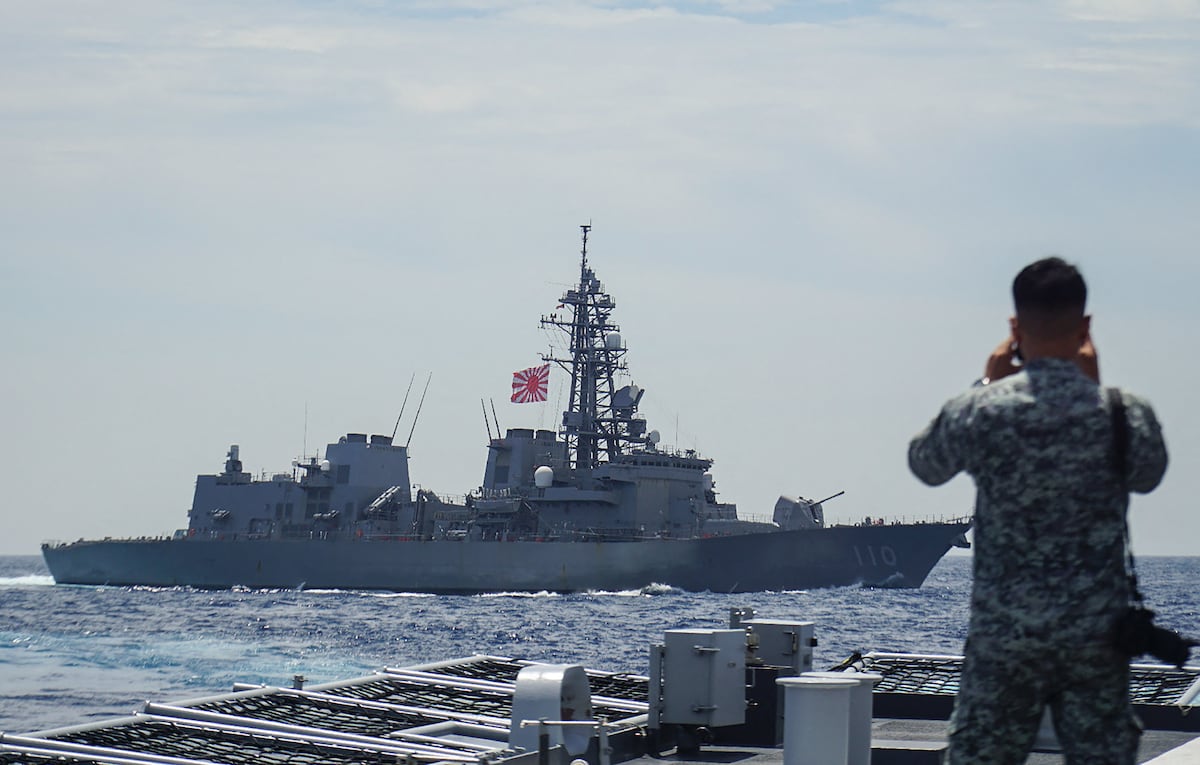
MANILA, Philippines — Japan’s defense ministry released its latest defense white paper, reiterating increased threats from deepening ties between China and Russia, and major advancements in North Korea’s nuclear missile tests.
Defense Minister Gen. Nakatani said in a July 15 press conference that Japan faces the “most severe and complex security environment” and the government is “working to achieve a radical strengthening of defense capabilities.”
The annual defense white paper summarizes the country’s security environment and the government’s actions in the past fiscal year as it implements goals defined in the three key strategy documents that are expected to be realized in 2027.
The larger security strategy includes heavy investments in standoff missile capabilities and the deployment of troops, platforms, and assets across strategic bases, particularly in the Nansei or southwest region, which receives the bulk of buildup targets.
The activities of Chinese surface fleets in waters surrounding the Senkaku Islands and Beijing’s threats to reclaim Taiwan by force have compelled Japan to ramp up island defense capabilities there.
The defense document reported cases of incursions, including an incident in May, when four Chinese Coast Guard ships entered the waters surrounding the Senkakus and a Z-9 anti-submarine helicopter entered Japan’s airspace after taking off from one of the vessels.
The incident was reported as a first, but the white paper noted an incident in 2024, when a Chinese military aircraft breached Japan’s airspace in August. A Chinese Navy aircraft carrier also loitered close to Japan’s territorial waters in September of the same year.
“China has been relentlessly continuing its unilateral attempts to change the status quo by force around the Senkaku Islands, leading to a matter of grave concern,” the document reads.
Nakatani refused to comment on the scope and scale of Japan’s role in a hypothetical conflict between the U.S. and China over Taiwan, but said the ministry will continue to work with Washington to strengthen deterrence.
Japan has steadily improved its southwestern frontlines. It has installed monitoring, patrol, and surveillance systems and deployed anti-ship guided missile units in the southwest. Electronic warfare and air defense units have also been set up while troops conduct exercises there.
Last week, the Ground Self-Defense Forces began the transfer of V-22 Ospreys temporarily based in Chiba , some 30 miles from Tokyo, to the newly opened Saga garrison in Kyushu Island.
The Ospreys will play a key role in the region’s defense, Nakatani said last week, adding the aircraft will support the amphibious task force unit responsible for recapturing and securing Japanese islands occupied in the event of an invasion.
The Self-Defense Forces will also begin training to launch the aircraft from Izumo-class destroyers that have been converted to accommodate F-35B fighter jets.
Japan had initially planned the F-35Bs to support amphibious operations, but the initial six jets missed the target March delivery period, pushing back training with the Maritime Self-Defense Forces.
The Ground Self-Defense Forces will also begin fielding Type 12 anti-ship missiles this year in choke points to bolster coastal defense.
The white paper also raised concerns over Russia and China’s relationship which saw the countries conducting “joint bomber flights and naval navigations” in areas close to Japan, the document said.
In April, the ministry released a separate report on the deployment of Russian submarines in the Far East. This includes a fifth Borey-class nuclear-powered ballistic missile submarine, a second Yasen-class M nuclear-powered cruise missile submarine, and an improved Kilo-class diesel-electric submarine, the fourth deployed with the Russian Pacific Fleet.
In recent years, North Korea’s nuclear missile tests and its attempts at launching reconnaissance satellites have been alarming experts in Tokyo, who fears Pyongyang might come closer to launching nuclear warheads that could strike Japan.
The white paper mirrors this concern as evidenced in the North’s continuous pursuits in “missile development at an extremely rapid pace, launching ballistic missiles that fly with irregular trajectories,” the white paper indicated, adding that this tests include so-called “hypersonic missiles.”
“North Korea is focusing on qualitatively improving its nuclear and missile capabilities, such as diversifying its equipment systems and acquiring intelligence, surveillance and reconnaissance (ISR) means that complement its nuclear and missile operational capabilities,” the document indicated.
The document was released days ahead of the Upper House elections on July 20. Local experts say the elections could either retain the ruling Liberal Democratic Party’s majority control in the chamber or, in worst-case scenarios, lead to Prime Minister Shigeru Ishiba’s resignation and a period of political unrest.
Leilani Chavez is an Asia correspondent for Defense News. Her reporting expertise is in East Asian politics, development projects, environmental issues and security.
菲律宾马尼拉——日本防卫省发布了最新的防卫白皮书,重申了中俄关系日益密切带来的威胁,以及朝鲜核导弹试验取得重大进展。
日本防卫大臣中谷大将在7月15日的新闻发布会上表示,日本面临着“最严峻、最复杂的安全环境”,政府正在“努力从根本上加强国防能力”。
年度国防白皮书总结了国家安全环境以及政府在过去一个财政年度为实现三个关键战略文件中确定的目标而采取的行动,这些目标预计将在 2027 年实现。
更宏大的安全战略包括对防区外导弹能力的大量投资,以及在战略基地部署部队、平台和资产,尤其是在南西或西南地区,该地区是大部分军事集结目标。
中国水面舰队在钓鱼岛周边海域的活动以及北京方面以武力收复台湾的威胁,迫使日本加强了该岛的防御能力。
该国防文件报告了多起入侵事件,其中包括 5 月份发生的一起事件,当时四艘中国海警船进入了钓鱼岛周围的水域,一架 Z-9 反潜直升机从其中一艘船上起飞后进入了日本领空。
据报道,此次事件为首例,但白皮书指出,2024年8月中国军机侵犯日本领空,同年9月中国海军航母也曾在日本领海附近徘徊。
文件指出:“中国持续不断地单方面试图以武力改变钓鱼岛周边的现状,这造成了严重关切。”
中谷拒绝就美国和中国之间可能因台湾问题发生的冲突中日本的角色范围和规模发表评论,但他表示,防卫省将继续与华盛顿合作,加强威慑。
日本不断加强其西南战线防御。已在西南地区部署了监控、巡逻和监视系统以及反舰导弹部队。此外,还组建了电子战和防空部队,并在此进行部队演习。
上周,陆上自卫队开始将暂时驻扎在距离东京约 30 英里的千叶的 V-22 鱼鹰运输机转移到九州岛新开设的佐贺驻军。
中谷上周表示,鱼鹰运输机将在该地区的防御中发挥关键作用,并补充说,该飞机将为负责在遭到入侵时夺回和保卫被占领的日本岛屿的两栖特遣部队提供支持。
自卫队还将开始训练从已改装为可搭载 F-35B 战斗机的出云级驱逐舰上起飞这些飞机。
日本最初计划使用 F-35B 来支持两栖作战,但首批六架战机未能按计划在 3 月份交付,导致与海上自卫队的训练推迟。
今年,陆上自卫队也将开始在咽喉要道部署12型反舰导弹,以加强海岸防御。
白皮书还对俄罗斯和中国的关系表示担忧,文件称,两国在日本附近海域进行了“联合轰炸飞行和海上航行”。
今年4月,国防部发布了一份关于俄罗斯潜艇在远东地区部署情况的单独报告。报告指出,俄罗斯已向远东地区部署了第五艘“北风之神”级核动力弹道导弹潜艇、第二艘“亚森”级M型核动力巡航导弹潜艇以及一艘改进型“基洛”级柴电潜艇,这是部署在俄罗斯太平洋舰队的第四艘同级潜艇。
近年来,朝鲜的核导弹试验和发射侦察卫星的尝试令东京的专家们感到担忧,他们担心平壤可能会更接近发射能够打击日本的核弹头。
白皮书反映了这种担忧,白皮书指出,朝鲜不断以极快的速度进行导弹研发,发射飞行轨迹不规则的弹道导弹,这便是明证,并补充说,这些试验包括所谓的“高超音速导弹”。
文件指出,“朝鲜正致力于从质上提升其核武器和导弹能力,例如使其装备系统多样化,并获取与其核武器和导弹作战能力相辅相成的情报、监视和侦察(ISR)手段。”
该文件在7月20日参议院选举前几天发布。当地专家表示,选举结果要么会维持执政的自民党在参议院的多数席位,要么在最糟糕的情况下,会导致首相石破茂辞职,并引发一段政治动荡时期。
莱拉尼·查韦斯是《防务新闻》的亚洲记者。她的报道专长是东亚政治、发展项目、环境问题和安全。