Check Out This Soviet Submarine Firing A Nuclear Ballistic Missile While Docked Pierside看看这艘停靠在码头的苏联潜艇是如何发射核弹道导弹的!
The Russian Navy has reportedly looked into reviving this tactic, but for cruise-missile armed submarines.
By Joseph Trevithick
Updated Mar 26, 2020 2:33 PM EDT
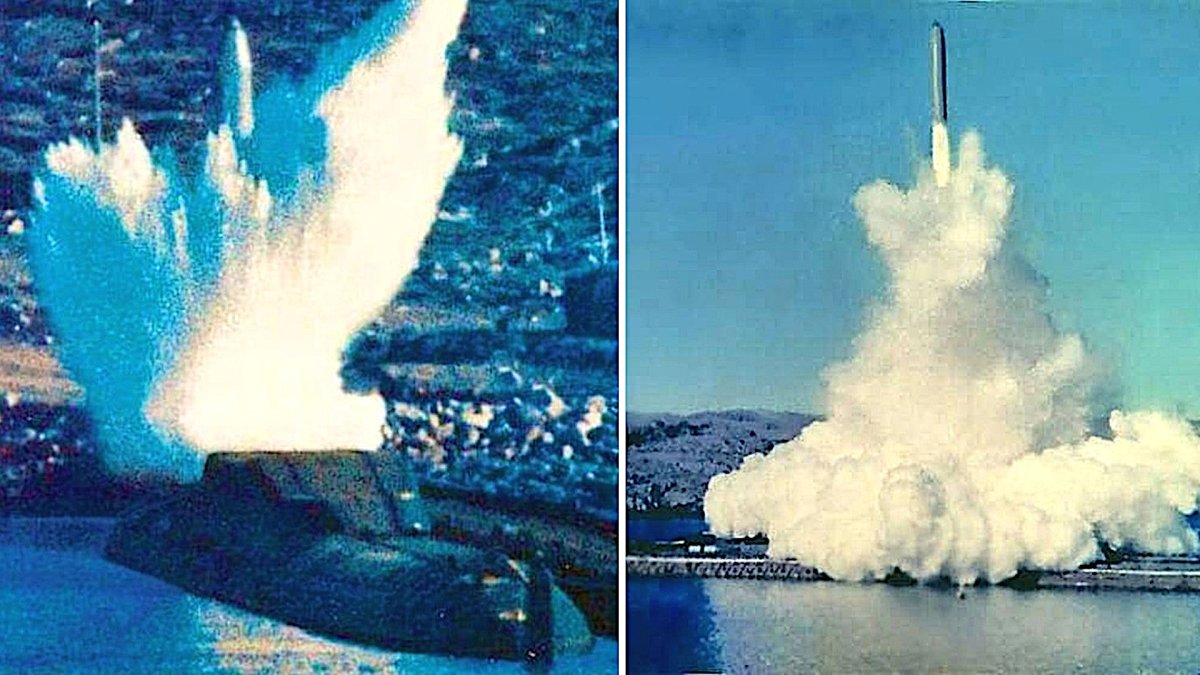
Pictures have been circulating online of a Soviet Delta III class nuclear ballistic missile submarine firing an R-29R submarine-launched ballistic missile during an exercise while still in port, a unique tactic that no other country appears to have ever employed. Last year, the Russian Navy reportedly conducted a similar test, but which involved a Yasen class guided-missile submarine conducting a pier-side launch of a Kalibr cruise missile , apparently for the first time ever.
The date and exact circumstances of the particular exercise seen in the photos on social media are unclear. An article in Russia’s Izvestia newspaper in 2019 said that the Soviet Navy had first begun training ballistic missile submarine crews to carry out these pier-side launches in the late 1960s and early 1970s.
This would fit broadly with the fact that a Delta III class submarine is seen in the pictures firing the R-29R missile . The Soviet Navy commissioned the first of the Delta IIIs, also known as Project 667BDR Kalmar class boats, in 1976.
The last member of the 14-ship class entered Soviet Navy service in 1982. The posts online generally agree that the launch took place prior to the collapse of the Soviet Union in 1991. Today, just one of these submarines, the Razan , also known as K-44, remains in active service as a ballistic missile submarine. Another Delta III , the Orenburg , or BS-136, is also still sailing, but has been converted into a special projects submarine capable of serving as a mother ship for small spy submarines, which you can read more about in this past War Zone piece .
Атомный подводный ракетоносец "Кальмар" ВМФ СССР стреляет ракетой Р-29Р с пирса на учениях. Когда нужно нанести ядерный удар немедленно! pic.twitter.com/zINMlI1FSX — Анатолий Власов 🇷🇺 (@AnatolyVlasov87) February 14, 2020
Атомный подводный ракетоносец "Кальмар" ВМФ СССР стреляет ракетой Р-29Р с пирса на учениях. Когда нужно нанести ядерный удар немедленно! pic.twitter.com/zINMlI1FSX
Nuclear ballistic missile submarines, or boomers, such as the Delta III s, have long offered the countries that operate them invaluable nuclear second-strike deterrent capabilities. This is in no small part because of their ability to operate submerged, often cruising slowly and quietly in remote areas, for weeks or months at a time.
Why the Russians decided to train their boomer crews to also be prepared to have them launch their world-ending weapons without ever leaving port is not entirely clear. “The fleet does not always have the deployment time necessary for the ships to depart from the pier and proceed to the previously designated strike area,” Igor Kurdin, a retired Russian Navy submarine captain and head of the St. Petersburg Club of Submariners, a naval veterans organization , told Izvestia last year.
The R-29R has a range of just under 4,040 miles, which would have allowed submarines armed with those missiles, such as the Delta III s, to hit anywhere in Europe, as well as portions of Alaska, Canada, and the northeastern United States, from naval bases in Russia’s northwestern corner. Ballistic missile submarines based in Russia’s Far East region would have been within range of Alaska, as well as, along with Hawaii and other targets in the Western Pacific, such as major American military bases on Guam .
The Delta III class submarine Razan ., Russian Navy
While the submarines would not be hidden in any way while in port, being able to fire their missiles while still moored at the pier would have made them a standing threat at all times. The Soviets could also have made use of the submarines without the need to find a full crew and otherwise provision them for long cruises, if necessary.
The tactic would also have given the Soviets some added defense against a first strike or otherwise losing ballistic missile submarines in port before they could fire their missiles during the initial wave of strikes in a nuclear conflict. Submarine bases would have been high priority targets in either of those scenarios and, as the retired Russian Navy captain Kurdin noted, the boomers might not have been able to escape out to sea before incoming strikes hit. Being able to fire their missiles from their moorings would have allowed them to still attempt to launch retaliatory strikes before being destroyed.
There are, of course, risks and drawbacks to doing this, as well, not least of which what could happen if the missile were to fail for some reason. The shock and blast from firing the missiles might also cause increased wear and tear, and even damage, to the submarine’s moorings.
There is no indication that the U.S. Navy, or any other country that operates nuclear ballistic missile submarines, has ever experimented with or actively trained to employ this same tactic. It’s unclear whether the Russian Navy continued to train boomer crews to carry out these operations after the collapse of the Soviet Union.
In March 2019, Izvestia did report that Russia’s sole Project 885 Yasen class guided-missile submarine, the Severodvinsk , had fired a Kalibr land-attack cruise missile while pier-side at the Nerpichya Naval Base, part of the larger Zapadnaya Litsa base, in Murmansk. This appeared to indicate a more recent revival of the tactic that was afforded by the fact that the Severodvinsk has a vertical launch capability. Other Russian submarines capable of firing Kalibrs do so by launching them via their torpedo tubes, something that cannot be readily done in port.
The 3M-14 variants of Kalibr, which can carry nuclear warheads, have a range between 930 and 1,500 miles, according to publicly available information . Russia is also reportedly working on a new, extended-range Kalibr-M that can hit targets over 2,800 miles away, at least.
With a range of 1,500 miles, Severodvinsk , or any other submarine capable of vertically launching these variants of Kalibr, such as the improved Project 885M Yasen-M submarines now under construction, could strike targets across Scandanavia and in northern Europe, as well as Iceland , on short notice from bases in northeastern
Russia. Other improved cruise missiles, such as the shadowy hypersonic 3M22 Zircon , which is in development now, could further expand those capabilities. From what we know, however, Zircon has a significantly shorter range than Kalibr.
Increased Russian submarine activity in the Atlantic has become a particular point of concern for the U.S. military, as well as its NATO allies, in recent years, which you can read about more in these past War Zone stories . The Kalibr cruise missile has also come up as representing an especially notable threat to America’s European allies and partners.
“The Kalibr class cruise missile, for example, has been launched from coastal-defense systems, long-range aircraft, and submarines off the coast of Syria,” U.S. Navy Admiral James Foggo, head of U.S. Naval Forces Europe and commander of NATO’s Allied Joint Force Command Naples, said in 2018 . “They’ve shown the capability to be able to reach pretty much all the capitals in Europe from any of the bodies of water that surround Europe.”
Russia’s revival of the tactic of being able to fire missiles from submarines in port only increases the flexibility of Severodvinsk and other future guided-missile submarines with vertical launch system capabilities, even in times where there might be too few resources to actually put them out to sea. It offers the benefit of being able to make use of boats on short notice for long-range strikes and reducing the chance of a pre-emptive strike negating their retaliatory capability just as it did for the Soviet Navy’s boomers.
If nothing else, it’s another example of interesting and unique naval tactics and capabilities that the Soviets developed during the Cold War and that continue to inform Russian Navy operations to this day.
Contact the author: joe@thedrive.com
Comments couldn’t be loaded. Please refresh the page.
作者:约瑟夫·特雷维西克
更新于美国东部时间2020年3月26日下午2:33
网上流传着苏联德尔塔III级核动力弹道导弹潜艇在港口进行演习时发射R-29R潜射弹道导弹的照片,这种独特的战术似乎没有其他国家采用过。据报道,俄罗斯海军去年也进行过类似的测试,但当时使用的是一艘亚森级导弹潜艇,在码头边发射了一枚“口径”巡航导弹,这显然是史无前例的。
社交媒体照片中显示的此次演习的具体日期和情况尚不清楚。俄罗斯《消息报》2019年的一篇文章指出,苏联海军早在20世纪60年代末70年代初就开始训练弹道导弹潜艇艇员进行码头发射。
这与照片中出现的德尔塔III级潜艇发射R-29R导弹的事实基本吻合。苏联海军于1976年服役了首艘德尔塔III级潜艇,该级潜艇也被称为667BDR型卡尔玛级潜艇。
14艘同级潜艇中的最后一艘于1982年加入苏联海军服役。网上普遍认为,该级潜艇的下水时间早于1991年苏联解体。如今,该级潜艇中仅剩一艘“拉赞”号(Razan,又称K-44)仍在服役,作为弹道导弹潜艇使用。另一艘德尔塔III型潜艇“奥伦堡”号(Orenburg,又称BS-136)也仍在服役,但已被改装为特种项目潜艇,可作为小型间谍潜艇的母舰。您可以在之前的“战区”文章中了解更多相关信息。
Атомный подводный ракетоносец "Кальмар" ВМФ СССР стреляет ракетой Р-29Р с пирса на учения. Когда нужно нанести ядерный удар немедленно! pic.twitter.com/zINMlI1FSX — Анатолий Власов 🇷🇺 (@AnatolyVlasov87) 2020 年 2 月 14 日
Атомный подводный ракетоносец "Кальмар" ВМФ СССР стреляет ракетой Р-29Р с пирса на учения. Когда нужно нанести ядерный удар немедленно! pic.twitter.com/zINMlI1FSX
核动力弹道导弹潜艇,例如德尔塔III型潜艇,长期以来为拥有它们的国家提供了极其宝贵的核二次打击威慑能力。这在很大程度上归功于它们能够在水下作战,通常能够在偏远地区缓慢而安静地巡航数周甚至数月之久。
俄罗斯为何决定训练其弹道导弹艇员,使其能够在不离开港口的情况下发射足以毁灭世界的武器,这一点尚不完全清楚。“舰队并非总有足够的部署时间,让舰艇离开码头并前往预先指定的打击区域,”俄罗斯海军退役潜艇艇长、圣彼得堡潜艇兵俱乐部(一个海军退伍军人组织)主席伊戈尔·库尔金去年告诉《消息报》。
R-29R导弹的射程略低于4040英里,这意味着装备该导弹的潜艇,例如德尔塔III型潜艇,可以从俄罗斯西北角的海军基地打击欧洲任何地区,以及阿拉斯加、加拿大和美国东北部的部分地区。部署在俄罗斯远东地区的弹道导弹潜艇也将进入阿拉斯加的射程,以及夏威夷和西太平洋的其他目标,例如关岛上的主要美国军事基地。
俄罗斯海军德尔塔III级潜艇“拉赞”号
虽然这些潜艇在港口停泊期间无法以任何方式隐藏,但它们能够在停泊码头时发射导弹,这将使它们始终构成威胁。如有必要,苏联还可以利用这些潜艇,而无需招募完整的船员或为它们进行长途航行准备其他物资。
这一战术还能为苏联提供额外的防御手段,以应对先发制人的打击,或者避免在核冲突的第一波攻击中,弹道导弹潜艇在港口内无法发射导弹而被摧毁。在上述两种情况下,潜艇基地都将是优先攻击目标。正如俄罗斯海军退役上校库尔金所指出的,弹道导弹潜艇可能无法在来袭的打击之前逃往外海。如果能够从停泊处发射导弹,它们在被摧毁之前仍有机会尝试进行报复性打击。
当然,这样做也存在风险和弊端,其中最主要的问题是,如果导弹因某种原因失效会发生什么。导弹发射产生的冲击波和爆炸也可能加剧潜艇系泊系统的磨损,甚至造成损坏。
没有任何迹象表明美国海军或其他任何拥有核动力弹道导弹潜艇的国家曾试验过或积极训练过使用这种战术。目前尚不清楚苏联解体后,俄罗斯海军是否继续训练弹道导弹潜艇艇员执行此类行动。
2019年3月,《消息报》报道称,俄罗斯唯一一艘885型“亚森”级导弹潜艇“北德文斯克”号在摩尔曼斯克市的涅尔皮奇亚海军基地(隶属于更大的“西部利察”海军基地)码头停泊期间,发射了一枚“口径”陆攻巡航导弹。这似乎表明,由于“北德文斯克”号具备垂直发射能力,这种战术近期有所复兴。其他具备发射“口径”导弹能力的俄罗斯潜艇是通过鱼雷发射管发射的,而这种发射方式在港口内难以实现。
根据公开信息,可携带核弹头的“口径”3M-14型火箭炮射程在930至1500英里之间。据报道,俄罗斯还在研发一种新型的远程“口径-M”火箭炮,其射程至少可达2800英里以上。
凭借1500英里的航程,北德文斯克号潜艇,或任何其他能够垂直发射这些口径导弹改进型的潜艇,例如目前正在建造的改进型885M“亚森-M”级潜艇,都可以从东北部的基地迅速打击斯堪的纳维亚半岛、北欧以及冰岛的目标。
俄罗斯。其他改进型巡航导弹,例如目前正在研发中的神秘高超音速3M22“锆石”导弹,可能会进一步增强这些能力。但据我们所知,“锆石”导弹的射程比“口径”导弹短得多。
近年来,俄罗斯潜艇在大西洋的活动日益频繁,这已成为美国军方及其北约盟国特别关注的问题,您可以在之前的“战区”报道中了解更多相关信息。此外,俄罗斯的“口径”巡航导弹也被认为对美国的欧洲盟友和伙伴构成了尤为显著的威胁。
“例如,口径级巡航导弹已经从叙利亚沿海的岸防系统、远程飞机和潜艇上发射过,”美国海军上将、美国海军驻欧洲部队司令兼北约那不勒斯联合部队司令詹姆斯·福戈在2018年表示。“他们已经证明,他们有能力从环绕欧洲的任何水域打击几乎所有欧洲国家的首都。”
俄罗斯恢复从港口潜艇发射导弹的战术,进一步提升了“北德文斯克”号以及其他未来具备垂直发射能力的导弹潜艇的灵活性,即使在资源不足以将其派往海上作战的情况下也能如此。这种战术的优势在于能够迅速调动潜艇进行远程打击,并降低被先发制人打击而丧失反击能力的风险,正如苏联海军的弹道导弹潜艇所经历的那样。
即便没有其他意义,这也是苏联在冷战期间发展出的有趣且独特的海军战术和能力的又一个例证,这些战术和能力至今仍在指导着俄罗斯海军的作战行动。
联系作者:joe@thedrive.com
评论加载失败,请刷新页面。