More than 150,000 public officers to receive AI, cybersecurity training at new institute超过15万名公务员将在新机构接受人工智能和网络安全培训
More than 150,000 Singapore public officers will receive AI, cybersecurity and digital training by 2028 through the new Institute of Digital Government. Read more at straitstimes.com.
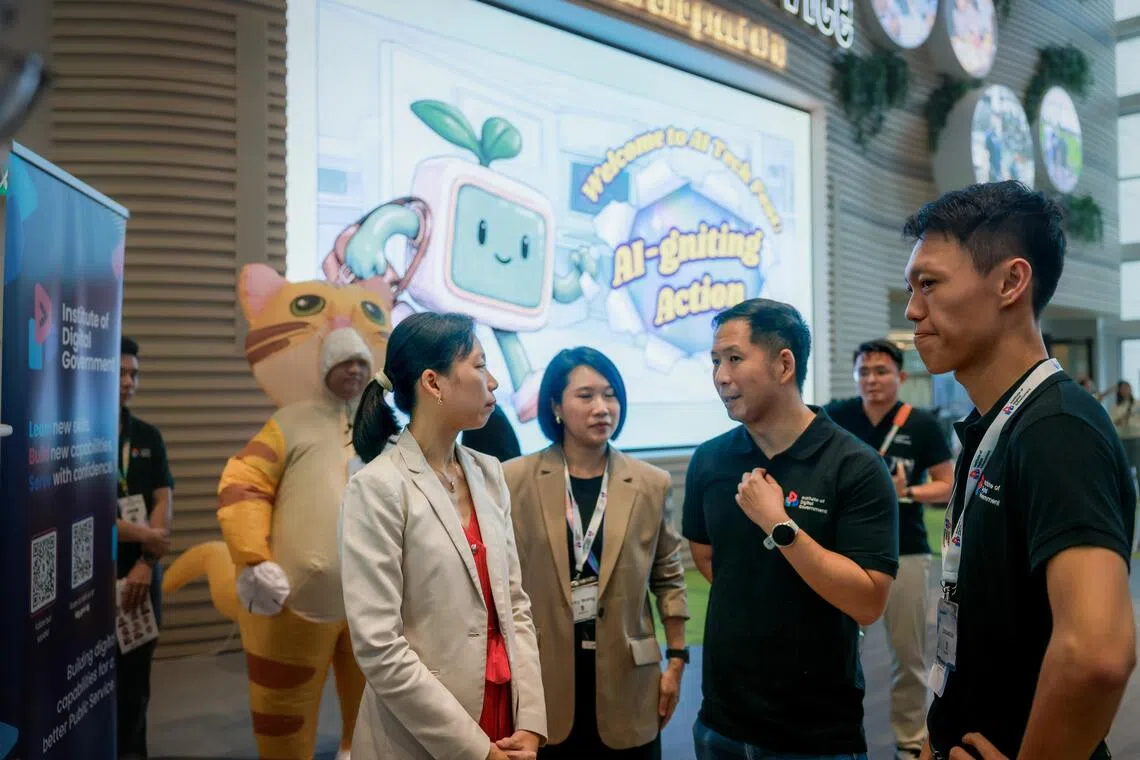
Acting Minister for Manpower and Senior Minister of State for Digital Development and Information Jasmin Lau (left) touring the AI Tech Fest exhibition during the launch of the Institute of Digital Government on Sept 18, 2026.
Published Sep 18, 2026, 07:50 PM
Updated Sep 18, 2026, 07:50 PM
A new Institute of Digital Government in Singapore will train over 150,000 public officers in AI, cybersecurity, and digital skills by 2028 through standardised online and workshop modules.
Training includes annual mandatory courses on cybersecurity, data protection, and AI literacy, plus three learning pathways based on officers’ AI familiarity to build practical skills.
The institute supports agency transformation via AI Sprints and fosters communities like Champions of AI Transformation to share AI practices and improve public service work.
SINGAPORE – As part of a push to get the public service artificial intelligence ready, a new institute aims to provide more than 150,000 public officers here with training in digital, data and AI capabilities by 2028.
A collaboration between the Ministry of Digital Development and Information (MDDI) and the Civil Service College (CSC), the Institute of Digital Government (IDG) was officially launched on Sept 18 at the AI Tech Festival, held at the CSC’s North Buona Vista campus.
Announced in March during the debate on MDDI’s budget, the new institute will enable all public officers here, across different roles and digital proficiency levels, to develop practical digital and AI capabilities relevant to their work.
While officers have previously undergone such training, IDG provides a standardised and centralised avenue for such training, which will be conducted online or via workshops.
All officers will be required to complete annual mandatory foundational modules, which will cover cybersecurity, data protection and AI literacy, MDDI said in a statement.
These modules will be regularly refreshed to ensure they remain relevant and aligned with the latest technological developments.
To help public officers use AI effectively, IDG will provide them with foundational skills in product thinking – an approach that aims to build meaningful solutions to real problems faced by users.
These skills include understanding user needs and defining the right problem to solve, before considering how technology can be applied in a given scenario.
Officers will then be able to build their digital capabilities via three structured learning pathways, based on their level of familiarity with AI or digital tools.
These pathways are Aware 101 for those unfamiliar with such tools, Apply 201 for those with a basic understanding of AI and Build 301, for those who wish to design and build solutions to solve problems at work.
The institute aims to have all public officers acquire a basic level of proficiency in AI by 2028, enabling them to use the technology effectively in their work.
The Singapore Public Service currently employs about 158,000 public officers across 16 ministries and more than 50 statutory boards.
To complement these learning pathways, IDG will support government agencies’ transformation efforts through AI Sprints – workshops held at the agency level, which allow officers to experiment and apply digital and AI skills to real workplace challenges.
“Officers will learn to frame problems, rapidly prototype and test solutions, and apply enterprise tools to improve how work is done, contextualised to the work in their agencies,” said MDDI.
The ministry added that these workshops have been conducted since May, with more than 1,000 public officers participating.
Senior Minister of State for Digital Development and Information Jasmin Lau, who launched the new institute, noted that 150 senior leaders in the public sector – including permanent secretaries, deputy secretaries and heads of agencies – had already undergone foundational digital capability training.
“More recently, they rolled up their sleeves and tried to build with AI themselves, from developing morning briefs to creating personal agents,” she said, adding that members of the Cabinet had also attended similar training sessions.
“We had to make sure that all of our ministers also understand how digital products are built, what cybersecurity is about, what AI is and how AI can be used,” she said.
Lau, who is also Acting Manpower Minister, noted that it is important for AI to become not just another key performance indicator, but a tool that helps public officers do their jobs better.
“It should give officers more time for work that requires judgement, context and care,” she said, adding that AI could possibly also free up time for such officers to spend with their families.
As part of its efforts, the institute is also establishing communities to bring officers across agencies together to share useful products and practices.
One such community is the Champions of AI Transformation, made up of officers in non-technical roles who are driving AI-enabled workflow redesign in their agencies.
SCDF firefighter and emergency medical technician Muhammad Naim Zahari, who began his AI journey in 2023, at the launch of IDG on Sept 18, 2026. The Straits Times
SCDF firefighter and emergency medical technician Muhammad Naim Zahari, who began his AI journey in 2023, at the launch of IDG on Sept 18, 2026.
Muhammad Naim Zahari, a firefighter and emergency medical technician with the Singapore Civil Defence Force, began his AI journey in 2023, when he took part in a data visualisation competition.
The 35-year-old father of one said he sees his role as providing an important human element to learning digital skills.
“It’s very important to not lose that human touch,” he said.
Zhaki Abdullah is a correspondent at The Straits Times. He is on the health beat, in addition to occasionally covering science, environmental, tech and Muslim affairs issues.
Ministry of Digital Development and Information
CSC/Civil Service College
2026年9月18日,人力部代部长兼数码发展及新闻部高级政务部长刘嘉玲(左)在数码政府研究院成立之际参观人工智能科技节展览。
发布于2026年9月18日晚上7:50
更新于2026年9月18日晚上7:50
新加坡新成立的数字政府学院将通过标准化的在线课程和研讨会模块,到 2028 年培训超过 15 万名公务员,提升他们的人工智能、网络安全和数字技能。
培训包括网络安全、数据保护和人工智能素养方面的年度必修课程,以及根据警员对人工智能的熟悉程度而制定的三条学习路径,以培养实践技能。
该机构通过人工智能冲刺项目支持机构转型,并培育人工智能转型倡导者等社区,以分享人工智能实践经验并改进公共服务工作。
新加坡——为了推动公共服务部门做好人工智能方面的准备,一家新成立的机构计划到 2028 年为超过 15 万名公务员提供数字、数据和人工智能能力方面的培训。
由数字发展与信息部 (MDDI) 和公务员学院 (CSC) 合作成立的数字政府研究所 (IDG) 于 9 月 18 日在公务员学院北波那维斯达校区举行的 AI 技术节上正式启动。
该新机构于 3 月份在 MDDI 预算辩论期间宣布成立,它将使这里所有不同职位和数字技能水平的公务员都能发展与其工作相关的实用数字和人工智能能力。
虽然警员们以前也接受过此类培训,但IDG提供了一个标准化、集中化的培训途径,培训将在线进行或通过研讨会进行。
MDDI在一份声明中表示,所有官员都必须完成年度强制性基础模块,内容涵盖网络安全、数据保护和人工智能素养。
这些模块将定期更新,以确保其与时俱进,并与最新的技术发展保持同步。
为了帮助公职人员有效利用人工智能,IDG 将为他们提供产品思维方面的基础技能——这种方法旨在为用户面临的实际问题构建有意义的解决方案。
这些技能包括了解用户需求并确定要解决的正确问题,然后再考虑如何在给定场景中应用技术。
警员们将能够根据自身对人工智能或数字工具的熟悉程度,通过三个结构化的学习路径来提升自身的数字能力。
这些路径分别是:面向不熟悉此类工具的人的“Aware 101”、面向对人工智能有基本了解的人的“Apply 201”以及面向希望设计和构建解决方案以解决工作中问题的人的“Build 301”。
该机构的目标是到 2028 年使所有公务员都具备人工智能的基本能力,使他们能够在工作中有效地使用这项技术。
新加坡公共服务部门目前在 16 个部门和 50 多个法定机构中雇佣了约 158,000 名公务员。
为了补充这些学习途径,IDG 将通过 AI Sprint(在机构层面举办的研讨会)来支持政府机构的转型工作,让官员们能够尝试并将数字和人工智能技能应用于实际工作中的挑战。
MDDI表示:“警官们将学习如何界定问题、快速构建原型并测试解决方案,以及应用企业工具来改进工作方式,并根据其所在机构的工作情况进行调整。”
该部补充说,这些研讨会从5月份开始举办,已有超过1000名公务员参加。
负责数码发展及新闻事务的高级政务部长刘嘉敏为新学院揭幕,她指出,公共部门已有150名高级领导人(包括常任秘书、副秘书和机构负责人)接受了基础数字能力培训。
“最近,他们卷起袖子,尝试自己运用人工智能进行开发,从编写晨间简报到创建个人代理,”她说道,并补充说内阁成员也参加了类似的培训课程。
她说:“我们必须确保我们所有的部长也了解数字产品是如何构建的,网络安全是什么,人工智能是什么以及如何使用人工智能。”
兼任人力部代部长的刘先生指出,人工智能不仅要成为另一个关键绩效指标,更要成为帮助公务员更好地完成工作的工具。
“这应该能让警员们有更多时间从事需要判断、了解情况和谨慎对待的工作,”她说道,并补充说,人工智能也可能让这些警员有更多时间陪伴家人。
作为其努力的一部分,该研究所还在建立社区,将不同机构的官员聚集在一起,分享有用的产品和做法。
其中一个这样的群体是人工智能转型倡导者,他们由非技术岗位的官员组成,这些官员正在各自的机构中推动人工智能赋能的工作流程重新设计。
新加坡民防部队消防员兼紧急医疗技术员穆罕默德·纳伊姆·扎哈里(Muhammad Naim Zahari)于2023年开启了他的人工智能之旅,并于2026年9月18日出席了IDG的启动仪式。《海峡时报》
新加坡民防部队消防员兼紧急医疗技术员穆罕默德·纳伊姆·扎哈里于 2023 年开始了他的人工智能之旅,并在 2026 年 9 月 18 日的 IDG 启动仪式上亮相。
新加坡民防部队的消防员兼紧急医疗技术员穆罕默德·纳伊姆·扎哈里 (Muhammad Naim Zahari) 于 2023 年参加了一场数据可视化比赛,由此开启了他的人工智能之旅。
这位35岁的单身父亲表示,他认为自己的角色是为学习数字技能提供重要的人文因素。
“保持人情味非常重要,”他说。
扎基·阿卜杜拉是《海峡时报》的记者。他主要负责健康新闻报道,偶尔也报道科学、环境、科技和穆斯林事务等议题。
数字发展和信息部
公务员学院