New festival on racial and religious harmony allows youth to learn about different scents, tastes一项旨在促进种族和宗教和谐的新节日让年轻人有机会了解不同的气味和味道。
The festival will be held every two years at a different institute of higher learning. Read more at straitstimes.com.
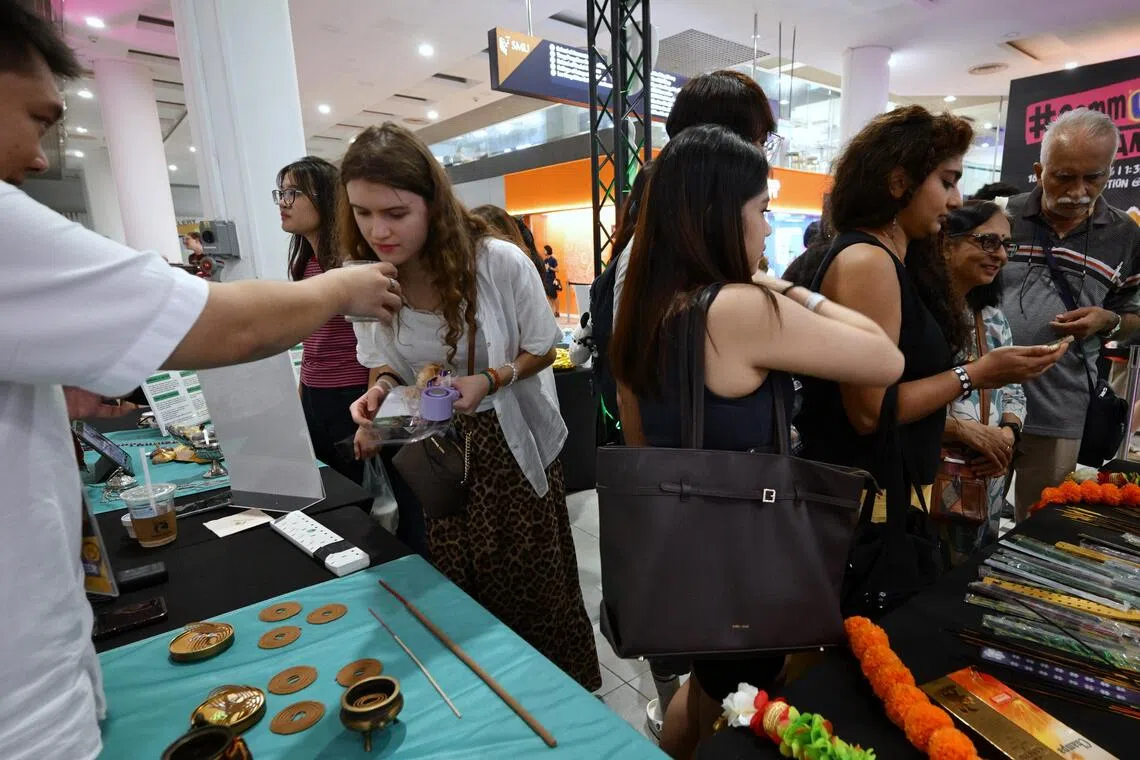
Experiential booths at the #commUNITY on Campus festival helped young people understand different cultures and beliefs.
ST PHOTO: NG SOR LUAN
Published Sep 18, 2026, 07:50 PM
Updated Sep 18, 2026, 07:50 PM
The #commUNITY on Campus festival at SMU celebrates racial and religious harmony by showcasing scents, tastes, and cultural objects from diverse faiths to build cross-cultural understanding among youths.
Organised by Youth Leaders @ Harmony Circle and supported by the Ministry of Culture, Community and Youth, the festival offers hands-on experiences and highlights similarities across religions, such as shared incense rituals.
The event aims to prepare young people for a diverse workforce by deepening their appreciation of multiracial and multireligious Singapore, emphasising the ongoing importance of harmony in society.
SINGAPORE – Despite being Buddhist, undergraduates Evlin Woo and Chloe Chua did not know the origins of the familiar scents that form part of their religious heritage.
At a festival celebrating racial and religious harmony held at the Singapore Management University on Sept 18, they got up close and personal with Bodhi leaves, mani pills and joss sticks made from sandalwood and agarwood.
These items were part of experiential booths meant to help young people understand different cultures and beliefs.
The event was jointly developed by 80 youths from the Youth Leaders @ Harmony Circle (YLHC) with 15 student cultural, faith-based and interfaith clubs across four institutes of higher learning (IHL) and other youth groups.
The festival, led by the YLHC and supported by the Ministry of Culture, Community and Youth, will be held every two years at a different institute of higher learning.
On Sept 18, more than 600 attendees got intimate with the tastes and scents of different cultures.
Chua, who studies accountancy, said: “A lot of the scents were familiar, but I think we never heard of the origin.”
In addition to the different tastes and aromas from different cultures, attendees also got to touch objects, as prayer beads, sacred threads and cloths.
Woo and Chua said they also learnt about the different objects belonging to the Judaic faith, such as tefillin – two black leather boxes with straps worn by men each weekday morning before prayer – and tallit, a fringed prayer shawl.
“They also shared about their culture and their beliefs and how they don’t use their phones or any devices on Saturday. It was nice to hear that it was part of their culture,” said Chua.
Representative from Singapore Taoist Federation, Edmund Zhang (left), 36, shares information about the wooden fish, a ritual percussion instrument. ST PHOTO: NG SOR LUAN
Representative from Singapore Taoist Federation, Edmund Zhang (left), 36, shares information about the wooden fish, a ritual percussion instrument.
Software engineer Fathima Raeesah learnt that Taoism and Hinduism share common beliefs when it comes to incense. Both religions believe that rising incense smoke represents the ascension of prayer towards God.
“I was able to see how the different religions have a lot of similarities between different aspects such as their flavours and scents. While learning about the differences, it is also a way to embrace the similarities they share,” said the 25-year-old .
Derek Tan, who co-led the organising committee of the festival, said the event brings different cultures and traditions together in a more relaxed and engaging way, which is useful as people may not always have the opportunity to have conversations across communities.
The other co-lead of the organising committee, Ismail Meera Begum , said the experiential booths let attendees understand first-hand the common ground between different cultures.
For example, talbina, which is a traditional food recommended by Prophet Muhammad in Islam, is similar to tea in Sikh tradition in that they are both symbols of hospitality.
“This festival gives people insight into the meaning behind certain food and beverages. They may not realise there is actually a deeper meaning behind such traditional food,” said Meera.
She added that the festival is catered towards youth because when they enter the workforce, they will encounter a world that is different from schooling life.
“Racial and religious harmony is a very important aspect which we need to cultivate in young people so that when they face the world, they know what to expect and how to handle certain differences that may come about.”
Senior Parliamentary Secretary for Culture, Community and Youth Goh Hanyan tries out the talbina drink. ST PHOTO: NG SOR LUAN
Senior Parliamentary Secretary for Culture, Community and Youth Goh Hanyan tries out the talbina drink.
Speaking at the festival, Senior Parliamentary Secretary for Culture, Community and Youth Goh Hanyan said Singapore cannot take racial and religious harmony for granted.
She said: “We have to continue to update what it means to all of us. For the younger generation, you all have a very different perspective, probably, of what it means to be a multiracial, multireligious society in Singapore.
“I’m very happy that you have taken interest in such an important theme, and taking it on your own to try to update this unique brand that we have in Singapore of being multiracial and multireligious.”
SMU/Singapore Management University
在#commUNITY校园节上,体验式展位帮助年轻人了解不同的文化和信仰。
圣徒照片:吴索銮
发布于2026年9月18日晚上7:50
更新于2026年9月18日晚上7:50
SMU 的 #commUNITY 校园节通过展示来自不同信仰的气味、味道和文化物品来庆祝种族和宗教和谐,从而在青年人之间建立跨文化理解。
该节日由和谐圈青年领袖组织,并得到文化、社区和青年部的支持,提供实践体验,并突出不同宗教之间的相似之处,例如共同的焚香仪式。
该活动旨在通过加深年轻人对新加坡多元种族和多元宗教的了解,帮助他们为多元化的劳动力市场做好准备,并强调社会和谐的持续重要性。
新加坡——尽管身为佛教徒,本科生吴伊琳和蔡克洛伊却不知道构成其宗教传统一部分的那些熟悉气味的起源。
9 月 18 日,在新加坡管理大学举办的庆祝种族和宗教和谐的节日上,他们近距离接触了菩提叶、玛尼丸以及用檀香和沉香制成的香。
这些物品是体验式展位的一部分,旨在帮助年轻人了解不同的文化和信仰。
本次活动由来自和谐圈青年领袖 (YLHC) 的 80 名青年与来自四所高等院校 (IHL) 的 15 个学生文化、信仰和跨信仰俱乐部以及其他青年团体共同策划。
该节日由青年领袖学院 (YLHC) 牵头,并得到文化、社区和青年部的支持,将每两年在不同的高等学府举办一次。
9月18日,600多名参与者近距离体验了不同文化的味道和气味。
学习会计专业的蔡同学说:“很多气味都很熟悉,但我想我们以前从未听说过它们的来源。”
除了体验不同文化的各种口味和香气外,参与者还可以触摸念珠、圣线和布料等物品。
伍和蔡表示,他们还了解了犹太教的各种物品,例如经文匣(tefillin)——两个黑色皮盒,上面有皮带,男人们每天早上祈祷前佩戴——以及祈祷披肩(tallit),一种带流苏的祈祷披肩。
“他们还分享了他们的文化和信仰,以及他们周六不使用手机或任何电子设备的习惯。很高兴听到这是他们文化的一部分,”蔡女士说。
新加坡道教总会代表张先生(左),36岁,正在介绍木鱼,一种仪式打击乐器。(海峡时报摄影:黄素銮)
新加坡道教联合会代表张埃德蒙(左),36岁,介绍木鱼,一种仪式打击乐器。
软件工程师法蒂玛·拉伊萨(Fathima Raeesah)了解到,道教和印度教在焚香方面有着共同的信仰。这两个宗教都认为,袅袅升起的香烟象征着祈祷升腾至神灵面前。
这位25岁的年轻人说:“我发现不同的宗教在很多方面都有很多相似之处,比如它们的味道和气味。在了解它们之间的差异的同时,这也是一种欣赏它们共同之处的方式。”
德里克·谭是该节日组织委员会的联合负责人,他表示,该活动以更轻松、更引人入胜的方式将不同的文化和传统聚集在一起,这很有用,因为人们可能并不总是有机会跨社区进行对话。
组委会另一位联合负责人伊斯梅尔·米拉·贝古姆表示,体验式展位让与会者能够亲身了解不同文化之间的共同点。
例如,伊斯兰教先知穆罕默德推荐的传统食物塔尔比纳,与锡克教传统中的茶类似,都是热情好客的象征。
“这个节日让人们深入了解某些食物和饮料背后的含义。他们可能没有意识到这些传统食物背后其实蕴含着更深层的意义,”米拉说道。
她补充说,这个节日是面向年轻人的,因为当他们进入职场时,他们会遇到一个与学校生活截然不同的世界。
“种族和宗教和谐是一个非常重要的方面,我们需要在年轻人身上培养这种意识,这样当他们面对世界时,就知道会遇到什么,以及如何处理可能出现的某些分歧。”
文化、社区及青年部高级政务次长吴汉彦试饮塔比纳饮料。海峡时报摄影:吴素銮
文化、社区及青年部高级政务次长吴汉彦试饮了塔尔比纳饮料。
文化、社区及青年部高级政务次长吴汉彦在节日上发表讲话时表示,新加坡不能将种族和宗教和谐视为理所当然。
她说:“我们必须不断更新它对我们所有人的意义。对于年轻一代来说,你们对新加坡多元种族、多元宗教社会的意义可能有非常不同的看法。”
“我很高兴你对这样一个重要的主题感兴趣,并且主动尝试更新新加坡多元种族和多元宗教的独特品牌形象。”
新加坡管理大学