Marines pass full financial audit, a first for any US military branch海军陆战队通过了全面的财务审计,这在美国任何军事部门中都是首次。
The Marine Corps was deemed by a third-party auditor to have a full accounting of all its assets and financial values.
The U.S. Marine Corps passed a full financial audit for the first time, with the service announcing Friday its fiscal 2023 financial audit received an “unmodified audit opinion” after a rigorous two-year review.
The milestone — something the Defense Department and the other armed services still have not achieved — comes after almost two decades of trying to prepare the Corps’ records and several failed audits along the way.
During this two-year audit, the Marine Corps had independent third-party auditors from Ernst and Young vet the value of all its assets listed on financial statements. The Corps also had to prove that every single item existed and was where the service said it was.
Gregory Koval, the assistant deputy commandant for resources, told reporters the audit team made more than 70 site visits in the U.S. and around the world. In these visits, they checked more than 7,800 real property assets such as land and buildings; 5,900 pieces of military equipment; 1.9 million pieces of non-ammunition supplies, such as spare parts; and 24 million items of ammunition, some of which are stored at Army and Navy facilities.
If a vehicle wasn’t where it was listed as being because it was out conducting operations, or a piece of ammunition wasn’t there because it had already been shot in a recent exercise, the Corps had to show documentation or photos of that, too, in order to explain discrepancies.
Koval said the final financial report states the Marine Corps passed its audit but still has some areas where it can improve.
Lt. Gen. James Adams, the deputy commandant for programs and resources, said one area of focus is automating processes. Today, there are disparate systems where data must be manually moved from one system to another, introducing the opportunity for error. The service is moving toward integrated, automated systems that would avoid human error in sharing information between human resources and financial data systems, for example.
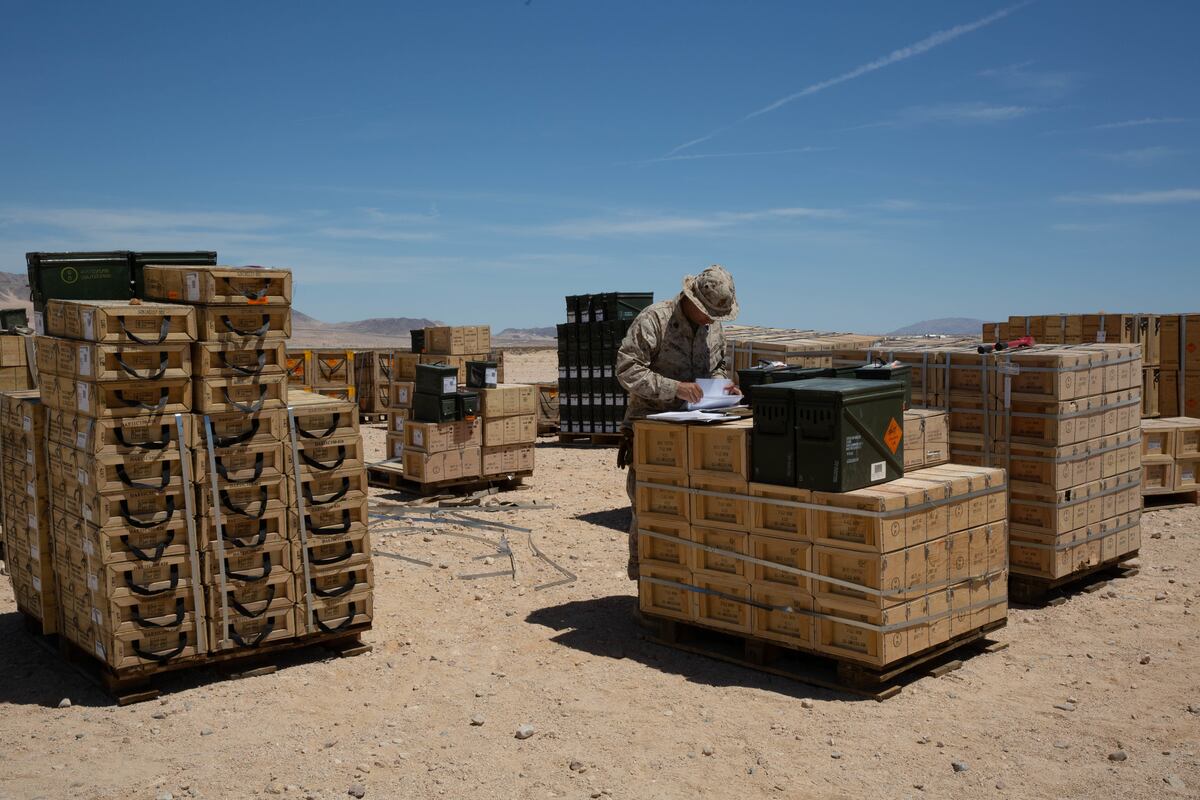
U.S. Marine ammunition technicians and officers with Marine Corps Base Quantico Ammunition Supply Point receive ammunition disposal training on base in 2020. (Sgt. Ann Correa/U.S. Marine Corps)
Adams said that passing the audit now will make all future ones more manageable. This last audit asked a third party to validate the existence and the value of every single thing the Marines own, which required significant historical research, he explained.
Subsequent audits, on the other hand, will be able to assume the past information is correct and therefore only cover “from this point forward,” instead asking Marines to prove information related to that fiscal year’s financial transactions.
Adams said the Corps got close to completing past audits in a single fiscal year, but because of the immense historical research, they couldn’t get the audit completed and over the finish line in a single year. For the fiscal year 2023 audit, the service requested an extension, which could prove to be a model for the other services.
“It was a goal of the commandant of the Marine Corps to pass the audit because he wants to show the credibility of the Marine Corps back to the Congress and the taxpayer,” Ed Gardiner, the assistant deputy commandant for programs and resources, told reporters.
In addition to having more time, this audit also used the military’s new general ledger software, Defense Agencies Initiative , in which auditors had confidence, according to Gardiner.
Gardiner explained the services were, by law, supposed to start financial audits in the 1990s, but the Marine Corps didn’t begin producing statements in preparation for an audit until 2006. The first audit in 2010 showed plenty of room for improvement, he said. In late 2013, the Marines announced they had passed a limited-scope audit for fiscal year 2012 — but in March 2015, a number of financial and oversight leaders reported the results were unreliable and the clean pass would be rescinded.
In 2017, the Marine Corps began conducting full financial statement audits.
The 2023 full financial statement audit was conducted to the highest standards, Gardiner said, with the Ernst and Young team not only being audited themselves by a peer-review team but also by the Pentagon’s inspector general team.
“We’ve been all the way to the end of the process, and we have lessons learned that we can share with the rest of the department,” he said, adding the Marine Corps hopes these lessons “can be an accelerant for the rest of the department.”
Pentagon Comptroller Michael McCord made similar remarks in November 2023, when the Pentagon failed its sixth audit since 2018.
Noting the Marines’ extension, McCord said that “we are very focused on it as a test case for the department and the larger services.”
“Whatever results of that may be when we get the auditor’s final opinion, I want to commend the USMC and, in particular, (Marine Corps Commandant Gen.) Eric Smith for their leadership and effort,” McCord added.
Megan Eckstein is the naval warfare reporter at Defense News. She has covered military news since 2009, with a focus on U.S. Navy and Marine Corps operations, acquisition programs and budgets. She has reported from four geographic fleets and is happiest when she’s filing stories from a ship. Megan is a University of Maryland alumna.
美国海军陆战队首次通过了全面的财务审计。该军种于周五宣布,经过严格的两年审查,其 2023 财年财务审计获得了“无保留意见的审计报告”。
这一里程碑——国防部和其他武装部队至今仍未实现的里程碑——是在近二十年来努力整理海军陆战队档案,以及在此过程中经历多次审计失败之后取得的。
在为期两年的审计过程中,海军陆战队聘请了安永会计师事务所的独立第三方审计师,对财务报表上列出的所有资产价值进行核查。海军陆战队还必须证明每一项资产都真实存在,并且存放地点与所声明的相符。
负责资源的助理副司令格雷戈里·科瓦尔告诉记者,审计小组在美国和世界各地进行了70多次实地考察。在这些考察中,他们检查了7800多项不动产资产,例如土地和建筑物;5900件军事装备;190万件非弹药物资,例如备件;以及2400万件弹药,其中一些储存在陆军和海军设施中。
如果车辆不在登记位置是因为外出执行任务,或者弹药不在登记位置是因为在最近的演习中已被发射,那么海军陆战队也必须出示相关文件或照片来解释差异。
科瓦尔表示,最终财务报告显示,海军陆战队通过了审计,但仍有一些方面可以改进。
负责项目和资源的副司令詹姆斯·亚当斯中将表示,重点领域之一是流程自动化。目前,各个系统各自独立,数据必须手动从一个系统传输到另一个系统,这容易出错。例如,该部门正在向集成化、自动化系统转型,以避免在人力资源系统和财务数据系统之间共享信息时出现人为错误。
2020年,美国海军陆战队匡蒂科基地弹药供应点的弹药技术人员和军官在基地接受弹药处理培训。(安·科雷亚中士/美国海军陆战队)
亚当斯表示,这次审计顺利通过将使未来的所有审计工作更加轻松。他解释说,上次审计要求第三方机构核实海军陆战队拥有的每一件物品的存在及其价值,这需要大量的历史研究。
另一方面,后续的审计可以假定过去的信息是正确的,因此只涵盖“从现在开始”,而是要求海军陆战队员证明与该财政年度财务交易相关的信息。
亚当斯表示,陆军工程兵团过去曾多次接近在一个财政年度内完成审计工作,但由于历史研究工作量巨大,最终未能按时完成。对于2023财年的审计,该兵团申请了延期,这或许可以为其他兵种提供借鉴。
“海军陆战队司令的目标是通过审计,因为他想向国会和纳税人证明海军陆战队的信誉,”负责项目和资源的助理副司令埃德·加德纳告诉记者。
加德纳表示,除了有更多的时间外,这次审计还使用了军方新的总账软件——国防机构倡议(Defense Agencies Initiative),审计人员对这款软件充满信心。
加德纳解释说,根据法律规定,各军种应该在上世纪90年代就开始进行财务审计,但海军陆战队直到2006年才开始编制审计准备报表。他说,2010年的首次审计显示,海军陆战队在财务方面还有很大的改进空间。2013年底,海军陆战队宣布他们通过了2012财年的有限范围审计——但到了2015年3月,一些财务和监督部门的负责人报告说,审计结果不可靠,之前的“通过”声明将被撤销。
2017年,海军陆战队开始进行全面的财务报表审计。
加德纳表示,2023 年的全面财务报表审计是按照最高标准进行的,安永团队不仅接受了同行评审小组的审计,还接受了五角大楼监察长小组的审计。
“我们已经走完了整个流程,并从中吸取了一些经验教训,可以与部门其他部门分享,”他说,并补充说,海军陆战队希望这些经验教训“能够加速部门其他部门的工作”。
五角大楼审计长迈克尔·麦考德在 2023 年 11 月发表了类似的言论,当时五角大楼自 2018 年以来第六次审计不合格。
麦考德指出海军陆战队的延期,并表示“我们非常关注此事,将其视为国防部和更广泛的军种的试验案例”。
“无论审计员的最终意见是什么结果,我都要赞扬美国海军陆战队,特别是海军陆战队司令埃里克·史密斯将军的领导和努力,”麦考德补充道。
梅根·埃克斯坦是《防务新闻》的海军作战记者。自2009年以来,她一直从事军事新闻报道,主要关注美国海军和海军陆战队的行动、采购项目和预算。她曾报道过四个不同地理区域的舰队,最喜欢在舰艇上进行新闻报道。梅根毕业于马里兰大学。