South Korea eyes mixed fleet of manned, unmanned warplanes韩国考虑组建有人驾驶和无人驾驶战机混合机队
The South Korean military's growing interest in manned-unmanned teaming comes amid a declining pool of 18-year-old conscripts.
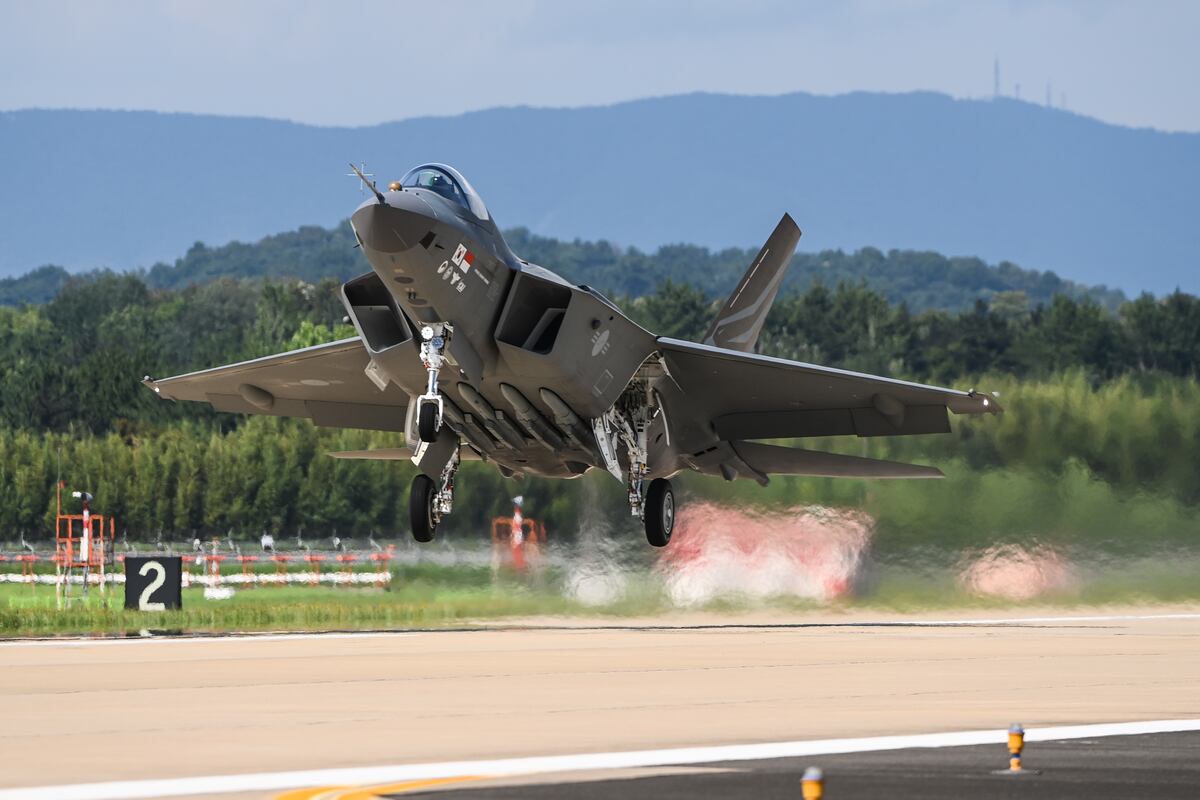
CHRISTCHURCH, New Zealand — With South Korea’s KF-21 fighter jet nearing mass production , the country is looking to incorporate unmanned technology that can operate alongside the Air Force’s fleet.
The military’s growing interest in manned-unmanned teaming comes amid a declining pool of 18-year-old conscripts and as relations with neighboring North Korea worsen .
Korea Aerospace Industries, a producer of various drones and crewed fighters, including the KF-21 Boramae and FA-50, is one of the companies leading the national effort.
In an exclusive briefing with Defense News, a KAI executive outlined the company’s four-phase road map to provide manned-unmanned teaming capabilities to the South Korean military.
“We have a very ambitious plan to create a system of systems for the future, and this is a combination of manned aircraft like the KF-21 and FA-50, together with unmanned combat vehicles as unmanned fighters, and also small-sized UAVs,” the executive said on the condition of anonymity, as the individual was not authorized to speak to the press.
The twin-seat configuration of the FA-50 light fighter lends itself to manned-unmanned teaming experimentation, as the rear pilot can control drones. (Gordon Arthur/Staff)
South Korea’s Air Force plans to acquire both single-seat and twin-seat variants of the 4.5-generation KF-21, with first delivery scheduled for June 2026. The twin-seat jet, apart from its training role, is expected to perform manned-unmanned teaming, or MUM-T, in its Block III configuration. This would involve a pilot in the back seat — or perhaps artificial intelligence — controlling drones.
The KF-21 was designed so users could equip it with new technology even after production, and the intention is to eventually develop a fifth- and sixth-generation variant. This aim falls under what KAI calls the next-generation air and space combat system, a sophisticated and linked network of sensors and platforms such as satellites, airborne early warning aircraft, crewed fighter jets and drones.
KAI is already implementing the first phase of its MUM-T road map, which began in 2023 and is to conclude next year. It involves the company and the Air Force collaboratively developing technologies to make MUM-T a reality with a helicopter and small, air-launched unmanned aerial vehicles. Once KAI proves the concept and technology for high-capacity communications and artificial intelligence, it will transition to more capable UAVs — which the company calls adaptable aerial platforms — to operate in conjunction with an FA-50 aircraft.
Although larger and possessing a longer endurance than the original air-launched UAVs, the recoverable “adaptable aerial platforms,” or AAPs, will not be excessively high-tech because they need to be affordable, the executive noted.
The second phase, to take place from 2025 to 2028, will culminate in a technology demonstration whereby an FA-50 testbed shows whether it can simultaneously control up to four adaptable aerial platforms. The demonstration is to feature AAPs acting as decoys to spoof the enemy; conducting electronic warfare with an onboard jammer; carrying out intelligence, surveillance and reconnaissance missions with an electro-optical/infrared payload; or performing strike missions with its own warhead.
By 2028, Korea Aerospace Industries hopes to have achieved a technology demonstration whereby an FA-50 will control four so-called unmanned adaptable aerial platforms. (Gordon Arthur/Staff)
The third phase, to conclude by 2037, will transition increasingly capable MUM-T technologies from an FA-50 to a twin-seat KF-21. Simultaneously, KAI is expected to reach the engineering and manufacturing design stage for an additional type of combat drone acting as a loyal wingman to the piloted aircraft.
A single KF-21 would control up to four of the combat drones. In turn, each loyal wingman would command four AAPs. This essentially means the combat power of a single KF-21 would expand to 20 unmanned aircraft.
Work is already underway on such combat drones, as the government’s Defense Acquisition Program Administration chose Korean Air Aerospace Division in August 2022 to develop a new loyal wingman. Development of the so-called KUS-LW drone commenced in November 2021.
“The squadron of UAVs will not only support and escort a manned aircraft, but will also be able to perform its own missions including surveillance, electronic interference tactics and precise shooting,” according to Korean Air.
Finally, the fourth phase, from 2038 onward, in which KAI hopes to have sufficiently mastered MUM-T to attain a true system of systems: This is the fruition of the next-generation air and space combat system.
“It’s a kind of compressed development,” the KAI executive said regarding the four-phase process. “We believe we have to move, otherwise we will miss the chance. This time we have to act to get in front, utilizing the technology we have accumulated for the last 30 years.”
Indeed, South Korea’s defense and aerospace industry has the experience and capability to develop MUM-T capabilities, according to Douglas Barrie, a senior fellow for military aerospace at the London-based International Institute for Strategic Studies think tank.
“As with most nations, however, it is at a relatively early stage in exploring, researching and developing such capabilities. Much will also depend on the extent of near-term ambition,” he told Defense News. “Any approach that allows you to bolster your combat mass at reasonable cost, and with systems that might allow the acceptance of higher attrition rates, is going to be attractive.”
Artificial intelligence is a key part of this. Algorithms can outperform their human counterparts in terms of decision-making speed, as crews must await orders from air operations center, plus an AI-enabled network can produce a swift kill chain.
“Within a very short time, they [the AI and aircraft] have to exchange a huge amount of data, so secure communications and software … are necessary for this future battlefield. Eventually, AI command — in other words, AI pilots in the aircraft, maybe in the back seat, we don’t know — will replace some parts of the air combat center,” the KAI executive said. “With these very special capabilities and features of the future system, the AI can make a decision within a very short time frame. This short procedure will give us a huge advantage, considering our enemy is not well prepared for this future battlefield.”
South Korea and KAI are also looking for foreign investors.
South Korean Defense Minister Shin Won-sik visited the Middle East in early February, during which he met his Qatari, Saudi and Emirati counterparts to discuss defense cooperation and unmanned technology.
Meanwhile, KAI is seeking international partners as it develops the MC-X Orca multirole cargo aircraft. The aircraft has a maximum takeoff weight of 92 tons and is about 132 feet long — between the lengths of a C-130J and A400M. Anticipated roles for the MC-X include transportation, aerial refueling, special forces operations, space rocket launches, airborne early warning, medical evacuation and maritime patrol — as well as MUM-T.
If the project proceeds, production of the MC-X wouldn’t take place until as soon as 2035, a company spokesperson said at the Seoul ADEX defense exhibition last year.
A scale model of Korea Aerospace Industries' proposed MC-X cargo aircraft is seen on display. Like its manned-unmanned teaming efforts, the firm is seeking foreign investors for the MC-X’s development. (Gordon Arthur/Staff)
“Our government is pretty much interested in having indigenous hardware, but there is a question when and how much they are willing to invest. So we are in discussion with our government, but at the same time we are looking for international partners interested in this idea of a multirole cargo aircraft. There are a couple of countries that would like to be partners in this initiative,” the KAI executive said, declining to name the countries.
The firm has previously tapped foreign sources to close gaps in its technological know-how. For example, in March 2021, the company signed a collaborative agreement with Israel Aerospace Industries for loitering munitions. In computer-generated promotional videos, KAI has shown IAI-style drones launched by Light Armed Helicopters and Surion choppers.
KAI also has export ambitions. The executive said there’s a potential export market for up to 800 KF-21 fighters over the next few decades, specifically citing Saudi Arabia and the United Arab Emirates as candidates.
And by demonstrating it can retrospectively integrate MUM-T capabilities onto FA-50 aircraft, the executive added, the company hopes to entice existing users like Indonesia, Iraq, Malaysia, the Philippines, Poland and Thailand to take advantage of the MUM-T technology.
“For the FA-50 and KF-21, we are not selling the current capability of the aircraft. We are at the same time trying to sell the value of this aircraft to do something else, something greater in the future, by giving them [potential customers] an idea of the MUM-T concept and a fifth-gen combat system — in other words, a system of systems,” the KAI executive said. “There is high value once they purchase the FA-50. With the capability, gradually year by year, they can operate this aircraft to be perfectly prepared for the future battlefield.”
Certainly KAI’s ability to achieve its four-phase MUM-T plan is possible, Barrie noted, but it’s not written in stone.
“In part, this will depend on how far and how quickly South Korea wants to develop the technology, combined with the kinds of roles associated with the uninhabited elements of any teaming architecture,” he said. “While ambition is laudable, it also needs to be realistic.”
Gordon Arthur is an Asia correspondent for Defense News. After a 20-year stint working in Hong Kong, he now resides in New Zealand. He has attended military exercises and defense exhibitions in about 20 countries around the Asia-Pacific region.
新西兰基督城——随着韩国KF-21战斗机接近量产,该国正寻求将无人技术融入其空军机队中。
随着18岁应征入伍人数的减少以及与邻国朝鲜关系的恶化,军方对有人-无人协同作战的兴趣日益浓厚。
韩国航空航天工业公司是韩国无人机和载人战斗机(包括 KF-21 Boramae 和 FA-50)的生产商,也是领导国家无人机研发工作的公司之一。
在接受《防务新闻》独家简报时,韩国航空航天工业公司 (KAI) 的一位高管概述了该公司为韩国军方提供有人-无人协同作战能力的四阶段路线图。
“我们有一个非常雄心勃勃的计划,要为未来打造一个系统之系统,这包括KF-21和FA-50等有人驾驶飞机,以及无人作战车辆(如无人战斗机)和小型无人机,”这位高管在匿名的情况下表示,因为他没有被授权接受媒体采访。
FA-50轻型战斗机的双座布局使其非常适合进行有人-无人协同作战试验,因为后座飞行员可以操控无人机。(戈登·阿瑟/工作人员)
韩国空军计划采购4.5代KF-21战斗机的单座和双座两种型号,首架交付预计将于2026年6月进行。双座型KF-21除了用于训练外,预计在其Block III配置下还将执行有人-无人协同作战(MUM-T)任务。这意味着后座飞行员(或人工智能)将控制无人机。
KF-21的设计初衷是让用户即使在生产完成后也能为其配备新技术,其最终目标是开发第五代和第六代改进型。这一目标属于韩国航空航天工业公司(KAI)所称的下一代空天作战系统范畴,该系统是一个由卫星、空中预警机、有人驾驶战斗机和无人机等传感器和平台组成的复杂互联网络。
KAI公司已开始实施其MUM-T路线图的第一阶段,该阶段于2023年启动,并将于明年完成。该阶段涉及KAI公司与美国空军合作开发相关技术,以期利用直升机和小型空射无人机实现MUM-T项目。一旦KAI公司验证了高容量通信和人工智能的概念及技术,该公司将过渡到性能更强大的无人机——KAI公司称之为“适应性空中平台”——与FA-50战斗机协同作战。
这位高管指出,虽然可回收的“适应性空中平台”(AAP)比最初的空射无人机更大、续航时间更长,但由于需要价格实惠,因此不会过于高科技。
第二阶段将于2025年至2028年进行,最终将以一项技术演示收尾。届时,FA-50试验平台将展示其能否同时控制多达四个可适应性空中平台。演示内容包括:AAP(自适应空中平台)作为诱饵迷惑敌方;搭载机载干扰器进行电子战;携带光电/红外有效载荷执行情报、监视和侦察任务;或携带自身弹头执行打击任务。
韩国航空航天工业公司希望到2028年实现一项技术演示,届时一架FA-50战斗机将控制四架所谓的无人自适应飞行平台。(戈登·阿瑟/工作人员)
第三阶段将于2037年完成,届时性能日益强大的MUM-T技术将从FA-50过渡到双座KF-21。与此同时,韩国航空航天工业公司(KAI)预计将进入另一种作战无人机的工程和制造设计阶段,该无人机将作为有人驾驶飞机的忠实僚机。
一架KF-21战斗机最多可以控制四架作战无人机。反过来,每架KF-21的僚机又可以指挥四架AAP(空中作战飞机)。这意味着一架KF-21的作战能力实际上可以扩展到20架无人机。
此类作战无人机的研发工作已经展开,韩国政府的国防采办计划管理局于2022年8月选择韩国航空宇宙株式会社(KARAD)开发新型忠诚僚机。这款名为KUS-LW的无人机的研发工作于2021年11月启动。
据大韩航空称,“这支无人机中队不仅可以支援和护送有人驾驶飞机,还可以执行包括监视、电子干扰战术和精确射击在内的独立任务。”
最后,从 2038 年开始的第四阶段,KAI 希望能够充分掌握 MUM-T 技术,从而实现真正的系统集成:这是下一代空天作战系统的实现。
“这是一种压缩式发展,”KAI高管在谈到这四个阶段的进程时说道。“我们认为必须行动起来,否则就会错失良机。这一次,我们必须抢占先机,利用我们过去30年积累的技术。”
事实上,据总部位于伦敦的国际战略研究所(International Institute for Strategic Studies)高级军事航空航天研究员道格拉斯·巴里(Douglas Barrie)称,韩国的国防和航空航天工业拥有发展多用途无人机(MUM-T)能力的经验和能力。
“然而,与大多数国家一样,我国在探索、研究和发展此类能力方面仍处于相对早期的阶段。很大程度上,这也取决于近期目标的远大程度,”他告诉《防务新闻》。“任何能够以合理成本增强作战力量,并能承受更高损耗率的系统方案,都将具有吸引力。”
人工智能是其中的关键组成部分。由于机组人员必须等待空中作战中心的命令,算法在决策速度方面可以超越人类,而且人工智能赋能的网络可以迅速形成杀伤链。
“人工智能和飞机需要在极短时间内交换海量数据,因此,安全的通信和软件对于未来的战场至关重要。最终,人工智能指挥——换句话说,人工智能飞行员将操控飞机,或许坐在后座,我们目前还无法确定——并将取代空战中心的部分职能,”韩国航空航天工业公司(KAI)的一位高管表示。“凭借未来系统的这些特殊能力和特性,人工智能可以在极短的时间内做出决策。考虑到我们的敌人尚未为未来的战场做好充分准备,这种快速决策流程将为我们带来巨大的优势。”
韩国和韩国航空航天工业公司(KAI)也在寻求外国投资者。
韩国国防部长申元植于2月初访问中东,期间他会见了卡塔尔、沙特阿拉伯和阿联酋的国防部长,讨论了国防合作和无人技术。
与此同时,韩国航空航天工业公司(KAI)正在寻求国际合作伙伴,共同研发MC-X“虎鲸”多用途运输机。该机最大起飞重量为92吨,机身长度约为132英尺(约40米),介于C-130J和A400M之间。MC-X的预期用途包括运输、空中加油、特种部队行动、航天火箭发射、空中预警、医疗后送和海上巡逻,以及MUM-T任务。
该公司发言人去年在首尔 ADEX 防务展上表示,如果该项目继续推进,MC-X 的生产最早也要到 2035 年才会开始。
展出的正是韩国航空航天工业公司(KAI)拟建的MC-X货运飞机模型。与该公司在有人/无人协同飞行领域的努力一样,MC-X的研发也正在寻求外国投资者。(戈登·阿瑟/摄)
“我国政府对自主研发硬件非常感兴趣,但问题是他们何时以及愿意投资多少。所以我们正在与政府进行磋商,同时也在寻找对多用途货机项目感兴趣的国际合作伙伴。有几个国家希望参与这个项目,”韩国航空航天工业公司(KAI)的一位高管表示,但他拒绝透露这些国家的名称。
该公司此前曾利用国外资源弥补自身技术上的不足。例如,2021年3月,该公司与以色列航空航天工业公司(IAI)签署了一项关于巡飞弹的合作协议。在电脑制作的宣传视频中,KAI展示了由轻型武装直升机公司(Light Armed Helicopters)和苏里翁(Surion)直升机发射的IAI式无人机。
韩国航空航天工业公司(KAI)也有出口方面的雄心。该公司高管表示,未来几十年内,KF-21战斗机的潜在出口市场可达800架,并特别指出沙特阿拉伯和阿拉伯联合酋长国是潜在出口国。
该高管补充说,通过证明可以将 MUM-T 功能追溯性地集成到 FA-50 飞机上,该公司希望吸引印度尼西亚、伊拉克、马来西亚、菲律宾、波兰和泰国等现有用户利用 MUM-T 技术。
“对于FA-50和KF-21,我们并非仅仅推销飞机目前的作战能力。我们同时也在努力展现这些飞机在未来能够发挥更大作用的价值,通过向潜在客户介绍MUM-T概念和第五代作战系统——换句话说,就是一个系统集成系统,”韩国航空航天工业公司(KAI)的一位高管表示。“一旦他们购买了FA-50,就能获得巨大的价值。凭借这些能力,他们可以逐年提升,从而为未来的战场做好充分准备。”
巴里指出,KAI 实现其四阶段 MUM-T 计划当然是有可能的,但这并非板上钉钉。
“这在一定程度上取决于韩国希望以多快的速度和多大的规模发展这项技术,以及任何团队协作架构中无人值守部分所涉及的角色类型,”他说道。“雄心壮志固然值得称赞,但也必须切合实际。”
戈登·阿瑟是《防务新闻》的亚洲特派记者。在香港工作20年后,他现居新西兰。他曾到访亚太地区约20个国家,参加过军事演习和防务展览。