Technology, AI has made us hasty readers – and that's a big problem科技和人工智能让我们变得阅读匆忙——这是一个大问题。
Teachers say some students no longer have the patience or stamina to follow a text from start to end – they skip words, rush through questions and miss the meaning of longer texts. The implications go beyond getting an answer wrong.
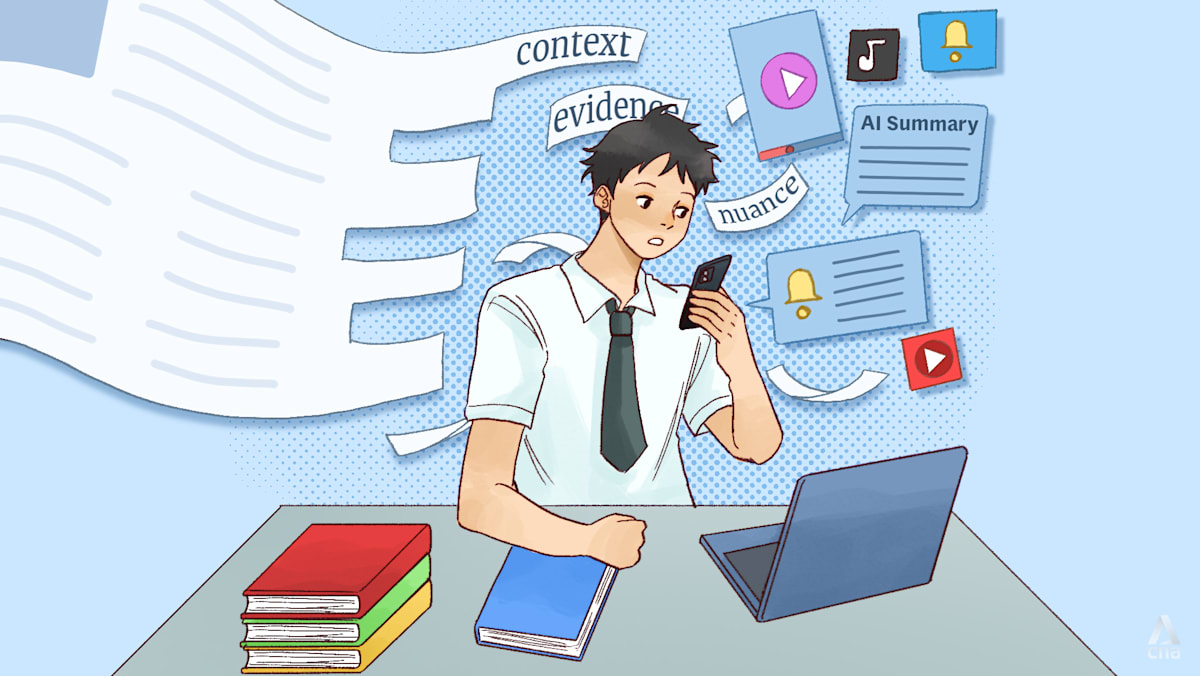
Teachers say some students no longer have the patience or stamina to follow a text from start to end – they skip words, rush through questions and miss the meaning of longer texts. The implications go beyond getting an answer wrong.
Technology has made information faster and easier to access, but educators say that students still need the patience and skills to understand, question and evaluate what they come across online. (Illustration: CNA/Clara Ho)
This audio is generated by an AI tool.
Some of Mr Julian Teo's secondary school students are in such a rush to answer mathematics questions that they skip over words. Others start working out the solution even before they finish reading.
The 48-year-old mathematics teacher said that he has seen this worrying pattern become increasingly common among his students over the past five years.
He showed CNA TODAY an example of the kind of problem sum that his students find too long to read properly. At 146 words, it required them to calculate the cost of driving between four cities.
"Their reading, comprehension and understanding skills are lacking because they don't read books, or long texts or articles, so chunks of words are tough for them," Mr Teo said. He has taught mathematics in various secondary schools for more than 20 years.
Indeed, the results of the 2025 OECD Programme for International Student Assessment (PISA), released on Sep 8 this year, showed that Mr Teo's students are unlikely to be an anomaly.
The test found that although Singapore's 15-year-olds still ranked first in reading , the country's average reading scores fell by eight points from 543 in 2022 to 535 in 2025.
This phenomenon is not unique to Singapore; it is evident among teenagers globally.
Across 91 countries, 760,000 students aged 15 took the test. Their average reading score was 461 in 2025, down from 476 in 2022.
OECD, the Organisation for Economic Co-operation and Development, which conducts the test once every three years, said in its PISA 2025 Results report: "This trend is particularly concerning because reading skills underpin learning across the curriculum and are essential for finding, evaluating, interpreting and reflecting on information in an increasingly digital world."
CNA Games Guess Word Crack the word, one row at a time Buzzword Create words using the given letters Mini Sudoku Tiny puzzle, mighty brain teaser Mini Crossword Small grid, big challenge Word Search Spot as many words as you can Show More Show Less
The results showed a decline in "the very skills that matter most in the AI (artificial intelligence) age", namely evaluating information, making connections across multiple sources, and thinking critically about what has been read, it added.
OECD also found that the number of "hasty readers" – students who rush through texts and give quick but incorrect answers – nearly doubled between 2018 and 2025.
Research has raised concerns about how AI use and digital habits may affect learning and attention.
A study of 1,000 students in Turkey, conducted in the 2023 to 2024 academic year, found that those with unrestricted access to AI performed worse in closed-book tests than those who had no AI access or had access with guardrails in place.
Phones put endless information and entertainment within easy reach, but experts say that sustained reading requires a different kind of attention. (Photo: CNA/Ili Mansor)
Another study of 583 people aged 13 to 25 in Singapore and Australia found that 68 per cent reported difficulty focusing.
Among the participants, 33 per cent described their inability to stop scrolling as a "kind of addiction", and 52 per cent admitted that they frequently get distracted during class by social media.
Singapore's Nanyang Technological University (NTU) and research agency Research Network conducted the study in collaboration with ListenLabs.ai, a United States-based AI platform.
The findings, released in July 2025, also reported that 65 per cent of students worried about the long-term impact of their social media use on school, work and their well-being.
To be fair, adults are not exactly burying their noses in books either.
A 2024 National Library Board (NLB) study found that only 28 per cent of Singaporean adults read books weekly. The proportion rose to 89 per cent when news, articles on social media and websites were included.
As for why they did not read books more, 62 per cent of the respondents said that they preferred spending their time on other activities, while 38 per cent said that they became bored after reading for a while.
It's understandable. Swiping through social media offers immediate stimulation, and getting the information we need from an AI-generated summary is undoubtedly very fast and easy.
However, these increasingly common habits are the opposite of what our brains need.
Education and literacy experts said that s ustained long-form reading has been linked to building attention and critical thinking skills, supporting overall mental well-being and developing empathy and social understanding.
Acknowledging these benefits, NLB launched ReadSG on Sep 6, a five-year national campaign to make reading a daily habit among Singaporeans.
For all the ways that technology is affecting how people read, education and AI experts told CNA TODAY that strong literacy skills are becoming more, not less, important in an AI-driven world.
WHY "HASTY READING" IS BECOMING THE NORM
Professor Annabel Chen, a clinical neuropsychologist and director of the Centre for Research and Development in Learning at NTU, said that technology has weakened people's ability to read deeply in several ways.
Digital environments have fragmented people's attention and encouraged "media multitasking", as notifications, rapid task-switching and competing digital information interrupt sustained attention on any one task, she added.
They also encourage people to scan, navigate hyperlinks and extract information rapidly.
Furthermore, search engines and generative AI (GenAI) can reduce the need for people to retrieve, integrate, formulate and evaluate information for themselves.
When internet users allow these tools to take over such tasks, they are "offloading" some of the thinking involved, Prof Chen said.
Cognitive offloading is not necessarily harmful and can free working memory, she added.
But excessive reliance on such tools may reduce opportunities to practise the mental processes needed to develop lasting knowledge and understanding.
Having information readily available does not necessarily mean understanding it, experts say, particularly when people skim rather than engage deeply with what they read. (Photo: CNA/Ili Mansor)
Reading a fluent AI-generated explanation can create a feeling of understanding, even if the person doesn't truly comprehend the material, she said.
This is especially relevant when students accept summaries or answers without checking sources, reconstructing arguments or generating explanations themselves, she added.
This illusion of understanding is becoming increasingly familiar to teachers and parents in Singapore.
Across subjects, educators said that students are having more difficulty paying attention or comprehending the bodies of text they read.
Mr Heng knows this problem all too well. The 53-year-old father of two secondary school children aged 15 and 14 often sees them glued to their phones at home.
He did not want to be identified by his full name because his employer does not allow him to speak to the media.
His children use their screen time for educational purposes, such as attending online classes and getting help to complete their homework.
But once the work is done, they stay on their screens, he said.
"They're busy swiping on TikTok, watching videos super fast that I catch no ball (don't understand) … I can't see what they're watching, let alone understand what they're hearing at that speed."
Mr Heng admitted, though, that he himself rarely puts his own phone down, and practically never opens a book.
"I don't remember when was the last time I read a book, let alone when my children did so ," he said. "After work, I just use Facebook and TikTok … it's much more fun than reading."
He has received feedback from his children's tuition teachers that they hastily read through questions and rush to answer them without fully understanding what is being asked.
At this point, he said, he is rather at a loss.
"I just remind them to slow down before their exams," he said. "I don't think there's much I can do ... I don't think (putting down) the phone helps."
Jennifer (not her real name), an upper primary school English teacher, has noticed 11- and 12-year-olds struggling to focus on reading. She declined to be named because she did not have permission to speak to the media.
"Some of my students will skip words, and seemingly read a passage very fast," she said. "But oftentimes, they're just bored and moving on from paragraph to paragraph."
When she asked students what they read outside of school, most said that they do not read books but watch videos online or play games instead.
Some of her students have also admitted to skipping book chapters to quickly read the conclusion, so that they can "move on to the next fun thing".
"I worry quite a lot, because the joy of reading comes from the trepidation and excitement of following a character on a journey," Jennifer said.
"Many children today see that journey – the discomfort and fun of the ups and downs – as something to skip."
A student using a learning tool on the Singapore Student Learning Space to simulate interviewing people near a volcano, during a geography class at Hougang Secondary School on Sep 18, 2026. (Photo: CNA/Lim Li Ting)
Among older students, teachers said, the same trend is occurring.
Mr Kelvin Hong, 58, founder of tuition centre The Economics Tutor and Ace GP, has noticed a change in the way his junior college students read.
Many lack the patience and stamina for sustained reading, and rather than read newspaper articles, commentaries, books or essays in their free time, they scroll through short social media posts, captions, headlines, online discussions and summaries.
"As someone who has taught Economics and General Paper for over 25 years, I find that, in recent years, more students struggle to explain a writer's overall argument, pick up on nuance or connect different ideas," Mr Hong said.
"Students are increasingly accustomed to scanning for key information and getting to the answer quickly.
"Faced with a long article or complex passage, some will skim for keywords instead of following the argument from beginning to end."
REDEFINING RULES OF LITERACY
Being able to sit with and understand written passages is one thing. In this digital age, literacy also means being able "to find, comprehend, evaluate, integrate and use information across human- and AI-generated sources", Prof Chen from NTU said.
This makes AI literacy increasingly important, she added.
People need to understand what AI can and cannot do, assess critically whether its answers are reliable, and know when and how to use it appropriately.
In an era where information is easily available with a tap of a screen, knowing what is true or false is crucial.
Associate Professor Loh Chin Ee, from the English Language and Literature Department at the National Institute of Education (NIE), said: "Given the amount of online information we have to process daily, a literate person would have to be able to read and process both print and digital texts."
For digital texts, people would have to process information presented in different forms – such as images, videos and graphics – across multiple sources, in order to search for information, analyse and evaluate what they encounter, she added.
Then they have to decide their next step: Do they believe the information? Should they act on it?
Assoc Prof Loh said that when a lack of literacy skills is paired with "hasty reading" habits of skimming through large chunks of text, people may find it harder to distinguish reliable information from false or misleading content.
With so much information available online – including convincing but potentially inaccurate AI-generated content – simply accessing information is no longer enough, Prof Chen said.
People need to judge whether the information is credible, cross-check evidence, reason critically and know what to trust, she added.
The goal is not necessarily to get students to use less technology, but to teach them when it can support their learning and when to rely on their own thinking. (Photo: CNA/Lim Li Ting)
AI also presents another challenge.
Even though GenAI can produce seemingly polished answers and clear explanations within seconds, Assoc Prof Loh cautioned against relying on it to do the thinking – a practice known as "cognitive offloading".
When people use AI for cognitive offloading, that is, getting it to do a task rather than thinking through the task themselves, it can lead to sloppiness and hinder learning, she said.
"Some friction is required for learning, so students who avoid that struggle by relying on AI lose the chance to learn."
That being said, how students use AI matters.
Assoc Prof Loh said that AI can support learning when used selectively, at appropriate ages and in a structured, intentional way.
Given how deeply embedded technology and AI are in today's world, the experts said that the answer to declining literacy skills is not to stop using them entirely.
Instead, students and adults need strong literacy skills, including AI literacy.
Such skills could matter outside the classroom.
Mr Foo See Yang, the managing director and strategic business group head at PERSOL APAC, a recruitment solutions provider, said that AI literacy can affect future job opportunities.
This involves more than just knowing how to use AI tools, because employers will also look out for skills such as critical thinking and judgment.
"People should be encouraged to attempt a task themselves and form an initial view, and then bring in AI for feedback, refinement, or to explore another perspective," Mr Foo said.
"This keeps people actively engaged in the thinking process, while still benefiting from what AI can offer."
So how can we strengthen critical thinking and judgment when digital distractions are everywhere?
One solution is surprisingly low-tech: good old reading.
Assoc Prof Loh said that students need to spend more time reading, particularly sustained, long-form texts such as fiction and non-fiction books, as well as news and magazine articles.
She pointed out that skimming and scanning are different from deep reading .
The problem arises when people avoid deep reading because it feels difficult.
"It does take effort to stay with a single text over a sustained period of time," she added. "Rather than immediate gratification, one has to be willing to wait to reap the rewards of the reading."
Assoc Prof Loh said that mandatory daily time limits on social media use can support efforts to reduce screen time, but they are not a standalone solution.
"Giving students time to read in school, creating opportunities for critical reading and encouraging parents and caregivers to put time aside for reading are helpful strategies," she suggested.
"The focus has to be on making reading engaging and meaningful."
A young adult reading a book in a library. Making time for books and other long-form texts can help readers practise staying focused on a single source of information. (Photo: Pexels)
Beyond encouraging children to read, the experts said that parents can also model good digital and AI habits, showing young people how these tools can support their thinking rather than replace it.
Ultimately, Prof Chen said that the goal should not be to get learners to use less technology, but to develop "cognitively flexible learners" who know when technology enhances learning and when it takes over the thinking they need to do themselves.
In response to CNA TODAY's queries, the Ministry of Education (MOE) said that it develops literacy skills progressively in students.
"MOE recognises concerns that excessive or poorly designed use of technology and AI could affect learning. Our approach is therefore guided by students' age, development and learning needs."
For Primary 1 to 3 students, learning remains hands-on and print-first, with limited use of technology and AI.
Upper primary students use AI safely and purposefully under teacher supervision.
In secondary school, students gradually use it more independently through structured learning tasks.
"At the same time, students continue to develop human qualities that AI cannot replace, including sound values, critical thinking, self-management and the confidence to make responsible choices," MOE added.
“Some friction is required for learning, so students who avoid that struggle by relying on AI lose the chance to learn.
At Hougang Secondary School, students use AI tools in certain classes, but teachers also guide them to think beyond AI-generated answers and the first results that appear on search engines.
For example, through the school's Science, Technology, Engineering and Mathematics (STEM) Applied Learning Programme, students learn crucial literacy skills such as evaluating evidence, making connections and drawing on different sources to understand a topic.
Mr Javen Gwee, the school's head of department for infocomm technology, said that the programme helps students break complex problems into smaller components.
They also learn to consider different perspectives and evidence, and use tools such as AI where relevant to generate and evaluate solutions.
Students are encouraged to explore and test ideas, gather and reflect on feedback, and refine their thinking.
The aim is for AI to support, not replace, students' thinking or crucial skills such as disciplinary knowledge and critical judgment, Mr Gwee said.
"For us, becoming future-ready is therefore not about using more AI.
"It is about developing students who know how to think with AI, when to question it, and when not to rely on it, while remaining grounded in purpose, responsibility and sound judgment."
Mr Jovin Loh makes it a daily routine to read to his two sons, four-year-old Owen (left) and one-year-old Connor (right). (Photo: Jovin Loh)
Fellow educator Jovin Loh, the co-founder of English learning centre Academia, has seen firsthand how important it is to inculcate literacy skills early.
Over the years, he has noticed that students increasingly need help with careful reading, comprehension, and reading stamina.
So, as a father of two boys aged four and one, he hopes to build the habit of reading at home. "I do worry that, as they get older, reading will face growing competition from phones, games and other forms of entertainment," Mr Loh said.
"That is part of why I think it helps to start young, before reading feels like something that has to fight for space."
For now, with limited exposure to digital media, his children enjoy their bedtime reading routine.
His younger son listens to his parents reading simple books such as The Very Hungry Caterpillar, while their older son gets to choose a book to read, often a short library book such as his favourite, The Gruffalo.
Mr Loh's efforts have paid off, especially with his older son Owen, who often insists that they read a storybook together while he eats his breakfast before preschool starts.
Mr Loh has also noticed a social benefit of reading: Owen has bonded with his preschool classmates over the books that they had all read.
He noticed this while volunteering to read some of his son's favourite books to his classmates.
"When I asked who had read the books before, the children were very excited to recognise them, and Owen was delighted that his friends knew the same stories he loved.
"I think that reinforces the idea that children do not only engage with books privately. Books can become part of their friendships, their family life and the conversations around them."
Get our pick of top stories and thought-provoking articles in your inbox
Stay updated with notifications for breaking news and our best stories
Join our channel for the top reads for the day on your preferred chat app
教师们表示,有些学生已经失去了耐心和毅力,无法从头到尾阅读一篇文章——他们会跳过一些词语,匆匆作答,错过较长文章的含义。这带来的影响远不止答错题那么简单。
科技使信息获取更加快捷方便,但教育工作者表示,学生仍然需要耐心和技能来理解、质疑和评估他们在网上看到的内容。(插图:CNA/Clara Ho)
这段音频是由人工智能工具生成的。
朱利安·张先生的一些中学生为了赶着回答数学题,甚至会跳过一些文字。还有一些学生甚至在读完题目之前就开始计算答案。
这位 48 岁的数学老师表示,在过去的五年里,他发现这种令人担忧的现象在他的学生中越来越普遍。
他向 CNA TODAY 展示了一道学生觉得太长而难以认真阅读的计算题示例。这道题长达 146 个单词,要求学生计算从四个城市开车到其他城市的费用。
“他们的阅读、理解和领悟能力不足,因为他们不读书,也不读长篇文本或文章,所以大段的文字对他们来说很困难,”张先生说。他曾在多所中学任教数学超过20年。
事实上,今年 9 月 8 日发布的 2025 年经合组织国际学生评估项目 (PISA) 结果显示,张先生的学生不太可能是个例外。
测试发现,虽然新加坡 15 岁青少年的阅读能力仍然排名第一,但该国的平均阅读分数从 2022 年的 543 分下降到 2025 年的 535 分,下降了 8 分。
这种现象并非新加坡独有,在全球青少年中都很普遍。
来自91个国家的76万名15岁学生参加了这项测试。他们的平均阅读成绩在2025年为461分,低于2022年的476分。
经济合作与发展组织(OECD)每三年进行一次PISA测试,该组织在其2025年PISA结果报告中表示:“这一趋势尤其令人担忧,因为阅读技能是所有课程学习的基础,对于在日益数字化的世界中查找、评估、解释和反思信息至关重要。”
CNA游戏 猜词游戏 逐行破解单词 流行词游戏 用给定的字母组成单词 迷你数独 小小谜题,挑战你的大脑 迷你填字游戏 小方格,大挑战 单词搜索 尽可能多地找出单词 显示更多 显示更少
报告补充说,结果显示,“在人工智能时代最重要的技能”有所下降,即评估信息、跨多个来源建立联系以及对所读内容进行批判性思考。
经合组织还发现,“匆忙阅读者”(即快速浏览文本并给出快速但错误答案的学生)的数量在 2018 年至 2025 年间几乎翻了一番。
研究引发了人们对人工智能使用和数字习惯如何影响学习和注意力的担忧。
2023 至 2024 学年,土耳其对 1000 名学生进行了一项研究,结果发现,那些可以不受限制地使用人工智能的学生在闭卷考试中的表现比那些无法使用人工智能或在有防护措施的情况下使用人工智能的学生更差。
手机让人们可以轻松获取海量信息和娱乐,但专家表示,持续阅读需要另一种专注力。(图片:CNA/Ili Mansor)
另一项针对新加坡和澳大利亚 583 名 13 至 25 岁人群的研究发现,68% 的人表示难以集中注意力。
参与者中,33%的人将自己无法停止浏览社交媒体描述为一种“瘾”,52%的人承认他们经常在课堂上因社交媒体而分心。
新加坡南洋理工大学 (NTU) 和研究机构 Research Network 与总部位于美国的 AI 平台 ListenLabs.ai 合作开展了这项研究。
2025 年 7 月发布的调查结果还显示,65% 的学生担心社交媒体的使用会对他们的学习、工作和身心健康产生长期影响。
公平地说,成年人也不是总埋头读书。
新加坡国家图书馆管理局 (NLB) 2024 年的一项研究发现,只有 28% 的新加坡成年人每周阅读书籍。如果将新闻、社交媒体文章和网站内容也计算在内,这一比例则上升至 89%。
至于他们为什么不多读书,62%的受访者表示他们更喜欢把时间花在其他活动上,而38%的受访者表示他们读了一段时间书后就感到无聊了。
这可以理解。浏览社交媒体能带来即时的刺激,而从人工智能生成的摘要中获取所需信息无疑非常快捷方便。
然而,这些日益普遍的习惯恰恰与我们的大脑所需背道而驰。
教育和识字专家表示,持续的长篇阅读与培养注意力、批判性思维能力、促进整体心理健康以及培养同理心和社会理解力有关。
鉴于这些益处,新加坡国家图书馆管理局于 9 月 6 日启动了 ReadSG 活动,这是一项为期五年的全国性运动,旨在让新加坡人养成每日阅读的习惯。
尽管科技正在以各种方式影响人们的阅读方式,但教育和人工智能专家告诉 CNA TODAY,在人工智能驱动的世界里,强大的读写能力正变得越来越重要,而不是越来越不重要。
为什么“快速阅读”正成为常态
南洋理工大学学习研究与发展中心主任、临床神经心理学家陈安娜贝尔教授表示,科技在很多方面削弱了人们深度阅读的能力。
她补充说,数字环境分散了人们的注意力,并助长了“媒体多任务处理”,因为通知、快速的任务切换和相互竞争的数字信息会打断人们对任何一项任务的持续注意力。
他们还鼓励人们快速浏览、点击超链接并提取信息。
此外,搜索引擎和生成式人工智能(GenAI)可以减少人们自行检索、整合、构建和评估信息的需求。
陈教授表示,当互联网用户允许这些工具接管此类任务时,他们实际上是在“卸载”一些相关的思考工作。
她补充说,认知卸载未必有害,反而可以释放工作记忆。
但过度依赖此类工具可能会减少练习发展持久知识和理解所需的思维过程的机会。
专家指出,信息唾手可得并不一定意味着理解,尤其是在人们只是浏览而非深入阅读的情况下。(图片:CNA/Ili Mansor)
她表示,阅读流畅的人工智能生成的解释可以让人产生理解的感觉,即使这个人并没有真正理解材料的内容。
她补充说,这一点尤其适用于学生不去核实来源、不去重构论点、不去自己提出解释就接受总结或答案的情况。
这种理解上的错觉在新加坡的教师和家长中越来越常见。
教育工作者表示,各个学科的学生都越来越难以集中注意力或理解他们阅读的文本内容。
亨先生对这个问题深有体会。这位53岁的父亲有两个分别15岁和14岁的中学生孩子,他经常看到孩子们在家沉迷于手机。
他不愿透露全名,因为他的雇主不允许他接受媒体采访。
他的孩子们利用屏幕时间进行学习,例如参加在线课程和获得完成作业的帮助。
他说,但工作完成后,他们就一直盯着屏幕。
“他们忙着在TikTok上滑动屏幕,飞快地观看视频,我根本看不懂……我看不到他们在看什么,更别说听懂他们在听什么了。”
不过,亨先生承认,他自己很少放下手机,也几乎从不打开书本。
“我不记得上次读书是什么时候了,更别提我的孩子们读书是什么时候了,”他说。“下班后,我只刷Facebook和TikTok……这比读书有趣多了。”
他从孩子的补习老师那里得到反馈,说他们匆匆浏览题目,急于作答,并没有完全理解题目的意思。
他说,此时此刻,他感到十分茫然。
“我只是提醒他们在考试前放慢节奏,”他说。“我觉得我能做的并不多……我觉得放下手机也没什么用。”
珍妮弗(化名)是一位高年级小学英语老师,她注意到11岁和12岁的孩子在阅读时难以集中注意力。她拒绝透露姓名,因为她没有获得接受媒体采访的许可。
“我的一些学生会跳过一些单词,看起来好像读文章很快,”她说。“但很多时候,他们只是感到无聊,所以直接从一段跳到下一段。”
当她问学生们在课外读些什么时,大多数学生表示他们不读书,而是看在线视频或玩游戏。
她的一些学生也承认,他们会跳过书中的章节,快速阅读结论,以便“继续做下一个有趣的事情”。
“我经常担心,因为阅读的乐趣来自于跟随书中人物踏上旅程时所感受到的忐忑和兴奋,”詹妮弗说。
“如今很多孩子都把这段旅程——其中的起伏跌宕带来的不适和乐趣——视为应该跳过的事情。”
2026年9月18日,在后港中学的一堂地理课上,一名学生正在使用新加坡学生学习空间(Singapore Student Learning Space)上的学习工具,模拟采访火山附近的人们。(图片:CNA/林丽婷)
教师们表示,高年级学生中也出现了同样的趋势。
58 岁的 Kelvin Hong 先生是补习中心 The Economics Tutor 和 Ace GP 的创始人,他注意到他的初级学院学生的阅读方式发生了变化。
许多人缺乏持续阅读的耐心和毅力,与其在空闲时间阅读报纸文章、评论、书籍或散文,不如浏览社交媒体上的短帖子、图片说明、标题、在线讨论和摘要。
“作为一名教授经济学和综合论文超过 25 年的教师,我发现近年来,越来越多的学生难以解释作者的整体论点,难以把握细微差别或将不同的想法联系起来,”洪先生说。
“学生们越来越习惯于快速浏览关键信息并找到答案。”
“面对长篇文章或复杂的段落,有些人会快速浏览以查找关键词,而不是从头到尾理解论点。”
重新定义读写规则
能够阅读并理解文字是一回事。南洋理工大学的陈教授表示,在这个数字时代,读写能力还意味着能够“在人类和人工智能生成的各种来源中查找、理解、评估、整合和使用信息”。
她补充说,这使得人工智能素养变得越来越重要。
人们需要了解人工智能能做什么和不能做什么,批判性地评估其答案是否可靠,并知道何时以及如何恰当地使用它。
在信息触手可及的时代,辨别真假至关重要。
新加坡国立教育学院(NIE)英语语言文学系副教授罗振义表示:“鉴于我们每天必须处理大量的在线信息,一个有文化的人必须能够阅读和处理纸质文本和数字文本。”
她补充说,对于数字文本,人们必须处理以不同形式(例如图像、视频和图形)呈现的来自多个来源的信息,以便搜索信息、分析和评估他们遇到的内容。
接下来,他们必须决定下一步行动:他们是否相信这些信息?他们是否应该根据这些信息采取行动?
罗副教授表示,当缺乏读写能力,再加上“匆忙阅读”的习惯(快速浏览大段文字)时,人们可能更难区分可靠的信息和虚假或误导性的内容。
陈教授表示,由于网上有如此多的信息——包括令人信服但可能不准确的人工智能生成的内容——仅仅获取信息已经不够了。
她补充说,人们需要判断信息的可信度,交叉核对证据,进行批判性思考,并知道该相信什么。
目标并非一定要让学生减少使用科技产品,而是要教会他们何时应该利用科技辅助学习,何时应该依靠自己的思考。(图片:CNA/林丽婷)
人工智能也带来了另一项挑战。
尽管 GenAI 可以在几秒钟内生成看似完美的答案和清晰的解释,但 Loh 副教授告诫人们不要依赖它来思考——这种做法被称为“认知卸载”。
她表示,当人们使用人工智能进行认知卸载时,也就是让人工智能执行任务而不是自己思考任务时,可能会导致马虎和阻碍学习。
“学习需要一定的摩擦,所以那些依赖人工智能来逃避这种挣扎的学生会失去学习的机会。”
也就是说,学生如何使用人工智能至关重要。
罗副教授表示,如果在适当的年龄以结构化、有目的的方式有选择地使用人工智能,它可以帮助学习。
鉴于科技和人工智能在当今世界已经根深蒂固,专家表示,解决识字能力下降问题的办法不是完全停止使用它们。
相反,学生和成年人需要具备较强的读写能力,包括人工智能素养。
这些技能在课堂之外也很有用。
招聘解决方案提供商 PERSOL APAC 的董事总经理兼战略业务集团负责人 Foo See Yang 先生表示,人工智能素养可能会影响未来的就业机会。
这不仅仅意味着知道如何使用人工智能工具,因为雇主还会关注批判性思维和判断力等技能。
“应该鼓励人们自己尝试完成任务并形成初步看法,然后再引入人工智能来提供反馈、改进或探索其他视角,”Foo先生说。
“这既能让人们积极参与思考过程,又能让他们受益于人工智能所能提供的功能。”
在数字干扰无处不在的情况下,我们该如何增强批判性思维和判断力呢?
一个解决办法出乎意料地简单:那就是阅读。
罗副教授表示,学生需要花更多时间阅读,特别是阅读篇幅较长的长篇文本,例如小说和非小说类书籍,以及新闻和杂志文章。
她指出,略读和浏览与深度阅读是不同的。
问题在于,人们因为觉得深度阅读很难而避免进行深度阅读。
她补充说:“长时间坚持阅读一本书确实需要付出努力。人们不能追求即时的满足感,而应该愿意等待,才能收获阅读带来的益处。”
罗副教授表示,强制限制社交媒体的每日使用时间可以支持减少屏幕时间的努力,但这并非一个独立的解决方案。
她建议:“给学生在学校留出阅读时间,创造批判性阅读的机会,并鼓励家长和监护人抽出时间阅读,这些都是有益的策略。”
“重点必须放在如何让阅读变得有趣且有意义上。”
一位年轻人正在图书馆读书。抽出时间阅读书籍和其他长篇文本,可以帮助读者练习专注于单一信息来源。(图片:Pexels)
专家表示,除了鼓励孩子阅读之外,家长还可以树立良好的数字和人工智能习惯,向年轻人展示这些工具如何辅助他们的思考,而不是取代他们的思考。
陈教授最终表示,目标不应该是让学习者减少对技术的使用,而是培养“认知灵活的学习者”,让他们知道技术何时能促进学习,何时会取代他们自己需要进行的思考。
针对 CNA TODAY 的询问,教育部表示,教育部会循序渐进地培养学生的读写能力。
教育部意识到过度或设计不当使用科技和人工智能可能会影响学习。因此,我们的方法以学生的年龄、发展阶段和学习需求为指导。
对于小学 1 至 3 年级的学生来说,学习仍然是实践操作和纸质材料为主,技术和人工智能的使用有限。
高年级小学生在教师监督下安全、有目的地使用人工智能。
在中学阶段,学生通过结构化的学习任务,逐步更加独立地使用这项技术。
“与此同时,学生们继续培养人工智能无法取代的人类品质,包括良好的价值观、批判性思维、自我管理能力以及做出负责任选择的信心,”教育部补充道。
“学习需要一些摩擦,所以那些依靠人工智能来避免这种挣扎的学生会失去学习的机会。”
在后港中学,学生们在某些课程中使用人工智能工具,但老师们也会引导他们跳出人工智能生成的答案和搜索引擎上出现的第一个结果的局限去思考。
例如,通过学校的科学、技术、工程和数学(STEM)应用学习计划,学生可以学习重要的读写技能,例如评估证据、建立联系以及利用不同的资源来理解一个主题。
该校信息通信技术系主任 Javen Gwee 先生表示,该课程帮助学生将复杂的问题分解成更小的组成部分。
他们还学会考虑不同的观点和证据,并在相关情况下使用人工智能等工具来生成和评估解决方案。
鼓励学生探索和检验想法,收集和反思反馈,并完善他们的思考。
郭先生表示,人工智能的目标是辅助而不是取代学生的思考或关键技能,例如学科知识和批判性判断。
因此,对我们来说,面向未来做好准备并不是要使用更多的人工智能。
“这旨在培养能够运用人工智能进行思考、何时质疑人工智能、何时不依赖人工智能的学生,同时保持目标明确、责任心强和判断力健全。”
乔文·洛先生每天都会给他的两个儿子读书,他们分别是四岁的欧文(左)和一岁的康纳(右)。(照片:乔文·洛)
教育工作者 Jovin Loh 是英语学习中心 Academia 的联合创始人,他亲眼目睹了早期培养读写能力的重要性。
多年来,他注意到学生们越来越需要在仔细阅读、理解和阅读耐力方面获得帮助。
作为两个男孩(分别四岁和一岁)的父亲,罗先生希望培养孩子们在家阅读的习惯。“我担心随着孩子们长大,阅读会面临来自手机、游戏和其他娱乐方式日益激烈的竞争,”罗先生说道。
“这就是为什么我认为从小开始培养阅读习惯很有帮助的原因之一,这样在阅读成为一件需要争取时间的事情之前,就能培养起阅读的兴趣。”
目前,由于接触数字媒体的机会有限,他的孩子们很享受睡前阅读的习惯。
他的小儿子听父母朗读一些简单的书籍,比如《好饿的毛毛虫》,而他的大儿子则可以选择自己想读的书,通常是一些篇幅较短的图书馆借阅书籍,比如他最喜欢的《咕噜牛》。
罗先生的努力得到了回报,尤其是他的大儿子欧文,他经常坚持要在幼儿园上课前吃早餐的时候和罗先生一起读故事书。
罗先生还注意到阅读带来的社交益处:欧文和他的幼儿园同学们因为一起读过的书而建立了友谊。
他在自愿为儿子的同学们朗读他儿子最喜欢的一些书时注意到了这一点。
“当我问孩子们之前谁读过这些书时,他们都非常兴奋地认出了这些书,欧文很高兴他的朋友们也知道他喜欢的那些故事。
“我认为这进一步印证了这样一个观点:孩子们不仅会在私下里阅读书籍,书籍还可以融入他们的友谊、家庭生活以及周围的对话中。”
订阅我们的邮件,即可获取精选热点新闻和引人深思的文章。
订阅通知,第一时间获取突发新闻和精彩报道。
加入我们的频道,即可在您常用的聊天应用上获取当日热门文章。