The longest commute: Sembawang residents on their arduous journey to get to work最长的通勤路:三巴旺居民艰难的上班之路
Sembawang residents have consistently faced the longest work commutes in Singapore. How are residents coping and what can be done to make it more accessible?
Sembawang residents have consistently faced the longest work commutes in Singapore. How are residents coping and what can be done to make it more accessible?
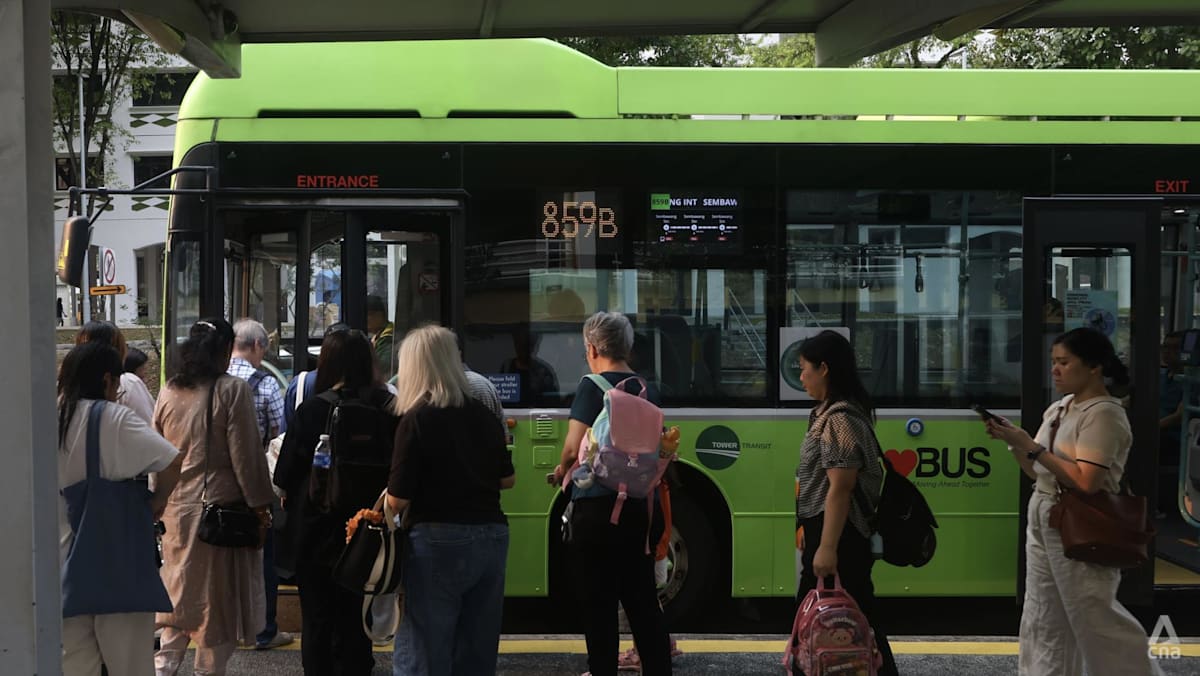
Commuters boarding a bus at bus-stop in front of Blk 482A carpark along Admiralty Link at 7:53am on Sep 18, 2026. (Photo: CNA/Ooi Boon Keong)
This audio is generated by an AI tool.
Since moving to Sembawang 24 years ago, Ms Bernice Ang has been sure to give herself ample time to get to appointments to factor in the long commute out of her neighbourhood.
The Housing and Development Board (HDB) cluster where she lives is only served by two feeder buses – service numbers 859 and 859B – which head to Sembawang MRT station.
During the morning peak period, bus stops along the route are packed with residents thronging buses that arrive, with many struggling to squeeze on board.
Ms Ang's worst commute was on a rainy day a couple years ago when she was huddled under the shelter of the bus stop with other commuters.
She knew the chances were slim to none that she would be able to board either of the first two buses which pulled into the bay, already packed to the brim.
"I had to wait for the third bus before I could finally squeeze on. What was supposed to be a 10-minute bus ride became 40 minutes," the 57-year-old administrative executive told CNA TODAY in Mandarin.
After getting to Sembawang MRT station, she still had to transfer from the North-South Line (NSL) to the North-East Line (NEL) to reach her Chinatown office.
That day, she took two hours to get to work instead of the usual 90 minutes.
"Now it's a bit better because I work in Bukit Batok so I don't have to change trains. But my problem still lies in the bus to the MRT," lamented Ms Ang, who started a new job this year.
"It's tiring, but there's no way around it."
CNA Games Guess Word Crack the word, one row at a time Buzzword Create words using the given letters Mini Sudoku Tiny puzzle, mighty brain teaser Mini Crossword Small grid, big challenge Word Search Spot as many words as you can Show More Show Less
A bus at Sembawang Bus Interchange on Sep 15, 2026. (Photo: CNA/Raydza Rahman)
With Sembawang tucked away along Singapore's northern edge, its 102,640 residents are no strangers to long commutes.
In fact, Sembawang residents take the longest time to get to work in Singapore, based on data from the General Household Survey 2025 published by the Department of Statistics (SingStat) in June.
Residents from the neighbourhood clocked a median travelling time of 50 minutes, receiving the dubious honour of beating Bukit Batok, Bukit Panjang, Choa Chu Kang, Jurong West, Punggol, Sengkang, Tengah, Woodlands and Yishun.
Residents in these other neighbourhoods reported a median work commute of 45 minutes.
The inaccessibility of Sembawang has been an issue for at least a decade: The same household survey in 2015 listed Sembawang among the towns with the longest work commutes, with a median travelling time of 45 minutes.
Many of the residents CNA TODAY spoke to said their commutes to work were between 60 and 90 minutes.
Beyond the statistics, what is the experience like on the ground for Sembawang residents and what will it take to improve journeys for thousands of commuters there?
Most of the 13 Sembawang residents CNA TODAY spoke to relied on taking a train from Sembawang MRT station for the bulk of their journey to work.
While there were few complaints about the train journey to central areas, many said getting to the train station was the most draining part of their commute.
Mr Cheok, 38, said the bus connectivity in Sembawang leaves much to be desired. The freelance trainer, who has approached the authorities with feedback on Sembawang's bus issues, did not want to be identified by his full name.
While his office is close by in Admiralty, he frequently has to meet clients all around the island. A trip to the central business district (CBD), consisting of a feeder bus and a transfer to Sembawang MRT station, can take him around 90 minutes.
Like Ms Ang, he relies on the same two feeder bus services to get him to the train station. The alternative is a 20-minute walk, parts of which are unsheltered.
Limited options aside, Mr Cheok pointed out that the frequency of feeder buses is also inconsistent.
"Bus rides to Sembawang station are about 10 to 15 minutes, but the clumping effect means that one can wait between seven and 25 minutes and then three buses appear at once," said the Sembawang resident of six years.
In Mr Cheok's opinion, there is also a lack of intra-town connectivity, which could help give Sembawang residents more options when travelling rather than everyone trying to make their way to Sembawang MRT station.
He pointed out that the "classic" Sembawang town, referring to the area around Sembawang MRT station, and the newer Canberra town are not well connected.
"Geographically, the towns aren't far apart, but it's frustrating trying to get from town to town via public transport," he said.
He recalled how he tried to make his way from his home near Admiralty Link to a Sheng Siong supermarket at Block 105 along Canberra Street.
As there was no direct bus route, he ended up having to take a bus, then the MRT, then another bus. The supermarket was a mere eight-minute drive away, but he took 40 minutes to reach it via public transport.
"Now, the problem is 'solved' because there is a new Sheng Siong Supermarket nearer to me," he said wryly.
Mr Cheok said the inconvenience of getting around has turned him into more of a homebody since he moved to the neighbourhood from Yishun and he hopes to move to a more centrally-located neighbourhood eventually.
Ms Ang agreed that the most difficult part of her commute is getting a bus to the MRT station.
"If I were to move, I would move to somewhere within walking distance of an MRT station," she said.
FEW ALTERNATIVES TO USING SEMBAWANG MRT STATION
While most of the residents CNA TODAY spoke to complained about the lack of feeder buses, some also pointed to the lack of viable alternatives to taking a train from Sembawang MRT station to central locations.
Sembawang residents currently have a few bus options to get to the city centre.
There is 980, which passes by Little India and Bugis, and terminates at Geylang, as well as 167, which passes by Orchard, The Esplanade and Tanjong Pagar before terminating at Bukit Merah.
Even with these two buses, residents said the MRT system is still the most efficient option for them.
For one thing, bus service 167, which was nearly canned in 2023 due to falling ridership , operates only at 30-minute intervals. Bus 980 also is not the most accessible for many Sembawang residents, said Mr Cheok.
"(The bus) cuts through the middle of Sembawang. And because of that, most people have to walk there, which is another 10 to 15 minutes," he said.
Commuters in Sembawang waiting for their buses on Sep 15, 2026. (Photo: CNA/Raydza Rahman)
While the Thomson-East Coast Line (TEL) offers Sembawang residents another option to get to the city centre, residents complained of a lack of feeder bus options to take them directly to Woodlands MRT station, which is on the line.
Mr Tang Yong Hong, a 32-year-old bank executive, said: "TEL would take me a similar time to get to the city as the NSL because I have to walk to Canberra MRT then take a train to Woodlands."
Despite feeling like the NSL takes "too many stops" to get to town, it's ultimately his best option, he said.
Mr Jonathan Quek, 38, a marketing manager, said he would rather head up north to Malaysia than brave the journey to the CBD.
Mr Quek, who lives near Canberra MRT station, is only three stops away from Woodlands station. From there, it's a 45-minute journey to the Johor Bahru city centre.
"I could either spend 45 minutes heading into town or 45 minutes heading to Johor Bahru via the Rapid Transit System where things suddenly become three times cheaper," he quipped.
SEMBAWANG'S GEOGRAPHY DIFFICULT TO OVERCOME
Transport analysts and other experts said that Sembawang's geographical location near the central catchment area makes it more inaccessible than other neighbourhoods, which may be equally far from the city.
"Sembawang is further prevented from having a crow's flight path to the city centre due to the inlet of Seletar Reservoir," said Associate Professor Lin Wei Qiang of the National University of Singapore's Department of Geography.
Sembawang is further prevented from having a crow's flight path to the city centre due to the inlet of Seletar Reservoir.
Towns to the north, including Mandai and Yishun , are also hampered by the fact that the central catchment area sometimes requires roads and train lines to take detours, he added.
"There simply isn't any other way to speed things up further," said Assoc Prof Lin.
Architect Calvin Chua, who is an Associate Professor of Practice at the Singapore University of Technology and Design (SUTD), also pointed out that the NSL takes a longer route into the downtown core, unlike the North-East Line, which takes Punggol residents to the city centre more quickly.
The longer route is partly due to the central catchment area, and also the need for the NSL to pass through different housing estates on the way to the city centre, he explained. As for how Sembawang compares to other neighbourhoods, Assoc Prof Chua said that while Jurong West residents, for example, also face similarly long commutes to the city centre via the East-West Line, they enjoy quick access to industrial areas in the west of Singapore , which is home to many jobs.
"The future Jurong Region Line will add further connectivity (for these residents) , compared to Sembawang's reliance on a single MRT line," he said.
Sembawang Bus Interchange on Sep 15, 2026. (Photo: CNA/Raydza Rahman)
Mr AP Gopinath Menon, formerly the chief transportation engineer at the Land Transport Authority (LTA), said that Sembawang residents face long commutes even if they are travelling by private transport and are again at a disadvantage compared to other neighbourhoods far from the city.
"Jurong and the western area are also far from the city. But there are more roads – Ayer Rajah Expressway, Pan Island Expressway, West Coast Highway and Boon Lay Way – as compared with the northern regions," he said.
The new North-South Corridor, a multi-modal transport link expected to open from 2029 , however, will help the northern regions like Sembawang, he said.
When CNA TODAY asked the LTA if it considered Sembawang to be adequately served by transport infrastructure and if it is planning any measures to reduce commute time, it referred us to Minister of Transport Jeffrey Siow's written response to a parliamentary question posed by Member of Parliament for Sembawang Group Representation Constituency (GRC) Vikram Nair.
The response in August said that LTA had introduced two new bus services and enhanced 10 existing services in Sembawang GRC, "providing residents with more direct and frequent bus options".
It added that it will continue to monitor travel patterns and feedback from residents, and enhance bus services where needed.
In the longer term, the LTA is studying the alignment for the future Seletar Line to better connect residents in the north with key employment centres in the city centre.
"In addition, to reduce the need for longer cross-island commutes to work for residents in the north, the government will continue with our strategy of providing more employment options closer to home, such as in Woodlands Regional Centre and Yishun," wrote Mr Siow.
Dr Terence Fan, a transport analyst and Assistant Professor of Strategy & Entrepreneurship (Education) at the Singapore Management University, said that Sembawang might benefit from more express buses.
Express bus services typically move commuters quicker than typical bus services by skipping intermediate stops and using expressways.
"If they can't fill the buses, then (adding) trains would be even worse, so I would not go there first. Start with buses and see what the ridership is like," he suggested.
Dr Fan posited that the fact that some Sembawang residents work around Seletar Airport where public transport connections are sparse could have also contributed to the high median commute time for the neighbourhood.
"Extending some express buses that originate from Yishun to start from Sembawang can be part of the solution. Given sufficient riders, dedicated express buses to Sembawang perhaps passing through Seletar may work too."
With sufficient ridership, extending the TEL to a new station in Sembawang could also help shorten commutes, Dr Fan suggested.
However, that's a solution that will require years to materialise and, for now, there's no silver bullet to solve Sembawang residents' transport woes.
Indeed, multiple Sembawang residents told CNA TODAY that, being so far north, they were resigned to facing long commutes for the foreseeable future.
Said Mr Quek , the marketing manager : "I got my house fairly cheap so at least I am being financially compensated for my long commute."
Get our pick of top stories and thought-provoking articles in your inbox
Stay updated with notifications for breaking news and our best stories
Join our channel for the top reads for the day on your preferred chat app
三巴旺居民一直以来都面临着新加坡最长的通勤时间。居民们是如何应对的?又该如何改善通勤条件?
2026年9月18日上午7点53分,乘客在海军部连路482A座组屋停车场前的巴士站候车。(图片:CNA/Ooi Boon Keong)
这段音频是由人工智能工具生成的。
自从 24 年前搬到三巴旺以来,伯妮丝·昂女士一直确保给自己留出充足的时间去赴约,以应对从她家附近到目的地的长途通勤。
她居住的建屋发展局 (HDB) 组屋区只有两条接驳巴士线路——859 路和 859B 路——开往三巴旺地铁站。
早高峰期间,沿线公交车站挤满了居民,他们争先恐后地登上到站的公交车,许多人费力地挤上车。
Ang女士最糟糕的通勤经历发生在几年前的一个雨天,当时她和其他通勤者一起挤在公交车站的遮雨棚下。
她知道自己几乎不可能搭上驶入车站的前两辆公交车中的任何一辆,因为那两辆车都已经挤满了人。
“我等了三班车才终于挤上去。原本10分钟的车程,结果花了40分钟,”这位57岁的行政主管用普通话告诉CNA TODAY。
到达三巴旺地铁站后,她还需要从南北线 (NSL) 换乘东北线 (NEL) 才能到达她在牛车水的办公室。
那天,她花了两个小时才到公司,而平时只需要90分钟。
“现在情况好多了,因为我在武吉巴督工作,不用换乘地铁了。但我的问题仍然是坐公交车去地铁站,”今年刚换工作的Ang女士抱怨道。
“虽然很累,但没办法避免。”
CNA游戏 猜词游戏 逐行破解单词 流行词游戏 用给定的字母组成单词 迷你数独 小小谜题,挑战你的大脑 迷你填字游戏 小方格,大挑战 单词搜索 尽可能多地找出单词 显示更多 显示更少
2026 年 9 月 15 日,三巴旺巴士转换站的一辆巴士。(照片:CNA/Raydza Rahman)
三巴旺位于新加坡北部边缘,其 102,640 名居民对长途通勤并不陌生。
事实上,根据新加坡统计局 (SingStat) 6 月份发布的《2025 年家庭普查》数据,三巴旺居民上班通勤时间是新加坡最长的。
该社区居民的平均出行时间为 50 分钟,荣获“殊荣”,击败了武吉巴督、武吉班让、蔡厝港、裕廊西、榜鹅、盛港、登加、兀兰和义顺。
其他社区的居民表示,通勤时间中位数为 45 分钟。
三巴旺交通不便的问题至少已经存在了十年:2015 年的同一项家庭调查显示,三巴旺是通勤时间最长的城镇之一,平均通勤时间为 45 分钟。
CNA TODAY 采访的许多居民表示,他们上下班通勤时间在 60 到 90 分钟之间。
除了统计数据之外,三巴旺居民的实际体验如何?需要做些什么才能改善当地数千通勤者的出行体验?
CNA TODAY 采访的 13 位三巴旺居民中,大多数人上班通勤都依赖从三巴旺地铁站乘坐地铁。
虽然很少有人抱怨乘坐火车前往市中心,但许多人表示,到达火车站是他们通勤过程中最疲惫的部分。
38岁的卓先生表示,三巴旺的公交网络状况令人堪忧。这位自由职业教练曾就三巴旺的公交问题向有关部门反馈,但他不愿透露全名。
虽然他的办公室就在附近的海军部,但他经常需要与岛上各处的客户会面。前往中央商务区(CBD)的行程,包括乘坐接驳巴士和在三巴旺地铁站换乘,大约需要90分钟。
和Ang女士一样,他也依赖两条接驳巴士线路前往火车站。另一种选择是步行20分钟,其中部分路段没有遮雨棚。
除了选择有限之外,卓先生还指出,接驳巴士的班次也不稳定。
“乘坐巴士前往三巴旺车站大约需要 10 到 15 分钟,但由于巴士扎堆效应,乘客可能需要等待 7 到 25 分钟,然后三辆巴士会同时出现,”这位在三巴旺居住了六年的居民说道。
在卓先生看来,三巴旺市内交通连接也存在不足,这本可以为三巴旺居民提供更多出行选择,而不是让大家都挤到三巴旺地铁站去。
他指出,“经典”的三巴旺镇(指三巴旺地铁站周边地区)和较新的坎贝拉镇之间的交通连接并不便利。
他说:“从地理位置上看,这些城镇相距不远,但乘坐公共交通工具从一个城镇到另一个城镇却很令人沮丧。”
他回忆起自己如何试图从位于海军部连路附近的家前往堪培拉街 105 座的昇菘超市。
由于没有直达公交线路,他最后不得不先乘公交车,再换乘地铁,最后再换乘另一辆公交车。超市开车只需八分钟,但他乘坐公共交通工具却花了四十分钟才到达。
“现在这个问题‘解决了’,因为我家附近新开了一家昇菘超市,”他苦笑着说。
张先生表示,自从从义顺搬到这个社区后,出行不便让他变得更加宅在家,他希望最终能搬到位置更中心的社区。
Ang女士也认为,她通勤中最困难的部分是乘坐公交车前往地铁站。
“如果我要搬家,我会搬到离地铁站步行可达的地方,”她说。
除了使用三巴旺地铁站之外,几乎没有其他选择。
虽然 CNA TODAY 采访的大多数居民都抱怨缺少接驳巴士,但也有一些人指出,从三巴旺地铁站到市中心地区,除了乘坐地铁之外,没有其他可行的替代方案。
三巴旺居民目前有几种公交线路可以前往市中心。
980 路公交车途经小印度和武吉士,终点站是芽笼;167 路公交车途经乌节路、滨海艺术中心和丹戎巴葛,终点站是红山。
即使有了这两辆公交车,居民们也表示,地铁系统仍然是他们最便捷的选择。
首先,167路公交车由于客流量下降,险些在2023年停运,而且该线路每30分钟才有一班。此外,980路公交车对于许多三巴旺居民来说也不太方便,卓先生说道。
他说:“(公交车)穿过三巴旺的中心地带。正因为如此,大多数人不得不步行前往,这又需要10到15分钟。”
2026年9月15日,通勤者在三巴旺等候巴士。(图片:CNA/Raydza Rahman)
虽然汤申-东海岸线 (TEL) 为三巴旺居民提供了前往市中心的另一种选择,但居民们抱怨缺乏接驳巴士选择,无法直接将他们送到位于该线路上的兀兰地铁站。
32岁的银行高管唐永鸿先生说:“乘坐TEL到达市区所需的时间与乘坐NSL到达市区所需的时间差不多,因为我必须步行到堪培拉地铁站,然后乘坐地铁到兀兰。”
他表示,尽管他觉得乘坐 NSL 到达市区“需要停靠的站点太多”,但这最终仍然是他的最佳选择。
38岁的市场经理Jonathan Quek先生表示,他宁愿北上马来西亚,也不愿冒险前往中央商务区。
郭先生住在坎贝拉地铁站附近,距离兀兰站只有三站地铁。从兀兰站出发,45分钟即可到达新山市中心。
“我可以选择花 45 分钟进城,或者花 45 分钟乘坐捷运系统前往新山,在那里东西会突然便宜三倍,”他打趣道。
森巴旺的地理环境难以克服
交通分析师和其他专家表示,三巴旺地理位置靠近市中心辐射区,因此比其他距离市中心同样遥远的街区交通更加不便。
“由于实里达蓄水池的入海口,三巴旺进一步被阻断了通往市中心的直线航线,”新加坡国立大学地理系副教授林伟强说。
由于实里达水库的入海口,三巴旺进一步被阻断了乌鸦飞往市中心的路线。
他还补充说,北部城镇,包括万代和义顺,也受到中心集水区有时需要道路和铁路线绕道而行的影响。
林副教授说:“根本没有其他办法可以进一步加快进度。”
新加坡科技设计大学 (SUTD) 实践副教授、建筑师 Calvin Chua 也指出,南北线通往市中心的路线较长,而东北线则能更快地将榜鹅居民送往市中心。
他解释说,路线较长的部分原因是由于其覆盖的中心区域,以及南北线需要穿过不同的住宅区才能到达市中心。至于三巴旺与其他社区的比较,蔡副教授表示,例如裕廊西的居民虽然也需要通过东西线前往市中心,通勤时间同样较长,但他们可以快速到达新加坡西部的工业区,那里有很多工作机会。
他说:“与三巴旺目前仅依赖一条地铁线路相比,未来的裕廊区域线将为(这些居民)提供更多交通便利。”
2026 年 9 月 15 日的三巴旺巴士转换站。(照片:CNA/Raydza Rahman)
曾任陆路交通管理局 (LTA) 首席交通工程师的 AP Gopinath Menon 先生表示,即使乘坐私家车出行,三巴旺居民也面临着漫长的通勤时间,与其他远离市区的社区相比,他们再次处于劣势。
“裕廊和西部地区也离市区较远。但与北部地区相比,那里的道路更多——有亚逸拉惹高速公路、泛岛高速公路、西海岸高速公路和文礼路,”他说。
他表示,预计将于 2029 年开通的新的南北走廊是一条多式联运交通线路,将有助于像三巴旺这样的北部地区。
当 CNA TODAY 询问陆路交通管理局是否认为三巴旺的交通基础设施足够完善,以及是否计划采取任何措施来减少通勤时间时,陆路交通管理局让我们参考交通部长萧伯纳对三巴旺集选区议员维克拉姆·奈尔提出的议会质询的书面答复。
8 月份的回应称,陆路交通管理局在三巴旺集选区推出了两条新的巴士服务,并加强了 10 条现有的巴士服务,“为居民提供更直接、更频繁的巴士选择”。
该公司还表示,将继续监测出行模式和居民反馈,并在需要时加强公交服务。
从长远来看,陆路交通管理局正在研究未来实里达线的走向,以便更好地连接北部居民与市中心的主要就业中心。
“此外,为了减少北部居民跨岛通勤上班的需要,政府将继续推行我们的战略,提供更多离家更近的就业机会,例如兀兰区域中心和义顺,”萧先生写道。
新加坡管理大学战略与创业(教育)助理教授、交通分析师范德伦博士表示,三巴旺可能会受益于更多的快速巴士。
快速公交服务通常比普通公交服务更快地运送通勤者,因为它跳过了中间站点并利用了高速公路。
“如果公交车都坐不满客,增加火车班次只会更糟,所以我不会先考虑火车。先从公交车开始,看看客流量如何,”他建议道。
范博士认为,三巴旺的一些居民在实里达机场附近工作,而那里的公共交通连接很少,这可能也是导致该地区通勤时间中位数较高的原因之一。
“将一些从义顺始发的快速巴士线路延伸至三巴旺,或许是解决方案之一。如果客流量足够大,开通途经实里达前往三巴旺的专用快速巴士线路也可能行得通。”
范博士建议,如果客流量足够大,将汤申-东南线延伸至三巴旺新站也有助于缩短通勤时间。
然而,这个解决方案需要数年时间才能实现,目前还没有灵丹妙药可以解决三巴旺居民的交通难题。
事实上,多位三巴旺居民告诉 CNA TODAY,由于地处北部,他们已经做好在可预见的未来面临漫长通勤的准备。
市场经理郭先生说:“我的房子买得很便宜,所以至少我的长途通勤得到了经济补偿。”
订阅我们的邮件,即可获取精选热点新闻和引人深思的文章。
订阅通知,第一时间获取突发新闻和精彩报道。
加入我们的频道,即可在您常用的聊天应用上获取当日热门文章。