2-year-old S’pore boy believed to be one of 400 in world with disease caused by a single altered gene一名2岁的新加坡男童被认为是全球400名患有由单个基因突变引起的疾病的患者之一。
A rare genetic disorder, ZTTK syndrome affects brain development causing seizures and delays, with early intervention improving outcomes for affected children. Read more at straitstimes.com.
Medical Mysteries is a series that spotlights rare diseases or unusual conditions.
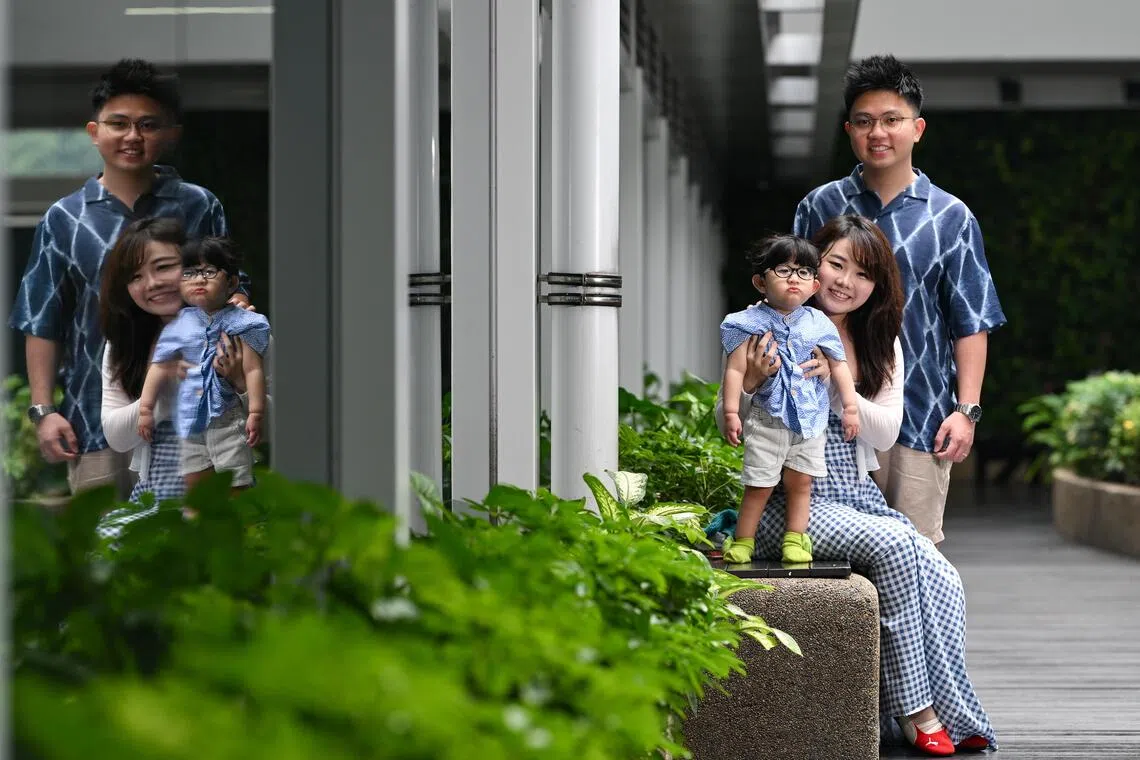
Teyden Hamilton Ho, two, with his father Ho Jun Han and mother Tizane Woo. Teyden was diagnosed with Zhu-Tokita-Takenouchi-Kim syndrome when he was 15 months old.
ST PHOTO: LIM YAOHUI
Published Sep 19, 2026, 12:00 PM
Updated Sep 19, 2026, 12:00 PM
Teyden Hamilton Ho, a two-year-old boy in Singapore, was diagnosed with ultra-rare ZTTK syndrome caused by a single altered gene affecting brain development and motor skills.
His family faces emotional challenges and seizures, but early intervention and physiotherapy have improved his condition and helped him manage symptoms.
ZTTK syndrome is often misdiagnosed due to overlapping symptoms, with ongoing support from specialists and rare disease groups vital for affected families.
SINGAPORE – During Tizane Woo’s 20-week prenatal scan, her doctor noticed something was not right with her child, Teyden Hamilton Ho.
“They told us that his head was smaller than average. The circumference of his hindbrain (cerebellum) was too small,” said the 26-year-old housewife.
“A week after I went for amniocentesis in the 22nd week of my pregnancy, I was told that Teyden has an additional chromosome, which was inherited from me.”
She and her husband were asked if they would like to abort the child because of all the issues he could face.
“But never once did we think of doing so because he was ours,” Woo said.
When Teyden was 15 months old, he was diagnosed with Zhu-Tokita-Takenouchi-Kim (ZTTK) syndrome after blood samples from all three of them were sent to the US for testing.
The condition, named after the four doctors and researchers who first identified it in 2016, is a rare hereditary disease caused by a single altered gene on a non-sex chromosome.
Broadly speaking, it affects brain development.
There is no figure available for how many people in the world have the condition, as it was only recently recognised, said geneticist Jeannette Goh, a consultant in the Department of Genomic Medicine at KK Women’s and Children’s Hospital (KKH).
She said it is believed that there are about 400 people who have the disease.
Woo’s obstetrician and gynaecologist Tony Tan had referred her to Goh.
“The symptoms of ZTTK syndrome are related to what the SON gene does. The gene acts like an editor for other genes and helps the body to read other gene instructions and many of these other genes are related to brain development,” said Goh.
“When the instructions get disrupted, we do get issues in intellectual and cognitive functions. Together with that, we see many developmental delays such as in their motor skills, breathing and speech. That is why we put (patients) into learning intervention programmes early.”
Goh said the possibility of the condition being missed, misdiagnosed or even undiagnosed is high because ZTTK syndrome is very rare and its symptoms overlap with other neurological conditions.
Genetic counsellor Priscella Chia from KKH, who also attends to Teyden, said it is “entirely normal for the first few tests to come back inconclusive”.
“About 80 per cent of rare diseases present with vague, overlapping symptoms. Standard medical tests (like basic blood work or imaging) usually rule out common conditions rather than pinpoint a rare one,” she added.
Woo said it was an emotional rollercoaster for her and her husband when Teyden was first diagnosed.
“I felt sad that I was the one who gave him his condition. At the same time, we were happy that we finally had a diagnosis for Teyden’s condition. We also had a lot of help from his physiotherapists who have taught us how to manage him,” she said.
“It helps also that Teyden is a super happy child and it made it easy for us to take care of him.”
Teyden now goes for physiotherapy twice a week at the Wings Therapy and Learning Centre in Singapore, to work on his posture, trunk control, and overall motor function.
“We started intensive sessions in June and it helped him a lot. Now he is able to sit up on his own for a period of time, which he could not do the last time. He was really floppy and his head control was very weak,” Woo said.
Teyden also tends to shake his arms and move his head to hit against the back of his high chair, a known neurological manifestation of ZTTK syndrome associated with several central nervous system anomalies.
“He cries when we stop him. To prevent him from hurting himself, we have put a cushion behind him. (But) he seems to know it is soft so he goes at it harder. He is cheeky that way,” Woo said.
Teyden Hamilton Ho (centre) with (from left) genetic counsellor Priscella Chia, father Ho Jun Han, mother Tizane Woo and geneticist Jeannette Goh. ST PHOTO: LIM YAOHUI
Teyden Hamilton Ho (centre) with (from left) genetic counsellor Priscella Chia, father Ho Jun Han, mother Tizane Woo and geneticist Jeannette Goh.
At the end of May , Teyden started having seizures, a sign of the condition that affects between 50 and 55 per cent of ZTTK syndrome patients.
“We did not know they were seizures. He was still on the BiPAP. He was still asleep, jerking. There was foam coming from his mouth and he was slowly turning blue. We called the ambulance,” Woo said.
A BiPAP machine is a non-invasive ventilator used to help with breathing by delivering pressurised air through a mask: higher pressure for inhalation and lower pressure for exhalation.
When Teyden had another seizure weeks later, his parents were ready with the video camera and they managed to capture the 11-minute incident and report it to the attending doctor at the emergency room in KKH.
Teyden is currently on anti-seizure medication. But it did not prevent another episode – this time brought on by fever and Covid-19, which meant he could have faced a significantly higher risk of presenting severe symptoms or respiratory complications.
“It was the scariest point of the two years of his life,” his mother said.
Teyden with family pets Momo (left) and Ming Ming. PHOTO: COURTESY OF TIZANE WOO
Teyden with family pets Momo (left) and Ming Ming.
PHOTO: COURTESY OF TIZANE WOO
Having recovered, Teyden is back to playing with the two family pets and attending classes at Fei Yue EIPIC Centre in Upper Thomson Road, which offers early intervention programme for young children with developmental and special needs.
“He is the youngest there, and the loudest in class,” Woo said, laughing.
Teyden’s father Ho Jun Han, 27, a data centre operator, said the boy likes to be involved in conversations and babbles a lot, even though he cannot form words.
They have joined a Facebook support group for the condition that is based in the US.
“Apart from Teyden, there is no one else in Singapore with his condition. It was here in this Facebook page that we got to see other kids with ZTTK, contact parents dealing with the condition and perhaps provide support for each other,” Woo said.
“We do not know what holds for him in the future because this condition is super rare... We are managing and trying to stay as positive as much as possible.”
ST Medical Mysteries
KK Women's and Children's Hospital
《医学谜案》是一档聚焦罕见疾病或不寻常病症的系列节目。
两岁的Teyden Hamilton Ho与他的父亲Ho Jun Han和母亲Tizane Woo合影。Teyden在15个月大时被诊断出患有朱-时田-竹之内-金综合征。
ST 照片:林耀辉
发布于 2026 年 9 月 19 日下午 12:00
更新于2026年9月19日中午12:00
新加坡一名两岁男孩 Teyden Hamilton Ho 被诊断患有极其罕见的 ZTTK 综合征,该综合征由单个改变的基因引起,影响大脑发育和运动技能。
他的家庭面临着情感上的挑战和癫痫发作,但早期干预和物理治疗改善了他的病情,并帮助他控制了症状。
由于症状重叠,ZTTK 综合征经常被误诊,因此,专家和罕见病团体的持续支持对受影响的家庭至关重要。
新加坡——在蒂赞·伍 (Tizane Woo) 怀孕 20 周进行产前扫描时,她的医生发现她的孩子泰登·汉密尔顿·何 (Teyden Hamilton Ho) 有些不对劲。
“他们告诉我们,他的头比平均水平小。他的后脑(小脑)周长也太小了,”这位26岁的家庭主妇说道。
“在我怀孕第 22 周进行羊膜穿刺一周后,我被告知 Teyden 多出了一条染色体,这条染色体是从我这里遗传的。”
医生问她和她丈夫是否愿意堕胎,因为孩子可能会面临很多问题。
“但我们从未想过要这样做,因为他是我们的孩子,”伍说。
泰登 15 个月大的时候,他被诊断出患有朱-时田-竹之内-金(ZTTK)综合征,此前他们三人的血液样本被送到美国进行检测。
这种疾病以 2016 年首次发现它的四位医生和研究人员的名字命名,是一种罕见的遗传性疾病,由非性染色体上的单个基因改变引起。
总的来说,它会影响大脑发育。
遗传学家、KK妇女儿童医院(KKH)基因组医学部顾问Jeannette Goh表示,由于这种疾病是最近才被发现的,因此目前还没有关于全世界有多少人患有这种疾病的统计数据。
她说,据信约有400人患有这种疾病。
Woo 的妇产科医生 Tony Tan 将她转诊给了 Goh。
“ZTTK综合征的症状与SON基因的功能有关。该基因就像其他基因的编辑器,帮助身体读取其他基因的指令,而这些基因中有很多都与大脑发育有关,”吴医生说。
“当指令被打乱时,就会出现智力和认知功能方面的问题。同时,我们还会看到许多发育迟缓,例如运动技能、呼吸和语言方面的发育迟缓。这就是为什么我们要尽早将(患者)纳入学习干预计划的原因。”
Goh表示,由于ZTTK综合征非常罕见,而且其症状与其他神经系统疾病重叠,因此该疾病被漏诊、误诊甚至漏诊的可能性很高。
来自KKH的遗传咨询师Priscella Chia也为Teyden提供咨询,她说“最初几次检测结果不确定是完全正常的”。
她补充说:“大约80%的罕见病症状模糊且相互重叠。标准的医学检查(如基本的血液检查或影像学检查)通常只能排除常见疾病,而无法准确诊断出罕见病。”
Woo表示,Teyden刚被确诊时,她和丈夫的情绪就像坐过山车一样。
“我很难过,因为是我让他患上了这种病。但同时,我们也为终于确诊泰登的病情而感到高兴。他的理疗师们也给了我们很多帮助,教会了我们如何照顾他,”她说。
“泰登是个非常快乐的孩子,这也有助于我们照顾他。”
Teyden 现在每周两次前往新加坡的 Wings 治疗和学习中心进行物理治疗,以改善他的姿势、躯干控制和整体运动功能。
“我们从六月份开始进行强化训练,这对他帮助很大。现在他可以自己坐一段时间了,这是他上次做不到的。他当时身体很软,头部控制能力也很差,”伍医生说。
泰登还经常摇晃手臂,并转动头部撞击高脚椅的靠背,这是 ZTTK 综合征的一种已知的神经系统表现,与几种中枢神经系统异常有关。
“我们阻止他的时候,他会哭。为了防止他受伤,我们在他身后放了个垫子。(但是)他好像知道垫子很软,所以反而更用力地抓。他就是这么调皮,”伍说道。
Teyden Hamilton Ho(中)与(从左至右)遗传咨询师Priscella Chia、父亲Ho Jun Han、母亲Tizane Woo和遗传学家Jeannette Goh合影。(海峡时报摄影:LIM YAOHUI)
Teyden Hamilton Ho(中)与(从左至右)遗传咨询师 Priscella Chia、父亲 Ho Jun Han、母亲 Tizane Woo 和遗传学家 Jeannette Goh 合影。
5 月底,泰登开始出现癫痫发作,这是影响 50% 至 55% ZTTK 综合征患者的一种疾病的征兆。
“我们当时并不知道那是癫痫发作。他还在用双水平呼吸机(BiPAP)。他当时还在睡梦中,身体却在抽搐。他嘴里吐出泡沫,脸色也慢慢发青。我们赶紧叫了救护车,”伍医生说道。
BiPAP 呼吸机是一种无创呼吸机,通过面罩输送加压空气来帮助呼吸:吸气时压力较高,呼气时压力较低。
几周后,泰登再次癫痫发作,他的父母早已准备好了摄像机,他们设法记录下了这 11 分钟的事件,并将其报告给了 KKH 急诊室的主治医生。
泰登目前正在服用抗癫痫药物。但这并没有阻止他再次癫痫发作——这次是由发烧和新冠肺炎引起的,这意味着他出现严重症状或呼吸系统并发症的风险可能显著更高。
“那是他两年生命中最可怕的时刻,”他的母亲说。
Teyden 与家中宠物 Momo(左)和 Ming Ming 合影。照片由 Tizane Woo 提供
Teyden 与家里的宠物 Momo(左)和 Ming Ming 在一起。
照片:由蒂赞·伍提供
康复后,泰登又可以和家里的两只宠物玩耍了,并且还在汤申路上段的飞跃早期干预中心上课。该中心为有发育和特殊需要的幼儿提供早期干预课程。
“他是班里年纪最小的,也是声音最大的,”伍笑着说。
Teyden 的父亲 Ho Jun Han 今年 27 岁,是一名数据中心运营商。他说,儿子喜欢参与对话,经常咿呀学语,尽管他不会说话。
他们加入了一个位于美国的针对这种疾病的Facebook支持小组。
“除了泰登之外,新加坡没有其他患有他这种疾病的人。正是在这个Facebook页面上,我们才能看到其他患有ZTTK的孩子,联系到正在应对这种疾病的家长,并互相提供支持,”伍说道。
“我们不知道他未来会怎样,因为这种情况非常罕见……我们正在尽力应对,并努力保持乐观。”
ST 医学谜案
KK妇女儿童医院