Indonesian businessman questioned in S’pore over alleged use of fake $10,000 notes at RWS casino一名印尼商人因涉嫌在圣淘沙名胜世界赌场使用假10000新元钞票,在新加坡接受讯问。
An Indonesian businessman is under investigation in Singapore for allegedly using counterfeit $10,000 notes at Resorts World Sentosa casino. Read more at straitstimes.com.
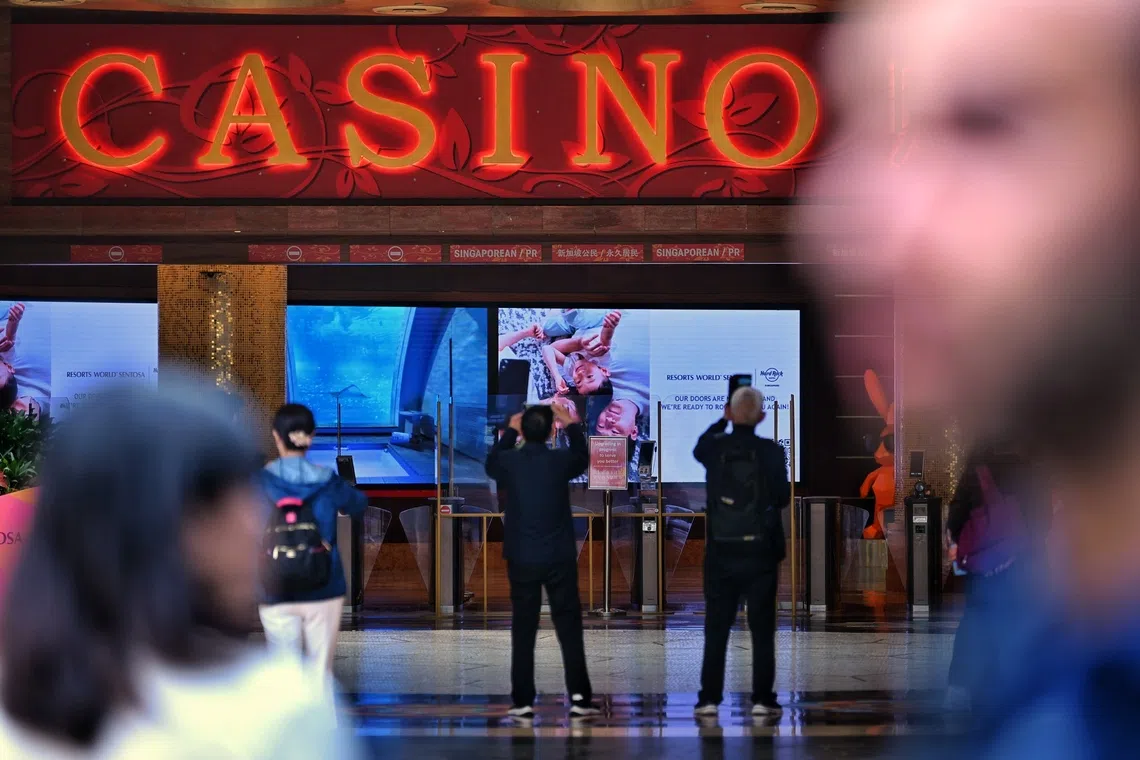
A total of 34 counterfeit $10,000 notes were allegedly used by the businessman over three visits to the casino in June.
Wahyudi Soeriaatmadja
Published Sep 19, 2026, 05:00 AM
Updated Sep 19, 2026, 05:00 AM
JAKARTA – An Indonesian businessman is assisting with investigations in Singapore over the alleged use of counterfeit $10,000 notes at the Resorts World Sentosa (RWS) casino.
The Straits Times has learnt that a total of 34 counterfeit $10,000 notes were allegedly used by the businessman, identified only as Steven, over three visits to the casino in June.
ST understands the notes were accepted and exchanged for casino chips before they were detected as counterfeit.
The businessman’s Jakarta-based lawyer Yosia Ginting told ST on Sept 17 that his client is a victim of fraud and had no knowledge that the banknotes were counterfeit.
According to the lawyer, Steven said the Singapore-dollar notes were given to him as payment for a shophouse he was selling in South Tangerang, a satellite town to Jakarta.
South Tangerang police chief, Superintendant (Supt) Boy Jumalolo, told ST that they held a meeting via Zoom on Sept 14 with representatives of the Singapore Police Force (SPF), including the SPF attache in Jakarta.
The meeting was conducted at the Indonesian National Police’s International Relations Division.
“At that meeting, we asked the SPF to issue a letter stating that the 34 notes from 1973 in the $10,000 denomination, which have been seized, are counterfeit.
“To date, Indonesian investigators have only received a copy of the seizure receipt, which describes them as ‘believed to be non genuine’,” said Supt Boy.
He added that Indonesian investigators are currently summoning witnesses.
A spokesman for SPF confirmed a report was lodged and said investigations are ongoing.
Yosia said his client had received the notes from a man named Anthony, who was introduced by one of Steven’s friends, identified only as Rangga.
At a meeting on June 8 at a cafe in Jakarta, Anthony gave him a single $10,000 note, claiming he wanted to exchange the note because it was old.
Yosia said Rangga reassured Steven, saying the note was checked at an OCBC branch in Indonesia and declared genuine.
Steven flew to Singapore the next day, where a money changer declined to accept the note because it was too large an amount.
Yosia said his client visited a bank but was told he had to open an account to change the note to smaller denominations, but he could not do this.
During a visit to Resorts World Sentosa , Yosia was introduced to a VIP host who suggested he change the note at the casino. The note was then allegedly verified and exchanged for casino chips.
Anthony met up with Steven again on June 11, after the businessman returned to Jakarta, and handed him 33 $10,000 notes to be changed to smaller denominations in Singapore.
He claimed the money was an inheritance from his parents.
According to Yosia, Anthony indicated that he wanted to buy Steven’s shophouse, which the businessman was offering to sell at 4.5 billion rupiah (S$323,500).
Anthony said he would pay him when the businessman returned to Jakarta with the Singapore currency in smaller denominations.
Yosia said his client then travelled to Singapore on June 12 and deposited 27 of the counterfeit $10,000 notes into his account at the casino. Six other notes remained at his home in Indonesia.
South Tangerang police confirmed this account in a statement on July 3.
Yosia said that when Anthony asked for the $10,000 notes in small denominations, Steven told him they should travel to Singapore together to collect the money.
The lawyer added: “Anthony declined, saying he didn’t have a passport and that he had business to attend to in Indonesia.”
On June 22, Steven used six of the counterfeit $10,000 notes kept in Jakarta as payment towards a house in Pamulang, Banteng province, which the businessman bought in May 2025.
But the seller’s daughter had difficulty changing the notes with a money changer in Jakarta.
On June 26, Steven flew to Singapore with his wife, their children and the seller’s daughter, with the intention of paying for the house.
Steven told the seller that the $10,000 notes could be changed to small denominations only in Singapore at the casino.
When the seller’s daughter realised she could not bring into Indonesia more than $6,000 , she told Steven to pay by bank transfer instead.
“That afternoon, after Steven took part in a baccarat tournament at (RWS), he was stopped by casino security and police,” said Yosia.
Steven was told that the serial numbers on some of the six notes matched some of the 28 notes he had exchanged on his two earlier trips.
Yosia said Steven was questioned at Police Cantonment Complex, where his client was told he was being investigated for bringing in a large sum of cash without declaring it, circulating counterfeit currency and using counterfeit currency.
The lawyer said Steven surrendered his passport and mobile phone, and was told he would have to remain in Singapore for between three and six months for police to complete their investigations.
The lawyer added: “Steven is a victim of fraud and is not part of a counterfeit money ring. We have reported to the South Tangerang police about this case.”
The $10,000 banknote was first issued in 1973 and discontinued in 2014. In 2021, the Monetary Authority of Singapore (MAS) stopped issuing the $1,000 note as well.
In a statement in 2020, MAS said the discontinuation of the $1,000 and $10,000 notes was a pre-emptive move to mitigate the money laundering and terrorism financing risks associated with large denomination notes.
It noted that discontinuing a high denomination note has also been the practice in other jurisdictions.
Over the years, a number of individuals have been hauled to court over the use of counterfeit $10,000 and $1,000 banknotes in Singapore.
In February, an Indonesian man who received a counterfeit $10,000 from his girlfriend in Singapore was caught after he tried to deposit it in his unsuspecting uncle’s bank account .
Aurick Kenji Almira Valeryan, 22, was sentenced to seven months’ jail.
A year earlier, a 36-year-old Indonesian man was charged after he tried to deposit a counterfeit $10,000 banknote at the DBS South Bridge branch at Hong Lim Complex.
Those convicted of using forged or counterfeit banknotes in Singapore may be jailed for up to 20 years.
Counterfeits/Forgery
Resorts World Sentosa
据称,该商人在六月份三次光顾赌场期间,共使用了 34 张面值 10,000 美元的假钞。
瓦尤迪·索里亚特马贾
发布于 2026 年 9 月 19 日上午 5:00
更新于2026年9月19日凌晨5:00
雅加达——一名印尼商人正在协助新加坡调查有关在圣淘沙名胜世界(RWS)赌场使用假10000美元钞票的指控。
《海峡时报》获悉,一名仅被确认为史蒂文的商人,在6月份三次光顾赌场期间,涉嫌使用了34张面值10000美元的假钞。
据ST了解,这些钞票在被发现是假钞之前,已被赌场接受并兑换成筹码。
这位商人的雅加达律师 Yosia Ginting 于 9 月 17 日告诉《海峡时报》,他的客户是诈骗案的受害者,并不知道这些钞票是假钞。
据律师称,史蒂文表示,这些新加坡元钞票是别人给他的,作为他在雅加达卫星城南丹格朗出售的一间店屋的付款。
南丹格朗警察局长博伊·朱马洛洛警司告诉《海峡时报》,他们于 9 月 14 日通过 Zoom 与新加坡警察部队 (SPF) 的代表举行了会议,其中包括新加坡警察部队驻雅加达的联络官。
会议在印度尼西亚国家警察国际关系部门举行。
“在那次会议上,我们要求新加坡警察部队出具一份声明,表明查获的 34 张 1973 年面值 10,000 美元的钞票是假钞。
“迄今为止,印尼调查人员只收到了一份查获收据的副本,上面称这些物品‘据信并非真品’,”警司博伊说。
他还补充说,印尼调查人员目前正在传唤证人。
新加坡警察部队发言人证实已接到报案,并表示调查正在进行中。
约西亚说,他的委托人从一名叫安东尼的男子那里收到了这些纸条,安东尼是由史蒂文的一位朋友介绍的,这位朋友只被称作兰加。
6 月 8 日,在雅加达一家咖啡馆的会面中,安东尼给了他一张 10,000 美元的钞票,声称他想把这张钞票兑换成其他货币,因为它已经过期了。
Yosia说,Rangga向Steven保证,这张纸条已经在印度尼西亚的一家华侨银行分行检查过,并被确认为真品。
史蒂文第二天飞往新加坡,但那里的货币兑换商拒绝接受这张钞票,因为金额太大。
约西亚说,他的客户去了一家银行,但被告知他必须开一个账户才能将钞票兑换成小面额的钞票,但他无法做到这一点。
在游览圣淘沙名胜世界期间,约西亚结识了一位贵宾接待员,该接待员建议他在赌场兑换纸币。据称,纸币随后被验证并兑换成了赌场筹码。
6 月 11 日,商人史蒂文返回雅加达后,安东尼再次与他见面,并给了他 33 张 10,000 美元的钞票,让他到新加坡兑换成小面额的钞票。
他声称这笔钱是他父母留给他的遗产。
据约西亚称,安东尼表示他想买下史蒂文的店屋,这位商人当时的要价是 45 亿印尼盾(约合 323,500 新元)。
安东尼说,等这位商人带着小面额的新加坡元回到雅加达后,他会付钱给他。
约西亚说,他的当事人随后于6月12日前往新加坡,并将27张面值1万美元的假钞存入了他在赌场的账户。另外6张假钞则留在他在印度尼西亚的家中。
南丹格朗警方在7月3日的一份声明中证实了这一说法。
约西亚说,当安东尼要求把10000美元的钞票换成小面额时,史蒂文告诉他,他们应该一起去新加坡取钱。
律师补充道:“安东尼拒绝了,他说他没有护照,而且他在印度尼西亚还有公务要处理。”
6 月 22 日,史蒂文用藏在雅加达的六张面值 10,000 美元的假钞支付了位于万腾省帕穆朗的一处房产的款项,这位商人于 2025 年 5 月购买了这处房产。
但卖家的女儿在雅加达找货币兑换商兑换钞票时遇到了困难。
6月26日,史蒂文带着妻子、孩子和卖方的女儿飞往新加坡,打算支付房款。
史蒂文告诉卖家,10000美元的钞票只能在新加坡的赌场兑换成小面额钞票。
当卖家的女儿意识到她不能携带超过 6000 美元进入印度尼西亚时,她告诉史蒂文改用银行转账付款。
“那天下午,史蒂文在(RWS)参加了一场百家乐锦标赛后,被赌场保安和警察拦了下来,”约西亚说。
史蒂文被告知,这六张钞票中的一些序列号与他之前两次旅行中兑换的 28 张钞票中的一些序列号相符。
约西亚说,史蒂文在警察营地接受了讯问,他的当事人被告知,他正在接受调查,罪名包括携带大量现金入境未申报、流通假币和使用假币。
律师表示,史蒂文交出了护照和手机,并被告知他必须在新加坡停留三到六个月,以便警方完成调查。
律师补充道:“史蒂文是诈骗案的受害者,他并非伪钞团伙成员。我们已就此案向南丹格朗警方报案。”
面值 10,000 美元的纸币于 1973 年首次发行,并于 2014 年停止发行。2021 年,新加坡金融管理局 (MAS) 也停止发行面值 1,000 美元的纸币。
新加坡金融管理局 (MAS) 在 2020 年的一份声明中表示,停止发行 1000 美元和 10000 美元面额的纸币是一项先发制人的举措,旨在减轻与大额纸币相关的洗钱和恐怖主义融资风险。
报告指出,其他司法管辖区也有停止发行高面额纸币的做法。
多年来,新加坡已有不少人因使用面值 10,000 美元和 1,000 美元的假钞而被传唤到法庭。
今年二月,一名印尼男子从新加坡女友那里收到一张 1 万美元的假钞,试图将其存入毫不知情的叔叔的银行账户,结果被抓获。
22岁的奥里克·肯吉·阿尔米拉·瓦莱里安被判处七个月监禁。
一年前,一名 36 岁的印尼男子因试图在芳林大厦的星展银行南桥分行存入一张面值 10,000 美元的假钞而被起诉。
在新加坡,使用伪造或变造钞票的人最高可被判处 20 年监禁。
伪造品/仿制品
圣淘沙名胜世界