A Chinese blockade could cripple Taiwan’s electricity, war game warns战争游戏警告:中国封锁可能导致台湾电力瘫痪
“Energy is the weakest element in Taiwan’s resilience against coercion,” warns a report by the U.S.-based Center for Strategic and International Studies.
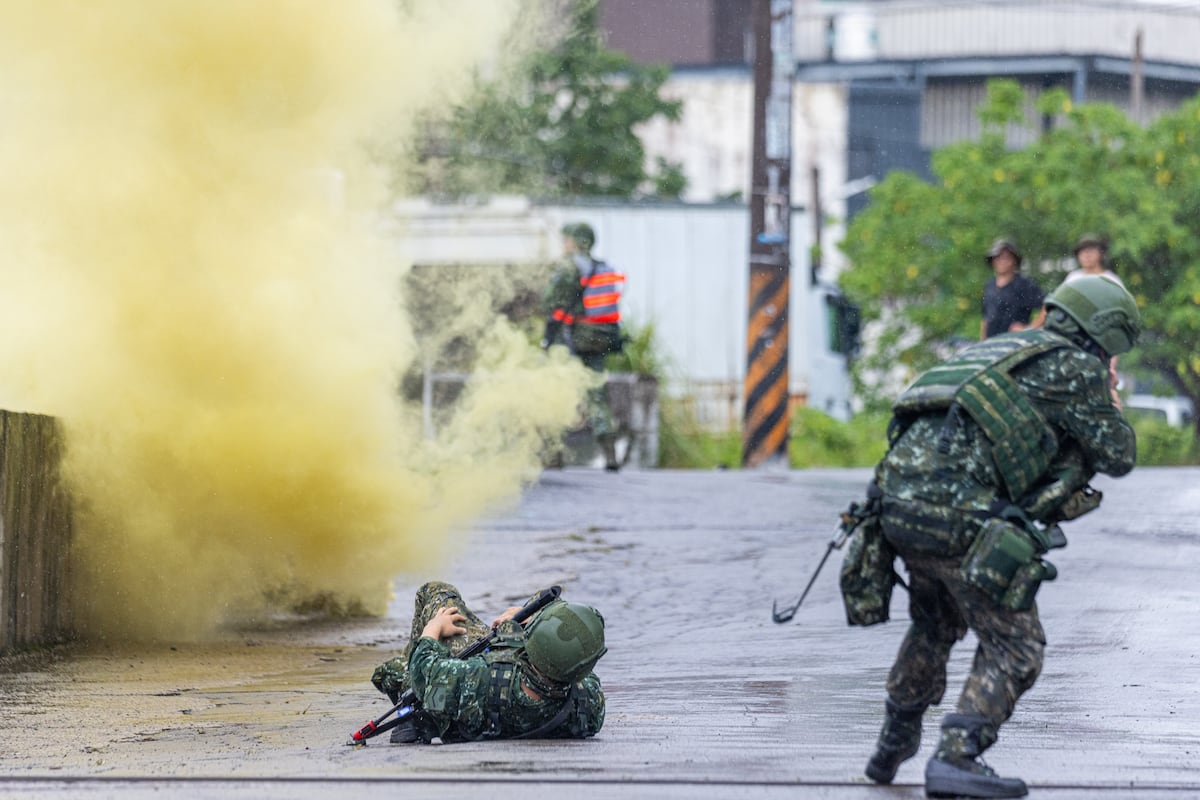
A Chinese blockade could cut Taiwan’s electrical generating capacity so much that the island is unable to function, according to war games conducted by a U.S. think tank.
“Energy is the weakest element in Taiwan’s resilience against coercion,” warned the report by the Washington-based Center for Strategic and International Studies. “The overwhelming preponderance of energy must be imported and is thus vulnerable to a blockade.”
China could supplement a blockade with attacks on Taiwan’s electrical grid, as Russia has done with some success in Ukraine.
“Total electricity production might be reduced to 20 percent of pre-blockade electricity levels,” CSIS said. At that level, all manufacturing ceases – including computer chips vital to the U.S. and the global economy.
These conclusions came from a series of 26 war games run by CSIS to test a blockade of Taiwan, an attractive option for Beijing that offers the prospect of Taiwan agreeing to “reunify” with China, without the need for a bloody and risky Chinese amphibious invasion.
CSIS researchers matched up various combinations of variables in each scenario, with the scenarios simulating 20 weeks of game time.
For example, the severity of China’s blockade ranged from a mere China Coast Guard stop-and-search operation to an all-out military effort that launched missiles at U.S. and Japanese bases.
Other variables included hardening Taiwanese infrastructure and anti-invasion defenses, procuring additional cargo ships for convoys, more lethal Chinese missiles, whether Japan chose to defend Taiwan, and whether the fighting extended beyond the local blockade zone.
The CSIS report admitted that some of these scenarios “are uninteresting because of the force mismatch: No one could doubt that a China willing to embark on a wider war against a constrained Taiwan could completely cut off imports to Taiwan.” Yet assuming various changes in U.S., Taiwanese and Chinese policy, strategy and forces had a major impact on scenario outcomes.
For example, a nightmare scenario depicted attacks on Taiwan’s electric grid and strikes on American airbases in Japan and Guam, while the U.S. refrained from hitting airbases on the Chinese mainland.
Chinese air forces “were able to crowd into forward coastal air bases without risk of being hit by air strikes,” while “the escalation level greatly improved the survivability of Chinese warships and submarines, which took shelter as needed in ports or other areas immediately offshore,” the report said.
In that game, the U.S. and Taiwan lost 33 surface warships – including two aircraft carriers – and 153 merchant ships. With Taiwan’s electrical generation meeting just 24 percent of demand, the result would be “not just economic collapse but also the failure to meet even minimal health and safety activities for the population.”
But in another scenario, Taiwan hardened its electrical infrastructure, the U.S. took a more aggressive posture, and large numbers of merchant ships were available to carry supplies to Taiwan. In this iteration, Chinese air and naval losses rose sharply, more cargo ships successfully ran the gauntlet to reach Taiwan, and there was sufficient electricity to meet most of the island’s demand.
Interestingly, five of the 26 scenarios were “free play” games where players could choose to escalate, deescalate, or negotiate an “off ramp” to end the conflict, rather than being locked into a course of action.
Most players seemed reluctant to escalate, CSIS noted. Yet they often made “small escalations” to signal the opposition, who responded with counter-escalations. In all five games, naval forces fired upon each other and suffered losses.
While a blockade would be grim for Taiwan, it is not hopeless. For example, the capability to assemble large numbers of merchant ships – and the necessary crews – would be the most important preparation that Taiwan and the U.S. can make, according to CSIS.
This includes sufficient liquified natural gas tankers crucial to meeting Taiwan’s energy needs, as well as providing governmental insurance to replace commercial insurers who avoid war zones. Transshipment will be key: most merchant ships won’t run a blockade, but their cargo can be unloaded in Japanese ports, and then reloaded aboard vessels that will make the Taiwan run.
Taiwan can also reduce its dependence on imported energy. This could include boosting its reserves of oil, natural gas and coal, and even reopening its last nuclear plant , which shut down in May. Meanwhile, the island’s electrical grid could be hardened, including stockpiles of spare parts such as transformers and turbines.
For its part, the U.S. could increase its air transport capacity for a Berlin 1948-style airlift. While insufficient to meet all of Taiwan’s needs, “in some circumstances, an airlift could have a powerful moral effect and provide some breathing room,” CSIS said. In addition, the U.S. Navy will need to improve its capability for convoy escort.
Ultimately, perhaps the most crucial step is to ensure that diplomacy is always an option. A Chinese blockade of Taiwan – and retaliation by the U.S. and its allies – could devastate the global economy, and not least the economies of China and America.
“Creative offers by the United States and Taiwan might allow China to declare victory and lift the blockade at an acceptable cost to the coalition (e.g., Taiwan agreeing to international observers in customs houses; reiterating the 1992 Consensus verbatim),” CSIS concluded.
Michael Peck is a defense writer whose work has appeared in Forbes, Business Insider, Foreign Policy magazine and the Center for European Policy Analysis. He holds an MA in political science from Rutgers Univ. Follow him on Twitter and LinkedIn .
Michael Peck is a correspondent for Defense News and a columnist for the Center for European Policy Analysis. He holds an M.A. in political science from Rutgers University. Find him at theuncommondefense.com. His email is mikedefense1@gmail.com.
据美国一家智库进行的战争推演显示,中国的封锁可能会大幅削减台湾的发电能力,导致该岛无法正常运转。
“能源是台湾抵御胁迫能力中最薄弱的环节,”总部位于华盛顿的战略与国际研究中心发布的报告警告说。“台湾绝大部分能源依赖进口,因此极易受到封锁的影响。”
中国可能会像俄罗斯在乌克兰取得一定成功那样,通过攻击台湾电网来加强封锁。
战略与国际研究中心(CSIS)表示,“总发电量可能降至封锁前水平的20%”。在这种水平下,所有制造业都将停摆——包括对美国和全球经济至关重要的计算机芯片。
这些结论来自战略与国际研究中心 (CSIS) 进行的 26 次战争演习,旨在测试封锁台湾的可行性。对于北京而言,这是一个极具吸引力的选择,它有望促使台湾同意与中国“统一”,而无需进行血腥且危险的中国两栖入侵。
CSIS 的研究人员将每种情景中的各种变量组合进行匹配,这些情景模拟了 20 周的游戏时间。
例如,中国封锁的严重程度从中国海警的简单拦截搜查行动到向美国和日本基地发射导弹的全面军事行动不等。
其他变量包括加强台湾的基础设施和反入侵防御、为护航船队采购更多货船、中国更致命的导弹、日本是否选择保卫台湾,以及战斗是否蔓延到当地封锁区之外。
战略与国际研究中心(CSIS)的报告承认,其中一些情景“由于双方力量悬殊而显得乏味:毫无疑问,一个愿意对受限的台湾发动更大规模战争的中国完全可以切断台湾的进口。”然而,假设美国、台湾和中国的政策、战略和力量发生各种变化,会对情景结果产生重大影响。
例如,一个噩梦般的场景描绘了对台湾电网的攻击以及对日本和关岛的美国空军基地的袭击,而美国却没有袭击中国大陆的空军基地。
报告称,中国空军“能够涌入前沿沿海空军基地而不必担心遭到空袭”,同时“局势升级大大提高了中国军舰和潜艇的生存能力,它们可以根据需要在港口或其他近海区域寻求庇护”。
在那场游戏中,美国和台湾损失了33艘水面舰艇——包括两艘航空母舰——以及153艘商船。由于台湾的发电量仅能满足24%的需求,其结果“不仅会导致经济崩溃,甚至连民众最基本的健康和安全保障都无法满足”。
但在另一种情况下,台湾加强了电力基础设施建设,美国采取了更为强硬的姿态,并且有大量商船可以向台湾运送物资。在这种情况下,中国空军和海军的损失急剧增加,更多货船成功突破重重阻碍抵达台湾,而且台湾的电力供应足以满足岛上大部分需求。
有趣的是,26 个场景中有 5 个是“自由游戏”游戏,玩家可以选择升级冲突、降级冲突或协商“退出方案”来结束冲突,而不是被锁定在某种行动方案中。
战略与国际研究中心(CSIS)指出,大多数参与者似乎都不愿升级冲突。然而,他们经常进行“小规模升级”以向对手发出信号,而对手则会以反制措施予以回应。在所有五场比赛中,海军部队都曾互相开火并遭受损失。
虽然封锁对台湾来说将是灾难性的,但并非毫无希望。例如,据战略与国际研究中心(CSIS)称,台湾和美国目前最重要的准备工作是集结大量商船及其所需船员。
这包括充足的液化天然气运输船,这对满足台湾的能源需求至关重要;此外,政府还将提供保险,以取代那些避开战区的商业保险公司。转运至关重要:大多数商船不会突破封锁,但它们的货物可以在日本港口卸货,然后再重新装载到能够维持台湾运转的船只上。
台湾还可以减少对进口能源的依赖。这包括增加石油、天然气和煤炭储备,甚至重启5月份关闭的最后一座核电站。与此同时,台湾的电网也可以得到加强,包括储备变压器和涡轮机等备用部件。
美国方面可以提升空运能力,进行类似1948年柏林空运行动的行动。战略与国际研究中心(CSIS)指出,虽然这不足以满足台湾的所有需求,但“在某些情况下,空运行动可以产生强大的精神鼓舞作用,并带来一些喘息之机”。此外,美国海军也需要提升护航能力。
归根结底,或许最关键的一步是确保外交途径始终是可行的选择。中国对台湾的封锁——以及美国及其盟友的报复——可能会重创全球经济,尤其是中国和美国的经济。
战略与国际研究中心(CSIS)总结道:“美国和台湾提出的创造性方案或许能让中国宣布胜利,并以联盟可接受的代价解除封锁(例如,台湾同意国际观察员进入海关;逐字逐句地重申九二共识)。”
迈克尔·佩克是一位国防作家,他的作品曾发表于《福布斯》、《商业内幕》、《外交政策》杂志和欧洲政策分析中心。他拥有罗格斯大学政治学硕士学位。请在推特和领英上关注他。
迈克尔·佩克是《防务新闻》的通讯员,也是欧洲政策分析中心的专栏作家。他拥有罗格斯大学政治学硕士学位。您可以在theuncommondefense.com找到他。他的邮箱是mikedefense1@gmail.com。