What if Russia invades the Baltic? A tabletop game offers answers如果俄罗斯入侵波罗的海国家会怎样?一款桌面游戏给出了答案。
“Littoral Commander: The Baltic” depicts a Russian invasion of the Baltic region around 2030.
As NATO prepares for a potential Russian invasion of the Baltic region, there are many questions. In an era of drones, hypersonic missiles and kill chains, how might combat go amid the fields, forests and islands of the area?
Some answers may be found in a new tabletop wargame. “Littoral Commander: The Baltic” isn’t just used by the military as a training tool. Civilians can also purchase it online and play it on their kitchen table.
The game depicts a Russian invasion of the Baltic region around 2030. In addition to the Baltic states, the 11 scenarios in the game include a Russian landing to seize the Swedish island of Gotland, an offensive launched from the Russian enclave of Kaliningrad and missile-equipped U.S. Marines attempting to stop Russian warships from breaking out of the Baltic to hunt convoys in the Atlantic. There is even a humanitarian scenario where the U.S. has to evacuate civilians while Russia tries to disrupt the operation.
The American side features the U.S. Marine Corps and Navy, with some forces from the Army. They square off against Russian naval infantry, VDV airborne troops and the ships of the Baltic Fleet.
Platoons — represented by cardboard pieces on the map — are rated for firepower, range and speed. The American forces include a plethora of types: Marine infantry, amphibious combat vehicles, Army HIMARS rockets, M1 Abrams tanks, Stryker armored reconnaissance vehicles, Typhon long-range missiles , air defense and logistics units, as well as U.S. Navy destroyers and amphibious assault ships. Russian forces include naval infantry, T-90 tanks, self-propelled howitzers, mortars and multiple rocket launchers, paratroopers and airborne artillery, air defense and logistics, plus cruisers, destroyers, frigates and amphibious ships.
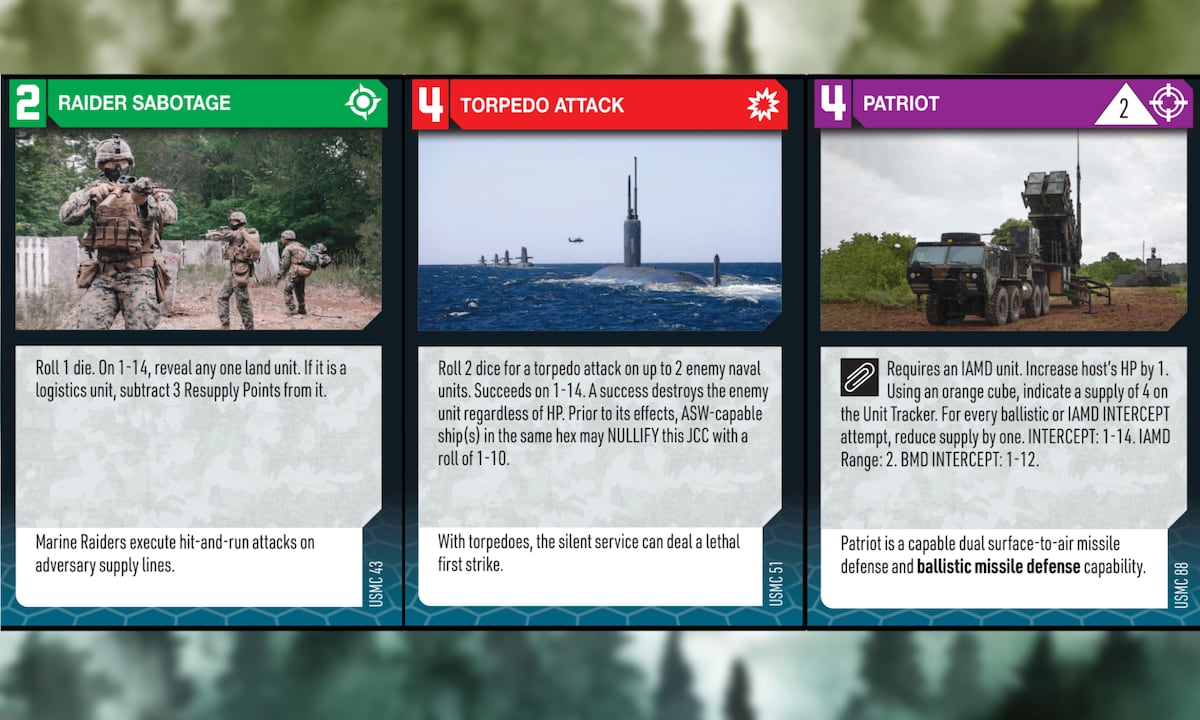
However, the heart of the game are the 277 “Joint Capability” cards, an abstract representation of the myriad force multipliers available to modern armies. By spending a limited pool of “Command Points” to buy cards from either a U.S. or Russian card deck, each side assembles a customized array of support forces. Players can choose from a wide variety of capabilities, including B-52 and Tu-22 bomber strikes, naval gunfire, special forces raids, drone strikes, laser air defenses, cyber warfare, psyops and electronic warfare (there’s even a “Public Affairs Officer” card).
“The cards feature a wide range of future, near-future and present-day capabilities to allow players to experiment and explore what capabilities can contribute to different scenarios,” Sebastian Bae, designer of “Littoral Commander,” told Defense News.
During a turn, players alternate taking actions such as movement, initiating combat and resupply. Their goal is to amass the most “Victory Points,” gained through destroying enemy units or capturing territory.
Select cards in "Littoral Commander: The Baltic." (Sebastian Bae/"Littoral Commander: The Baltic")
The key to winning “Littoral Commander” can be summed as: “What can be seen can be destroyed, so don’t be seen.” The fog of war always hovers over the game, with combat units on the map flipped upside down, so the enemy doesn’t know whether they are an infantry unit, an artillery battery, a frigate — or just a decoy.
“Littoral Commander” resembles a game of hide-and-seek. Both sides use ground troops and reconnaissance assets to detect and identify enemy forces, while trying to screen friendly forces from enemy detection. Once an enemy unit is located, it can be targeted by long-range fires such as artillery, missiles, aircraft and drones. Meanwhile, the target attempts to break contact and become concealed again.
The game illustrates a dilemma amply demonstrated in the Ukraine war. To destroy the enemy with firepower means having to open fire. But firing on the enemy means losing concealment, which leaves the firing unit vulnerable to a counterstrike.
Bae’s goal was to illustrate the interlocking dynamics of the modern kill chain. For example, the U.S. might have a task force of face-down ship counters in the Baltic, exact type unknown (are they frigates, destroyers or decoys?). Russia plays a drone or satellite card to detect them, and rolls dice: If successful, the ships are revealed and can be attacked by long-range missiles. But the U.S. can respond with a cyber warfare card to disrupt the attack.
“Players must play this cat and mouse game where each side is seeking to establish all sensing and fires superiority,” explained Bae, a Marine veteran and Iraq War veteran who now designs wargames for the Center for Naval Analyses think tank. “Exploring when they must fight, when they have to conceal themselves and how they deploy effects against the enemy.”
Compounding the problem is that the U.S. and Russian forces have limited stockpiles of guided munitions, such as artillery shells, cruise missiles and — perhaps most importantly — air and missile defense interceptors. This puts a premium on judicious target selection.
And if battlefield problems aren’t enough, “Littoral Commander” players must also deal with public opinion. The game includes an “Influence Meter” that awards players additional resources for destroying enemy units and capturing key terrain — or rewards the enemy if you bombard urban areas (this is where the PAO card comes in handy).
“Littoral Commander: The Baltic” is actually the second game in the series, following “Littoral Commander: Indo Pacific,” which covered a U.S.-China conflict over Taiwan and the Philippines. The games have been used by U.S. military staff colleges, U.S. Marine tactical units, the British and Australian armies, the Bundeswehr, the Philippines Marine Corps and others.
“Littoral Commander: Australia” is scheduled for publication this year, and further expansions to include NATO and Japanese forces are planned.
In the end, the goal of “Littoral Commander” is to “help civilians imagine the challenges and requirements of a Baltic conflict and what that means,” Bae said. “And also to help military leaders to be better prepared to make hard choices in uncertain battlefields if the balloon ever goes up.”
Michael Peck is a correspondent for Defense News and a columnist for the Center for European Policy Analysis. He holds an M.A. in political science from Rutgers University. Find him at theuncommondefense.com. His email is mikedefense1@gmail.com.
随着北约为应对俄罗斯可能入侵波罗的海地区做准备,许多问题浮出水面。在无人机、高超音速导弹和杀伤链时代,该地区的田野、森林和岛屿之间将如何展开战斗?
或许一些答案可以在一款新的桌面战争游戏中找到。“近岸指挥官:波罗的海”不仅仅是军方的训练工具,平民也可以在线购买,在家里的餐桌上进行游戏。
这款游戏描绘了2030年前后俄罗斯入侵波罗的海地区的情景。除了波罗的海三国之外,游戏中的11个场景还包括:俄军登陆瑞典哥特兰岛、从俄罗斯飞地加里宁格勒发起进攻,以及装备导弹的美国海军陆战队试图阻止俄罗斯军舰突破波罗的海前往大西洋猎杀运输船队。游戏中甚至还有一个人道主义场景,美国必须撤离平民,而俄罗斯则试图干扰撤离行动。
美方由美国海军陆战队和海军组成,另有部分陆军部队参战。他们的对手是俄罗斯海军陆战队、空降兵部队和波罗的海舰队的舰艇。
地图上用纸板模型代表的排,根据火力、射程和速度进行评级。美军兵种众多:海军陆战队步兵、两栖作战车辆、陆军HIMARS火箭炮、M1艾布拉姆斯主战坦克、斯特瑞克装甲侦察车、台风远程导弹、防空和后勤部队,以及美国海军驱逐舰和两栖攻击舰。俄军兵种包括海军陆战队、T-90坦克、自行榴弹炮、迫击炮和多管火箭炮、伞兵和空降炮兵、防空和后勤部队,以及巡洋舰、驱逐舰、护卫舰和两栖舰艇。
然而,游戏的核心在于277张“联合能力”卡牌,它们抽象地展现了现代军队可用的各种作战能力倍增器。玩家可以通过消耗有限的“指挥点数”从美军或俄军卡组中购买卡牌,组建一支定制的支援部队。玩家可以选择的能力种类繁多,包括B-52和图-22轰炸机打击、舰炮火力、特种部队突袭、无人机打击、激光防空、网络战、心理战和电子战(甚至还有一张“公共事务官”卡牌)。
“这些卡牌涵盖了未来、近未来和当今的各种能力,让玩家可以进行试验,探索哪些能力可以应用于不同的场景,”《近岸指挥官》的设计师塞巴斯蒂安·贝告诉《防务新闻》。
回合中,玩家轮流执行移动、发起战斗和补给等行动。他们的目标是积累最多的“胜利点数”,这些点数可以通过摧毁敌方单位或占领领土获得。
《海岸指挥官:波罗的海》中的精选卡牌。(Sebastian Bae/《海岸指挥官:波罗的海》)
《海岸指挥官》的制胜之道可以概括为:“凡是能被看到的,都能被摧毁,所以不要让自己被发现。”战争迷雾始终笼罩着整个游戏,地图上的作战单位上下颠倒,敌人根本无法分辨它们是步兵单位、炮兵连、护卫舰,还是仅仅是诱饵。
“近岸指挥官”模式类似于一场捉迷藏游戏。双方都使用地面部队和侦察力量来探测和识别敌军,同时努力掩护己方部队不被敌方发现。一旦发现敌方单位,就可以使用远程火力(例如火炮、导弹、飞机和无人机)对其进行打击。与此同时,目标会试图脱离接触并重新隐蔽起来。
这款游戏生动地展现了乌克兰战争中一个显而易见的困境:用火力摧毁敌人意味着必须开火。但向敌人开火意味着失去隐蔽,使射击单位容易受到反击。
贝的目标是阐明现代杀伤链中环环相扣的动态机制。例如,美国可能在波罗的海部署了一支由面朝下的舰船模型组成的特遣舰队,具体类型不明(是护卫舰、驱逐舰还是诱饵?)。俄罗斯打出无人机或卫星卡牌来探测这些模型,然后掷骰子:如果成功,这些舰船就会显露出来,并可能遭到远程导弹的攻击。但美国可以打出网络战卡牌来干扰攻击。
“玩家必须玩这种猫捉老鼠的游戏,双方都力求在感知和火力方面取得绝对优势,”贝解释道。他是一位海军陆战队退伍老兵,也参加过伊拉克战争,现在为海军分析中心智库设计兵棋推演。“他们需要探索何时必须战斗,何时必须隐蔽,以及如何对敌人实施打击。”
雪上加霜的是,美俄两国军队的制导武器储备有限,例如炮弹、巡航导弹,以及——或许最为重要的——防空和导弹防御拦截器。这使得谨慎选择目标变得至关重要。
如果战场上的难题还不够,《海岸指挥官》的玩家还必须应对舆论。游戏中包含一个“影响力计量表”,玩家摧毁敌军单位和占领关键地形即可获得额外资源——但如果轰炸城区,则会奖励敌人(这时公共事务卡就派上用场了)。
《近岸指挥官:波罗的海》实际上是该系列的第二款游戏,前作《近岸指挥官:印太》则描绘了美中两国围绕台湾和菲律宾的冲突。该系列游戏已被美国军事院校、美国海军陆战队战术部队、英国和澳大利亚军队、德国联邦国防军、菲律宾海军陆战队等机构采用。
《近岸指挥官:澳大利亚》计划于今年出版,并计划进一步扩展,纳入北约和日本军队。
贝说,最终,“近岸指挥官”项目的目标是“帮助平民百姓想象波罗的海冲突的挑战和需求,以及这意味着什么”。“同时也是为了帮助军事领导人更好地做好准备,以便在局势不明朗的战场上做出艰难的抉择,一旦冲突爆发,他们就能从容应对。”
迈克尔·佩克是《防务新闻》的通讯员,也是欧洲政策分析中心的专栏作家。他拥有罗格斯大学政治学硕士学位。您可以在theuncommondefense.com找到他。他的邮箱是mikedefense1@gmail.com。