Why Gen Zs are spending their Saturdays in a stranger’s ‘living room’为什么Z世代会在周六待在陌生人的“客厅”里?
Discover how Singapore’s unique social spaces help Gen Z and young adults connect, converse, and make new friends beyond home and work. Read more at straitstimes.com.
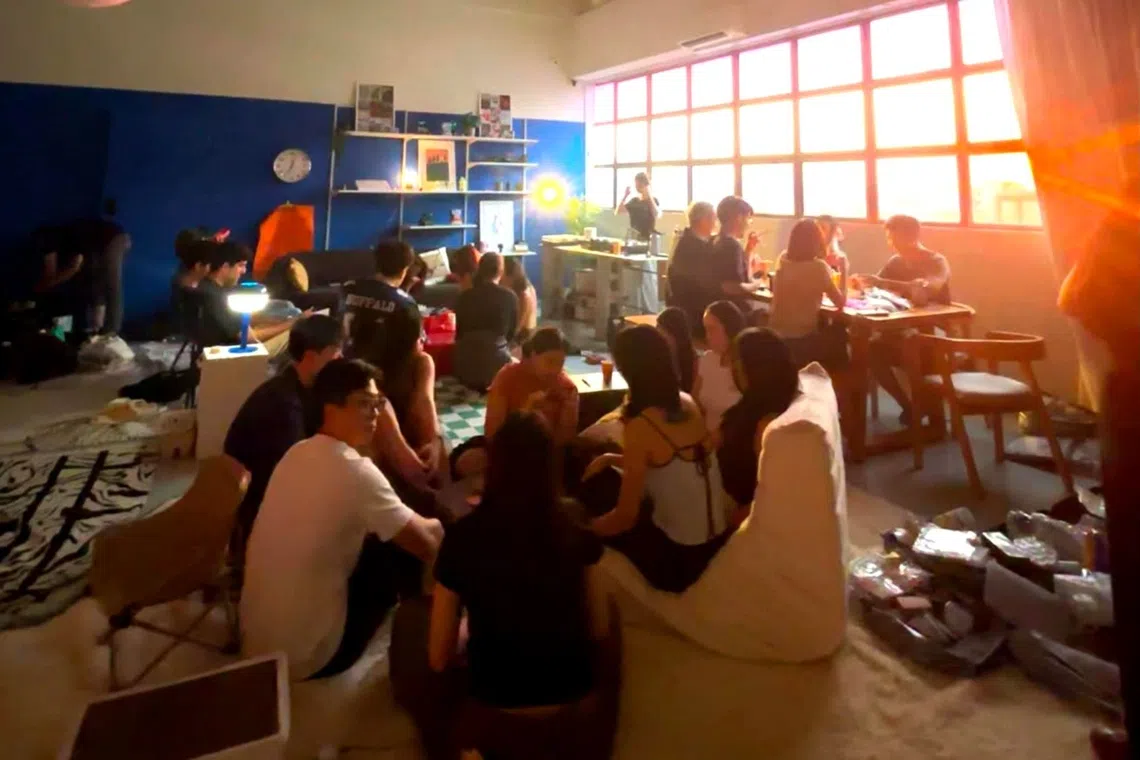
After Hours, Slow House is a community initiative that invites strangers to slow down, spend time with themselves and connect with others.
Published Sep 19, 2026, 08:55 AM
Updated Sep 19, 2026, 08:55 AM
Ren Lee created After Hours, Slow House, a rented space in Singapore that invites strangers to unwind through casual conversations and activities.
Friendzone runs Dilly Dally Space, a community venue encouraging young people to slow down, connect and make friends in a relaxed, playful environment on weekdays.
Both spaces address social isolation by offering informal third places for young people to meet, though building lasting friendships requires repeated visits and lowered expectations.
SINGAPORE – On a Saturday in mid-August, I make plans to spend the afternoon with a bunch of people I have never met before.
My instructions arrive in the form of a TikTok: Take Exit B at Marymount MRT station, follow the covered walkway, head past the hulking grey buildings that feel anything but convivial, keep going, cross this road, take a left, get in the lift and leave your shoes at the door.
I push it open and find myself in what looks like somebody’s mid-century modern Build-To-Order flat. The floor is covered in a patchwork of tastefully mismatched rugs. There are slouchy caterpillar couches and an electric blue feature wall, onto which is bolted a shelf of eclectic knick-knacks. Music is playing too, a tasteful rotation of recent Hot 100 hits.
But we are in a commercial property, not a residential estate, and my host, Ren Lee, does not actually live here.
The 24-year-old National University of Singapore student rents this space on select weekends, turning it into a “living room” where strangers can hang out.
He was inspired by his eight-month trip to Vietnam and China in 2025, where, while on a break from his degree, he attended various social events. “During this period, I met a lot of people who brought me immense joy,” recalls the third-year computer science student.
He wanted other Singaporeans to be able to experience the serendipity of connecting with strangers, but was aware that not everyone had the privilege of being able to spend so much time overseas.
“It got me to reflect on the state of Singapore right now. People are more socially awkward and risk-averse. I think the beauty of life is meeting other people, and that’s something I felt was missing back home.”
Though Singapore has its fair share of social mixers, most are geared towards helping people find love or friendship. His event, on the other hand, has “no agenda”. “For me, it’s more of letting our guests see where the afternoon takes them,” he says.
At After Hours, Slow House, guests are welcome to unwind and stay for as long as they like. ST PHOTO: CHERIE LOK
At After Hours, Slow House, guests are welcome to unwind and stay for as long as they like.
ST PHOTO: CHERIE LOK
After Hours, Slow House first opened its doors in February and takes place roughly once a month on a Saturday.
It is pretty much as advertised: a space where you can lie back and have long, meandering conversations with fellow guests, or retreat to a quiet corner with a book or a craft activity.
About 80 per cent of guests come alone, says Lee. Some drop in for a couple of hours while others linger late into the night. Not everyone is a natural extrovert, but most do make an effort to socialise. He helps to break the ice by introducing them to one another.
Most participants are in their early to mid-20s, though there are a few 40- and 50-somethings scattered around the room. So in the space of an hour, I go from chatting about national service with a 19-year-old recruit (he is having a miserable time) to family planning with a 52-year-old life coach (no plans to have children any time soon, thanks for asking).
Alyssa, a 25-year-old who decided to give this event a shot because “Singapore can be quite lonely”, asks Robin Fan, the 52-year-old, why he wants to spend his day with Gen Zs.
“Why not?” he replies with a shrug. “They’re interesting people and they have interesting perspectives.”
He says he is at the age where “you’re not supposed to want to make new friends”, and most of his existing friends are busy with their families, so how else is he supposed to connect with people?
A range of items for activities, such as painting sets, are available for guests. ST PHOTO: CHERIE LOK
A range of items for activities, such as painting sets, are available for guests.
With the frank questions and overlapping chatter, the vibe is not unlike that of an extended family gathering. As 24-year-old Renee Tu observes: “It’s like being at my grandparents’ place and all my cousins are here.”
She is perched at the corner of a table, working her way through a paint-by-numbers set, but gets sucked into conversation every now and then. Socialisation, as it turns out, is a bit of an inevitability in this space.
Zen Aw showed up to the second session of After Hours, Slow House in March with the intention of parking herself somewhere to finish a university assignment.
“There was a girl sitting opposite me doing some handicraft, and she asked me, ‘What are you doing? Why’d you bring laptop and everything?’ Then we started to yap and realised that our energies match.”
In the end, she did not finish her assignment, but made a new friend. She also became a volunteer, helping Lee plan this bi-monthly event, now on its fifth run.
“I just felt bad for him. I can see he puts his heart into this and we need to help anchor him so he doesn’t burn out,” says the 28-year-old fourth-year business analytics student at the Singapore University of Social Sciences. “We want this event to have longevity. When you try to create something good for people, you have to make sure it doesn’t hurt you too.”
Running this passion project has not been easy, especially when attendance doubles with each iteration. What started as a cosy gathering of 20 people is now a 100-strong logistical conundrum.
“A lot of people have reached out asking how they can contribute because, by the third run, I was making a net loss of $3,000,” says Lee. He is grateful for his budding community, which pitches in by sponsoring food and drinks.
After Hours, Slow House runs until 6am the next morning. ST PHOTO: CHERIE LOK
After Hours, Slow House runs until 6am the next morning.
The costs of running this event also mean he has little choice but to charge for entry. General admission is fixed at $35 and includes board games, as well as free-flow snacks and packet drinks.
“I’ve realised that by charging them, it helps people appreciate where they are, and they’re more intentional about how they spend their time here. But I’ll try to keep things affordable,” he says, adding that he plans to host future versions of the event in cafes like Acoustics Coffee Bar in Farrer Park.
In any case, the entry fee does not seem to have deterred guests.
As the sun sets, more people stream in. Dinner is procured via a GrabFood group order by various people. A DJ starts spinning in the corner. A bunch of guests band together to finish a puzzle, flipping all the pieces over and matching them by numbers instead in the interest of time.
In the centre of the room, a game of “Who Am I?” gets going. One girl is assigned a recently infamous local politician and the entire circle blinks in confusion. “Never heard of him,” someone says.
The room is booked till 6am, though the last guests leave around 2am or 3am. On my way out at 10.40pm, I encounter a group of new arrivals, bearing snacks from the nearest 7-Eleven. The door opens and they stumble, giggling, into the light.
Somewhere to dilly-dally
The Dilly Dally Space is a room in Bishan Community Club where young people can linger. PHOTO: FRIENDZONE SG
The Dilly Dally Space is a room in Bishan Community Club where young people can linger.
PHOTO: FRIENDZONE SG
Later in the month, I drop by another “living room”. This time, it is a room in Bishan Community Club that has been jazzed up with a few camping chairs and crates that double as tables. In one corner is a table stacked with board games, sweets and conversation cards.
The aptly named Dilly Dally Space brands itself as somewhere for youth aged 17 to 35 to “slow down, hang out and just be”. It is run by Friendzone SG , a social enterprise which organises events that help Singaporeans build connections in their neighbourhoods and workplaces.
It was launched in August as part of the National Youth Council’s (NYC) efforts to create more third spaces.
“One of the aspirations that emerged from our SG Youth Plan engagements with youth was for more spaces that youth could hang out, pursue their hobbies and interests, and take part in activities,” says an NYC spokesperson. “Three in five young people also believe that such spaces will give them the opportunity to meet people from more diverse backgrounds.”
These spaces become all the more crucial as young people mature and enter the working world, says Friendzone co-founder Tham Jun Han, 33. “Once people become adults, it’s harder to find the time and energy to hang out somewhere, especially somewhere with air-con.”
The Dilly Dally Space is open to 17- to 35-year-olds. PHOTO: FRIENDZONE SG
The Dilly Dally Space is open to 17- to 35-year-olds.
The concept of a third place – now often used interchangeably with “third space” – was first articulated by American sociologist Ray Oldenburg in his 1989 book, The Great Good Place.
He defined third places as “public places that host the regular, voluntary, informal and happily anticipated gatherings of individuals beyond the realms of home and work”. In these spaces, conversation is the main activity, and the mood should be playful.
“But there’s one thing missing from his definition, and it is that people need to make new friends in these spaces,” says Tham.
He hopes to spark these connections by first giving young people a low-commitment space to be themselves. Along the way, his team will introduce participants to one another and encourage them to bond over shared interests.
“Our end goal is to encourage people who visit to contribute back to the space by running activities.”
The team uses warm light and low furniture to make the room feel cosier. PHOTO: FRIENDZONE SG
The team uses warm light and low furniture to make the room feel cosier.
Warm lighting helps the room feel more cosy, as does the low furniture. Tham and his team deliberately avoided proper tables and chairs because he did not want it to become a study or co-working space.
“Many third spaces in Singapore have this problem. Young adults naturally turn it into a study room and then it gets quiet. But we want people to talk and make friends.”
He keeps the music on as well, because past experiences have taught him that once the room gets too quiet, conversation dies.
So far, the turnout has been modest – around four to five people milling about at any given time during the opening hours from 3pm to 8pm every Thursday. Admission is free.
Surely they would get a better turnout on a Friday or Saturday afternoon? On the contrary. “We realised that among young adults, Fridays, Saturdays and Sundays are reserved for close friends and family. So when they want to make new friends, they’ll do it on the weekdays. It feels like a lower commitment,” Tham tells me.
Considering that The Dilly Dally Space is still in its pre-pilot phase and minimal marketing has been done to promote it, he is satisfied with the response so far.
Can you make friends here?
During my visit to The Dilly Dally Space, I meet Julian Kang, a 27-year-old engineer who has brought a friend along.
“I just moved back to Singapore from the US, so I thought this would be a nice way to meet people,” says Kang, who graduated from Purdue University in 2025.
“When I first moved back, I hadn’t really reconnected with my old friend groups. My poly friends had their own uni friends, but all my uni friends were overseas, so I had to make new friends.”
He is optimistic, having kept in touch with some of the people he met at Friendzone’s other events. “I mean, you’re not guaranteed to make friends, but you never try, never know.”
However, his friend, Chris Seah, is not thinking that far ahead. “I’m just here to chill,” says the 28-year-old entertainer. “I wanted to see for myself what these kinds of spaces are like and whether they actually work. I was really just curious.”
Attendees relaxing at After Hours, Slow House. PHOTO: REN LEE
Attendees relaxing at After Hours, Slow House.
A few weeks prior, I ask the attendees of After Hours, Slow House a similar question: Have you made any new friends tonight?
“I had a good time. I thought my social battery would run out, but it didn’t,” says 26-year-old Windsor, who declines to give his last name. He has spent eight hours in the makeshift living room, painting and chatting. “But whether I made friends, I don’t know. People usually don’t follow up after these sorts of events.”
Aw, the After Hours regular, says that if you are really serious about building connections, you have to keep coming back. “Then you’ll start to see familiar faces, and it’s like, ‘Hey, what’s up? How have you been since the last time?’ The more you come, the cosier it gets, and the more connections you form.”
Ultimately, she advises attendees to leave their expectations at the door. “People make friends at different levels. Some people turn out to be acquaintances, but there are also people you find you genuinely want to build a connection with. But that will take time. It’s not like I can meet you and immediately have a heart-to-heart talk.”
So maybe you will walk out of there with a new Instagram mutual or an acquaintance you meet for coffee once a year. You might find your new best friend. You might find nothing at all.
Worth a shot? All it takes is some small talk and your Saturday afternoon.
“下班后,慢屋”是一项社区倡议,旨在邀请陌生人放慢脚步,与自己相处,并与他人建立联系。
发布于 2026 年 9 月 19 日上午 8:55
更新于2026年9月19日上午8:55
Ren Lee 创建了 After Hours, Slow House,这是一个位于新加坡的租赁空间,邀请陌生人通过轻松的交谈和活动来放松身心。
Friendzone 运营着 Dilly Dally Space,这是一个社区场所,鼓励年轻人放慢脚步,在工作日于轻松愉快的环境中交流和交朋友。
这两个空间都通过为年轻人提供非正式的第三空间来应对社会孤立问题,但要建立持久的友谊需要反复访问和降低期望值。
新加坡——八月中旬的一个星期六,我计划和一群我以前从未见过的人一起度过下午时光。
我的指示是以 TikTok 的形式发布的:从玛丽蒙地铁站 B 出口出站,沿着有顶走廊走,经过那些感觉一点也不友好的庞大灰色建筑,继续往前走,穿过这条马路,左转,进入电梯,把鞋子留在门口。
我推开门,发现自己置身于一间看起来像是上世纪中期现代风格定制公寓的房间里。地板上铺着几块风格各异却又搭配得恰到好处的地毯。房间里摆放着几张慵懒的毛毛虫沙发,一面亮蓝色的特色墙上,墙上钉着一个摆满各式小摆件的架子。音乐也正播放着,循环播放着近期热门百强单曲榜上的金曲。
但我们身处商业地产,而非住宅区,而且我的房东 Ren Lee 实际上并不住在这里。
这位24岁的新加坡国立大学学生会在特定的周末租用这个空间,将其变成一个“客厅”,供陌生人聚会。
2025年,他利用假期前往越南和中国进行了为期八个月的旅行,这段经历给了他很多启发。期间,他参加了各种社交活动。“在那段时间里,我遇到了很多让我感到无比快乐的人,”这位计算机科学专业三年级的学生回忆道。
他希望其他新加坡人也能体验到与陌生人结识的意外惊喜,但他意识到并非每个人都有幸能在海外待这么长时间。
“这让我开始反思新加坡现在的状况。人们变得更加不善社交,也更加规避风险。我认为生活的美好之处在于结识他人,而这正是我觉得在家乡所缺失的。”
虽然新加坡有不少社交聚会,但大多数都旨在帮助人们寻找爱情或友谊。而他的活动则“没有任何目的”。他说:“对我来说,这更像是让客人们自由自在地度过这个下午。”
在 After Hours, Slow House,客人可以尽情放松身心,想待多久就待多久。ST 摄影:CHERIE LOK
在 After Hours, Slow House,客人可以尽情放松,想住多久就住多久。
《海峡时报》照片:洛克·谢丽
After Hours, Slow House 于 2 月首次开业,大约每月一次,在周六举行。
它基本符合广告宣传:你可以在这里放松身心,与同住的客人进行长时间的闲聊,或者找个安静的角落看书或进行手工活动。
李说,大约80%的客人都是独自前来。有些人待上几个小时就走了,有些人则会待到深夜。并非每个人都是天生的外向者,但大多数人都会努力与人交流。他会帮忙打破僵局,互相介绍认识。
大多数参与者都在二十岁出头到二十五六岁,不过房间里也零星散落着一些四五十岁的人。所以在一个小时的时间里,我一会儿跟一个19岁的新兵聊兵役(他过得很不开心),一会儿又跟一个52岁的人生导师聊生育计划(谢谢关心,她近期没有要孩子的打算)。
25 岁的 Alyssa 因为“新加坡可能会很孤独”而决定尝试参加这个活动,她问 52 岁的 Robin Fan,他为什么想和 Z 世代一起度过一天。
“为什么不呢?”他耸耸肩回答道,“他们都很有趣,观点也很有意思。”
他说他现在这个年纪“不应该想结交新朋友”,而且他现有的朋友大多都忙于照顾家人,所以他还能通过什么方式与人建立联系呢?
酒店为客人提供各种活动用品,例如绘画套装。(海峡时报照片:洛克雪莉)
酒店为客人提供各种活动用品,例如绘画套装。
坦诚的提问和此起彼伏的交谈声,营造出一种大家庭聚会的氛围。正如24岁的Renee Tu所说:“感觉就像回到了爷爷奶奶家,所有的堂表兄弟姐妹都来了。”
她坐在桌角,一边涂着数字油画,一边时不时地被拉进别人的谈话中。事实证明,在这个地方,社交几乎是不可避免的。
三月份,Zen Aw 参加了 After Hours, Slow House 的第二场活动,她打算找个地方静下心来完成大学作业。
“当时有个女孩坐在我对面做手工,她问我:‘你在干什么?为什么带了笔记本电脑什么的?’然后我们就开始聊天,发现我们俩很合得来。”
最终,她虽然没能完成任务,却结识了一位新朋友。她还成为了一名志愿者,帮助李策划这项每两个月举办一次的活动,如今这项活动已经举办了五届。
“我只是觉得他挺可怜的。看得出来他全身心投入,我们需要帮他理顺思路,免得他精疲力竭,”这位28岁的新加坡社会科学大学四年级商业分析专业的学生说道。“我们希望这项活动能够长久举办下去。当你努力为人们创造美好事物时,也必须确保它不会伤害到自己。”
运营这个充满热情的项目并不容易,尤其是每次参与人数都翻倍增长的情况下。最初只是20人的温馨聚会,如今却变成了100人的后勤难题。
“很多人联系我,询问如何才能提供帮助,因为到了第三届比赛,我已经净亏损了3000美元,”李说。他很感激这个正在成长起来的社区,大家纷纷慷慨解囊,赞助食物和饮料。
下班后,Slow House 将营业至次日清晨 6 点。ST 摄影:CHERIE LOK
下班后,Slow House 将营业至次日早上 6 点。
举办此次活动的成本也意味着他别无选择,只能收取门票。普通门票价格固定为35美元,包含桌游、无限量小吃和袋装饮料。
“我意识到,收费能帮助人们更好地珍惜他们身处的环境,让他们更有意识地安排在这里的时间。但我会尽量保持价格亲民,”他说道,并补充说他计划未来在像花拉公园的Acoustics Coffee Bar这样的咖啡馆举办类似的活动。
总之,门票似乎并没有阻挡游客的热情。
夕阳西下,人潮涌动。晚餐由几位客人通过GrabFood团购。角落里,一位DJ开始打碟。为了节省时间,一群客人聚在一起拼拼图,他们把所有拼图块翻过来,按数字匹配。
房间中央,一场“我是谁?”的游戏开始了。一个女孩被分配到一位最近臭名昭著的当地政客,所有人都一脸茫然。“没听说过这个人。”有人说道。
房间预订到早上六点,不过最后一批客人凌晨两三点才离开。晚上十点四十我出门时,遇到一群刚到的客人,他们从附近的7-11便利店买了些零食。门开了,他们跌跌撞撞地走进了灯光下,咯咯地笑着。
找个地方闲逛
Dilly Dally Space是碧山民众俱乐部内的一个房间,供年轻人闲逛。(图片来源:FRIENDZONE SG)
Dilly Dally Space 是碧山民众俱乐部内的一个房间,年轻人可以在那里消磨时光。
照片:FRIENDZONE SG
当月晚些时候,我又去拜访了另一间“客厅”。这次是碧山民众俱乐部的一间房间,里面摆放着几把露营椅和用作桌子的木箱,布置得别具一格。角落里的一张桌子上堆满了棋盘游戏、糖果和聊天卡片。
这个名为“Dilly Dally Space”的空间名副其实,它自诩为17至35岁年轻人“放慢脚步、放松休闲、享受当下”的场所。该空间由社会企业Friendzone SG运营,该企业组织各种活动,帮助新加坡人在社区和工作场所建立联系。
该项目于 8 月启动,是全国青年委员会 (NYC) 为创造更多第三空间而采取的举措之一。
纽约市发言人表示:“我们在与青年互动中了解到,新加坡青年计划的一项重要愿望是,希望有更多空间供青年人休闲娱乐、发展兴趣爱好并参与各种活动。五分之三的年轻人也认为,这样的空间能让他们有机会结识来自不同背景的人。”
Friendzone联合创始人、33岁的Tham Jun Han表示,随着年轻人逐渐成熟并进入职场,这些空间变得更加重要。“一旦人们长大成人,就很难找到时间和精力去某个地方聚会,尤其是有空调的地方。”
Dilly Dally Space面向17至35岁的年轻人开放。图片来源:FRIENDZONE SG
Dilly Dally Space面向17至35岁的人群开放。
“第三空间”的概念——现在经常与“第三场所”互换使用——最早由美国社会学家雷·奥尔登堡在其 1989 年出版的《美好的第三场所》一书中提出。
他将第三空间定义为“在家庭和工作场所之外,人们定期、自愿、非正式且令人期待的聚会场所”。在这些空间里,交谈是主要活动,气氛应该是轻松愉快的。
“但他的定义中缺少了一点,那就是人们需要在这些空间里结交新朋友,”Tham说道。
他希望通过首先为年轻人提供一个轻松自在的空间来激发他们之间的联系。在此过程中,他的团队会安排参与者互相认识,并鼓励他们通过共同的兴趣爱好建立友谊。
“我们的最终目标是鼓励参观者通过举办活动来回馈这个空间。”
团队运用暖色调灯光和低矮家具,营造出温馨舒适的氛围。图片:FRIENDZONE SG
该团队运用暖色调的灯光和低矮的家具,使房间感觉更加温馨舒适。
暖色调的灯光和低矮的家具让房间更显温馨舒适。Tham和他的团队特意没有摆放正式的桌椅,因为他不想让这里变成自习室或联合办公空间。
“新加坡很多第三空间都存在这个问题。年轻人自然而然地会把它变成自习室,然后就变得很安静。但我们希望人们能在这里交流、交朋友。”
他一直让音乐开着,因为过去的经验告诉他,一旦房间里太安静,谈话就会停止。
目前来看,到场人数不多——每周四下午3点到晚上8点开放期间,任何时候都只有四五个人在附近闲逛。入场免费。
周五或周六下午的活动肯定会吸引更多人参加吧?恰恰相反。“我们发现,对于年轻人来说,周五、周六和周日都是留给亲朋好友的时间。所以,当他们想结交新朋友时,他们会选择在工作日进行。这样感觉更轻松一些。”Tham告诉我。
考虑到“Dilly Dally Space”仍处于试运行阶段,且宣传推广力度有限,他对目前的反响感到满意。
你在这里能交到朋友吗?
在参观 Dilly Dally Space 期间,我遇到了 27 岁的工程师 Julian Kang,他带了一位朋友一起来。
“我刚从美国搬回新加坡,所以我觉得这是个结识新朋友的好方法,”康说道,他于 2025 年毕业于普渡大学。
“我刚搬回来的时候,还没怎么跟以前的朋友重新联系上。我的理工学院朋友有他们自己的大学朋友,但我所有的大学朋友都在国外,所以我不得不结交新朋友。”
他很乐观,因为他一直和在Friendzone其他活动中认识的一些人保持联系。“我的意思是,你不能保证一定能交到朋友,但你不试试,就永远不会知道结果。”
然而,他的朋友克里斯·西赫却没想那么远。“我只是来放松放松的,”这位28岁的艺人说道。“我想亲眼看看这种地方到底是什么样的,以及它们是否真的有效。我纯粹是出于好奇。”
参加者在After Hours, Slow House放松身心。照片:REN LEE
参加者在 After Hours, Slow House 放松身心。
几周前,我曾向参加 After Hours, Slow House 活动的人们提出过类似的问题:今晚你们交到新朋友了吗?
“我玩得很开心。我原以为我的社交能力会耗尽,但并没有,”26岁的温莎说道,他拒绝透露自己的姓氏。他在临时搭建的客厅里待了八个小时,一边画画一边聊天。“但我有没有交到朋友,我就不知道了。人们通常不会在这种活动之后继续保持联系。”
常客Aw说,如果你真的想建立人脉,就必须坚持来。“然后你就会开始看到熟悉的面孔,你会说,‘嘿,最近怎么样?上次来之后过得如何?’你来的次数越多,气氛就越融洽,你建立的人脉也就越多。”
最后,她建议与会者不要抱有过高的期望。“人们交朋友的方式各不相同。有些人最终只是泛泛之交,但也有些人是你真心想要建立联系的。但这需要时间。我不可能一见面就和你促膝长谈。”
所以,你或许会结识一位新的Instagram共同好友,或者一位每年会一起喝咖啡的熟人。你可能会找到新的挚友。也可能什么也找不到。
值得一试吗?只需要一些闲聊,再加上你的周六下午。