Missile mishaps, ammo snags – report details Danish frigate deployment导弹事故、弹药故障——报告详述丹麦护卫舰部署情况
A recent government report about the frigate Iver Huitfeldt's deployment in the Red Sea has detailed a series of problems at sea.
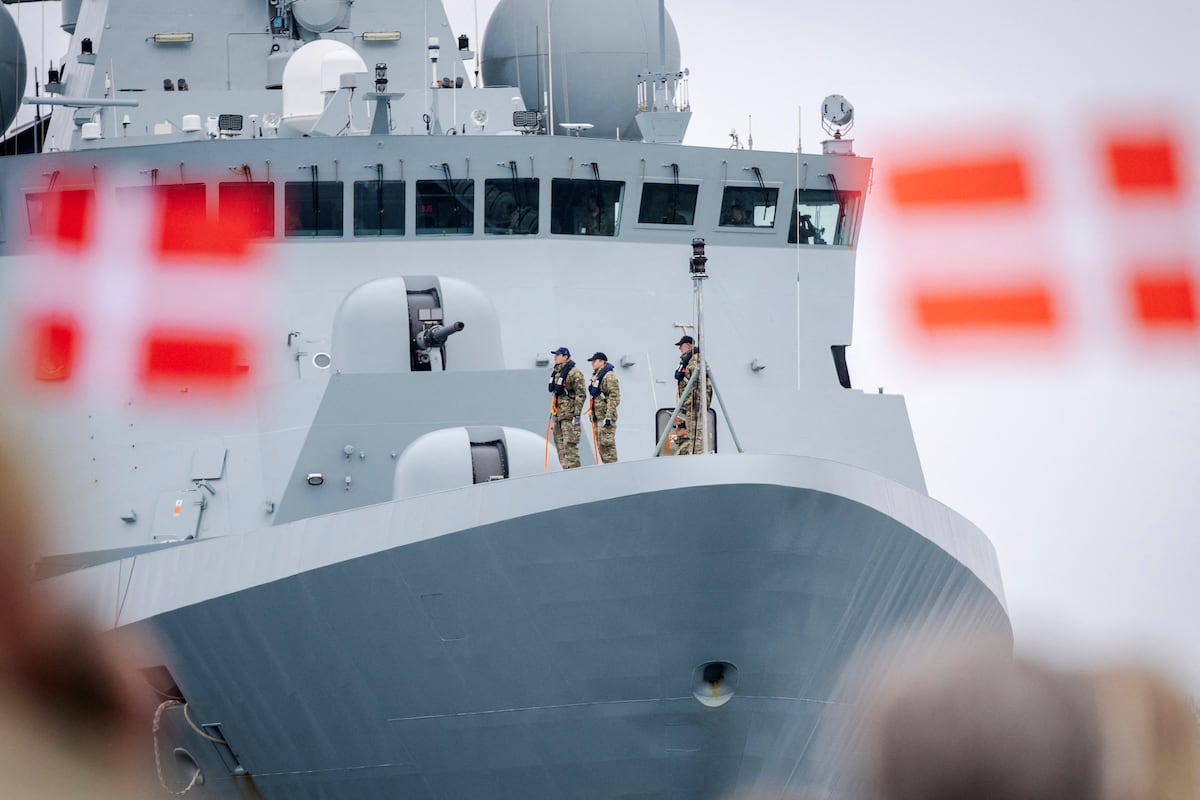
MILAN — New information has come to light about the state of the Danish frigate Iver Huitfeldt when it departed for the Red Sea in January, including crew concerns about inexperienced personnel on board and equipment not fully tested, according to a report released by the Danish government.
The Danish Defense Ministry announced on March 26 that the warship was sailing home after completing its mission in the Red Sea as part of the U.S.-led Operation Prosperity Guardian , during which it succeeded at downing four drones earlier that month.
Days later, reports emerged that the vessel had encountered problems related to weapons and mission systems which prevented the firing of surface-to-air missiles against the incoming aerial threats for roughly half an hour.
“The crew of Iver Huitfeldt experienced challenges in conducting engagement with the frigate’s missile system as well as a high failure rate of 76mm artillery shells during the engagement of drones on March 9,” an unclassified version of the deployment review found.
The 13-page document states that trouble began in the Evolved SeaSparrow Missile launcher system, where an unknown error condition occurred after the firing of the first missile, which affected the ESSM second launcher, rendering them unable to engage for 30 minutes.
Following this, the crew was found to have “inadvertently” triggered an additional error in the ship’s command and control system, further affecting the missile engagement. During its incapacity, the frigate was placed under protective radar coverage from an American warship and eventually relocated to a lower threat area north of the Red Sea.
“The complete launcher system has therefore been taken ashore after Iver Huitfeldt’s return to Denmark, where analysis is continuing in collaboration with the supplier,” the report said.
The ESSM weapons are made by a multinational industry consortium led by RTX’s Raytheon. More than a dozen navies around the world have the missiles in their inventories.
Contrary to initial claims made by some Danish media, the investigation concluded that there is no indication of deficiencies with the ship’s active phased array radar, made by Thales Netherlands.
Regarding artillery malfunctions, the crew reported that those were primarily caused by the early burst of shells close to the ship or failing to hit the target. The frigate’s captain estimated that around 50% of the munitions used during the March 9 drone operation detonated early.
The shells fired by the Iver Huitfeldt were from production batches made between 1989 and 1992, which investigators said had previously not encountered such problems in test firings.
While the country’s Defense Command maintains it did not receive any reports of operational concerns prior to the frigate deployment, a few details provided in the report appear to contradict this.
The document notes that when the frigate underwent the British Fleet Operational Sea Training course, in December 2023, in at least two instances the crew faced challenges with data flow between the ship’s command-and-control system and the radar and fire-control system.
Additionally, a day after leaving Denmark, the vessel’s commander shared in an assessment that the personnel situation remained “fragile due to inexperience in new crew members,” and that regarding the state of the equipment a “few concerns persisted, but appeared manageable.”
These concerns were in reference to the installation of one of the ship’s guns and counter-drone system, which remained to be finalized and tested.
In one of the concluding sections, the report further states that prior to March 9, the Ministry of Defense Acquisition and Logistics Organisation had knowledge of an existing “software weakness” in the interface between the ships’ radar and fire control system.
“It could cause the system to lock if a certain operator behavior was detected, and this knowledge has probably to some extent been present in the naval command,” it said.
Elisabeth Gosselin-Malo was a Europe correspondent for Defense News. She covers a wide range of topics related to military procurement and international security, and specializes in reporting on the aviation sector. She is based in Milan, Italy.
米兰——丹麦政府发布的一份报告显示,有关丹麦护卫舰“伊弗·休特费尔特”号1月份启程前往红海时的状态,出现了新的信息,其中包括船员对船上人员经验不足和设备未经充分测试的担忧。
丹麦国防部于 3 月 26 日宣布,该军舰在完成其在红海执行的由美国领导的“繁荣卫士行动”任务后正在返航。该行动中,该军舰于当月早些时候成功击落了四架无人机。
几天后,有报道称该舰遇到了与武器和任务系统相关的问题,导致其无法向来袭的空中威胁发射地对空导弹,持续了大约半小时。
一份未公开的部署审查报告发现,“伊弗·休特费尔特号的船员在使用护卫舰导弹系统进行交战时遇到了挑战,而且在 3 月 9 日与无人机交战时,76 毫米炮弹的故障率也很高。”
这份 13 页的文件指出,问题始于改进型海麻雀导弹发射系统,在第一枚导弹发射后出现了未知错误情况,影响了第二个 ESSM 发射器,导致它们 30 分钟内无法交战。
随后,船员被发现“无意中”触发了舰艇指挥控制系统的另一个故障,进一步影响了导弹的拦截。在失去作战能力期间,这艘护卫舰被置于一艘美国军舰的雷达保护之下,最终被转移到红海以北的低威胁区域。
报告称:“因此,在伊弗·胡特费尔特返回丹麦后,整个发射系统已被运上岸,目前正在与供应商合作继续进行分析。”
ESSM导弹由RTX公司旗下的雷神公司牵头的跨国工业联盟制造。全球十几个国家的海军都装备了这种导弹。
与一些丹麦媒体最初的说法相反,调查结论是,没有迹象表明泰雷兹荷兰公司制造的该舰有源相控阵雷达存在缺陷。
关于火炮故障,舰员报告称,主要原因是炮弹在舰艇附近提前爆炸或未能击中目标。护卫舰舰长估计,3月9日无人机行动中使用的弹药约有50%提前爆炸。
“伊弗·休特费尔特”号发射的炮弹来自 1989 年至 1992 年间生产的批次,调查人员表示,这些炮弹此前在试射中从未出现过此类问题。
虽然该国国防司令部坚称在护卫舰部署之前没有收到任何有关作战问题的报告,但报告中提供的一些细节似乎与此相矛盾。
该文件指出,2023 年 12 月,这艘护卫舰在接受英国舰队海上作战训练课程时,至少有两次舰员在舰艇的指挥控制系统与雷达和火控系统之间的数据流方面遇到了挑战。
此外,离开丹麦一天后,该船指挥官在一份评估报告中表示,由于新船员缺乏经验,人员状况仍然“脆弱”,并且关于设备状况,“仍然存在一些问题,但似乎可以控制”。
这些担忧指的是舰上一门火炮和反无人机系统的安装,该系统仍需最终确定和测试。
报告在其中一个结论部分进一步指出,在 3 月 9 日之前,国防部采购和后勤组织就已经知道舰艇雷达和火控系统接口中存在“软件缺陷”。
“如果检测到某种操作员行为,可能会导致系统锁定,而海军指挥部可能在某种程度上已经掌握了这种信息,”声明中写道。
伊丽莎白·戈斯林-马洛曾任《防务新闻》欧洲通讯员。她的报道涵盖军事采购和国际安全等广泛领域,尤其擅长航空领域的报道。她常驻意大利米兰。