How DC became obsessed with a potential 2027 Chinese invasion of TaiwanDC漫画为何对2027年中国可能入侵台湾的情节如此着迷?
Some in defense circles say the U.S. needs to prepare for Beijing's invasion of Taiwan in 2027. China experts say it isn’t a deadline.
This is the first story of a two-part series. The second story is available here .
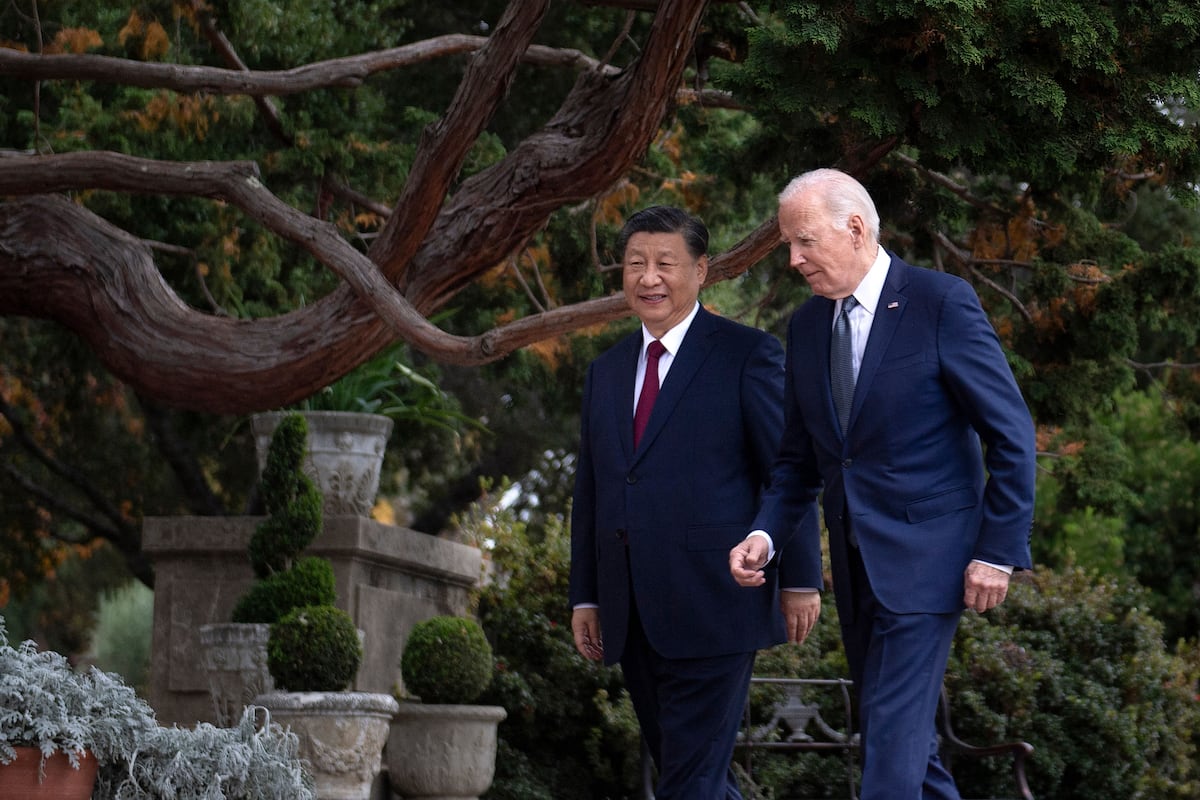
At a summit near San Francisco in November, the leaders of America and China turned to the biggest threat to their relationship.
The topic was Taiwan, which China’s government considers part of its rightful territory and has threatened to take by force. When it came up, according to an American official who later spoke to the press, Chinese leader Xi Jinping grew exasperated — not at the risk of war, but at the timeline.
“Xi basically said: ‘Look, I hear all these reports in the United States [of] how we’re planning for military action in 2027 or 2035,’ ” the official said.
“ ‘There are no such plans,’ ” Xi said in the official’s telling. “ ‘No one has talked to me about this.’ ”
That first year, 2027, is a fixation in Washington. It has impacted the debate over China policy — a shift from the long term to the short term. It’s also helped steer billions of dollars toward U.S. forces in the Pacific. And in the last several years, it’s been a question mark hanging over the Biden administration’s approach to the region.
According to U.S. intelligence, Xi has told the Chinese military it needs to be ready to invade Taiwan by that year. But ready to invade is different than will invade; American officials stress the year isn’t a deadline.
Defense News spoke to sources in Congress, the Pentagon and Washington-based think tanks to understand what may be the most important, most misunderstood year in Sino-U.S. relations. The message was that 2027 has exposed a rift in Washington’s China strategy. The U.S. is more focused on the country it calls its “pacing challenge,” but experts disagree on whether it’s running a sprint or a marathon — and if it can prepare for both.
China “will not renounce the use of force as a possibility” around Taiwan, said David Finkelstein, who studies the Chinese military at the Center for Naval Analyses. “So the military option hangs over the Taiwan Strait like Damocles’ sword .”
In the years leading up to 2021, Sino-U.S. relations had soured. Washington had become more confrontational during Donald Trump’s presidency, in large part as a response to Beijing’s own aggression. The People’s Liberation Army was — and still is — bulking up quickly , with weapons, reforms and exercises that could enable an invasion of Taiwan. Lawmakers concerned the U.S. was falling behind had just created the Pacific Deterrence Initiative , an effort to rush more money to military leaders in the region.
With that backdrop, Sen. Dan Sullivan, R-Alaska, began his questioning at a 2021 hearing.
“The common theme I hear with regard to China’s actions under Xi Jinping’s leadership is alarm,” Sullivan said, citing concerns over Taiwan, Hong Kong, and China’s strong-arming of U.S. allies like Australia and India.
Sullivan then asked the sole witness that day — Adm. Phil Davidson, the retiring head of U.S. Indo-Pacific Command — whether that changed the odds of a conflict around Taiwan.
“The threat is manifest during this decade,” Davidson said at the end of his answer, “in fact, in the next six years.”
Adm. Phil Davidson, the head of U.S. Indo-Pacific Command at the time, tours a memorial on Sept. 12, 2019, while visiting with Philippine military members. (MC1 Robin W. Peak/U.S. Navy)
It’s rare to find a true before-and-after moment on an issue as complex as Sino-U.S. relations. This, said several experts, was one.
“It set off these warning alarms that broke outside the niche community and into the broader policy conversation in D.C.,” said a Republican congressional aide, granted anonymity because the individual was not authorized to talk to the press.
The concern it generated earned a nickname: the “Davidson window,” shorthand for the near-term threat of an attack on Taiwan.
And that changed how Congress spent money. The Pacific Deterrence Initiative doesn’t have its own budget, but in the last few years the U.S. has spent more on its forces in the region. Indo-Pacific Command sends Congress a yearly list of priorities, including what doesn’t make the Pentagon’s budget request.
The latest wish list has called for $26.5 billion in spending. And while $11 billion didn’t make the cut in the Pentagon’s fiscal 2025 budget request, that means about $15 billion did, with the chance lawmakers may add more in the next spending bill.
Congress also gave the Pentagon $1 billion in annual authority to send Taiwan weapons. The recently passed national security supplemental includes almost $2 billion to replace whatever the Pentagon sends, along with $2 billion more in financing to purchase American equipment.
“You can draw a direct line between Adm. Davidson’s comments and the ability to get something like the foreign military financing for Taiwan through,” the congressional staffer said.
Suddenly, in a considerable number of hearings, members of Congress were asking military leaders about their windows.
At the start of the summer , the chief of naval operations and the commandant of the Marine Corps said they shared Davidson’s concerns.
Gen. Mark Milley, then-chairman of the Joint Chiefs of Staff, said in a later hearing that Davidson’s comments were based on a speech from Xi, calling on China’s military to “develop capabilities to seize Taiwan and move it from 2035 to 2027.”
U.S. officials haven’t shared the text of that speech.
This became the standard line across the administration — affirmed by Central Intelligence Agency Director Bill Burns .
“President Xi has instructed the PLA [People’s Liberation Army], the Chinese military leadership to be ready by 2027 to invade Taiwan. But that doesn’t mean that he’s decided to invade in 2027 or any other year as well,” Burns said during a TV interview in February 2023.
Amphibious assault vehicles of the Chinese People's Liberation Army move in formation at sea during a live-fire training exercise held in 2023. (Xie Wenjian/Chinese Defense Ministry)
And as the hearing with Milley showed , that distinction is easy to miss. Then-Rep. Elaine Luria, D-Va., argued with the general over whether other witnesses had said China would invade by 2027.
Milley said no, but added a caveat: “Intent is something that can change quickly.”
The back-and-forth showed two factors that have defined the 2027 debate ever since: For one, it’s hard to keep the year from looking like a timeline; and second, even though ability and intent are different, they’re still related.
The first issue has been clear in the three years since Davidson testified. More officials were pressed to offer their own assessments.
In fall 2022, Secretary of State Antony Blinken said China wants to unify with Taiwan on a “much faster timeline” than the U.S. expected. Then-Chief of Naval Operations Adm. Mike Gilday soon after said his service needed a “fight tonight” approach to the region.
Then in early 2023, a memo from Gen. Mike Minihan, head of Air Mobility Command, leaked.
“I hope I am wrong,” it read. “My gut tells me we will fight [China] in 2025.”
After this last case, the Pentagon intervened. Officials began repeating a new talking point: Conflict with China is “neither imminent nor inevitable.” They’ve stuck to that assessment ever since.
But by then, said a senior defense official, granted anonymity to speak freely, the concerns around 2027 had spread widely.
People around Washington would call the official’s office to ask if China would invade that year and whether the U.S. is ready. Since then, the official said, the misconception has become less common.
“It’s not like Xi Jinping has a calendar up in his office with a date in 2027 marked ‘invade Taiwan,’ ” the official said.
In fact, many of the experts who spoke with Defense News said it’s unlikely any Chinese leader would set a deadline. Chinese law doesn’t have timelines for an attack on Taiwan; it has conditions, particularly an attempt by the island to declare independence .
And Xi hasn’t scrapped China’s policy toward the island, which calls for unification without war. Some leading China analysts don’t think invading the island is a legacy issue for him.
“Xi is a politician,” said Toshi Yoshihara, who studies the Chinese military at the Center for Strategic and Budgetary Assessments think tank. “All politicians want options, so the last thing you want is to be tied to a deadline.”
The Pentagon doesn’t dismiss 2027 altogether. That’s because it’s a real goal for China’s military — just a nuanced one.
China’s government has set a series of year-based goals throughout this century, almost like mile times a runner wants to hit while training to win a race.
The most important one is 2049, which is 100 years after the founding of the People’s Republic of China. By then, China’s leaders want to reach “national rejuvenation” — or as they see it, again becoming the world’s most powerful country. A core part of that goal is unification with Taiwan.
Members of the media look at the Taiwanese developed large UAV Teng Yun, which resembles the American MQ-9 Reaper and can stay aloft for up to 24 hours, at the National Chung-Shan Institute of Science and Technology in Taichung in central Taiwan on Nov. 15, 2022. (Walid Berrazeg/AP)
China has also set short- and medium-term markers. The earlier one is 2027, the 100th anniversary of the People’s Liberation Army. It was added to China’s calendar in 2020. The midterm one is 2035.
“It’s a yardstick,” said Chad Sbragia, a researcher at the Institute for Defense Analyses and former head of the Pentagon’s China policy.
The logic isn’t so different from how the U.S. works. Take an initiative like Replicator, for example. Deputy Defense Secretary Kathleen Hicks has pledged to field thousands of drones by August 2025, which forces the Pentagon to move faster and offers a chance for accountability.
China’s military goals aren’t that specific. Instead, they’re captured in somewhat vague phrases repeated by Chinese officials. By 2035, the modernization of its armed forces should be “basically complete.” By 2049, it wants to have a “world-class” military.
The official said it’s not totally clear — to both the American and Chinese governments — what those phrases mean.
The goals for 2027 are more detailed, though hard to translate from the original Chinese. Here’s how it’s described in the Pentagon’s 2023 report on China’s military strength:
“‘Accelerate the integrated development of mechanization, informatization, and intelligentization,’ while boosting the speed of modernization in military theories, organizations, personnel, and weapons and equipment.”
The aims are simpler than they sound, the defense official said.
Two Taiwanese Kuang Hua VI-class missile boats maneuver at sea during a military drill on Jan. 31, 2024. (Annabelle Chih/Getty Images)
The first half focuses on the military’s equipment, its ability to gather data, and its ability to communicate or jam its enemies. The second part refers to doctrine — or the ability for all the different parts of the People’s Liberation Army to fight together.
These are the main areas where China thinks its military must improve if the nation is to surpass its rivals, most of all the United States. Others include corruption and the long time since China last fought a war, which means its leaders have less data on how their forces could perform today.
These goals all matter for a potential fight with Taiwan, though the official stressed that any conflict is still just that — potential. China’s government would prefer to annex the island without a war, and may think a stronger military could force Taiwan into negotiations . The defense official said it’s difficult to judge whether China is on pace to reach its goals, which are more difficult to measure than simply a weapons inventory.
“The amount of military equipment they’re producing is eye-watering,” Sbragia said.
In response, some people, like U.S. military leaders in the Pacific and hawkish lawmakers, say America needs to surge money to its forces in the region. American law doesn’t require the nation to defend Taiwan, but U.S. President Joe Biden has said several times that it would.
Others, such as officials in the Biden administration, argue the U.S. can’t fixate on a threat this decade.
“We don’t really get to choose one or the other,” the defense official said. “We don’t get to say we’re going to pour all of our resources into being ready right now and shortchange what we think we need to invest in for the future.”
Not everyone agrees the U.S. can do both. Even those that do — such as former Rep. Mike Gallagher, R-Wis., who until recently led the House’s committee focused on competition with China — argue the U.S. should be spending much more on the effort .
But China will likely be a long-term competitor — as illustrated by its goals, which stretch decades into the future. One of the benefits of the 2027 debate in Washington, multiple China experts told Defense News, is that it’s made America’s government take that competition more seriously.
But they also gave a warning: America shouldn’t think there’s zero chance of conflict before that year, and if nothing happens after that date, it shouldn’t get complacent.
That means spending the money it can on the short-term threat while also upgrading U.S. forces for the long term, said Zack Cooper, who studies U.S.-China strategic competition at the American Enterprise Institute think tank.
“We don’t want to be eating our seed corn,” he said.
Noah Robertson is the Pentagon reporter at Defense News. He previously covered national security for the Christian Science Monitor. He holds a bachelor’s degree in English and government from the College of William & Mary in his hometown of Williamsburg, Virginia.
这是两篇系列故事的第一篇。第二篇故事请点击此处阅读。
11 月在旧金山附近举行的一次峰会上,中美领导人将目光转向了两国关系面临的最大威胁。
讨论的话题是台湾问题,中国政府认为台湾是其合法领土的一部分,并威胁要武力收复。据一位后来接受媒体采访的美国官员透露,当谈到台湾问题时,中国领导人习近平感到恼火——并非担心战争风险,而是对时间安排不满。
这位官员说:“习近平基本上是说:‘你看,我听到美国方面有很多报道,说我们正在计划在2027年或2035年采取军事行动。’”
据这位官员转述,习近平说:“没有这样的计划。没有人跟我谈过这件事。”
2027年,这个年份,在华盛顿引起了广泛关注。它影响了对华政策的辩论——从长期视角转向短期视角。它也促使数十亿美元的资金流向美国在太平洋的军事力量。而在过去几年里,它一直成为拜登政府对该地区政策的一个问号。
据美国情报部门称,习近平已指示中国军方做好当年入侵台湾的准备。但做好入侵准备与实际入侵是两回事;美国官员强调,那一年并非最后期限。
《防务新闻》采访了国会、五角大楼和华盛顿智库的消息人士,试图了解中美关系中或许最为重要也最容易被误解的一年。采访结果显示,2027年暴露了华盛顿对华战略的分歧。美国更加关注这个被其称为“节奏挑战”的国家,但专家们对于美国究竟是在进行短跑还是马拉松,以及是否能够同时做好这两种准备,存在分歧。
海军分析中心研究中国军事的戴维·芬克尔斯坦表示,中国“不会放弃在台湾问题上使用武力的可能性”。“因此,军事选项就像达摩克利斯之剑一样悬在台湾海峡上空。”
在2021年之前的几年里,中美关系持续恶化。在唐纳德·特朗普执政期间,华盛顿的态度变得更加对抗,这在很大程度上是对北京自身咄咄逼人的回应。中国人民解放军当时正在——而且现在仍在——迅速扩充军备,其武器装备、改革和演习都可能使其具备入侵台湾的能力。一些担心美国落后于该地区的国会议员刚刚启动了“太平洋威慑倡议”,旨在向该地区的军事领导人提供更多资金。
在这种背景下,阿拉斯加州共和党参议员丹·沙利文在 2021 年的听证会上开始了质询。
“我听到的关于中国在习近平领导下的行动的共同主题是担忧,”苏利文说,他列举了对台湾、香港以及中国对澳大利亚和印度等美国盟友的强硬态度等担忧。
随后,沙利文询问当天唯一的证人——即将退休的美国印太司令部司令菲尔·戴维森海军上将——这是否改变了台湾周边地区发生冲突的可能性。
“威胁在本十年内就会显现出来,”戴维森在回答的最后说道,“事实上,将在未来六年内显现出来。”
2019年9月12日,时任美国印太司令部司令菲尔·戴维森海军上将访问菲律宾军方人员期间,参观了一处纪念碑。(美国海军一级军士长罗宾·W·皮克摄)
在像中美关系这样复杂的问题上,真正意义上的“前后对比”时刻实属罕见。但多位专家表示,这次事件就是其中之一。
“这引发了这些警告警报,警报范围从小众群体扩展到了华盛顿特区更广泛的政策讨论中,”一位共和党国会助理说道,他要求匿名,因为他没有被授权接受媒体采访。
它引发的担忧获得了一个绰号:“戴维森窗口”,是台湾近期可能遭受攻击的简称。
这改变了国会的支出方式。“太平洋威慑倡议”没有独立的预算,但近年来,美国在该地区的军事开支有所增加。印太司令部每年都会向国会提交一份优先事项清单,其中包括五角大楼预算申请中未包含的项目。
最新的支出愿望清单要求拨款265亿美元。虽然其中110亿美元未能列入五角大楼2025财年的预算申请,但这意味着大约有150亿美元得以落实,而且立法者有可能在下一项支出法案中追加拨款。
国会还授权五角大楼每年拨款10亿美元用于向台湾输送武器。最近通过的国家安全补充拨款法案包括近20亿美元,用于替换五角大楼输送的任何武器,以及另外20亿美元用于购买美国装备。
“你可以直接看出戴维森海军上将的言论与能否获得对台军事援助之类的拨款之间的联系,”这位国会工作人员说。
突然间,在相当多的听证会上,国会议员们开始询问军方领导人有关窗户的问题。
夏季伊始,海军作战部长和海军陆战队司令表示,他们与戴维森有着同样的担忧。
时任参谋长联席会议主席马克·米利将军在后来的听证会上表示,戴维森的言论是基于习近平的讲话,习近平在讲话中呼吁中国军队“发展能力,将夺取台湾并将其从2035年提前到2027年”。
美国官员尚未公布该演讲稿。
这成为整个政府的标准说法——中央情报局局长比尔·伯恩斯也证实了这一点。
“习近平主席已指示解放军和中国军方领导层做好在2027年入侵台湾的准备。但这并不意味着他已经决定在2027年或其他任何年份入侵台湾,”伯恩斯在2023年2月的一次电视采访中说道。
2023年,中国人民解放军两栖突击车在海上进行实弹演习,图为两栖突击车列队行进。(谢文健/中国国防部)
正如米利将军的听证会所表明的那样,这种区别很容易被忽略。当时的弗吉尼亚州民主党众议员伊莱恩·卢里亚与这位将军争论,其他证人是否曾说过中国会在2027年之前入侵美国。
米利表示不,但他补充说:“意图是可以很快改变的。”
双方的来回交锋揭示了自 2027 年以来一直定义着这一年辩论的两个因素:首先,很难让这一年看起来不像是一个时间表;其次,尽管能力和意图不同,但它们仍然是相关的。
自戴维森作证以来的三年里,第一个问题已经很明确了。更多官员被迫提出自己的评估。
2022年秋季,美国国务卿安东尼·布林肯表示,中国希望以比美国预期“快得多的时间表”实现与台湾的统一。时任海军作战部长迈克·吉尔迪海军上将随后表示,海军需要对该地区采取“今晚就开战”的策略。
2023年初,空军机动司令部司令迈克·米尼汉将军的一份备忘录泄露了。
“我希望我是错的,”信中写道。“我的直觉告诉我,我们将在2025年与中国开战。”
在最近这起事件之后,五角大楼介入了。官员们开始反复强调一个新的论点:与中国的冲突“既非迫在眉睫,也非不可避免”。此后,他们一直坚持这一评估。
但一位不愿透露姓名的高级国防官员表示,到那时,人们对 2027 年的担忧已经广泛传播开来。
华盛顿周边地区的人们会打电话到这位官员的办公室,询问中国是否会在当年发动入侵,以及美国是否做好了准备。这位官员说,自那以后,这种误解已经不那么普遍了。
“习近平的办公室里并没有挂着日历,上面标着2027年‘入侵台湾’的日期,”这位官员说。
事实上,许多接受《防务新闻》采访的专家表示,任何中国领导人都不太可能设定最后期限。中国法律没有规定攻击台湾的时间表,而是规定了相关条件,特别是台湾试图宣布独立的情形。
习近平并未放弃中国对岛政策,即不战而统一。一些中国问题分析专家认为,入侵该岛并非习近平的政治遗产问题。
“习近平是个政治家,”战略与预算评估中心研究中国军事的吉原俊彦说,“所有政治家都想要选择,所以最不希望的就是被最后期限束缚。”
五角大楼并没有完全排除2027年的可能性。这是因为这对于中国军方来说确实是一个目标——只不过是一个比较微妙的目标。
中国政府在本世纪制定了一系列年度目标,就像跑步运动员在训练中为了赢得比赛而想要达到的每英里成绩一样。
其中最重要的年份是2049年,即中华人民共和国成立100周年。届时,中国领导人希望实现“民族复兴”——或者用他们的话说,再次成为世界上最强大的国家。而实现与台湾的统一是这一目标的核心组成部分。
2022年11月15日,在台湾中部台中市的国立中山科技大学,媒体记者们正在观看台湾自主研发的大型无人机“腾云”。该无人机外形酷似美国的MQ-9“死神”无人机,续航时间可达24小时。(Walid Berrazeg/AP)
中国还设定了短期和中期目标。较早的目标是2027年,即中国人民解放军建军100周年,该年份于2020年被列入中国日历。中期目标是2035年。
“这是一个衡量标准,”国防分析研究所研究员、五角大楼前中国政策负责人查德·斯布拉吉亚说。
这种逻辑与美国的运作方式并无太大差异。以“复制者”(Replicator)计划为例。美国国防部副部长凯瑟琳·希克斯承诺,到2025年8月将部署数千架无人机,这迫使五角大楼加快步伐,也为问责制提供了契机。
中国的军事目标并不具体,而是以一些模糊的措辞来概括,这些措辞经常被中国官员反复提及。到2035年,其军队现代化建设应该“基本完成”。到2049年,中国希望拥有一支“世界一流”的军队。
这位官员表示,对于美国和中国政府来说,这些短语的含义并不完全清楚。
2027年的目标更为详细,但很难从中文原文翻译过来。以下是五角大楼2023年关于中国军事实力的报告中的描述:
“加快推进机械化、信息化、智能化一体化发展,同时加快军事理论、组织、人员、武器装备现代化进程。”
这位国防官员表示,这些目标比听起来要简单得多。
2024年1月31日,两艘台湾光化六级导弹艇在海上进行军事演习。(Annabelle Chih/Getty Images)
前半部分着重介绍军队的装备、情报收集能力以及与敌方通信或干扰敌方通讯的能力。后半部分则涉及作战理论——或者说解放军各兵种协同作战的能力。
中国认为,如果想要超越竞争对手,尤其是美国,其军队必须在以下几个主要方面进行改进。其他问题还包括腐败以及中国上次经历战争已是多年未见,这意味着其领导人对军队目前的作战能力缺乏足够的了解。
这些目标对于可能发生的与台湾的冲突都至关重要,不过这位官员强调,任何冲突目前都只是潜在的可能性。中国政府更倾向于不战而胜地吞并台湾,并可能认为更强大的军事力量能够迫使台湾进行谈判。这位国防官员表示,很难判断中国是否正按计划实现其目标,因为这些目标比单纯的武器库更难以衡量。
“他们生产的军事装备数量令人瞠目结舌,”斯布拉吉亚说。
对此,一些人,例如美国驻太平洋地区的军事领导人和鹰派议员,表示美国需要加大对该地区军队的投入。美国法律并未强制要求美国保卫台湾,但美国总统乔·拜登曾多次表示美国会这样做。
另一些人,例如拜登政府的官员,则认为美国不能在本十年内一直专注于某个威胁。
这位国防官员说:“我们实际上无法二选一。我们不能说要把所有资源都投入到眼前的准备工作中,而忽视我们认为未来需要投资的方面。”
并非所有人都认为美国可以同时做到这两点。即使是那些持相同观点的人——例如前威斯康星州共和党众议员迈克·加拉格尔(他直到最近还领导着众议院负责对华竞争的委员会)——也认为美国应该在这方面投入更多资金。
但中国很可能成为美国的长期竞争对手——其目标跨越数十年,便足以证明这一点。多位中国问题专家告诉《防务新闻》,华盛顿关于2027年的辩论带来的好处之一是,它促使美国政府更加认真地对待这场竞争。
但他们也发出警告:美国不应认为在那一年之前发生冲突的可能性为零,即使在那之后什么也没发生,也不应该掉以轻心。
美国企业研究所智库研究美中战略竞争的扎克·库珀表示,这意味着美国既要尽可能地把钱花在应对短期威胁上,也要为长期发展升级美军。
“我们不想吃掉我们种的玉米,”他说。
诺亚·罗伯逊是《防务新闻》的五角大楼记者。他此前曾为《基督教科学箴言报》报道国家安全新闻。他拥有弗吉尼亚州威廉斯堡威廉与玛丽学院的英语和政治学学士学位。