One defense strategy, two drastically different budgets一套国防战略,两种截然不同的预算
The Air Force wants to trim procurement funds, but boost research and development. The Navy wants money to cover ongoing operations at the expense of R&D.
This is the second story of a two-part series. The first story is available here .
Call it a tale of two China strategies.
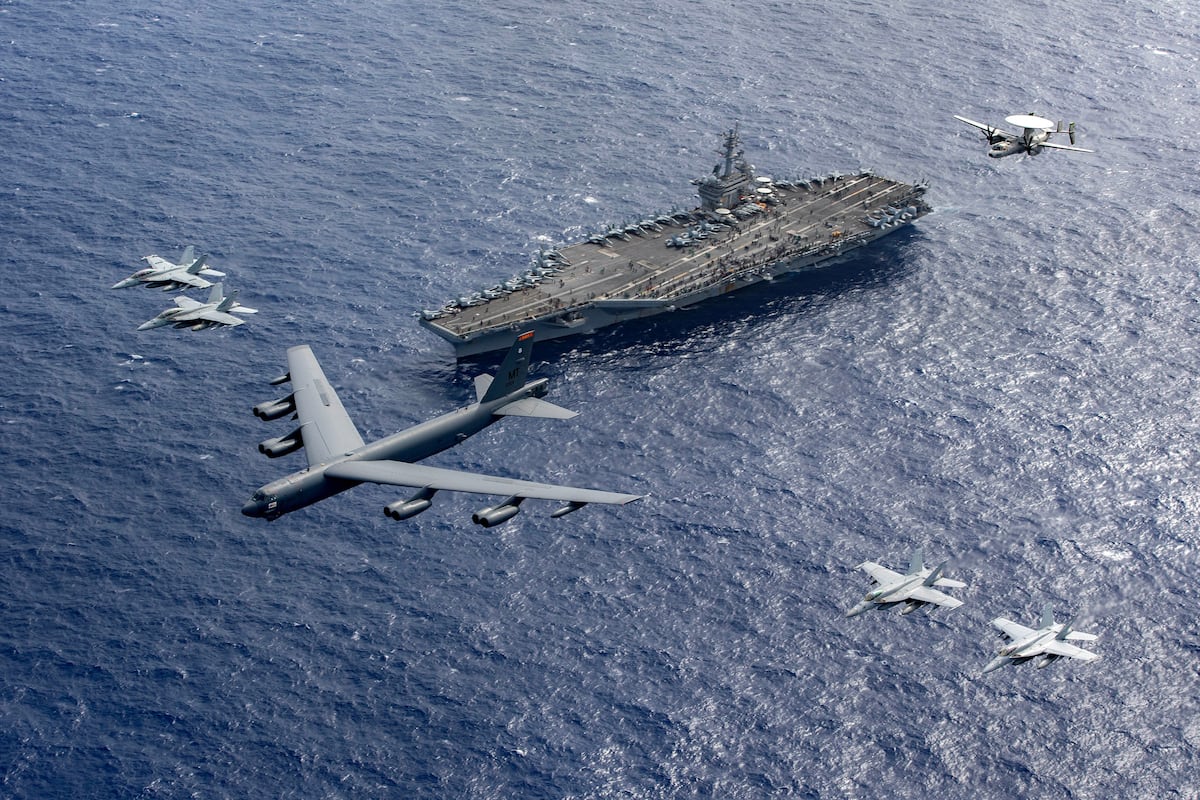
The U.S. Air Force and Navy are each preparing for a potential fight in the Pacific against China , perhaps in the next couple of years, under the guidance of the same National Defense Strategy. But this uncertain timing overlaps uncomfortably with a mountain of modernization priorities for each service.
Add to that budget caps for fiscal 2024 and fiscal 2025, and the two services have responded with very different budget strategies.
On one side, the Air Force’s proposed FY25 budget would trim its procurement account by $1.6 billion from the prior year, while boosting research, development, test and evaluation spending by nearly that amount. In the process, the service expects to reduce its fighter jet purchases by 12.
For its part, the Navy has found itself in a shooting war in the Red Sea while also trying to increase its presence in the Pacific region to deter China. The service has prioritized paying for current operations and personnel in its FY25 spending request. Procurement spending is flat, while research and development drops 5%.
U.S. intelligence officials say Chinese President Xi Jinping has set a goal for the nation’s military to modernize enough to carry out an invasion of Taiwan — which China views as a rogue breakaway province — as early as 2027.
Chinese President Xi Jinping is displayed on a screen as Type 99A2 battle tanks participate in a 2015 parade in Beijing. (Ng Han Guan/AP)
The Air Force says that, while it wrestles with spending caps under the Fiscal Responsibility Act, it leaned toward research and development more than procurement to ensure future capabilities remain on track.
The Navy, in contrast, contends that if it must deter or fight China in this “decade of concern,” it would do so with the fleet it has today, not the one it hopes to develop in the decades to come.
As the services determine their approaches, lawmakers are weighing in on whether the United States will be ready to face China in time.
Rep. Rob Wittman, R-Va., said at a March conference China could try to take Taiwan by force as early as 2027, noting that fielding capabilities at the turn of the decade will be too late.
“Anybody that uses a metric or time frame and says, ‘We’ll get this stuff done by 2030′ — wrong answer,” Wittman said at the McAleese & Associates event. “2027 needs to be the metric. That’s how we will have the opportunity to deter [China].”
A pattern of differing approaches
At least one expert told Defense News it’s normal for the Navy and Air Force to take different approaches on modernization.
In general, the Navy has taken a more strategic, methodical route to accomplishing its aircraft modernization goals, holding back on buying next-generation aircraft until technology matures and prices come down, said Todd Harrison, a senior fellow at the American Enterprise Institute think tank who focuses on defense budgets.
In the meantime, the Navy has bought aircraft already in production to fill out its inventory. For example, over the last decade, the service repeatedly extended its fourth-generation F/A-18E/F Super Hornet production line to avoid a fighter jet shortfall. It introduced its fifth-generation F-35C in 2019, well after the Marine Corps’ F-35B in 2015 and the Air Force’s F-35A in 2016.
Sailors perform maintenance on an F/A-18E Super Hornet from the hanger bay of the U.S. Navy aircraft carrier John C. Stennis. (MCSN Tomas Compian/U.S. Defense Logistics Agency)
“That’s why for about a decade, until just recently, the Navy had a higher aircraft procurement budget than the Air Force,” Harrison said. “The Air Force approach has been more about chasing new technologies and shiny objects that are dangled in front of them.”
The Air Force is now simultaneously trying to buy the F-15EX, a new version of a legacy fighter, and the F-35A, while “getting knee-deep” into developing a sixth-generation fighter program called Next Generation Air Dominance, or NGAD, Harrison said.
“They’re trying to buy three different generations of fighters all at the same time,” he said. “And it looks like they just aren’t sure where they want to place their bets. That’s an unsustainable approach, and it looks like it’s catching up to them. They just don’t have the resources to continue buying three different lines of three different generations of fighters all at once.”
But if China moves to reclaim Taiwan in 2027, Harrison said, the Air Force is “going to come up short. They’re not going to have the future systems like NGAD in time, and they’re not going to have the quantity of fifth-gen and fourth-gen fighters that they would likely need in those scenarios. … They’re destined to fall short on quantities with this approach.”
The Pentagon released footage of a Chinese aircraft approaching a U.S. aircraft over the South China Sea.
The Navy, for its part, acknowledges it would enter a hypothetical 2027 battle with the fleet it has today. So even as its ship and aircraft fleet have shrunk in size in recent years amid the decommissioning of Cold War-era platforms, the service has focused on the readiness of the ships and planes it would take to war.
The Navy has launched several data-driven efforts aimed at quickening maintenance, and it has looked to field software updates and other capabilities that can be rapidly implemented on existing platforms, rather than built into those of the future.
Navy Under Secretary Erik Raven told Defense News all the services are driven “to be ready to execute the [National Defense Strategy] over the near, the medium and the longer term. Each service will come to that with a slightly different view on how to execute that strategy. But we’re fundamentally all aligned to execute that strategy.”
While the Navy has sided with Wittman’s push to be ready by 2027, Air Force Secretary Frank Kendall said at the McAleese conference his service must take a longer view.
“It’s a risk balance over time,” Kendall said. “If you fixate only on 2027, you’re going to find that in ’29 you’re in big trouble.”
Maj. Gen. Dave Tabor, director of programs for the Air Force’s Office of the Deputy Chief of Staff for Plans and Programs, told Defense News the service must be able to field enough existing capabilities and continue developing the next generation of aircraft to stay on the cutting edge. To do that, he said, the service had to strike a fine balance between R&D and procurement.
And with the Fiscal Responsibility Act’s budgetary caps pushing the Air Force to make tough choices, R&D came out on top.
“At the end of the day, we got pinched by the topline,” Tabor said, and six F-35s and six F-15EXs got cut. “The result is relatively minimal to our overall rollout, but it’s 12 jets [cut] that last year we were thrilled to have.”
The consequences of the FRA’s budgetary caps started to come into focus last summer after the Air Force had drawn up its program objective memorandum, which spells out the service’s spending plans over the next five years, Tabor said.
“We knew that [the FRA] was coming; we didn’t know how it was going to manifest,” he added.
Then-Air Force Chief of Staff Gen. CQ Brown speaks with airmen during a stop at Travis Air Force Base, Calif., on Aug. 4, 2022. (Senior Airman Alexander Merchak/U.S. Air Force)
Top Air Force leaders, including then-Chief of Staff Gen. CQ Brown, current Chief of Staff Gen. David Allvin and Secretary Kendall, convened in June for a high-level meeting called Corona South. A key topic of discussion, Tabor said, was what to put on the chopping block to meet the budget caps. The matter remained unsettled as Corona South wrapped up, he added, and only became more clear after submitting the program objective memorandum at the end of June.
In hindsight, the Air Force would have liked a clearer picture of its budgetary outlook earlier, though service leaders ended up relatively satisfied with the result, Tabor said.
“Building a 90% solution is a whole lot different than building a 100% solution and taking 10% out of it, and the latter is kind of what we ended up with,” he said. “The approach was [preserving capabilities that provide] relative value to the joint fight and what did the least amount of damage to what we had already done.”
If a conflict with China were to erupt, he added, systems now in the works — such as NGAD, the B-21 Raider stealth bomber and artificial intelligence-operated drones known as collaborative combat aircraft — would allow the Air Force to fight in ways it never had before.
NGAD and the collaborative combat aircraft ended up winners in the Air Force’s proposed R&D budget: The former’s funding in 2025 would jump by $815 million to more than $2.7 billion, and CCA spending would increase by $165 million to $557 million.
But Harrison and Heather Penney, a former F-16 pilot and senior resident fellow at the Mitchell Institute for Aerospace Studies, said the Air Force can’t count on having newer capabilities, such as NGAD, fielded in the early 2030s. Such a time frame could be overly optimistic, they agreed, given the advanced technology that must be refined for NGAD and the track record of some nascent aircraft programs failing to stay on schedule.
This concept art shows a concept for the U.S. Air Force's future fighter, known as Next Generation Air Dominance. (Boeing)
“When was the last time we ever saw an advanced capability show up on time and on budget?” Penney said. The B-21′s apparent success so far is “an exception to how we’ve seen everything else happen. The capabilities [intended for NGAD], in terms of fully operationally capable — that’s not 2030. We’re talking 2035, 2040.”
Tabor said NGAD is “proceeding at pace” and that, even if it falls behind schedule, “we’re prepared with other capabilities to mitigate risk” for a conflict with China.
‘Something has to give’
For the Navy, prioritizing current operations over future platforms wasn’t a choice; it was an operational imperative.
The Navy reported it has lobbed a billion dollars’ worth of missiles into the skies of the Middle East since October, shooting down drones and missiles launched by the Yemen-based Houthi rebel group. The service hasn’t publicly estimated the cost of its operations there, which include the higher-than-usual tempo of daily operations for ships and planes, the extension of the Gerald R. Ford Carrier Strike Group’s deployment in the fall, and what’s likely to be a greater maintenance bill.
“Where the Department of the Navy really placed its priorities is on our fundamental mission of being forward-deployed around the world so that if a crisis hits, we’re there on the scene,” Raven, the undersecretary, told Defense News days after releasing the FY25 budget. “Readiness and people were the two top priorities that really came through in this budget.”
The Navy asked for $87.6 billion for operations and maintenance, up $3 billion from FY24. It also continued a recent focus on munitions, asking for $6.6 billion to buy weapons and expand the industrial base that builds them.
But it had to then cut procurement and R&D. The Navy asked for six ships, compared to the seven it previously expected to include in its FY25 budget. It also asked for 75 planes, compared to the 94 it previously planned to purchase.
Naval special warfare operators use a submarine exploration diver propulsion vehicle during underwater training in the waters near Virginia Beach, Va., on Jan. 7, 2024. (MC1 Trey Hutcheson/U.S. Navy)
This took a toll on all three of the Navy’s key modernization programs : its own Next Generation Air Dominance, which includes a manned and unmanned family of systems to replace the F/A-18E/F Super Hornet fleet; the SSN(X) next-generation attack submarine that will follow the Virginia class; and the DDG(X) next-generation destroyer that will follow the Arleigh Burke class.
The Navy’s NGAD effort took the biggest financial hit: The service wants $454 million in FY25, compared to $1.5 billion in FY24, for the F/A-XX piloted aircraft portion of the program.
The SSN(X) program faces the most significant delay: The service now says it will begin acquisition in the early 2040s, compared to a previous 2035 start and a 2031 plan before that.
Raven said the Navy had to take risk here, given the FRA budget caps.
“If we’re going to prioritize people and readiness, something has to give, and we saw the best benefit in taking more risk in that longer-term modernization,” he told Defense News. “But budget caps have consequences. There are hard choices being made in this year’s budget.”
Down the line, Raven added, “there may be opportunities to learn from the Air Force as it develops its path to some of these same types of technologies” — such as their separate NGAD programs.
Though lawmakers like Wittman have expressed a preference for prioritizing readiness over future fleet size and capability, one expert warned the Navy is digging itself a hole it will struggle to get out of.
“Given the long lead time to design and build capital assets such as ships and aircraft, the U.S. Navy has entered its version of a ‘doom loop’ where funds for future ships are deferred to pay for today’s readiness — which ensures tomorrow’s readiness will also suffer, as new ships are required to maintain readiness,” Mackenzie Eaglen, a senior fellow at the American Enterprise Institute, told Defense News.
“Readiness and fleet size are inextricably linked,” Eaglen added. “It’s shortsighted to believe they are separate and distinct.”
The Air Force, after decades of deferred modernization, now faces a “massive gap” between its current reality and the vision Kendall crafted for transforming the service through next-generation systems, Penney said. But it can’t achieve that vision without pouring its money into research and development.
“Nobody’s wrong here, and nobody’s right,” she said.
Stephen Losey is the air warfare reporter for Defense News. He previously covered leadership and personnel issues at Air Force Times, and the Pentagon, special operations and air warfare at Military.com. He has traveled to the Middle East to cover U.S. Air Force operations.
Megan Eckstein is the naval warfare reporter at Defense News. She has covered military news since 2009, with a focus on U.S. Navy and Marine Corps operations, acquisition programs and budgets. She has reported from four geographic fleets and is happiest when she’s filing stories from a ship. Megan is a University of Maryland alumna.
这是两篇系列故事的第二篇。第一篇故事请点击此处阅读。
这可以看作是两种不同的对华战略。
美国空军和海军都在同一份《国防战略》的指导下,为未来几年内可能在太平洋地区与中国发生的潜在冲突做准备。但这种不确定的时机与两军各自大量的现代化优先事项不谋而合,造成了棘手的冲突。
再加上 2024 财年和 2025 财年的预算上限,这两个部门采取了截然不同的预算策略。
一方面,空军提出的2025财年预算将比上一年削减16亿美元的采购预算,同时将研发、测试和评估支出增加近16亿美元。在此过程中,空军预计将减少12架战斗机的采购量。
海军方面,一方面深陷红海战事,另一方面也在努力加强在太平洋地区的存在以遏制中国。在2025财年的预算申请中,海军优先考虑支付当前行动和人员开支。采购支出保持不变,而研发支出则下降了5%。
美国情报官员表示,中国国家主席习近平已设定目标,要求中国军队实现现代化,以便最早在 2027 年入侵台湾——中国视台湾为叛离的省份。
2015年北京阅兵式上,中国国家主席习近平的影像出现在大屏幕上,99A2式主战坦克正在参加阅兵式。(Ng Han Guan/AP)
空军表示,尽管它在《财政责任法案》规定的支出上限下苦苦挣扎,但它更倾向于研发而不是采购,以确保未来的能力保持在正轨上。
与之相反,海军方面则认为,如果必须在这个“令人担忧的十年”中威慑或对抗中国,它将使用现有的舰队,而不是希望在未来几十年中发展的舰队。
在各军种确定应对策略的同时,立法者们也在权衡美国是否能够及时做好应对中国的准备。
弗吉尼亚州共和党众议员罗伯·威特曼在 3 月份的一次会议上表示,中国最早可能在 2027 年就试图武力夺取台湾,并指出到本世纪末才具备部署能力将为时已晚。
“任何使用指标或时间框架并声称‘我们将在2030年之前完成这些事情’的人——答案都是错误的,”维特曼在麦卡利斯咨询公司举办的活动上表示。“2027年才应该是衡量标准。只有这样,我们才有机会遏制(中国)。”
不同方法的模式
至少有一位专家告诉《防务新闻》,海军和空军在现代化方面采取不同的方法是正常的。
美国企业研究所高级研究员托德·哈里森(Todd Harrison)专注于国防预算,他表示,总体而言,海军采取了更具战略性和系统性的方式来实现其飞机现代化目标,在技术成熟和价格下降之前,不会购买下一代飞机。
与此同时,海军也采购了一些已在生产的飞机来补充其库存。例如,过去十年间,海军多次延长其第四代F/A-18E/F“超级大黄蜂”战斗机的生产线,以避免战斗机短缺。海军于2019年推出了第五代F-35C战斗机,比海军陆战队的F-35B(2015年)和空军的F-35A(2016年)晚了不少时间。
水兵们正在美国海军“约翰·C·斯坦尼斯”号航空母舰的机库内对一架F/A-18E“超级大黄蜂”战斗机进行维护。(MCSN Tomas Compian/美国国防后勤局)
“这就是为什么在过去十年里,直到最近,海军的飞机采购预算一直高于空军,”哈里森说。“空军的做法更多的是追逐新技术和那些摆在他们面前的闪亮新玩意儿。”
哈里森说,空军目前正同时尝试购买F-15EX(一款传统战斗机的升级版)和F-35A,同时还“深入”开发名为“下一代空中优势”(NGAD)的第六代战斗机项目。
“他们试图同时引进三代不同的拳手,”他说。“看起来他们自己也拿不定主意该把赌注押在哪里。这种做法不可持续,而且似乎正在让他们付出代价。他们根本没有足够的资源同时引进三代不同的拳手。”
但哈里森表示,如果中国在2027年收复台湾,空军“将会捉襟见肘。他们无法及时拥有像下一代防空系统(NGAD)这样的未来系统,也无法拥有在那种情况下可能需要的第五代和第四代战斗机的数量……他们这种做法注定会在数量上出现不足。”
五角大楼公布了一段视频,显示一架中国飞机在南海上空接近一架美国飞机。
海军方面承认,如果2027年真的爆发战争,它将以目前的舰队规模参战。因此,尽管近年来随着冷战时期舰艇和飞机的退役,其规模有所缩减,但海军始终专注于提升未来参战舰艇和飞机的战备水平。
海军已启动多项数据驱动型举措,旨在加快维护速度,并着眼于在现有平台上快速部署软件更新和其他功能,而不是将其构建到未来的平台上。
海军副部长埃里克·雷文告诉《防务新闻》,所有军种都致力于“在近期、中期和长期内执行[国家国防战略]。每个军种对如何执行该战略会有略微不同的看法。但我们在执行该战略的根本目标上是一致的。”
虽然海军支持维特曼提出的在 2027 年做好准备的方案,但空军部长弗兰克·肯德尔在麦卡利斯会议上表示,空军必须着眼于更长远的未来。
肯德尔说:“这是一个长期的风险平衡问题。如果你只关注2027年,你会发现到了2029年你就麻烦大了。”
空军副参谋长办公室计划与项目主管戴夫·塔博尔少将告诉《防务新闻》,空军必须能够部署足够的现有能力,并继续研发下一代飞机,才能保持领先地位。他表示,为此,空军必须在研发和采购之间取得良好的平衡。
由于《财政责任法案》的预算上限迫使空军做出艰难的选择,研发最终脱颖而出。
“最终,我们还是受到了预算限制,”塔博尔说,于是削减了6架F-35和6架F-15EX的订单。“这对我们整体的部署计划影响不大,但这可是去年我们非常期待拥有的12架战机啊。”
塔博尔表示,去年夏天,空军制定了计划目标备忘录,详细阐述了空军未来五年的支出计划,此后,FRA 预算上限的后果开始显现。
“我们知道(FRA)即将到来;但我们不知道它会以何种形式出现,”他补充道。
2022年8月4日,时任空军参谋长CQ·布朗将军在加利福尼亚州特拉维斯空军基地停留期间与空军官兵交谈。(美国空军高级飞行员亚历山大·默查克/美国空军)
包括时任空军参谋长布朗上将、现任空军参谋长戴维·奥尔文上将和空军部长肯德尔在内的空军高层领导人于6月召开了一次名为“南方新冠疫情”的高级别会议。塔博尔表示,会议的一个关键议题是,为了达到预算上限,哪些项目需要削减。他补充说,在“南方新冠疫情”会议结束时,这个问题仍未得到解决,直到6月底提交项目目标备忘录后才变得更加明朗。
事后看来,空军本希望更早地了解其预算前景,但塔博尔表示,尽管如此,空军领导人最终对结果还是比较满意的。
他说:“构建一个90%的解决方案与构建一个100%的解决方案再去掉10%截然不同,而我们最终采取的正是后者。” “我们的方法是保留那些对联合作战具有相对价值的能力,并尽可能减少对我们已完成工作的损害。”
他补充说,如果与中国发生冲突,目前正在研发的系统——例如下一代空中防御系统(NGAD)、B-21“突袭者”隐形轰炸机和被称为协同作战飞机的由人工智能操作的无人机——将使美国空军能够以以前从未有过的方式作战。
在空军提出的研发预算中,NGAD 和协同作战飞机最终成为赢家:前者在 2025 年的资金将增加 8.15 亿美元,达到 27 亿美元以上,而 CCA 的支出将增加 1.65 亿美元,达到 5.57 亿美元。
但哈里森和前F-16飞行员、米切尔航空航天研究所高级研究员希瑟·彭尼表示,空军不能指望在2030年代初就能部署诸如下一代空中导航系统(NGAD)之类的新型能力。他们一致认为,考虑到NGAD需要完善的先进技术,以及一些新兴飞机项目未能按计划完成的记录,这样的时间表可能过于乐观。
这张概念图展示了美国空军未来战斗机的概念设计,该战斗机被称为“下一代空中优势”(Next Generation Air Dominance)。(波音公司)
“我们上一次看到先进能力按时按预算交付是什么时候?”彭尼说道。B-21迄今为止取得的成功“与我们所见的其他项目截然不同。就下一代空中防御系统(NGAD)的全面作战能力而言,那不是2030年。我们说的是2035年,2040年。”
塔博尔表示,NGAD正在“快速推进”,即使进度落后,“我们也已准备好其他能力来降低”与中国发生冲突的风险。
总得有所改变。
对海军而言,优先考虑当前作战行动而非未来平台并非一种选择,而是一种作战上的必然要求。
美国海军报告称,自去年10月以来,已向中东空域发射了价值10亿美元的导弹,击落了也门胡塞武装发射的无人机和导弹。海军尚未公开估算其在该地区行动的成本,这些成本包括舰艇和飞机日常行动频率高于往常、杰拉尔德·R·福特号航母打击群秋季部署时间的延长,以及可能增加的维护费用。
“海军部真正优先考虑的是我们在全球前沿部署的基本使命,这样一旦危机发生,我们就能第一时间赶到现场,”海军部副部长雷文在公布2025财年预算几天后告诉《防务新闻》。“战备和人员是这份预算中真正体现的两大优先事项。”
海军申请拨款 876 亿美元用于运营和维护,比 2024 财年增加了 30 亿美元。海军还延续了近期对军需品的重视,申请拨款 66 亿美元用于购买武器和扩大制造武器的工业基础。
但随后不得不削减采购和研发预算。海军最初要求建造六艘舰艇,而此前预计在2025财年预算中建造七艘。此外,海军还要求采购75架飞机,而此前计划采购94架。
2024年1月7日,美国海军特种作战人员在弗吉尼亚州弗吉尼亚海滩附近水域进行水下训练时,使用潜艇勘探潜水推进器。(一级军士长特雷·哈奇森/美国海军)
这给海军的三项关键现代化计划都造成了影响:其自身的下一代空中优势计划(包括用于取代 F/A-18E/F 超级大黄蜂战斗机队的有人和无人系统系列);将在弗吉尼亚级之后建造的下一代攻击型核潜艇 (SSN(X));以及将在阿利·伯克级之后建造的下一代驱逐舰 (DDG(X))。
海军的 NGAD 项目遭受了最大的财政打击:该军种希望在 2025 财年获得 4.54 亿美元,而 2024 财年则需要 15 亿美元,用于该项目的 F/A-XX 有人驾驶飞机部分。
SSN(X)计划面临最严重的延误:该机构现在表示,将在2040年代初开始采购,而此前的计划是2035年开始,再之前是2031年。
雷文表示,鉴于联邦铁路管理局的预算上限,海军必须承担风险。
“如果我们优先考虑人员和战备,就必须有所取舍,而我们认为,承担更多风险进行长期现代化改造能带来最大的收益,”他告诉《防务新闻》。“但预算上限会带来后果。今年的预算中,我们必须做出艰难的选择。”
雷文补充说,从长远来看,“随着空军发展出类似技术的发展路径,我们或许有机会向其学习”——例如他们各自的下一代航空发展计划。
尽管像维特曼这样的立法者表示,他们更倾向于优先考虑战备而不是未来的舰队规模和能力,但一位专家警告说,海军正在给自己挖一个难以摆脱的坑。
“鉴于设计和建造舰船和飞机等资本资产需要很长的准备时间,美国海军已经陷入了一种‘恶性循环’,即未来舰船的资金被推迟用于支付今天的战备费用——这必然会导致明天的战备也会受到影响,因为需要新的舰船来维持战备,”美国企业研究所高级研究员麦肯齐·伊格伦告诉《防务新闻》。
伊格伦补充道:“战备状态和舰队规模密不可分。认为它们是分离且互不相干的,是目光短浅的。”
彭尼表示,空军在经历了数十年的现代化进程停滞后,如今面临着现状与肯德尔构想的通过下一代系统改造空军的愿景之间存在的“巨大差距”。但如果不投入大量资金用于研发,空军就无法实现这一愿景。
“这里没有人是错的,也没有人是对的,”她说。
斯蒂芬·洛西是《防务新闻》的空战记者。他此前曾在《空军时报》报道领导层和人事问题,并在Military.com网站报道五角大楼、特种作战和空战。他曾前往中东报道美国空军的行动。
梅根·埃克斯坦是《防务新闻》的海军作战记者。自2009年以来,她一直从事军事新闻报道,主要关注美国海军和海军陆战队的行动、采购项目和预算。她曾报道过四个不同地理区域的舰队,最喜欢在舰艇上进行新闻报道。梅根毕业于马里兰大学。