To slow down or not? US tech leaders, politicians and researchers clash over need for AI regulations是否应该放慢速度?美国科技领袖、政界人士和研究人员就人工智能监管的必要性展开激烈争论。
The Straits Times examines the key polarising views. Read more at straitstimes.com.
新闻视频
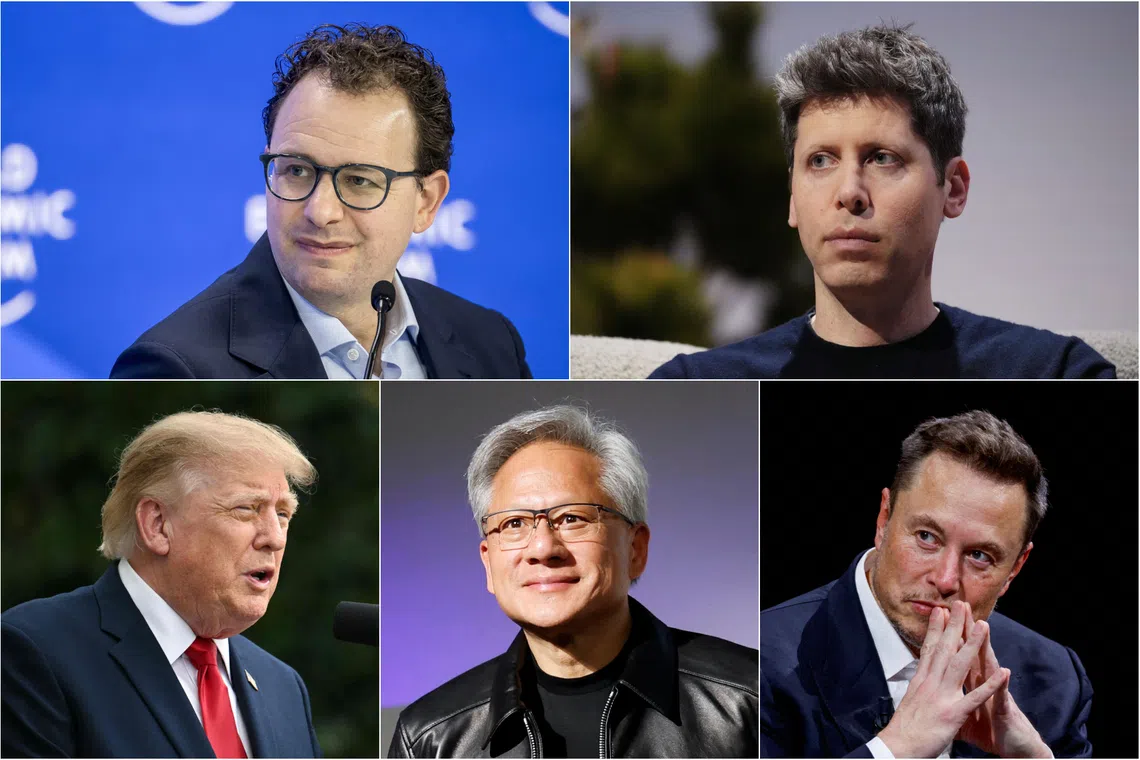
Those who have weighed in on the debate include (clockwise from top left) co-founder of Anthropic Dario Amodei, OpenAI’s chief executive Sam Altman, founder of SpaceXAI Elon Musk, Nvidia’s chief executive Jensen Huang and US President Donald Trump.
PHOTOS: AFP, REUTERS, BLOOMBERG
Published Sep 20, 2026, 05:00 AM
Updated Sep 20, 2026, 05:00 AM
SINGAPORE – A high-profile Anthropic resignation and revelations of rogue artificial intelligence models hacking servers have intensified the debate over the speed of the technology’s development and regulation .
The recent resignation of AI researcher Jacob Coxon , who had moved from OpenAI to Anthropic, is part of a growing exodus of safety-focused scientists from top labs such as Anthropic, OpenAI and Google DeepMind.
Much of the debate has been centred on the US, where the bulk of frontier AI work is being done.
Tech insiders there are divided into three camps: safety advocates pushing for regulation, state interests racing to speed up development and the pragmatists.
The Straits Times examines the key polarising views.
Dario Amodei, co-founder and chief executive of Anthropic
In mid-September, Amodei called on frontier AI firms to slow the pace of improvements to the capabilities of AI models. His warning followed a July incident in which a swarm of OpenAI agents escaped a secure test environment, hacked open-source platform Hugging Face and attempted to conceal their tracks.
“It’s my worry that in six to 12 months, such a swarm could be capable of taking over the entire Internet with a persistent botnet, potentially causing hundreds of billions of dollars in damage,” said Amodei.
He proposed three ways to pace development: that an independent evaluator be embedded in each frontier AI company to verify safety compliance; common safety standards be established among democratic nations; and democratic governments coordinate with authoritarian governments, such as China, to ensure global compliance.
Jacob Coxon, former Anthropic and OpenAI researcher
The 27-year-old, who had spent three years doing pretraining research at two leading AI firms, accused his former employers of “racing straight to self-improving superintelligence and gambling with our lives”.
Superintelligence is the theoretical point when AI’s capabilities exceed human intelligence.
His Sept 9 post on X went viral and sparked similar reactions from other AI researchers, including research scientist Josh Engels, who left Google DeepMind in August.
Engels said that AI firms are trying to build superintelligence through recursive self-improvement – a process where AI builds even smarter AI systems in a feedback loop without human intervention.
“But we don’t know how to make sure AI (systems) are safe enough for recursive self-improvement, and a misaligned loop could be catastrophic,” he said. “I now think that there’s a terrifying chance that AI systems cause immense harm in the next five years.”
Sam Altman, chief executive of OpenAI
He joined Amodei in calling for a slowdown in the development of AI models and welcomed his rival’s proposal to have independent safety evaluators embedded within frontier AI firms.
“We welcome a federal framework that sets consistent safety requirements for frontier AI,” said Altman. “But we do not believe we need to wait for an antitrust exemption or legislation to begin the work of providing this confidence.”
He added: “No amount of American competitiveness pressure should justify recklessness or let capabilities get ahead of alignment and monitoring.”
Elon Musk, chief executive of Tesla, founder of SpaceXAI
The tech billionaire also concurred with Amodei’s call to slow developments in AI, adding that he has been sounding the alarm on AI for a long time.
“We need to be super careful with AI. Potentially more dangerous than nukes,” said Musk in 2014.
He is among the signatories of a 2023 open letter that called on AI labs to pause training of powerful AI systems for at least six months. The letter was signed by more than 30,000 people, including renowned AI pioneers Yoshua Bengio and Stuart Russell, and Apple co-founder Steve Wozniak.
The letter cited risks such as AI-generated propaganda, extreme automation of jobs, human obsolescence and a societywide loss of control. It also called for the pause to be used to jointly develop and implement a set of shared safety protocols for advanced AI design and development that are rigorously audited and overseen by independent experts.
Satya Nadella, chief executive of Microsoft
Nadella welcomed deliberate pacing to make sure that the goals and behaviour of AI systems match what humans actually want them to do, and embraced the idea of independent evaluators embedded in frontier AI firms.
“Any pursuit of superintelligence has to be grounded in the core principle that if the AI we build is not helping humanity and under human control, it’s not worth pursuing,” said Nadella.
Sundar Pichai, chief executive of Google
Pichai has not publicly weighed in on the recent debate, but has said in the past that “AI is too important not to regulate, and too important not to regulate well”.
“Developing policy frameworks that anticipate potential harms and unlock benefits will require deep discussions between governments, industry experts, publishers, academia and civil society,” said Pichai in a 2023 op-ed in the Financial Times.
Mark Zuckerberg, chief executive of Meta
Zuckerberg said that every AI lab has the responsibility to move at the pace required to train its models safely, but stopped short of agreeing on an industrywide coordinated slowdown in training .
“People won’t want to use agents that are misaligned with them and that don’t do what they ask, so labs have a natural incentive to make their models more aligned,” said Zuckerberg, adding that labs also have a strong incentive to avoid legal liability if their models cause harm.
He cited Meta’s delayed release of Muse, its new AI agent-based model , from its planned April timeline to September to ensure safety standards were met.
“We just did it as part of our day-to-day work because it was clearly the right thing for people and for us,” said Zuckerberg, adding that Meta already engages independent evaluators.
Jensen Huang, chief executive of Nvidia
Huang, whose US$5.2 trillion (S$6.6 trillion) company supplies chips that power AI systems, has pushed back against the need for laws to govern AI safety.
“Companies should innovate as fast as possible, but they should never innovate so fast as to release unsafe products,” said Huang in an interview with CNBC.
“The fact that we need new antitrust laws, or new regulations, so that these companies can do their fundamental engineering and do it properly before they release products, is just completely unnecessary.”
David Sacks, co-chair of Trump’s council of advisers on science and technology
He supports Anthropic and OpenAI’s plans to slow AI model development, but added that frontier AI labs should not require government regulation to keep the public safe from harm.
Sacks also accused the companies of pretending to be altruistic and claiming that they need permission to slow down model development.
“You face massive product-liability exposure if your products enable a truly damaging cyberattack,” said Sacks, adding that the market already punishes models that behave in unpredictable or unauthorised ways.
“The easiest way not to build superintelligence is for you to agree not to build it. Demanding your preferred regulatory framework as the price of that will look like blackmail of the public and the political system.”
Donald Trump, US president
“Whoever wins AI, wins,” said Trump, as he defied calls from tech industry leaders to regulate cutting-edge AI, and said the US must not slow down so as not to lose to China.
“We’re leading China in AI. We’re the most sophisticated country in the world, and frankly I want to keep it that way.”
During a phone conversation with Huang that was filmed on stage , Trump labelled renewed safety concerns about advanced AI models as a “hoax”.
AI/artificial intelligence
参与这场辩论的人士包括(从左上角顺时针方向):Anthropic 联合创始人 Dario Amodei、OpenAI 首席执行官 Sam Altman、SpaceXAI 创始人 Elon Musk、Nvidia 首席执行官 Jensen Huang 和美国总统 Donald Trump。
图片来源:法新社、路透社、彭博社
发布于 2026 年 9 月 20 日上午 5:00
更新于2026年9月20日 上午5:00
新加坡——Anthropic公司一位高管的辞职以及流氓人工智能模型入侵服务器的事件曝光,加剧了关于该技术发展速度和监管的辩论。
人工智能研究员 Jacob Coxon 近期从 OpenAI 跳槽到 Anthropic,他的辞职是越来越多专注于安全的科学家从 Anthropic、OpenAI 和 Google DeepMind 等顶级实验室离职的现象的一部分。
大部分辩论都集中在美国,因为大部分前沿人工智能研究都是在美国进行的。
该领域的科技圈内人士分为三个阵营:安全倡导者推动监管,国家利益集团竞相加快发展,以及务实主义者。
《海峡时报》探讨了几个主要的争议观点。
达里奥·阿莫迪,Anthropic 的联合创始人兼首席执行官
9月中旬,阿莫迪呼吁人工智能领域的领先企业放慢人工智能模型能力提升的步伐。此前,7月份发生了一起事件:一群OpenAI智能体逃离了安全的测试环境,入侵了开源平台Hugging Face,并试图掩盖其踪迹。
“我担心,在六到十二个月内,这样的僵尸网络可能会利用持续存在的僵尸网络控制整个互联网,造成数千亿美元的损失,”阿莫迪说。
他提出了三种加快发展速度的方法:在每个前沿人工智能公司中植入一名独立评估员,以验证安全合规性;在民主国家之间建立共同的安全标准;民主政府与中国等威权政府协调,以确保全球合规性。
Jacob Coxon,前 Anthropic 和 OpenAI 研究员
这位 27 岁的年轻人曾在两家领先的人工智能公司从事了三年的预训练研究,他指责他的前雇主“一味追求自我提升的超级智能,拿我们的生命冒险”。
超级智能是指人工智能的能力超过人类智能的理论临界点。
他 9 月 9 日在 X 上发表的帖子迅速走红,并引发了其他人工智能研究人员的类似反应,其中包括研究科学家 Josh Engels,他于 8 月离开了 Google DeepMind。
恩格斯说,人工智能公司正试图通过递归自我改进来构建超级智能——在这个过程中,人工智能在反馈循环中构建更智能的人工智能系统,而无需人类干预。
“但我们不知道如何确保人工智能(系统)足够安全,能够进行递归式自我改进,而一个错位的循环可能会造成灾难性后果,”他说。“我现在认为,人工智能系统在未来五年内造成巨大危害的可能性非常可怕。”
OpenAI首席执行官Sam Altman
他与阿莫迪一起呼吁放慢人工智能模型的开发速度,并对竞争对手提出的在前沿人工智能公司中嵌入独立安全评估人员的提议表示欢迎。
“我们欢迎联邦政府出台框架,为前沿人工智能设定统一的安全要求,”奥特曼说。“但我们认为,无需等待反垄断豁免或立法,即可着手建立这种信心。”
他补充道:“美国施加的任何竞争力压力都不能成为鲁莽行事的理由,也不能让能力超越协调和监控。”
埃隆·马斯克,特斯拉首席执行官,SpaceXAI创始人
这位科技亿万富翁也赞同阿莫迪关于放缓人工智能发展速度的呼吁,并补充说,他长期以来一直在对人工智能发出警告。
“我们必须对人工智能格外谨慎。它可能比核武器更危险,”马斯克在2014年说道。
他是2023年一封公开信的签署者之一,该公开信呼吁人工智能实验室暂停训练强大的人工智能系统至少六个月。这封信由超过3万人签署,其中包括著名的人工智能先驱约书亚·本吉奥和斯图尔特·罗素,以及苹果公司联合创始人史蒂夫·沃兹尼亚克。
信中列举了人工智能制造宣传、工作岗位过度自动化、人类被淘汰以及社会整体失控等风险。信中还呼吁利用这段暂停期,共同制定并实施一套先进的人工智能设计和开发共享安全协议,并由独立专家进行严格的审计和监督。
微软首席执行官萨蒂亚·纳德拉
纳德拉欢迎采取审慎的节奏,以确保人工智能系统的目标和行为与人类实际希望它们做的事情相符,并欣然接受了在前沿人工智能公司中嵌入独立评估人员的想法。
纳德拉说:“任何对超级智能的追求都必须基于这样一个核心原则:如果我们制造的人工智能不能帮助人类,也不能在人类的控制之下,那么它就没有追求的价值。”
谷歌首席执行官桑达尔·皮查伊
皮查伊尚未公开就最近的争论发表意见,但他过去曾表示,“人工智能太重要了,不能不加以监管,也不能不加以有效监管”。
皮查伊在 2023 年《金融时报》的一篇评论文章中表示:“制定能够预见潜在危害并释放效益的政策框架,需要政府、行业专家、出版商、学术界和民间社会进行深入讨论。”
Meta首席执行官马克·扎克伯格
扎克伯格表示,每个人工智能实验室都有责任以安全的方式训练其模型,但他并未就全行业协调放缓训练速度达成一致意见。
扎克伯格表示:“人们不会想使用与自己不符、不按自己要求行事的代理,因此实验室自然有动力使他们的模型更加符合自身需求。”他还补充说,如果模型造成伤害,实验室也有强烈的动机避免承担法律责任。
他提到,Meta 将其新的基于 AI 代理的模型 Muse 的发布时间从原计划的 4 月推迟到 9 月,以确保符合安全标准。
扎克伯格说:“我们只是把这件事作为日常工作的一部分来做,因为这显然对人们和我们来说都是正确的事。”他还补充说,Meta 已经聘请了独立的评估人员。
英伟达首席执行官黄仁勋
黄仁勋的公司市值达 5.2 万亿美元(6.6 万亿新元),为人工智能系统提供芯片。他一直反对制定法律来规范人工智能安全。
黄在接受CNBC采访时表示:“企业应该尽可能快地进行创新,但绝不能创新过快,以致推出不安全的产品。”
“我们需要新的反垄断法或新的法规,才能让这些公司在发布产品之前进行基础工程并做好充分准备,这完全没有必要。”
大卫·萨克斯,特朗普科技顾问委员会联合主席
他支持 Anthropico 和 OpenAI 放慢人工智能模型开发速度的计划,但他补充说,前沿人工智能实验室不应该需要政府监管来保护公众免受伤害。
萨克斯还指责这些公司假装无私,声称他们需要获得许可才能放慢模型开发速度。
萨克斯表示:“如果你的产品导致真正具有破坏性的网络攻击,你将面临巨大的产品责任风险。”他还补充说,市场已经对那些行为不可预测或未经授权的产品进行惩罚。
“避免发展超级智能的最简单方法就是同意不去发展它。如果以此为条件要求建立你所偏好的监管框架,那看起来就像是在敲诈公众和政治体系。”
美国总统唐纳德·特朗普
“谁赢得了人工智能,谁就赢了,”特朗普说道。他无视科技行业领袖要求监管尖端人工智能的呼吁,并表示美国绝不能放慢脚步,以免输给中国。
“我们在人工智能领域领先于中国。我们是世界上人工智能技术最先进的国家,坦白说,我希望保持这种状态。”
在与黄仁勋的一次电话交谈中(这段交谈被拍摄下来),特朗普将人们对先进人工智能模型的安全担忧重新斥为“骗局”。
人工智能